
Journalist

Dulani Jayasuriya
-
 Big Tech's AI Power Struggle Intensifies Among Companies, Government, and Security The global AI industry is escalating beyond mere model competition, with a focus on corporate, security, and platform dominance. On May 14, developments included Anthropic's rapid expansion in the corporate AI market, tensions between OpenAI and Apple, and increased AI oversight by the U.S. government. Anthropic Surpasses OpenAI in Corporate AI Market Anthropic is quickly establishing its presence in the corporate AI sector. According to market data firm Ramp's AI index, Anthropic's adoption rate of AI in businesses has reached 34.4%, surpassing OpenAI's 32.3% for the first time. This shift is attributed to a surge in demand for automation in coding, legal, and financial tasks based on the Claude model. On the same day, Anthropic announced an expansion of its strategic partnership with PwC. PwC plans to train 30,000 U.S. employees on the 'Claude Code' and aims to extend AI utilization throughout its global organization. The two companies will also establish a separate AI Center of Excellence (CoE) to jointly pursue corporate AI transformation projects. Industry experts suggest that Anthropic is evolving from a simple generative AI company into an 'enterprise operating platform.' The rapid increase in demand for AI agent-based task automation is reshaping the corporate market landscape, which has traditionally been dominated by OpenAI. OpenAI-Apple Tensions Rise Over Platform Control Tensions between OpenAI and Apple are also escalating. According to Bloomberg, OpenAI is considering legal action regarding its AI collaboration agreement with Apple. Initially, the two companies planned to integrate ChatGPT into Siri and the iOS ecosystem, but conflicts have arisen as Apple expands its adoption of other AI models, including Google Gemini and Anthropic Claude. Particularly, Apple is exploring options that would allow users to select their preferred AI models in its next operating system, potentially diminishing OpenAI's influence within the platform. Industry analysts have noted that "the search engine wars of the AI era are now shifting to operating systems and personal assistant platforms." U.S. Government Strengthens AI National Security Oversight The U.S. government's moves to regulate AI are accelerating. Major companies, including Google, Microsoft, and xAI, have agreed to pre-submit next-generation AI models to agencies under the U.S. Department of Commerce. This initiative aims to verify the security and risks of models before they are publicly released. Simultaneously, the U.S. Department of Defense has signed contracts with OpenAI, Google, Microsoft, and AWS to enhance military AI collaboration through secure networks. In contrast, Anthropic continues to express concerns over the use of surveillance and autonomous weapons, leading to ongoing tensions with the Defense Department. * This article has been translated by AI. 2026-05-15 09:13:18
 -
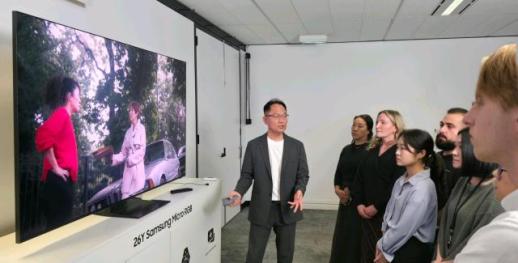 Samsung Unveils Next-Generation Displays at 2026 Australia Tech Seminar Samsung Electronics is accelerating its efforts to capture the premium TV market in Australia, a region known for its strong sports viewing culture and high console gaming usage. The company is focusing on a premium strategy that emphasizes AI-based picture quality technology and gaming features.From May 14 to 15, Samsung hosted the '2026 Australia Tech Seminar' in Sydney, where it showcased new AI TV technologies and its next-generation display lineup.The seminar is an annual event held since 2012, aimed at introducing Samsung's latest audio and visual technologies to global experts.Key local tech media, industry representatives, and consumer outlets attended the event organized by Samsung's Australian branch.During the seminar, Samsung introduced its 2026 screen products, including Micro RGB and OLED TVs, as well as Odyssey gaming monitors, highlighting key technologies.The company presented advanced display technologies and AI-driven viewing experiences tailored to Australian content consumption trends and living environments, emphasizing its home entertainment strategy.Notably, the new TV models feature enhanced AI capabilities designed to provide a more evolved viewing experience.The new TVs include the 'Vision AI Companion,' which analyzes the viewer's environment and content to deliver an optimized experience.Samsung also demonstrated the 'AI Football Mode,' which enhances the sports viewing experience by using AI to analyze soccer match scenes in real-time, delivering vivid colors and smooth motion while enhancing crowd sounds and commentary for greater immersion.Additionally, Samsung showcased its advanced display technology with the 'Micro RGB' TV, which utilizes the 'Micro RGB AI Engine' to finely adjust colors and contrast, achieving improved color representation and optical control compared to traditional TVs, ensuring stable picture quality across various viewing environments.The TV also features 'Micro RGB Color Booster Pro' and 'Micro RGB HDR Pro,' which provide clear and consistent colors regardless of brightness conditions.The event also highlighted the picture quality performance of the 2026 Samsung OLED (S95H), which is the first Samsung OLED to incorporate burn-in prevention technology, minimizing image retention during extended viewing.Samsung introduced several new gaming monitor products, including the 'Odyssey 3D,' which provides realistic 3D effects without glasses by analyzing user gaze in real-time using Eye Tracking and View Mapping technologies; the 'Odyssey G8 (G80HS),' the first gaming monitor to offer 6K ultra-high resolution and a 65Hz refresh rate; and the 'Odyssey OLED G8 (G80SH),' which supports fast response times and excellent black color representation with deep contrast ratios, delivering an unparalleled gaming environment.Lee Hun, Vice President of Samsung Electronics' Visual Display Business, stated, "Samsung is innovating picture quality and overall user experience based on AI technology, actively expanding the 'AI TV era.' We will continue to evolve user-centered viewing environments through differentiated AI screen experiences."* This article has been translated by AI. 2026-05-15 09:11:12
 -
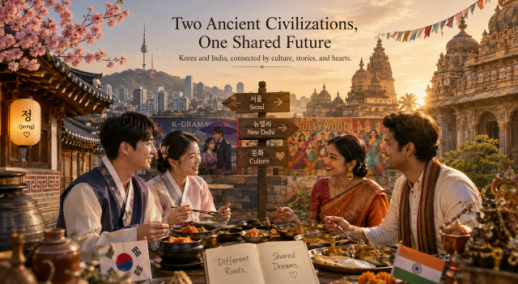 AJP Korea-India Essay Contest Winner: Grand Prize SEOUL, May 15 (AJP) - There is a particular kind of magic that happens when two ancient civilizations recognize themselves in each other. It does not announce itself loudly. It arrives quietly — in the similarity between the deep bow of a Korean elder greeting a guest and the folded-hands namaste of an Indian grandmother; in the way both a Korean grandmother's doenjang jjigae and an Indian mother's dal carry the same grammar of love — slow-cooked, unpretentious, irreplaceable. Korea and India are not obvious twins. On the surface, they seem to belong to different chapters of Asia's story. One is a compact, technologically hyper-advanced nation of 51 million people that rebuilt itself from rubble within a single generation. The other is a vast, ancient subcontinent of 1.4 billion, a democracy of staggering diversity, still in the energetic middle chapters of its own transformation. And yet, when you place these two worlds side by side — not in the language of trade figures or diplomatic communiqués, but in the language of everyday life, of street food and festivals, of K-dramas and Bollywood, of temples and technology — something remarkable emerges. This essay is that portrait. It is written in the belief that culture is the truest diplomacy, that shared moments are the foundation of shared futures, and that the most important frame two nations can inhabit together is not a formal summit photograph, but the frame of a story both peoples recognize as their own. I. The Kitchen as Common Ground Begin with food, because food never lies. Walk through a Korean market — Gwangjang in Seoul, perhaps — and the sensory experience is immediately familiar to anyone who has grown up around Indian bazaars. The riot of color. The vendors who have been at the same stall for thirty years and consider themselves artists, not merchants. The smell of fermentation, of spice, of things that have been slow-processed into something greater than their ingredients. A Korean pojangmacha — the beloved street tent stall — operates on the same democratic philosophy as an Indian dhaba: the food is honest, the portions generous, the customers from every walk of life, and the cook has an opinion about how things should be done that no restaurant critic could shake. Kimchi and Indian pickle — achar — are not the same food. But they are the same idea: the transformation of humble vegetables into something complex and alive through fermentation and patience. Both cultures understood, long before modern science confirmed it, that the gut is where health begins. Both built entire culinary philosophies around this intuition. Tteok — Korean rice cakes — appear at every significant moment of Korean life: birth, the hundredth day, first birthday, weddings, ancestral rites, the new year. Modak, the sweet rice dumpling offered to Ganesha in India, carries an almost identical weight of sacred meaning. Rice, shaped by hand and offered with intention, becomes ceremony in both cultures. The grain that feeds both nations daily also marks their most important thresholds. This is not coincidence. It is the convergence of two agricultural civilizations that built their deepest rituals around the rhythms of planting and harvest, that understood food as not merely sustenance but as the primary language of care. II. The Screen as Mirror In 2020, something unexpected happened in India. A Korean drama called Crash Landing on You found its way onto Indian streaming platforms, and millions of Indian viewers — who had perhaps never thought much about Korea beyond Samsung phones and Hyundai cars — fell completely, helplessly in love with it. They were not falling in love with the exotic. They were falling in love with the familiar. The drama's central tensions — love across social barriers, family expectation versus personal desire, the weight of duty toward parents, the question of whether following your heart constitutes bravery or selfishness — are not specifically Korean concerns. They are human concerns, but they are especially familiar concerns to anyone who has grown up in a culture where family is not background but foreground, where individual decisions are never fully individual, where love must reckon with approval and approval must reckon with tradition. Indian viewers recognized this immediately. They recognized the mother who loves fiercely but controls with equal fierceness. They recognized the young person caught between a dream and a duty. They recognized the particular comedy of large extended families inserting themselves into everything. They recognized the food being pushed toward people as the primary expression of concern. The Korean Wave — Hallyu — has been building in India for years, but it is not simply a matter of Indian audiences consuming Korean content. It is a cultural conversation. Indian music has its own enormous global footprint, and Korean listeners have discovered in Bollywood's emotional directness something that resonates — the willingness to cry in public, to declare love operatically, to let songs carry the weight that polite conversation cannot. There is something significant happening here that goes beyond entertainment trends. When people recognize themselves in another culture's stories, they become — quietly, without policy or proclamation — less foreign to each other. Every Indian teenager who learned to make ramyeon after watching a Korean drama, every Korean student who discovered the depth of Indian cinema beyond the stereotype of sudden dance numbers, has performed a small but genuine act of bridge-building. III. Everyday Life: The Texture of Shared Time The most profound commonalities between Korea and India are not in the grand gestures but in the daily texture of life. Both cultures organize existence substantially around the concept of jeong in Korean and apnapan in Hindi — an untranslatable quality of deep attachment, familiarity, and belonging that develops between people over shared time. Neither word translates cleanly as "love" or "friendship"; both describe something warmer and less dramatic than love, more binding than friendship — the feeling that someone or something has become woven into who you are. Both cultures are also, in their bones, communal in ways that post-industrial Western societies frequently are not. The Korean concept of nunchi — the social intelligence required to read a room, to understand what is needed without being told, to subordinate individual impulse to collective harmony — has functional equivalents across Indian social life, where reading the emotional weather of a gathering and adjusting accordingly is considered a fundamental social skill. The education cultures of both countries are strikingly parallel. In both Korea and India, the examination is not merely an academic event but a family ordeal, a community project, a civilizational pressure point. Families restructure their entire lives to support studying children. The outcome is treated as meaningful not just for the individual but for the family's standing. This reflects something real: a belief in education as the primary vehicle of transformation, a conviction that knowledge is the most honorable form of advancement — rooted in both Korea's Confucian scholarly tradition and India's ancient reverence for the guru and the vidya — the teacher and the knowledge. IV. The New Frame: Technology and Tradition In 2026, both Korea and India stand at a remarkable intersection of ancient culture and accelerating technology, and the choices each is making at this intersection look, once again, strikingly similar. Korea has become one of the world's most advanced digital societies while simultaneously experiencing a powerful resurgence of interest in traditional arts — hanji papermaking, hanbok fashion, minjung painting, traditional fermentation. The tension between preservation and transformation is not resolved but held, thoughtfully, by a culture that has learned to carry both at once. India is navigating its own version of this: one of the world's fastest-growing digital economies, home to a booming tech sector and a generation of entrepreneurs who are as comfortable in Silicon Valley as in their home cities, while simultaneously seeing a renaissance of interest in classical dance, regional languages, traditional textiles, and indigenous ecological knowledge. Both nations are using technology not to replace tradition but to amplify and preserve it. Korean developers have built apps to teach hanji crafts to young people who might never have encountered them. Indian technologists have created digital archives of classical music performances, regional dialect dictionaries, and visual records of craft traditions at risk of disappearing. In both cases, the frame of the future is being used to hold images from the past — not as nostalgia but as living inheritance. Artificial intelligence now enters this frame. The contest for which this essay is written is itself a signal of where both cultures are heading: toward a future in which AI is not a replacement for human creativity but a collaborator in it, a tool for capturing and sharing the moments that would otherwise go unrecorded. An Indian farmer describing the particular quality of monsoon light on a rice paddy. A Korean grandmother demonstrating the precise angle of wrist required to make perfect mandu. A young person in Seoul and a young person in Mumbai, connected by a shared love of a song, a film, a flavor, discovering that their interior lives are less different than their geographies suggest. AI can help record these moments. But it cannot manufacture their meaning. The meaning comes from the cultures themselves — from the depth of what Korea and India each carry, and from the genuine recognition that passes between them when they encounter each other honestly. V. A Future Built from Shared Moments There is a Korean proverb: ganeun mari gowaya oneun mari gopda — "For beautiful words to come back to you, beautiful words must go first." There is an Indian equivalent in the concept of karma, but also in the simpler folk wisdom that the well-digger's children do not go thirsty. Both traditions understand that what we offer shapes what we receive; that relationship is built through accumulated acts of consideration; that the future is made from the quality of the present moment. The relationship between Korea and India is still, in many ways, in its early chapters. The diplomatic relationship is relatively young. The awareness that ordinary citizens of each country have of the other is growing but still partial. There are gaps in understanding, moments of genuine cultural distance, areas where the differences are real and worth acknowledging honestly. But the trajectory is clear. The cultural currents are moving toward each other, driven not by governments but by millions of individual people — the Indian student learning Korean to understand a drama without subtitles, the Korean traveler who goes to India expecting temples and leaves having been changed by something less nameable and more important, the chef who realizes that fermentation is fermentation regardless of which ocean it originated beside, the musician who hears in the other tradition's scales something that answers a question their own tradition posed. The frame that contains Korea and India together is not yet full. It is still being composed. But the image that is emerging is one of two ancient, resilient, creative, and profoundly human civilizations who have discovered, at the beginning of the twenty-first century, that they have more to say to each other than either had imagined. Every shared meal is a line in that composition. Every drama watched across the border is a brushstroke. Every student who learns the other language, every entrepreneur who builds a bridge between Seoul and Bangalore, every grandmother whose recipe travels farther than she ever did — each adds to the frame. The frame is ours. The future it holds is shared. And the moment — this particular moment of recognition and possibility — is exactly the right one to capture. *The author, Sonali Ray, is based in India. Her writing was submitted in English. 2026-05-15 09:09:23
 -
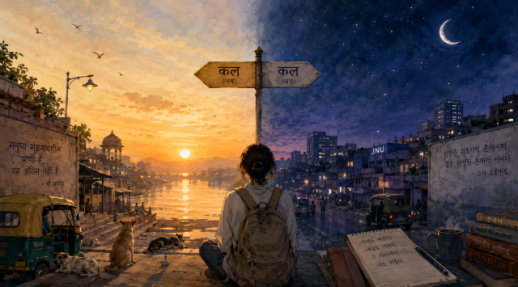 AJP Korea-India Essay Contest Winner: Gold Prize SEOUL, May 15 (AJP) - In Hindi, there is a word called "kal." It means both “yesterday” and “tomorrow.” When I first learned this word as a Hindi major in college, I thought it felt very much like India itself. Two completely opposite ideas existing within a single word. A word that refuses to define only one thing. At the time, however, I did not understand why it stayed with me for so long. In the winter of my second year at university, I traveled to India for a school-organized exchange program. India, which I visited despite everyone’s worries, was quite different from what I had expected. From the cold air I felt the moment I stepped off the plane, to the taxi driver who waited patiently with the meter turned off after we realized we had the wrong address, and who even stopped to ask strangers for directions himself when we could not find the place — everything slowly broke down the arrogance and prejudice I did not know I had. Strangely, the feeling that I had lost something made me feel lighter. That night, I fell asleep with the cold air of India drifting through the window. The next morning, I woke up early. The sound of motorcycles being repaired at the shop below the hostel and the barking of stray dogs fighting outside struck my ears through the open window. Half awake, I stepped outside and tried to catch a tuk-tuk. I thought it would be easy since I was out so early, but it was not. More than ten drivers waiting outside the hostel began arguing over who would take me. The chaos felt like stepping directly into the middle of real life. Feeling responsible for the situation I had caused, I tried to calm everyone down and solve it fairly by choosing based on price. In the end, that was what I did. As I caught my breath inside the tuk-tuk, I thought about the convenience of taxis in Korea. Now, all we have to do is open an app and a car arrives right in front of us. But many taxi drivers in Korea often say life was better before these apps existed. High commission fees, pressure to accept rides, and endless waiting for requests leave drivers trapped in a system where waiting itself becomes exhausting. Even I find myself staring nervously at my phone when I am in a hurry, unable to do anything until a driver finally accepts my request. That is what life without choice feels like. The waiting grows longer, and during that time, people slowly become smaller. We think we have choices, but in reality, society and systems often choose for us. We simply receive the result. Maybe that is why it has become harder to find taxis on the street. People begin predicting each other’s behavior, moving only toward crowded places, and waiting once again. The waiting simply changes shape. In that process, we stop becoming people who choose and move on our own. Instead, we become people waiting to be chosen. And it is not only about taxis. In this false sense of convenience, we have started taking other people’s time and labor for granted. We have also lost small moments of understanding and consideration for one another. My main destination in India was Jawaharlal Nehru University in New Delhi. The university is well known in Korea, especially for its Korean language department. Located deep within the hills, it still took another ten minutes by tuk-tuk after reaching the area. When I arrived, stray dogs were resting on the stairs and sofas as if they were welcoming me. Although it was part of a Korean language exchange program, many of the classes focused on Indian history, traditions, and language. I especially enjoyed the literature class. Reading passages written during the colonial period allowed me to feel more deeply connected to that history. Sharing the pain of colonial experience also made me feel closer to India itself. “Man is a transitional being; he is not final.” This quote by Indian philosopher and independence activist Sri Aurobindo means that human beings are unfinished and always changing. To me, this sentence describes India better than anything else. Indian people rarely give absolute answers. Even my Hindi professor often avoided saying “yes” or “no.” Instead, he tilted his head slightly — a gesture that can mean both agreement and disagreement, or answered with “maybe.” That is because possibilities are always left open. India seems to understand that deciding something too quickly can be both arrogant and careless. Perhaps that openness is why the country was able to rebuild itself after independence, developing industries such as textiles and tea while later becoming a global leader in pharmaceuticals through constant challenges and new attempts. We all know we should leave room for possibility, yet modern society pushes us to define everything too quickly. For the past several years, introducing ourselves with MBTI types has become almost natural. It is easy, simple, and convenient. “I” means shy, “E” means outgoing, “T” means logical, and “F” means emotional. But from the beginning, I always felt uncomfortable with it. I was afraid of being reduced to only four letters while every other possibility about me disappeared. During introductions, I often avoided the test altogether because I disliked the feeling of being explained so quickly and so completely. Even when I asked friends whether they found this strange, most replied that it simply made people easier to understand. Society does not easily allow people to change their decisions. It demands quick and certain answers. That is why we live in constant tension, preparing ourselves for futures that may never even arrive. And the easiest way to prepare for the future is by copying what already exists. Ignoring our own uniqueness, we stop thinking deeply and focus only on fitting into familiar shapes. Modern society builds walls in pursuit of comfort, even though that comfort is often temporary and uncertain. But perhaps our exhaustion comes from those very walls. Maybe stopping our thoughts would make life easier. Still, it feels wasteful to live that way when we were born as people capable of reflection. In his essay You, the Sentence, Yoo Jin-mok writes that “you” and “I” are part of the same sentence, and that we do not need quotation marks or references to explain ourselves. Every person carries a different meaning, and we can only understand each other within the full context of a sentence. Sometimes, understanding can happen simply through eye contact, without explanation or effort. This trip to India taught me how to accept things as they are. In a country where nothing has only one answer, I came to understand that yesterday can become tomorrow, and tomorrow can become yesterday. And somewhere in between, I think I will remain, without deciding completely which one I am. *The author, Kim Ji-youn, is based in Korea. Her writing was submitted in Korean, and was translated into English by AI. 2026-05-15 09:08:44
 -
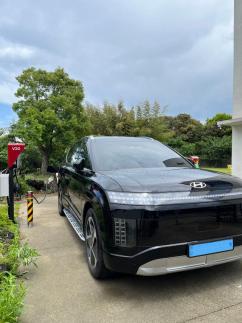 Hyundai Launches V2G Pilot Program for Electric Vehicles in Jeju Hyundai Motor Group announced on May 15 that it will officially launch a Vehicle-to-Grid (V2G) pilot program for general customers in Jeju Island. V2G technology connects electric vehicle (EV) batteries to the power grid, allowing for two-way energy exchange. This approach transforms electric vehicles from mere transportation into strategic assets for energy storage and distribution. The company has been operating a V2G pilot program in collaboration with the mobility platform SoCar since the second half of last year and is now expanding it to include local residents. Forty Jeju residents who own Hyundai's Ioniq 9 or Kia's EV9 and can install V2G bi-directional chargers at their homes or workplaces have been selected as participants. These participants are early adopters with a strong interest in the environmental benefits of V2G technology. Hyundai Group conducted field surveys to ensure a diverse representation of occupations and residences among the final participants. They will receive free installation of the bi-directional chargers and full coverage of EV charging fees during the pilot period. Participants will experience a new form of mobility, utilizing their electric vehicles not just for charging but as 'mobile energy storage systems' (ESS) that can store and supply power. The full implementation of V2G is expected to shift the energy industry from a supplier-centric model to a locally driven economic model. In Jeju, which has a high proportion of wind and solar energy, excess power generated during the day can be stored in electric vehicles and returned to the grid at night, maximizing the utilization and economic viability of renewable energy. Hyundai Motor Group plans to accelerate the development of the domestic V2G ecosystem and industry activation in collaboration with the government and local authorities through this pilot program expansion. A Hyundai Group official stated, "We expect the V2G pilot program, which involves direct participation from the residents of Jeju, to support the realization of local energy production and consumption. It will also play a significant role in achieving Jeju's carbon neutrality vision for 2035." Meanwhile, Jeju is serving as a testbed for carbon neutrality policies, aiming to achieve net-zero emissions by 2035, 15 years ahead of the national target. The island is pursuing various roadmaps to transition its energy production and consumption paradigms. By 2035, Jeju plans to expand its renewable energy generation capacity to 7GW, increasing its share of renewable energy to over 70%. It will also convert existing thermal power plants to hydrogen combustion and co-firing plants. Additionally, the island is testing technologies to promote distributed energy through regulations on new registrations of internal combustion vehicles and the transition of large buses and trucks to hydrogen vehicles, along with V2G initiatives.* This article has been translated by AI. 2026-05-15 09:08:04
 -
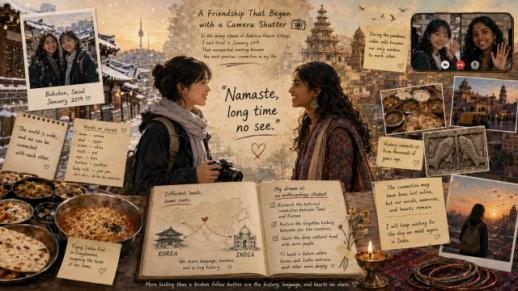 AJP Korea-India Essay Contest Winner: Silver Prize SEOUL, May 15 (AJP) - Winter of 2019, Found in White Silence One winter day, when worries about my future had reached even the tips of my toes, I found myself wandering through Bukchon Hanok Village as if I were being pulled there by something unseen. The roofs of the hanok houses, covered in white snow, seemed to quietly cover my complicated thoughts as well. As I walked through the cold air, I suddenly remembered a day from early January 2019. It was just as freezing as today. That was the day I met my Indian friend, Hiral. A Friendship That Began with a Camera Shutter At the time, I was still a high school student. Hiral, who was traveling alone, shyly asked me to take her picture. Even now, I clearly remember her bright smile through the camera lens against the snowy hanok village. I became her guide for the day, walking together through the narrow alleys of Bukchon. My English was not very good, so I could not make perfect sentences, but I tried my best to explain the beauty of Korean culture with sincerity in every word. She smiled shyly as she talked about how much she liked K-pop, and during those moments, I realized something important. To a high school student who felt uncertain about the future, she showed me that the world was wide and that people could still connect with each other, even across great distances. Before parting ways, we exchanged Instagram accounts, and our connection became much deeper than I expected. During the pandemic especially, video calls became our only way of staying close. She showed me everyday life in India through the screen, introducing me to Indian food and culture one by one. Sometimes she even cooked Korean ramen herself while laughing and saying we should meet again someday. Wanting to feel closer to her culture, I began visiting Indian restaurants in Dongdaemun. As I tried tandoori chicken, curry, naan, and lassi, I imagined the taste of the home she missed. But in 2024, our connection suddenly disappeared. Her Instagram account was hacked, and the friendship we had built for almost five years was lost overnight. Even the messages we exchanged while comforting each other during the difficult days of COVID-19 vanished in an instant. Still, that powerful experience of meeting and losing someone became a compass in my life. The Future I Dream of as an Anthropology Student One of the most surprising things while talking with Hiral was discovering the strange similarities between Korean and Tamil, her native language from South India. Not only did Tamil use the same sentence order as Korean — subject, object, and verb — but many everyday words sounded surprisingly alike. Family words such as “mom,” “dad,” and “older sister” felt familiar. Even words for body parts sounded similar. What shocked me most was learning that even expressions used with children — playful words like comforting sounds and baby-talk phrases — existed in both languages in very similar ways. At that moment, our friendship no longer felt like simple coincidence. It felt like something connected by history itself. These feelings also reminded me of historical traces connecting Korea and India from long ago: the stone pagoda said to have been brought from India by Queen Heo Hwang-ok, the twin-fish symbol found near King Suro’s tomb, and research suggesting similarities between ancient remains found in Gimhae and people from South India’s Tamil region. To me, these were not just historical facts. They felt like proof that the emotions and understanding we shared had roots stretching back thousands of years. Though we were born in different countries, we shared similar emotions, language, and history. Because of this experience, I decided to study anthropology. I now dream of becoming a researcher who studies the historical relationship between Korean and Tamil. What began as a wish to reconnect with a lost friend has grown into a dream of rediscovering the forgotten ties between two countries. I want to continue studying the deep cultural similarities between Korea and India and share them with more people. The Day We Meet Again Whenever I return to Bukchon, I sometimes feel as if Hiral might suddenly appear from somewhere beyond the stone walls. Maybe it is because the gratitude I never fully expressed and the pure feelings from that time still remain there. Even though our online connection has been lost, I still dream of meeting her again someday on a street somewhere in India. The friendship may have been interrupted, but the countless conversations we shared and the warmth of those memories have not disappeared. As I wait for the day we meet again, I want to continue recording and sharing the deep cultural connection between Korea and India. Remembering Hiral, the Diamond in My Life Her name, “Hiral,” means “diamond.” And truly, she was one of the brightest diamonds in my life. I hope that the friendship once buried beneath the white snow of Bukchon will bloom again someday, becoming part of a future where Korea and India embrace each other more deeply. If I ever meet her again in India, I want to tell her this with my brightest smile: “My Hiral, because of you, I was able to see a much bigger world.” More lasting than a broken Instagram follow button are the history, language, and emotions we shared together. And so, I quietly repeat the words I hope to say to her someday again: “Namaste, long time no see.” *The author, Gu Jun-hee, is based in Korea. The author's writing was submitted in Korean, and was translated into English by AI. 2026-05-15 09:07:43
 -
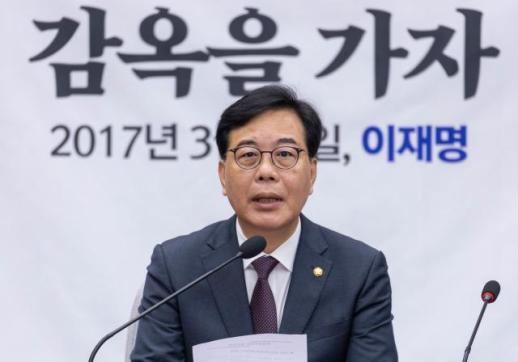 Song Eon-seok Criticizes President Lee for Election Interference During Market Visits Song Eon-seok, co-chair of the People Power Party's election campaign committee, criticized President Lee Jae-myung on May 15 for his frequent visits to traditional markets, calling it "blatant election interference." In a Facebook post, Song stated, "The president is not just crossing the line of election interference; he is actively campaigning." He noted that after attending a K-Shipbuilding meeting in Ulsan, President Lee visited the Namnok Market in Ulsan and then the Moran Market in Seongnam after a meeting at the Saemaul Undong Central Association. He added that last Friday, the president visited the Namdaemun Market following a Parents' Day ceremony, claiming, "He is now conducting open campaign tours of traditional markets every day." Song emphasized that the Moran Market is politically significant for President Lee, as it is his political hometown, and the candidate for Seongnam mayor, Kim Byeong-wook, is a former senior secretary at the Blue House. He argued that the choice of location is suspicious, stating, "While past presidents have faced allegations of election interference, none have campaigned directly in traditional markets every day just 20 days before an election." He recalled that in March 2016, when then-President Park Geun-hye visited innovation centers in Daegu and Busan, the Democratic Party vehemently criticized her for election interference, despite her actions being part of her official duties. "The Democratic Party condemned her for visiting regions, labeling it election interference, while President Lee is not even visiting traditional markets, yet he is campaigning openly," Song remarked. He concluded by stating, "If the president continues this campaign, the People Power Party will take immediate legal action against his blatant electioneering." Jeong Hee-yong, head of the election campaign headquarters, also targeted President Lee, questioning, "Is the obligation of political neutrality and concerns over election interference a selective principle that disappears when the regime changes?" He criticized the president for leading the push for a so-called 'special prosecutor for the cancellation of charges' amid constitutional controversies, suggesting that such behavior reflects a selective interpretation of laws and principles. Jeong added, "The public does not trust a power that is strict with others but lenient with itself. I urge the president to reflect on the weight of his past words and at least adhere to the standards he has set for himself."* This article has been translated by AI. 2026-05-15 09:07:09
 -
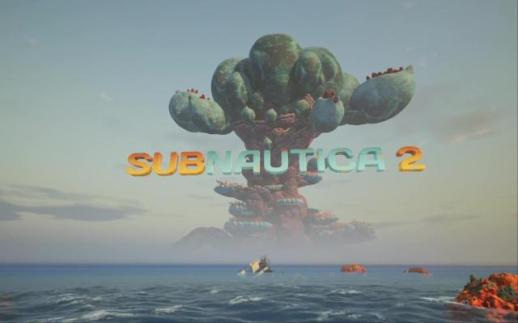 K-Game: Subnautica 2 dives into early access, lonelier than it looks SEOUL, May 14 (AJP) - Most survival games this reviewer has lived inside — Rust, Minecraft, Terraria, Core Keeper — share a comfortable rhythm: gather, build, defend, repeat. Fishing is a life-hobby for this reviewer, an in-game delicacy for such survival games as well. "Subnautica 2," which entered early access on Friday at zero a.m. KST, breaks that rhythm in two specific places. The fish want to eat you. And you cannot breathe. That combination — predators that hunt rather than wander, plus a permanent oxygen clock — is something only this series really commits to, and the sequel does not soften it. Even with a crafting-survival muscle memory built over years, the first dive produced the familiar tightening that the original game weaponized so well: a so-called thalassophobia and megalophobia inducer. Full disclosure: this reviewer never finished the 2018 original, having played it in patches and watched the rest as YouTube playthroughs. That made "Subnautica 2" one of the more anticipated titles on the personal calendar — and, after about five hours of solo play, one of the more interesting to write about. Developed by Krafton-owned Unknown Worlds Entertainment, the sequel drops players onto an unfamiliar alien ocean world aboard a doomed Alterra colony ship called the Cicada. It ditches the first game's planet 4546B entirely and, for the first time in the series, supports up to four-player co-op alongside solo. The franchise has sold more than 18.5 million copies to date, per Unknown Worlds, and the sequel topped Steam's global wishlist for nine straight months, crossing five million wishlists before launch. Story, lightly told The structural pitch differs from the first game in one key way: this is not an escape story. Players are not trying to leave. The Cicada's AI is barking objectives, the planet is hostile, and the goal is to adapt to it — to stay. Adaptation is also a mechanic. A new system called BioMod lets the player splice alien genes into their body to unlock new traits — bio-orb cave markers, faster swim speed, surfacing the planet's biology through one's own skin. The longer the player runs, the further from human baseline they drift. There is no protagonist voice-over and very little hand-holding. Skip the AI dialogue and the logs from earlier visitors, and early objectives become genuinely opaque. Several hours in, this reviewer was still freediving for blueprints like a checklist-bound pearl diver, scanner in hand, oxygen ticking. How the loop feels The loop lands somewhere between meditative and slightly panicked. Without an extra tank, the player surfaces about every 30 seconds or sprints to a bubble-emitting plant to top off. Movement, health and inventory size all expand by finding hidden biopods across the map — a soft, exploration-rewarding progression that worked on this reviewer more than the standard XP bar would. This reviewer's usual survival-game default is "fisherman and forager" — let someone else fight, let the snacks pile up. "Subnautica 2" is the rare entry where collecting fish is also collecting predators, since plenty of them bite back. Less Stardew Valley, more Jeju haenyeo (women divers) in a horror cut: the diver goes down, the diver comes up with whatever did not get her. It is a strangely compelling pitch. Hostile life is otherwise thin in the early game. Nibblers dart in for a single chomp and flee. Larger pursuers can be peeled off with a sonic resonator or a flare — though firing the resonator near a wall produced a reliable bug in which the pursuing creature simply embedded itself in the geometry. Death is gentler than it sounds. A "Reprint" mechanic revives the player from stored memory — think the recent film "Mickey 17" — at the cost of two or three items rather than the full inventory. A quiet kindness in a game that otherwise enjoys making the player suffer. Toys, bases, and the small annoyances The new flagship vehicle, the TadPole, is a glass-fronted, winged sub that can carry up to three players hanging from a top rail, with a smaller drone that detaches to thread tight caves. Base-building has loosened considerably, though the early-access blueprint pool is narrow: this reviewer spent the first stretch living in a hamster-tube of corridors before stumbling on an abandoned habitat that unlocked proper rooms. Solar panels cover the early game but tank hard at night. Inventory management is the most frustrating area. There is no stacking, no drag-to-discard, only five hotkey slots, and the hand-held field container does not auto-collect. One container this reviewer set down on the seabed re-spawned, apparently floating, in a completely different biome on the next load — the first major bug in roughly four hours of play. How it looks, how it runs The jump from Unity to Unreal Engine 5 is doing real work. Light falls through the water column with a softness the first game never had, and at about 200 meters down the sun simply gives up. On a system with an RTX 5070, 32GB of RAM and an AMD Ryzen AI 7 350, the game held up at maximum settings with motion blur off, with occasional hitches — most reliably when climbing a ladder into a vehicle pod. Krafton has said the game targets 4K at 60 fps on an RTX 5070 Ti or Radeon RX 7900 XTX, a softer ask than most UE5 releases. The early-access map is also visibly fenced in. Swim too far toward the giant central tree on the horizon and the world simply tells you it has not been built yet — usually by spawning three leviathan-class predators that kill the player on contact. An honest map border, at least. A note on how the game got here The road to launch was unusually loud. Krafton and the studio's three co-founders — Charlie Cleveland, Max McGuire and former CEO Ted Gill — spent much of 2025 in court over a $250 million earnout tied to the sequel's release. A Delaware Chancery judge in March 2026 ruled Krafton had wrongfully terminated the trio and reinstated Gill as CEO, pushing early access into this year. Co-op, in theory Four-player co-op was not testable during this review window — multiplayer did not return for press play after an earlier closed beta. The setup is straightforward enough on the menu: one player hosts in survival or creative mode (a third slot is marked "Coming Soon"), and the rest join through a Steam friends list or a short friend code. Character customization is thinner than pre-launch chatter suggested — players pick one of four pre-set survivors, and that is it for now. Lead designer Anthony Gallegos has said co-op tuning will follow player feedback after launch. The hooks are there on paper — three-seat TadPole rides, two-player lever puzzles, bio-orb breadcrumb trails. Whether they land is something this reviewer will have to come back to once there is a full team in the water. Worth diving in? After four hours, "Subnautica 2" feels recognizably Subnautica — slower, prettier, more legally complicated, and built around evolving into the planet rather than escaping from it. The horror still works in the specific way only this series does. The inventory does not. The map is small, the bugs are real, and a lot of the promised content is on a roadmap rather than in the build. For someone who came in as a fan-by-osmosis rather than a finisher of the first game, the early hours felt less like clearing a tutorial and more like learning to be a different kind of animal in a place that is actively trying to digest you. For a survival game that lets the player literally adapt into the ecosystem, that seems to be the entire point. 2026-05-15 09:00:00
 -
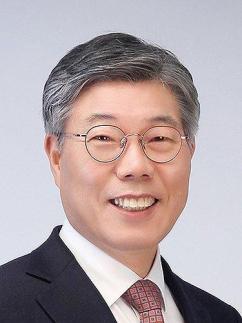 iM Financial Chairman Hwang Byeong-woo to Visit UK, Assures Investors of Performance and Dividends Hwang Byeong-woo, Chairman of iM Financial Holdings, is set to visit the United Kingdom for the first time since taking office. The trip aims to enhance shareholder value by promoting iM Financial's growth story as it transitions to a commercial bank.According to financial industry sources on May 15, Hwang will be in the UK from May 18 to 22.During his visit, he plans to meet with local investors, including asset management firms in London, Stockholm, and Edinburgh. This marks Hwang's inaugural trip to the UK.iM Financial's foreign ownership rate stands at 42.89%. However, the company remains relatively unknown among UK investors. Hwang intends to directly communicate the company's financial performance, long-term growth strategies, and shareholder return policies, including dividends.Hwang's trip is part of the strategy to realize the vision of a 'hybrid financial group.' Since transitioning to a commercial bank in 2024, iM Financial has increased corporate loans in the metropolitan area by utilizing dedicated corporate sales teams. The amount of corporate loans in Korean won rose from 34.6 trillion won at the end of last year to 35.9 trillion won in the first quarter of this year.The number of digital customers has also grown, increasing from 3.87 million in 2024 to 4.47 million in the first quarter of this year, with non-face-to-face savings and deposits accounting for 84% of the total. The proportion of non-banking revenue surged from 15.5% in the first quarter of 2024 to 34% in the first quarter of this year, reflecting increased fees across subsidiaries, including banking, securities, and capital. Hwang's decision to step down as bank president and focus entirely on synergies among subsidiaries has significantly contributed to this growth. In his New Year's address, he emphasized the need for seamless integration of all financial services under the 'Seamless iM' initiative, advocating for broader collaboration and synergy among subsidiaries. This growth trajectory has led to a doubling of iM Financial's stock price, which has risen from the 8,000 won range prior to the bank's transition to approximately 19,000 won now.Hwang is also pursuing an aggressive value-up policy based on his confidence in the company's performance, continuing with share buybacks. Following the separation of dividend taxation last year, iM Financial plans to implement reduced dividends (tax-exempt dividends) this year. Hwang has expressed his commitment to supporting the stock price by purchasing an additional 2,900 shares in March, following the acquisition of 7,136 shares in January.This year, the company is expected to seek growth drivers in new business areas. Hwang has stated, "In a rapidly evolving management environment driven by artificial intelligence (AI), we must identify tasks optimized for the group's capabilities and build success stories." iM Bank is collaborating with Deloitte Group in Korea to explore new digital asset ventures and is developing AI-based facial recognition for remote identity verification and digital asset ATMs.* This article has been translated by AI. 2026-05-15 08:56:23
 -
 Midtjylland Wins Danish Cup After Four Years with Lee Han-beom's Goal Midtjylland secured the Danish Football Association (DBU) Cup title for the third time in its history, defeating Copenhagen 1-0 in the final held at Parken Stadium in Copenhagen on May 15. The victory marks Midtjylland's first cup win since the 2021-2022 season. Lee Han-beom scored the winning goal with a header in the 82nd minute, contributing significantly to the team's success. He played the full match alongside fellow starter Cho Gyu-sung, who, while not scoring, was instrumental in pressuring the opposing defense throughout the game. In earlier rounds of the DBU Cup, Lee also made notable contributions, scoring the decisive goal in the first leg of the semifinals and providing an assist in the second leg. After the match, teammate Viktor Bæk Jensen praised Lee's performance, stating on the club's website, "Lee has been outstanding all season. He has consistently delivered impressive performances since the beginning of the season and has been incredibly reliable. He deserves immense praise." Midtjylland's triumph adds to their previous cup victories in the 2018-2019 and 2021-2022 seasons, solidifying their status in Danish football.* This article has been translated by AI. 2026-05-15 08:51:05