
Journalist

Elizabeth Englezos
-
 Korea FTC Warns of Rising Wedding Service Disputes as Spring Peak Season Begins South Korea’s Fair Trade Commission said on 22 it issued a consumer alert for wedding services as demand peaks during the spring wedding season. The FTC, citing data from the Korea Consumer Agency and others, said consumer dispute-relief requests tied to wedding services totaled 1,076 last year, up 171 cases, or 18.9%, from 905 a year earlier. In April and May last year, the number of cases rose 56.0% from the same period the previous year. Of the complaints received, 88.1% involved disputes over contract cancellations, penalty fees and withdrawal rights. The FTC urged couples to prioritize companies that use the standard contract terms for wedding planning agencies. It said firms using the standard terms clearly disclose base prices by service and the criteria for penalty fees. The commission also recommended comparing prices in advance through the Consumer Agency’s “Cham Price” service, which publishes regional price information for major wedding items such as meal costs, venue rental fees and studio-dress-makeup packages, along with price data for as many as 67 optional items. Looking ahead, the FTC said it will intensively inspect whether wedding service providers are properly implementing detailed service descriptions and price displays at points of sale. Providers that fail to comply with required key information disclosures may face administrative fines of up to 100 million won. The government said it will continue to monitor unfair practices in the wedding services market to prevent consumer harm in advance and support informed choices by providing information on wedding services.* This article has been translated by AI. 2026-04-22 10:05:26
 -
 LG AI Research, Nvidia deepen alliance to expand EXAONE ecosystem LG AI Research and Nvidia are strengthening a technology alliance to expand the “K-EXAONE” ecosystem. LG AI Research said executives including Woo-hyung Lim, co-head of LG AI Research, and Jin-sik Lee, head of the EXAONE Lab, met Monday afternoon at the institute’s headquarters in Seoul’s Magok district with Bryan Catanzaro, Nvidia vice president of applied deep learning research, and So-young Jung, head of Nvidia Korea, to discuss cooperation on developing next-generation AI models. The two companies said they will broaden collaboration by combining LG’s AI model, EXAONE, with Nvidia’s Nemotron open ecosystem to jointly develop specialized models for professional fields. LG AI Research said it used Nemotron open datasets during EXAONE’s development to help ensure training data quality. Nvidia supported optimization of model training and improvements in inference performance and efficiency by providing its latest Blackwell graphics processing units, the NeMo Framework AI development platform and TensorRT-LLM software designed to boost inference performance. “As a key partner of LG AI Research, Nvidia has worked together to make EXAONE Korea’s top AI model,” Catanzaro said. “By combining LG’s EXAONE and Nvidia’s Nemotron, we will lead sovereign AI and contribute to expanding the ecosystem,” he said. Lim said Nvidia has been a core technology partner in developing EXAONE. “We will take LG and Nvidia’s cooperation a step further by expanding the research-and-development ecosystem and deliver sovereign AI results that can be felt in industrial settings,” he said. * This article has been translated by AI. 2026-04-22 10:05:17
 -
 22 South Korean Public Agencies Rated Below Satisfactory in Customer Satisfaction Survey Korea Electric Power Corp. and SR were among 22 public agencies rated “insufficient” or worse in a customer satisfaction survey for last year. The government said it will require the agencies to analyze the causes of weak service and draw up specific improvement plans. The Finance and Economy Ministry on Tuesday released results of its “2025 public-agency customer satisfaction survey” covering 186 public institutions. The overall composite score was 89.2, up 1.3 points from 87.9 a year earlier. By type, quasi-government agencies scored highest at 91.4, followed by state-run enterprises at 89.2 and other public institutions at 88.1. The government said broader customer-tailored service channels and more active efforts to address complaints helped lift satisfaction overall. The survey also replaced the previous three-tier system (excellent, average, insufficient) with five grades: very excellent, excellent, average, insufficient and very insufficient. Under the new scale, 77 agencies — 41.4% of the total — were rated “excellent” or higher. Twenty-two agencies, or 11.8%, were rated “insufficient” or below, down 12.9 percentage points from the previous year. Among state-run enterprises, Korea Electric Power was rated “insufficient,” while SR was rated “very insufficient.” In the quasi-government category, the Health Insurance Review and Assessment Service, the Korea Sports Promotion Foundation, the Small Enterprise and Market Service, and the Korea Internet & Security Agency were rated “insufficient.” In the other public-institution category, Public Home Shopping, the Korea Legal Aid Corp., the Independence Hall of Korea, the Korea Creative Content Agency, and the Korea Health Personnel Licensing Examination Institute were rated “insufficient” or below. Twelve agencies were rated “very excellent.” In the state-run enterprise group, the Jeju Free International City Development Center, Korea Gas Corp., the Korea Broadcast Advertising Corp., and Korea Water Resources Corp. made the list. In the quasi-government group, the Korea Trade-Investment Promotion Agency, the Korea Institute for Animal Products Quality Evaluation, and the Korea Environment Corp. were included. Forty agencies, including the Korea Land and Geospatial Informatix Corp. (LX), maintained an “excellent” or higher rating for at least two consecutive years. The Korea Trade-Investment Promotion Agency and the Korea Institute for Animal Products Quality Evaluation were selected as excellent agencies for a seventh straight year. The ministry said it also tightened rules to improve fairness and credibility. To better reflect differences in agency operations, it introduced target scores across 13 detailed categories linked to management evaluation standards. For agencies found to have engaged in misconduct during the survey, it said they must adopt measures to prevent recurrence and will be barred for two years from participating in the survey as contractors, among other steps. The results will be reflected in the 2025 management performance evaluation of public agencies and will be disclosed through the public agency management information system, ALIO. Starting next year, the government plans to fully apply a next-generation evaluation index, the “PCSI 3.0 model,” designed for a digital administrative environment.* This article has been translated by AI. 2026-04-22 10:04:52
 -
 KDI: Oil Price Cap Cut March Inflation Up to 0.8 Points, Keeping Rise Below 3% The government’s cap on petroleum product prices lowered consumer inflation last month by as much as 0.8 percentage points, helping keep the rate from topping 3%, according to a study by a state-run research institute. The Korea Development Institute also found that fuel-tax cuts contributed to lower prices, but warned that low-income households could feel the impact of high oil prices more acutely and may need stronger support. In an emergency brief released Tuesday by KDI’s Middle East war response task force, the institute estimated the first round of the price cap reduced March consumer inflation by 0.4 to 0.8 percentage points. KDI said the timing of the cap’s impact varied depending on how quickly international crude prices feed into retail gas station prices. Under longer assumed lags, the initial effect was smaller and then grew over time. In its analysis of the fuel-tax cut, KDI said most of the reduction was passed through to lower gasoline prices, reflecting a structural feature in which the gasoline supply curve is close to flat. Based on the fourth week of March, the final week the first cap was applied, KDI estimated the price-cut effect at about 460 won per liter for regular gasoline, 916 won for automotive diesel and 552 won for indoor kerosene. It projected that the fuel-tax cut, expected to be reflected more fully starting in April, would lower inflation by about 0.2 percentage points. KDI said disruptions in the global energy supply chain drove the oil-price surge and could add downside pressure to the broader economy. Given South Korea’s high trade openness and heavy reliance on energy imports, an oil shock can quickly raise firms’ production costs and constrain households’ real income and consumption, potentially slowing growth. Still, KDI said its review of consumption trends in March after the outbreak of the Middle East war found no statistically significant slowdown. Comparing credit card spending in January through March with the same period over the past three years, total card spending remained broadly in line with past levels even after the war began. KDI also detected a slight decline in overall mobility as high oil prices persisted. The total number of mobile movers, a proxy tied to broad economic activity including consumption and production, gradually edged down after the war’s outbreak, showing a modest decrease. As support measures expand to address high oil prices, KDI said policymakers should closely examine energy spending patterns by household type. Using the National Data Policy Committee’s analysis of the past three years of household trend surveys, KDI said the share of energy spending relative to current income for the lowest income quintile (bottom 20%) was more than three times that of the highest quintile, suggesting low-income households may feel oil shocks more strongly. In a summer-only analysis of the relationship between Dubai crude prices and energy spending shares, KDI said the share of housing and utility costs rose significantly more in the first quintile than in the fifth, while the share of transportation fuel costs increased significantly more in the second and third quintiles than in the fifth. The results suggest low-income households are more exposed through cooling and cooking energy, while the second and third quintiles, with higher shares of working households, are more exposed through vehicle fuel costs. KDI said if high oil prices persist, the summer burden of housing and utility costs could rise disproportionately for low-income households, underscoring the need for tailored energy support by household characteristics. Senior Research Fellow Lee Young-wook said, “We need to close blind spots in support for damage from high oil prices and establish an energy support system tailored to household characteristics.” He added that, considering the heavier summer housing and utility burden for low-income households, authorities should review measures such as distributing heat-wave necessities through the Just Dream Center and providing emergency energy support linked to heat-wave alerts.* This article has been translated by AI. 2026-04-22 10:04:25
 -
 Lee Jae-myung’s Vietnam trip puts South Korea’s economic diplomacy to the test After completing a trip to India, President Lee Jae-myung moved directly to Vietnam for a state visit, a sequence that underscores a shift in diplomatic focus from security to economic strategy. Competition over emerging markets and supply chains has become central to national planning, and Vietnam is already one of South Korea’s key trading partners and among its largest investment destinations. That is why the visit is being watched as a test of “economic diplomacy.” The question, as always, is how to measure results. Without clear standards, overseas trips risk ending as photo opportunities and announcements. During the Vietnam visit, officials are discussing large-scale projects including nuclear power, infrastructure, bio-related industries, new airports and new-city development. Energy security and cooperation on critical-mineral supply chains are also on the agenda. These issues are closely tied to South Korea’s economic future, but their value diminishes if they do not lead to concrete contracts and investment. At the same time, judging success only by short-term deal counts is also risky. Supply-chain diversification and energy security are structural tasks that are not easily reduced to immediate figures. The trip should be assessed by two measures: in the short term, how quickly memorandums of understanding are converted into actual contracts and investment; and over the medium to long term, how steadily a Vietnam-centered production and supply-chain structure is built. The near-term focus should be on execution, while the longer-term test is whether the underlying structure changes. The article argues that South Korean diplomacy has too often remained “MOU-centered,” with many agreements signed but limited systematic tracking and disclosure of how many became contracts and how fast investment was carried out. It says the government should build a cross-government implementation monitoring system to track the full process after MOUs, with sector-by-sector teams regularly checking project progress and disclosing results transparently. Diplomatic outcomes, it says, are completed through follow-through, not announcements. It also draws a line between the roles of government and business. Measuring sales diplomacy solely by corporate order totals, it says, is a logical leap. The government’s role is to open markets and reduce political and institutional risk, while companies are responsible for turning opportunities into contracts and profits. If those roles are blurred, diplomacy can face excessive pressure for quick wins and companies can become bound by political expectations. Vietnam’s political structure is another variable. The first meeting with the new leadership centered on General Secretary To Lam is described as an important diplomatic moment, but the article cautions against relying on personal ties. In systems with high power concentration, it says, predictability and institutional stability matter. That is why stronger investment guarantees, clearer dispute-resolution procedures and more institutionalized government-to-government cooperation should accompany any push for closer ties. Long-term results, it argues, require cooperation built on systems rather than individuals. The article says South Korea is at a turning point and must prepare for a “post-China” era, with Vietnam and India emerging as key alternatives. It describes India as a place that shows market potential, while Vietnam serves as a hub for production and supply-chain realities. Linking the two, it says, could open a new growth path for the South Korean economy, and that is the strategic meaning of the trip. In the end, it concludes, sales diplomacy is not completed by declarations. In the short term it must be proven in contracts and investment, and in the long term it must lead to changes in supply chains and industrial structure. The government should support that through institutions, and companies should deliver results through execution. The direction, it says, is right; what remains is speed and outcomes.* This article has been translated by AI. 2026-04-22 10:01:15
 -
 Harvard Graduate Student Workers Strike for First Time in 4 1/2 Years A union representing Harvard University graduate students who work as teaching fellows, student mentors and research assistants has gone on strike, the Boston Globe reported April 21. The union began the strike at 12 a.m., halting work that includes teaching, grading, mentoring and research, the report said. Members held pickets across campus later in the morning. The union said it has negotiated with the university for 14 months over a new contract without progress. It is seeking a minimum annual salary of $55,000, but the university has offered a 2.5% annual increase, the union said. The union said some members earn about $26,000 a year. It also wants the minimum hourly wage for part-time workers raised to $25 from $21. Some students have argued that doctoral students are paid less than those at the nearby Massachusetts Institute of Technology. Provost John Manning disputed the union’s claims, saying doctoral students receive $425,000 in support over five years, including tuition and insurance, and that the living-stipend portion amounts to more than $50,000 a year. The union is also seeking paid leave for international students to attend immigration-related government appointments and stronger legal support for noncitizens facing risks of detention and deportation. Will Golay, an astronomy doctoral student who attended the protest, said only one of the union’s 23 demands has been settled and the rest remain in dispute. “We are striking not only over the bargaining agenda, but to urge Harvard (administrators) to come to the table and negotiate in good faith,” he said. Union chair Sarah Speller and vice chair Sudipa Saha wrote in an email to the campus April 17 that the decision to strike was not made lightly. “We love teaching and research and that’s why we’re here, but we can’t deliver the world’s best classes when we can’t pay rent or child care, or when we face harassment at work or the risk of detention,” they wrote. About 60% of union members are doctoral students, many of whom receive living stipends because they teach. The union estimates its membership at 4,000, while the university counts 1,300 graduate students who pay union dues. The two sides are also disputing the status of 800 graduate students who receive stipends while doing research instead of teaching. The university argues that research done for one’s degree is not employment. The strike is expected to last at least eight days. The Harvard Crimson reported the next bargaining session is scheduled for April 28. Separately, Boston 25 reported that Harvard’s non-tenure-track faculty union, after 18 months of stalled talks, plans to hold a strike authorization vote. WGBH reported that since forming in 2018, Harvard’s graduate student union has struck twice, in 2019 and 2021. The current walkout is the first in about 4 1/2 years, since October 2021. The union struck for three days in 2021, then returned to work and prepared for a second strike before approving a labor agreement in November 2021, the Harvard Crimson reported.* This article has been translated by AI. 2026-04-22 09:52:32
 -
 Pakistan PM Welcomes U.S. Extension of Iran Ceasefire, Hopes for Peace Deal in Second Talks Shehbaz Sharif, Pakistan’s prime minister, welcomed the United States’ announcement extending a ceasefire with Iran and voiced hope for progress in follow-up talks. In a post Monday on X, Sharif thanked U.S. President Donald Trump for accepting Pakistan’s request to extend the ceasefire. He said he hoped both sides would continue to observe the truce and reach a comprehensive peace agreement in a second round of talks planned in Islamabad to permanently end the conflict. Pakistan’s government has taken the same line. In a briefing April 16, the Foreign Ministry said Pakistan’s diplomatic efforts led to the U.S.-Iran ceasefire and the resumption of negotiations. It said it was important for both sides to keep their ceasefire commitments and that Pakistan would continue to support dialogue and talks. Pakistan mediated the first round of talks in Islamabad on April 11-12, hosting delegations led by U.S. Vice President JD Vance and Iranian Parliament Speaker Mohammad Bagher Ghalibaf. The latest statements did not amount to a confirmed end to the war. While the United States announced an extension of the ceasefire, Iran has maintained that lifting a maritime blockade and ending pressure must come first. Sharif’s message was seen less as a declaration of an end to hostilities than a reaffirmation that Pakistan intends to keep the mediation framework in place, secure a second round of talks and link it to a final agreement.* This article has been translated by AI. 2026-04-22 09:52:00
 -
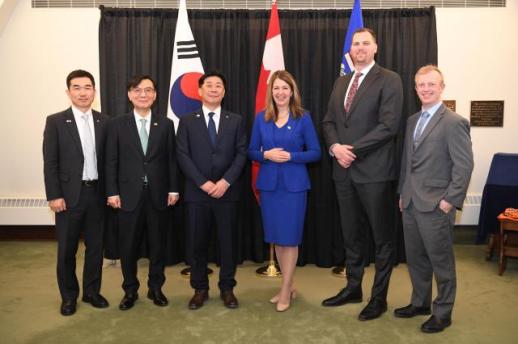 Korea's Hanwha expands partnership with Alberta for submarine bid in Canada SEOUL, April 22 (AJP) -South Korea's Hanwha Group pitching for a $40 billion submarine program in Canada is widening its support base across the North American country to win favor against its European competition. Hanwha Group is expanding cooperation with the Canadian province of Alberta across key industries including energy, defense and shipbuilding as it seeks to broaden local industrial partnerships and economic cooperation tied to Hanwha Ocean’s bid for Canada’s Canadian Patrol Submarine Project, or CPSP. The group signed a memorandum of understanding with the Alberta government Tuesday (local time) at the provincial government building in Edmonton. Attendees included Alberta Premier Danielle Smith, Economic Development and Trade Minister Joseph Schow, South Korean Ambassador to Canada Lim Ki-mo and Hanwha Energy CEO Lee Jae-kyu. The two sides agreed to pursue mid- to long-term investment and build an industrial ecosystem in Alberta beyond individual projects. Hanwha Energy, Hanwha Ocean, Hanwha Aerospace and Hanwha Power will take part, expanding cooperation in oil, liquefied natural gas, hydrogen, carbon capture and storage, and defense and shipbuilding supply chains. Hanwha said the MOU focuses on a low-carbon energy transition, industrial growth and stronger supply-chain stability. In the near term, the sides plan to expand trade in resources such as natural gas. Over the mid to long term, they aim to broaden cooperation to hydrogen- and ammonia-based clean energy and carbon-management infrastructure. Hanwha also said it will support efforts aligned with Canada’s Defense Industrial Strategy, including strengthening domestic industrial capabilities, maintenance and operations capacity, and building a regional defense ecosystem. Alberta is attracting about $6.5 million in investment from the federal government as it grows into a defense manufacturing hub. Smith said, “Alberta is a global business hub, and this agreement with Hanwha Group shows our competitiveness as a destination for international investment.” Lee said, “This MOU has elevated our cooperative relationship with Alberta by another step,” adding, “We will bring together the group’s capabilities to deliver tangible results across a range of areas.” Hanwha has been mounting a groupwide push to win the Canadian submarine project, expanding its outreach beyond inland industrial bases to key maritime hubs. Earlier, Hanwha Ocean CEO Kim Hee-cheol visited Halifax on April 14 and discussed defense and industrial cooperation with officials from Nova Scotia. Halifax is a strategic center of the country’s naval industry. The talks covered defense readiness, maintenance, repair and overhaul (MRO) capabilities, workforce development and industrial infrastructure, as Hanwha Ocean shared its long-term strategy for the project. The local partnership is part of Hanwha Ocean’s strategy to shorten delivery timelines and strengthen localization as it competes with Germany’s ThyssenKrupp Marine Systems (TKMS) in the final stage of the bid. The company has also partnered with five Canadian firms — OSI Maritime Systems, EMCS Industries, Techsol Marine, Jastram Technologies and Curtiss-Wright — to reinforce its local industrial base. Such localization efforts are seen as critical, as Canada places strong emphasis on domestic industrial and economic contributions in major defense procurement programs. Canada’s CPSP involves the procurement of up to 12 diesel-electric submarines of around 3,000 tons. The contract value alone is estimated at $13.5 billion, with the total project size, including 30 years of MRO, potentially reaching $40 billion. A consortium of Hanwha Ocean and HD Hyundai Heavy Industries is competing against Germany’s ThyssenKrupp Marine Systems, with a final decision expected around June. 2026-04-22 09:51:46
 -
 South Korean Won Opens Sharply Lower as U.S.-Iran Talks Stall, Oil Jumps The South Korean won opened sharply weaker against the U.S. dollar on Tuesday as uncertainty over a second round of U.S.-Iran cease-fire talks pushed oil prices higher and boosted demand for safe-haven assets. As of 9:10 a.m. in Seoul, the won was trading at 1,477.4 per dollar. It opened at 1,479.5, up 11.0 won from the previous session’s close. Markets have refocused on the risk of supply disruptions as doubts grow over whether the two sides can even hold a second round of talks, with the cease-fire set to expire in a day, the report said. Overnight, Brent crude futures for June delivery settled at $98.48 a barrel, up 3.14% from the previous session. U.S. West Texas Intermediate for June rose 2.57% to $89.67 a barrel. U.S. stocks also fell. The Dow Jones Industrial Average closed down 293.18 points, or 0.59%, at 49,149.38. The S&P 500 dropped 45.13 points, or 0.63%, to 7,064.01, and the Nasdaq fell 144.43 points, or 0.59%, to 24,259.96. Min Kyeong-won, an economist at Woori Bank, said the exchange rate was likely to rise as investors focus less on a cease-fire extension and more on concerns that failed negotiations could prolong the closure of the Strait of Hormuz. He said President Donald Trump has said the cease-fire would be extended until talks with Iran conclude, but worries about disruptions to global crude supply have resurfaced because a Pakistan meeting was called off and the Strait of Hormuz remains blocked.* This article has been translated by AI. 2026-04-22 09:51:16
 -
 BMW Renovates Suncheon Showroom and Service Center BMW Korea said Tuesday that its official dealer, Kolon Motors, has renovated the BMW Suncheon showroom and service center. The facility in Seomyeon, Suncheon, South Jeolla Province, is a three-story building with one basement level and a total floor area of 4,016.9 square meters. Customers can handle vehicle purchases, maintenance and accident repairs in one place. The renovation applies BMW Group’s latest space concept, “Retail Next,” reorganizing customer flow and improving comfort. The second-floor showroom displays six of BMW’s latest models. A new lounge-style handover zone for customers was added on the first floor. The service center also expanded its paint booth to strengthen accident-repair capacity. A Kolon Motors official said the showroom, service center and handover zone are now connected in a single space, allowing customers to experience consistent premium service.* This article has been translated by AI. 2026-04-22 09:48:08