SEOUL, May 27 (AJP) - Samsung Electronics went on a multitrillion-won spending blitz Wednesday, pledging 5 trillion won ($3.6 billion) over the next five years to nurture talent and support suppliers on the very day it averted a historic strike by agreeing to hand out over 40 trillion won in rewards tied to this year’s blockbuster earnings and soaring share prices.
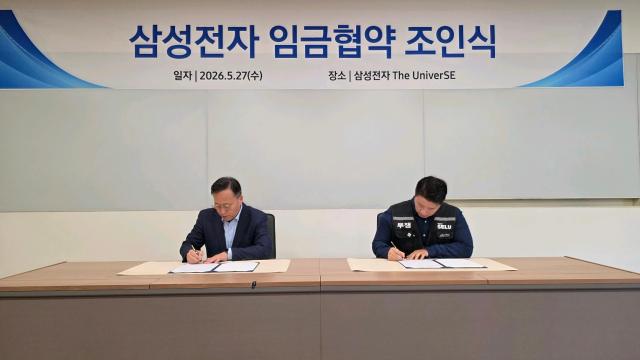
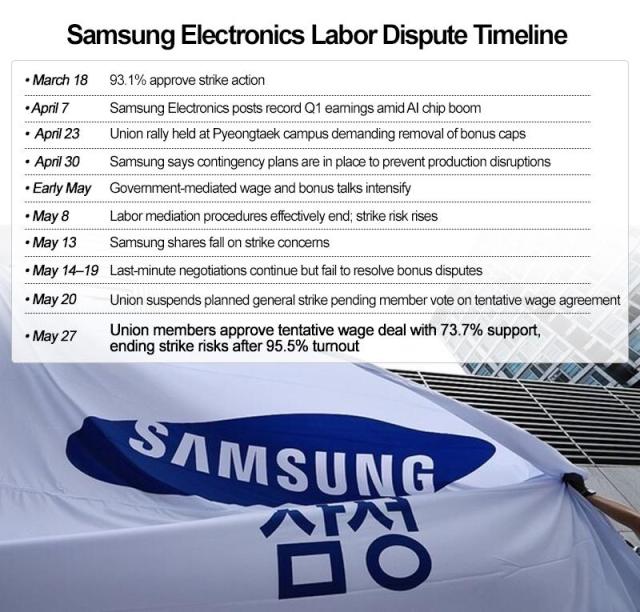
Management and labor formally signed the 2026 wage agreement after union members approved the deal by 73.7 percent, with turnout reaching 95.5 percent, ending months of escalating tensions that had threatened Samsung’s first large-scale strike.
Following the signing ceremony in Giheung, Gyeonggi Province, Samsung executives issued a rare joint statement apologizing for the labor unrest and unveiling a 5 trillion won support package for smaller suppliers, AI talent development and inclusive financing programs.
The extravaganza, however, appeared hastily assembled to paper over the deep internal fractures exposed during the negotiations.
At the center of the conflict was a widening disparity in performance bonuses between the highly profitable Device Solutions (DS) semiconductor division and the Device eXperience (DX) division, which oversees mobile and consumer electronics businesses.
The deal mostly rewards chipmakers – up to 600 million won through special boon-tied bonus, while non-memory workers get 6 million at best. An estimated 74,000 of the chip division is expected to collect the special bonus, costing the company over 40 trillion won – most of what the company has earned in the first quarter.
Samsung Electronics earned 57.2 trillion in operating profit in the first quarter, of which 53.7 trillion won came from the chip division.
After 93.1 percent of unionized workers approved strike action in March, tensions peaked in April with large-scale rallies demanding the removal of bonus caps. A tentative agreement was reached late on May 20, only hours before a planned general strike.
But the relief quickly gave way to another round of infighting.
A surge of disgruntled DX employees joined the minority Samsung Electronics Co. Union (SECU), swelling its membership to around 12,000. The representative majority union then stripped SECU members of voting rights on May 21, prompting the smaller union to seek a court injunction Tuesday.
Management experts say preventing future labor crises will require Samsung to fundamentally overhaul its compensation structure, replacing opaque and ad hoc bonus decisions with transparent and predictable standards.
Hwang Yong-sik, a business administration professor at Sejong University, said the essence of a performance-based reward system lies in predictability and motivation.
“The necessity of predictability is to ensure employees are motivated, immersed in their work and driven to produce results. That is the true purpose and essence of a performance bonus system,” Hwang told AJP.
Addressing calls from some employees to structurally separate Samsung’s divisions to resolve bonus inequities, Hwang dismissed the idea as unnecessary for a diversified conglomerate.
“There is no need to physically separate the organization to achieve equality,” he said. “As long as the company sets clear standards that bonuses are paid according to each business unit’s performance — meaning if the DX division generates strong operating profits in the future, it receives corresponding rewards — there should be no major issues.”
While Samsung has stepped back from the brink of a strike, the bigger challenge now lies in repairing trust within an increasingly divided workforce and building a compensation framework capable of sustaining cohesion during the intensifying global AI and semiconductor race.

Copyright ⓒ Aju Press All rights reserved.