

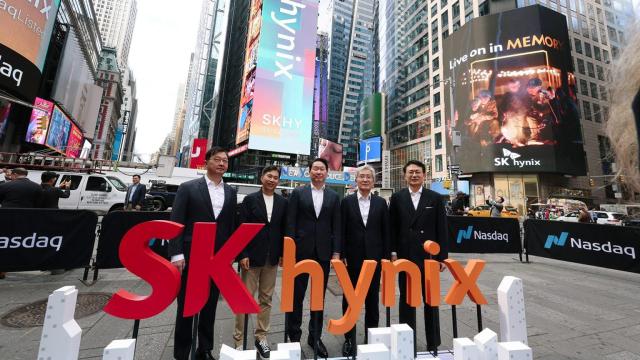
SEOUL, July 12 (AJP) -Korean chipmakers are fastening investment to expand next-generation semiconductor facilities in South Korea under a government-led initiative to cement the country's leadership in the AI era, a drive that is expected not only to reinforce economic growth but also provide rare support for the stubbornly weak won through an influx of dollar earnings from booming chip exports and the proceeds of SK hynix's blockbuster Nasdaq stock offering.
The investment acceleration comes as semiconductors have become the single biggest engine of South Korea's economy. Chip exports accounted for nearly 40 percent of the country's record first-half exports, which approached $500 billion, underscoring how closely the nation's trade performance, currency and industrial competitiveness have become intertwined with the fortunes of its semiconductor sector.
The latest catalyst arrived on Friday when SK hynix completed a $26.5 billion American depositary receipt (ADR) offering on Nasdaq, the second-largest equity offering in U.S. market history and the largest ever by a foreign company. The proceeds will be paid to the company on July 14 and are expected to translate into one of the largest inflows of U.S. dollars into the Korean financial system in years.
Unlike export earnings that many Korean companies increasingly retain overseas to fund global operations, most of the ADR proceeds are earmarked for domestic capital spending.
SK hynix plans to use the funds to accelerate construction of its Yongin semiconductor cluster, expand its advanced P&T7 packaging facility in Cheongju, purchase extreme ultraviolet lithography equipment and invest in other AI memory manufacturing infrastructure in South Korea.
While part of the proceeds will remain in foreign currency for equipment purchases such as ASML tools, a substantial portion is expected to be converted into won as construction and domestic investment proceed.
The $26.5 billion raised exceeds the roughly $19.9 billion actually drawn under the Bank of Korea's dollar swap line with the U.S. Federal Reserve during the height of the COVID-19 financial crisis and approaches the average daily turnover of the domestic spot foreign-exchange market.
Analysts expect the company to sell dollars gradually from the second half of July through August and September to minimize market disruption, providing a steady source of dollar liquidity at a time when the won has remained under pressure from strong overseas investment by Korean investors and persistent global dollar strength.
The U.S. dollar has averaged above 1,500 won in June for the first time since Asian currency crisis in late 1990s and remains above the level.
The fundraising also comes as Seoul and the industry's two memory champions dramatically accelerate the timetable for Korea's next semiconductor production base.
Samsung Electronics has advanced the roadmap for its Yongin National Semiconductor Industrial Complex, targeting operation of its first fabrication plant in 2029, one to two years earlier than previously planned.
The top DRAM maker agreed with the government to bring forward the overall development schedule for the cluster, with completion of the final fab now targeted for 2040, seven years ahead of earlier plans.
SK hynix is moving even more aggressively. The company and the government agreed to complete its Yongin semiconductor cluster by 2035 instead of the previous 2047 target, shortening the project by 12 years.
Chairman Chey Tae-won also unveiled plans to accelerate investments of 600 trillion won in Yongin to expand DRAM production and 100 trillion won in Cheongju to boost NAND capacity, positioning the company to meet surging global demand for AI memory.
Copyright ⓒ Aju Press All rights reserved.
