
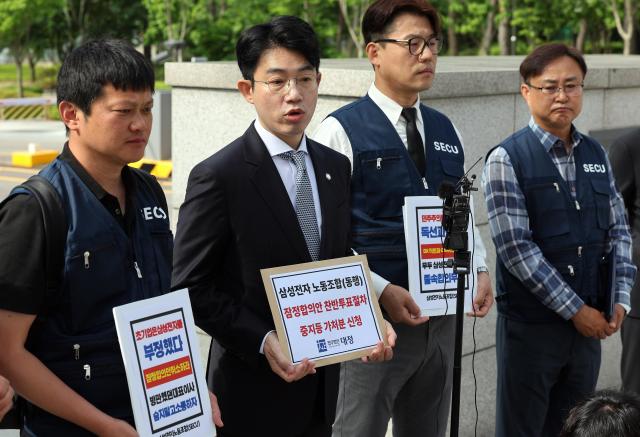
SEOUL, May 26 (AJP) - A labor union representing Samsung Electronics' Device eXperience (DX) division filed a court injunction on Tuesday to halt an ongoing vote on a tentative wage agreement, highlighting a deepening internal conflict among the tech giant's labor groups.
The "Donghaeng" union submitted the request to the Suwon District Court, accusing the larger "Enterprise Union" of unlawfully stripping its members of their voting rights.
During a press conference ahead of the filing, Donghaeng representatives stated that the larger union abruptly revoked their voting rights on the evening of May 21, shortly after repeatedly asking them to participate in the vote. The minority union argued that excluding a participating member of the joint bargaining group is legally impermissible.
Donghaeng claims the exclusion stems from the larger union's concerns over the DX division's growing influence. Membership in the Donghaeng union has recently surged from approximately 2,600 to over 13,000.
The likelihood of the court intervening in time appears low, as the voting period is set to close on Wednesday. A court hearing would need to take place on Tuesday, a timeline legal observers note is practically difficult. However, Donghaeng representatives expressed hope that the court might expedite the process given the urgency of the matter.
If the voting concludes before a court ruling is issued, the Donghaeng union plans to file a separate injunction to suspend the validity of the finalized agreement.
The legal action underscores a growing "union-versus-union" dispute within Samsung Electronics, as non-memory and DX employees actively campaign to reject the tentative wage deal.

Candice Kim
Candice Kim is a dedicated business and technology reporter specializing in the intersection of high-tech innovation and fast-paced consumer trends. Her core beats span the semiconductor, IT, cosmetics, and retail sectors, where she provides in-depth coverage of industry titans including Samsung Electronics, SK hynix, and LG Electronics, alongside leading consumer brands like Olive Young and Musinsa. Whether analyzing complex silicon supply chains or tracking the latest shifts in beauty and fashion retail, Candice is committed to delivering sharp, accurate reporting that keeps readers informed on the forces shaping today's most dynamic markets.
Copyright ⓒ Aju Press All rights reserved.
Related News
-
 AJP Watch: Samsung's 'fixed stock bonus' deal sends shockwaves across chip sector and supply chain
Members of the Samsung Electronics Labor Union hold a rally on April 23 2026 in front of the Pyeongtaek campus. AJP Han Jun-gu SEOUL, May 25 (AJP) - Samsung Electronics’ tentative wage agreement is nearing ratification with near-record union turnout, crystallizing a new dilemma in the AI era: how far semiconductor giants can go in sharing windfall profits before it begins to strain investment capacity, deepen social divisions and unsettle global competitors. The deal can avert an immediate strike that threatened to disrupt the memory supercycle underpinning South Korea’s exports and stock rally. But the agreement’s centerpiece — a fixed stock-based profit-sharing structure tied directly to operating profit — is now reverberating far beyond Samsung’s Suwon campuses, unsettling shareholders, stirring resentment across Samsung affiliates and increasingly drawing attention from rival chipmakers abroad, particularly TSMC in Taiwan. As of Sunday afternoon, turnout for the union ratification vote had exceeded 84.6 percent, according to industry sources, with approval widely expected when voting concludes Wednesday. The unusually strong participation reflects how profoundly the agreement could reshape compensation expectations across Asia’s semiconductor sector. At the heart of the controversy is Samsung’s newly introduced “special management performance bonus,” which guarantees employees stock compensation equivalent to 10.5 percent of a business division’s operating profit. While performance-linked bonuses are common globally, industry analysts say institutionalizing a fixed percentage inside a labor agreement marks a sharp departure from prevailing international practices, where boards typically retain discretion to balance compensation against strategic investment needs. Foreign brokerages have already begun flagging concerns. Citi analyst Peter Lee warned of “downside risks to earnings due to bonus-related provisions amid escalating labor strikes,” lowering operating profit projections for Samsung Electronics. The timing is especially sensitive. AI-driven demand has triggered one of the most capital-intensive cycles in semiconductor history. TSMC plans as much as $56 billion in capital expenditure this year, while Micron Technology has pledged more than $25 billion for fiscal 2026 in addition to a $100 billion long-term megafab investment in New York. Samsung itself has earmarked more than 110 trillion won ($81 billion) for research, development and facility expansion this year alone. Analysts caution that locking in fixed double-digit profit-sharing formulas could eventually constrain Samsung’s flexibility in funding next-generation high-bandwidth memory (HBM), advanced packaging and foundry expansion at a time when competition against TSMC, Micron and SK hynix is intensifying. Unlike traditional industrial cycles, the AI infrastructure race increasingly rewards companies capable of reinvesting enormous sums with speed and consistency. The ripple effects are no longer confined to South Korea. The turbulence inside Samsung’s semiconductor complex in Suwon is now reverberating through Hsinchu, Taiwan’s chipmaking hub. Employees at TSMC — the world’s most critical contract chip manufacturer supplying firms from Nvidia and Apple to Tesla — have grown increasingly vocal over their own compensation structure after reports emerged that performance bonuses could be reduced to offset the mounting costs of building 12 overseas fabrication plants. Despite TSMC posting a 58 percent year-on-year jump in first-quarter net profit, frustration has reportedly spread across anonymous employee forums. According to Taiwan’s Liberty Times, workers explicitly referenced Samsung’s labor negotiations while criticizing TSMC management. Some posts complained that “the company changes everything on a whim,” while others openly discussed the possibility of collective action, writing: “It’s time we strike too,” and “May 27 will be the real turning point.” TSMC's fabrication plant in Hsinchu, Taiwan/ REUTERS-Yonhap For decades, Asian semiconductor champions largely maintained an implicit social contract: workers accepted grueling hours and hierarchical cultures in exchange for stability, prestige and gradual prosperity. Samsung’s new fixed-profit-sharing model threatens to reset those expectations. Workers across the sector are increasingly asking why extraordinary AI profits should remain concentrated at the corporate level while employees shoulder intense workloads and geopolitical uncertainty. At the same time, investors and executives fear the opposite risk — that institutionalized profit-sharing could gradually erode the massive capital discipline required to sustain semiconductor leadership. The agreement is also exposing widening internal fissures inside Samsung Group itself. Under the proposed structure, employees in Samsung Electronics’ memory business could receive roughly 600 million won ($438,000) in annual bonuses if operating profit reaches 300 trillion won, including both the new stock-based incentive and existing excess profit-sharing payments. Even loss-making non-memory semiconductor divisions such as System LSI and foundry operations would reportedly receive more than 200 million won in combined bonuses through shared Device Solutions division funding pools. That has triggered growing frustration across Samsung affiliates including Samsung Display, Samsung SDI and Samsung Electro-Mechanics, where employees complain of widening disparities despite their own operational contributions. Internal discontent has become severe enough that employees increasingly use the self-deprecating nickname “Samsung huja” — implying second-tier Samsung workers — to describe themselves. The contrast is stark even within the conglomerate. Samsung Display recorded a 6.2 percent wage increase this year, Samsung Electro-Mechanics 5.9 percent and Samsung SDI 4 percent, while their bonus formulas remain tied to the older Economic Value Added (EVA) framework instead of operating profit. The spillover is beginning to reshape labor expectations across the broader Samsung empire. Samsung Display’s union plans to negotiate an alternative compensation structure later this year, while Samsung Electro-Mechanics is reviewing whether to shift its OPI formula toward either EVA-based 20 percent calculations or operating profit-linked 10 percent formulas similar to Samsung Electronics. Industry observers warn the agreement could embolden labor activism across major Korean corporations. Samsung Biologics unions are already engaged in strike action, while Samsung C&T reportedly raised planned wage increases to avoid similar disruptions. The social implications extend far beyond Samsung. According to Leaders Index, employees at South Korea’s top 211 companies earned an average annual compensation package of 102.8 million won last year including bonuses. Across all Korean businesses, the average worker earned about 50.61 million won annually, according to the Korea Enterprises Federation. Under Samsung’s new structure, some semiconductor employees could effectively receive compensation equivalent to the annual salaries of more than a dozen ordinary workers in a single year. The widening divide reflects how the AI boom is concentrating extraordinary wealth into a narrow segment of strategic industries. What was once primarily a technological race is increasingly becoming a political and social challenge as governments, unions and corporations struggle to redefine compensation norms during the transition into the AI economy. For Samsung, the immediate crisis may have been contained. Production lines continue operating, investors have avoided the shock of an 18-day strike and the AI memory cycle remains intact for now. But the agreement may ultimately prove to be more than a labor settlement. It could become an early test case for how democracies, corporations and workers negotiate the distribution of AI-era wealth — and whether the race for technological supremacy can coexist with mounting demands for economic equity without weakening the enormous reinvestment needed to sustain the boom itself.
-
 The Rise of AI Semiconductor Dominance: How South Korea and Taiwan Became Global Leaders
The global economy in 2026 revolves around three semiconductor giants: South Korea's Samsung Electronics and SK Hynix, and Taiwan's TSMC. While oil, automobiles, steel, and finance shaped the 20th century, the core drivers of civilization are now shifting towards artificial intelligence (AI) and semiconductors as we move toward the mid-21st century. AI is not just an industry; it is a new civilizational infrastructure that reshapes military, diplomatic, economic, educational, medical, cultural, financial, administrative, and energy systems. At the heart of this AI civilization are GPUs (graphics processing units), HBM (high bandwidth memory), advanced foundries, and cutting-edge processes. While U.S. tech giants are developing AI platforms, the essential hardware that powers these AIs is supplied by South Korea and Taiwan. If the U.S. controls the design and operating systems of AI, South Korea and Taiwan hold the memory and production heart of this new civilization. Today, semiconductors are the strongest pillar of the South Korean economy, with Samsung Electronics and SK Hynix at the center. Together, their market capitalizations account for about 45% of the entire South Korean stock market. This indicates not just the size of these two companies but also their deep connection to the structure of the South Korean capital market, the returns of the national pension, retirement funds, ETFs, individual investors' assets, exchange rates, exports, tax revenues, employment, and even national growth rates. Samsung Electronics is a representative national stock with approximately 5 million individual shareholders. Considering family units, a significant portion of the South Korean population is directly or indirectly linked to Samsung Electronics. SK Hynix has also emerged as a leader in HBM for the AI era, transforming from a memory company into a key player in the global AI supply chain. Taiwan's TSMC has reached the top in a different way. TSMC is the world's strongest foundry, not a memory producer. Most advanced chips from major global AI and IT companies like NVIDIA, Apple, AMD, Broadcom, and Qualcomm rely on TSMC's production capabilities. TSMC is not just a manufacturing company; it is the central hub of the world's cutting-edge technology production system. TSMC accounts for about 35-40% of the Taiwanese stock market, and it is difficult to explain Taiwan's exports, investments, exchange rates, growth rates, and national security without referencing TSMC. Thus, the Taiwan Strait issue is not merely a territorial conflict; it is underpinned by the strategic value of TSMC, often referred to as the 'Silicon Shield.' If TSMC falters, the entire global AI industry and advanced supply chain could be at risk. However, the true competition for dominance in AI semiconductors is not determined solely by market capitalization or technological prowess. More crucial is how profits are distributed, reinvested, how talent is retained, and how the balance between shareholders, employees, and the national economy is designed. Recently, the controversy over performance bonuses at Samsung Electronics and SK Hynix has gained attention for this reason. In a tentative wage negotiation agreement for 2026, Samsung proposed allocating 10.5% of its operating profit for special management performance bonuses. SK Hynix also agreed to allocate 10% of its operating profit for employee performance bonuses after union pushback. Employees may justifiably demand to share in the profits when the company performs well. The semiconductor industry operates under extreme pressure, with relentless research and development and production. It is undeniable that engineers, researchers, and production workers are the core of the company's competitiveness. The challenge lies in the nature of the semiconductor industry as a long-term investment sector. Profits earned during boom periods must be used to endure downturns and prepare for next-generation processes. Missing an investment cycle can lead to a widening technology gap, which is not easily closed. Both memory and foundry sectors require tens of trillions of won in capital investment, long-term research and development, yield assurance, and customer trust to survive. Allocating a fixed percentage of operating profit to performance bonuses may enhance short-term predictability of compensation but could weaken long-term investment capacity. Particularly concerning is the forecast that if the AI semiconductor supercycle materializes, Samsung Electronics and SK Hynix could face performance bonus burdens in the tens of trillions of won or more. Meanwhile, competitors are currently channeling cash into investments. U.S. Micron is significantly increasing its capital expenditures this year and is constructing large production facilities, including the Clay mega-fab in New York. TSMC is also expanding its capital investments to as much as $56 billion, approximately 85 trillion won, broadening its production bases not only in Taiwan but also in the U.S. and Europe. If Samsung and SK Hynix distribute tens of trillions of won in bonuses while competitors use that money to build factories and acquire equipment for next-generation production capabilities, immediate labor peace could lead to long-term competitive weakness. In semiconductors, investment equates to future market share. Today's cash distribution influences tomorrow's technological dominance. However, performance bonuses should not be dismissed. The key is to share performance while establishing more refined and transparent criteria. In the past, Samsung Electronics and SK Hynix based their bonuses on economic value added (EVA), but there was significant dissatisfaction with the opaque calculation methods, leading to suspicions that the companies could arbitrarily adjust variables. Consequently, employees began demanding simpler and more intuitive operating profit-based criteria. The companies share responsibility here; if compensation criteria are not transparent, employees will not trust them. However, simplicity does not always equate to a good system. Basing bonuses solely on operating profit could overlook essential factors such as investment, cash flow, shareholder returns, future competitiveness, and contributions to research and development. Global tech giants and semiconductor companies generally reflect company performance, individual contributions, long-term stock performance, and strategic contributions in their compensation structures. TSMC has a guideline to allocate at least 1% of operating profit for performance bonuses, but the specific amount is determined by a committee of outside directors reviewing the year's performance. Last year, TSMC reportedly distributed performance bonuses totaling approximately 206.1 billion Taiwanese dollars, around 9.6 trillion won, to over 90,000 employees. This amount corresponds to about 10% of operating profit, but it is not a fixed formula; rather, it combines the board's and committee's judgments. U.S. companies also utilize not only cash bonuses but also restricted stock units, stock options, and long-term incentives. By granting shares to key talent over several years, they link employee compensation to the company's long-term stock performance. This is not merely compensation but a system that combines talent retention, shareholder value, and long-term strategy. Samsung's decision to offer performance bonuses in the form of company stock rather than cash, with some sale restrictions, represents a significant change. SK Hynix is also operating a shareholder participation program that allows employees to receive part of their bonuses in company stock. However, this alone is not sufficient. For stock-based compensation to become a true long-term reward system, it must reflect sale restrictions, long-term performance criteria, research and development outcomes, shareholder returns, investment capacity, and cash flow. While it is desirable for employees to become owners of the company, if it weakens the company's future investment capacity, it risks becoming a short-term distribution logic rather than a genuine ownership mentality. It is noteworthy that this controversy has expanded into discussions about shareholder loyalty obligations. Operating profit is not solely the employees' share; it encompasses the risks of shareholders' capital, taxes for the state, the ecosystem of partner companies, future investment resources, and funds for downturns. A company is a product of labor and a combination of capital, technology, and market trust. Therefore, the issue of allocating a fixed percentage of operating profit ahead of taxes, investments, dividends, and research and development cannot be resolved solely through labor-management agreements. At a minimum, transparent procedures and explanations that the board, shareholders, and market can accept are necessary. This is not an argument to neglect labor; rather, it is a necessary mechanism for sustainable performance sharing. If Samsung Electronics and SK Hynix are the heart of the South Korean economy, that heart must not only beat strongly but also endure over time. If profits are shared during boom periods but investment capacity diminishes during downturns, the competitive edge cannot be maintained. The semiconductor industry is not one that ends with a single boom. The future battlefield will be much broader, encompassing AI servers, HBM, next-generation DRAM, NAND, foundry, packaging, glass substrates, power semiconductors, and on-device AI. What is needed now is a national strategic compensation system that transcends labor-management conflicts. A balance is required that provides fair compensation to employees, predictable returns to shareholders, sufficient investment capacity for the company, and a sustainable industrial foundation for the nation. The United States is well aware of this structure. That is why the CHIPS Act aims to attract Samsung and TSMC to American soil. The U.S. strategy is not merely about attraction; it seeks to incorporate advanced semiconductor production capabilities into its national security framework to maintain AI dominance. China is pursuing a similar path, attempting to achieve self-sufficiency in AI chips centered around Huawei and pouring massive funds into domestic production of memory and foundry. Japan is also dreaming of reviving advanced foundry capabilities led by Rapidus and turning its strengths in materials, equipment, and precision chemicals back into strategic assets. The U.S. is organizing alliances, China is pursuing self-sufficiency, and Japan aims to dominate the supply chain. In this vast landscape, South Korea holds two jewels: Samsung Electronics and SK Hynix. Therefore, South Korea's tasks are clear. First, it must maintain a competitive edge in HBM and next-generation memory. Second, it must continue to challenge in foundry and advanced packaging. Third, it must transparently and long-term adjust labor-management compensation systems to global standards. Fourth, it must establish governance that is acceptable to the national pension, individual shareholders, employees, and partner companies. Fifth, it must treat semiconductors not merely as an export industry but as a national security industry. The 19th century was the era of Britain, and the 20th century was the era of the United States. The world in the mid-21st century stands before a new question: Where is the core production base of AI civilization? The answer is becoming increasingly clear. It is Northeast Asia, where South Korea, Taiwan, Japan, and China converge. While military power remains overwhelmingly in the hands of the United States and finance is still dominated by the dollar, the key axis of AI semiconductor production is pulsing in East Asia. Samsung Electronics and SK Hynix supply the memory for AI, while TSMC produces its brain. These three companies are not just private enterprises; they are strategic assets supporting the foundation of the global digital economy. If oil moved the 20th century, semiconductors are driving the 21st-century civilization. The heart of that semiconductor industry is now beating in South Korea and Taiwan. However, no matter how strong the heart, if it misuses its resources, the body cannot endure for long. The performance bonus controversy at Samsung Electronics and SK Hynix is thus not merely a wage issue; it is a national question about how South Korea will share, invest, and preserve the wealth generated in the AI era for future generations. The answer does not lie on one side. There is no technology without labor, no competitive edge without investment, and no capital market without shareholder trust. Now, South Korea's semiconductor industry must answer a larger question: How to share today's achievements without losing tomorrow's dominance. This must become the new common sense of South Korea in the AI semiconductor era.* This article has been translated by AI.
-
 Samsung faces pressure from shareholders amid union vote on tentative deal
Samsung's headquarters is seen in southern Seoul, in this photo taken on May 22, 2026. Yonhap SEOUL, May 24 (AJP) - Samsung Electronics has allowed access to its register of shareholders. It comes amid growing opposition from some retail investors over a last-minute, tentative deal between management and its labor union last week that averted an 18-day strike but sparked fresh controversy over how the electronics giant distributes its unprecedented profits, fueled by an artificial intelligence-driven chip supercycle. ACT, a platform for retail shareholders, said Samsung accepted its request to review and copy the register just two days after it was filed. The group is expected to carry out the review at Samsung Electronics' headquarters in southern Seoul later this week. The unusually swift approval gives ACT access to the register, which contains ownership details as well as voting rights and dividend eligibility, allowing the group to pursue coordinated shareholders' action at South Korea's largest listed company by market capitalization. Under South Korean law, shareholders have the right to request access to such records, a step often used as a starting point for collective action. The request was made after the company's tentative wage and bonus-related arrangements raised questions about whether shareholders were receiving a fair share of the company's profits. Once access to the register is completed, the group plans to contact institutional and retail investors, even those holding a minimum number of shares, to seek support for collective action. ACT plans to contact domestic and foreign investors holding over 6,735 Samsung shares, aiming to collectively reach the 1.5-percent threshold required under South Korean law to call an extraordinary shareholders' meeting. To qualify, shareholders must have held their shares for at least six months. The core concern centers on a bonus structure that allocates a fixed share of operating profit to bonus payments, which critics say could come at the expense of dividends and broader shareholder returns, infringing on their interests. ACT argues that while management can hand out one-off bonuses at its discretion, a permanent profit-sharing arrangement of this kind is significant enough that shareholders should have a say. ACT's push comes as Samsung union members are in the middle of a weeklong vote on whether to accept the tentative deal, putting the company under simultaneous pressure from both labor and shareholders. With voting set to close on Wednesday, more than 80 percent of the 57,290 eligible voters out of about 70,505 union members had already voted, raising the likelihood that the deal would pass, with members of the memory division accounting for the largest share at around 24,000, followed by roughly 17,000 from the non-memory business and about 22,000 from other divisions. For the deal to pass, more than half of eligible voters must participate and a majority must vote in favor.