
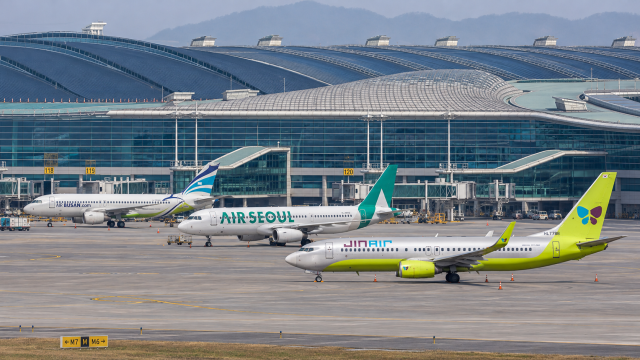
Busan Mayor Chun Jae-soo and Hanjin Group Chairman Cho Won-tae reached an agreement Thursday to establish the combined carrier's headquarters in the southeastern port city. The airline is scheduled to launch on March 17, 2027, under the Jin Air name.
"Starting with the relocation of its headquarters to Busan, the integrated Jin Air plans to work with the city to develop Gimhae International Airport into its second hub and actively cooperate to revitalize the regional aviation industry and economy," Jin Air said in a statement to AJP on Thursday.
"We plan to continue discussions on all remaining details."
In a separate phone interview with AJP, a Jin Air official declined to elaborate on the reasons behind the selection of Busan, saying the company was not yet in a position to provide details beyond its official statement.
The decision comes ahead of the Dec. 17 launch of the integrated Korean Air, six years after the airline announced its 1.8 trillion won ($1.3 billion) acquisition plan for Asiana Airlines in November 2020.
The consolidation also extends to their low-cost subsidiaries. Jin Air operates under Korean Air, while Air Busan and Air Seoul are subsidiaries of Asiana Airlines.
"As Korean Air and Asiana Airlines merge, their subsidiaries are being brought together as well," the Jin Air official told AJP, explaining that the LCC merger is part of the broader post-merger integration process.
The Ministry of Land, Infrastructure and Transport approved the merger of the three budget carriers on Nov. 12.
The combined carrier will have a fleet of 60 aircraft and approximately 4,200 employees, with annual revenue projected to reach around 3 trillion won in its first year of operation.

Under Jin Air's integration plan, international routes from Gimhae International Airport will increase from 28 to 33, while weekly international flights will rise from 281 to 339.
Employment has also emerged as a key issue in the integration process.
Jin Air's pilots' union on Thursday called on management to ensure that employees based in Seoul would not face deteriorating working conditions or other disadvantages as a result of the headquarters relocation.
The integration plan submitted to the transport ministry includes commitments to retaining existing employees and avoiding forced restructuring.
Busan also seeks to link the carrier's expansion with the development of Gadeokdo New Airport, strengthening the city's role as an aviation hub in southeastern South Korea.
The move comes as Busan is gaining popularity as an international tourist destination. According to the city government, Busan welcomed 3.93 million foreign visitors in the first nine months of 2026, up 47 percent from a year earlier and already surpassing the 3.64 million recorded in all of 2025.
The number of foreign nationals entering South Korea directly through Gimhae International Airport and the Port of Busan also rose 52.7 percent to 2.33 million during the same period, highlighting growing demand for direct international access to the city.
While the headquarters location has been confirmed, details regarding the relocation schedule, staffing arrangements and the scope of corporate functions to be transferred to Busan remain subject to further discussions.

Kim Hee-su
Kim Hee-su is a bilingual reporter at AJU Press, covering defense and foreign affairs. Before joining AJP in 2025, she worked at The Korea Times, where she wrote interview stories, including a profile of North Korean defector Kim Gum-hyok, and produced digital content. She also previously worked as a researcher for KBS News 9’s International News Department, supporting correspondents in 10 countries around the world. She graduated from the University of Toronto in Canada with a double major in Book and Media Studies and East Asian Studies.
Copyright ⓒ Aju Press All rights reserved.
Related News
-
 Jin Air Holds Uniform Fitting Event with Air Busan and Air Seoul Employees
Jin Air conducted a uniform fitting event for employees of Air Busan and Air Seoul. On November 25, Jin Air announced that employees from the three companies had the opportunity to try on Jin Air uniforms in advance. The event was organized to enhance a sense of belonging and unity as one team. The event was held in two locations: Busan and Seoul. In Busan, the fitting for Air Busan employees will take place over approximately six weeks, from November 23 to December 31. In Seoul, the fitting for Air Seoul and Air Busan employees will be conducted over about four weeks, from December 7 to December 31. The uniforms being worn were designed based on feedback from frontline employees since July 2019. They incorporate materials that offer excellent stretch and breathability, and the designs consider the specific job characteristics of different roles to enhance practicality and comfort. Notably, the cabin crew uniform has expanded clothing options by adding skirts to the existing jeans, taking into account the working environment and personal preferences. A Jin Air representative stated, "We hope this fitting event serves as an opportunity for employees of the three companies to wear the same uniform and become one team. We will ensure that all members naturally integrate after the merger to provide consistent safety and service to our customers." Meanwhile, Jin Air plans to absorb and merge with Air Busan and Air Seoul for integrated operations starting March 17 of next year.* This article has been translated by AI.
-
Jin Air Joins Competition for Free In-Flight Wi-Fi Following Korean Air and Asiana
South Korea's low-cost carrier Jin Air will introduce the satellite internet service Starlink. The competition for high-speed free in-flight Wi-Fi has intensified as it expands from major airlines like Korean Air and Asiana to low-cost carriers.According to the airline industry on November 17, Jin Air plans to implement SpaceX's low-orbit satellite internet service Starlink next month. Starlink utilizes satellites positioned in low Earth orbit to provide high-speed internet access on aircraft. It offers faster communication speeds and lower latency compared to existing paid in-flight Wi-Fi, and its free availability has led to high customer satisfaction.In South Korea, Korean Air and Asiana Airlines first introduced Starlink on long-haul flights to the United States and other destinations on September 15. They have since increased the number of aircraft equipped with the service from 14 to 42. This means that 20.2% of their total fleet of 208 aircraft have adopted Starlink.The Hanjin Group has announced plans to sequentially introduce Starlink to Air Busan and Air Seoul, which are set to merge with Jin Air in the future. As a result, low-cost carriers that have been hesitant to adopt free in-flight internet services are now taking action.Multiple low-cost carriers, including Trinity Airlines, Jeju Air, Eastar Jet, and Parata Airlines, are also considering the introduction of free in-flight Wi-Fi services. New carriers are expected to emerge as early as the first half of next year.The push for airlines to expand and consider free internet services is driven by fierce competition for passenger acquisition. In particular, low-cost carriers face a structure where fare differences between routes are minimal, making it difficult to secure a competitive advantage based solely on price.According to the Financial Supervisory Service's electronic disclosure system, the average fare per international passenger for the third quarter of this year (including seat sales and fuel surcharges) was 175,946 won for Jin Air and 177,000 won for Jeju Air, showing little difference. Trinity Airlines, which has a higher proportion of long-haul routes, reported a higher fare of 222,133 won. With similar fare levels, the market analyzes that Jin Air is seeking differentiation through in-flight convenience services.Kim Kwang-ok, a professor at Korea Aerospace University, stated, "For Jin Air, in the context of fierce competition among low-cost carriers with similar fares and flight times, in-flight Wi-Fi is a differentiating factor that passengers can immediately perceive. It can be seen as a strategy to secure loyal customers by encouraging repeat boarding from those who have experienced it."* This article has been translated by AI.
-
 S. Korea approves merger of Jin Air, Air Busan and Air Seoul
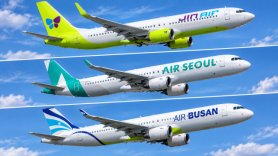
A composite illustration shows aircraft operated by Jin Air (top), Air Seoul (middle) and Air Busan (bottom), which are set to merge into a single low-cost carrier in March 2027. AI-generated image SEOUL, November 12 (AJP) - South Korea has approved the merger of three low-cost carriers — Jin Air, Air Busan and Air Seoul — clearing a major regulatory hurdle ahead of their planned integration in March 2027. The Ministry of Land, Infrastructure and Transport said Thursday it had granted conditional approval for the merger, requiring the airlines to strengthen flight safety systems and implement consumer protection measures. The Fair Trade Commission (FTC) also approved the merger, concluding that it was unlikely to restrict competition because all three airlines already belong to Hanjin Group. The approvals follow clearance from Vietnam's Competition Commission last month, completing the domestic and overseas competition reviews required for the merger. Jin Air aims to launch the integrated airline on March 17, 2027, pending approval at an extraordinary shareholders' meeting and the issuance of a unified Air Operator Certificate (AOC). Under the ministry's conditions, Jin Air must complete safety inspections related to changes in its operating systems and obtain necessary approvals from foreign aviation authorities before the merger takes effect. The airline must also submit monthly progress reports on its safety and consumer protection commitments. As part of the integration, Jin Air submitted a plan to develop Busan into its second aviation hub, expanding international operations at Gimhae International Airport. The airline plans to increase international routes from 28 to 33 and weekly flights from 281 to 339 following the merger. The ministry said it would closely monitor the integration of Korean Air's full-service and low-cost airline subsidiaries to ensure flight safety and consumer convenience. It also plans to consider measures to strengthen competition among other low-cost carriers as Korean Air's aviation group expands.