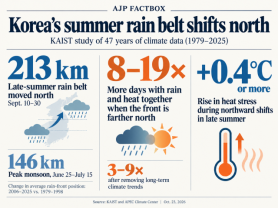
SEOUL, July 12 (AJP) — South Korea has officially entered what meteorologists increasingly describe as the era of extreme summer, with authorities activating the country's highest-ever heat alert for the first time as scorching temperatures spread well beyond their traditional hotspots.
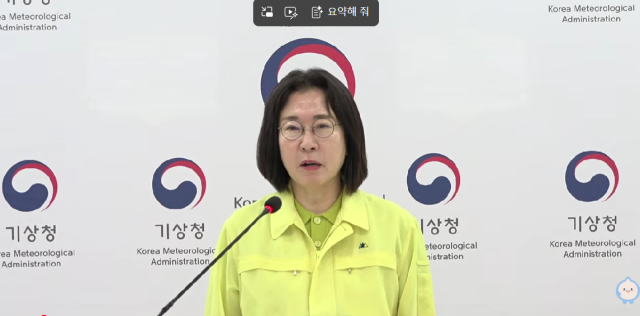
The Korea Meteorological Administration on Sunday issued its inaugural Heat Wave Emergency Warning for Pohang and Gyeongsan after apparent temperatures were forecast to exceed 38 degrees Celsius following days of persistent heat. The warning, introduced only this year, sits above the country's long-standing two-tier advisory system and reflects a simple reality: conventional heat warnings are no longer sufficient for increasingly dangerous summers.
The milestone carries significance beyond a single forecast. It illustrates how South Korea's summer climate is evolving from periodic heat waves into longer-lasting and geographically broader episodes of extreme heat, mirroring changes already observed across Europe, North America and other parts of Asia.
The nickname "Daefrica" — a blend of Daegu and Africa — once captured Korea's summer geography. For decades Daegu's basin topography made it synonymous with the country's most oppressive heat.
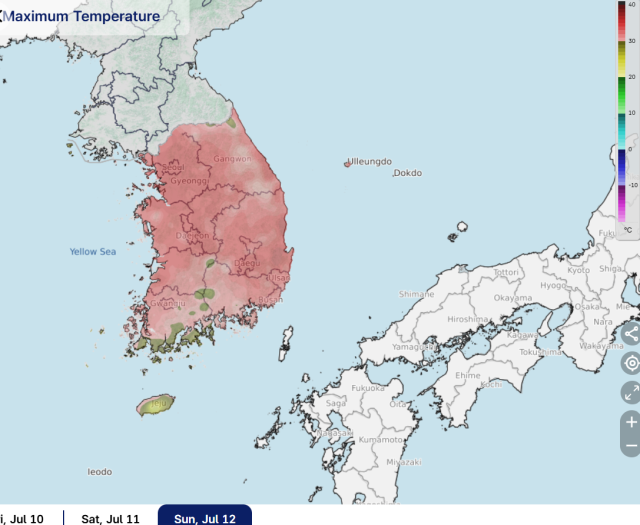
That map is changing.
Record temperatures are now being registered across inland North Gyeongsang Province and along the country's eastern coastline. Uiseong reached 40.4 degrees Celsius in August 2018, surpassing Daegu's famous 40-degree record from 1942. Pohang, Gyeongju, Yeongdeok, Gumi, Uljin and other cities have repeatedly rewritten local temperature records over the past several summers.
Rather than one exceptionally hot city, meteorologists increasingly describe an expanding belt of extreme heat stretching across much of southeastern Korea.
The first Emergency Warning itself reflects this shift. Instead of Daegu, authorities selected Gyeongsan and Pohang, acknowledging that dangerous heat is no longer confined to the country's traditional "furnace."
The transformation is not limited to hotter afternoons.
South Korea's tropical nights — when temperatures never fall below 25 degrees Celsius — are beginning earlier, lasting longer and covering wider areas than in previous decades.
Nighttime heat has emerged as one of the greatest public-health concerns because it prevents the human body from recovering from daytime exposure. The KMA this year expanded its tropical-night advisory system, recognizing that the health risks increasingly continue around the clock.
Scientists say nighttime temperatures worldwide are rising faster than daytime temperatures because greenhouse gases trap outgoing heat after sunset while expanding urban areas absorb and slowly release solar energy accumulated during the day.
Heat is becoming a health emergency
The new Emergency Warning is designed for conditions that authorities believe threaten healthy adults as well as traditionally vulnerable groups.
According to the Korea Disease Control and Prevention Agency, apparent temperatures above 38 degrees increase all-cause mortality among people aged 65 and older by 19 percent, while significantly raising cardiovascular risks.
As of Friday, 535 people had already suffered heat-related illnesses this year, with two reported deaths.
Officials are urging residents to suspend outdoor activities, move into air-conditioned environments and regularly check on elderly family members and neighbors.
South Korea's experience reflects a broader global shift.
The summer of 2026 has brought exceptional heat across large parts of Europe, North America, China and Japan, straining electricity grids, reducing agricultural output and increasing wildfire risks.
Climate researchers have repeatedly found that while no individual heat wave can be attributed solely to climate change, global warming substantially increases the probability, duration and intensity of extreme heat events.
The underlying physics is straightforward.
Rising greenhouse-gas concentrations increase average global temperatures. Warmer oceans add more moisture and energy to the atmosphere. High-pressure systems responsible for summer heat are becoming more persistent, while expanding cities amplify temperatures through the urban heat island effect as concrete, asphalt and buildings absorb solar radiation during the day and slowly release it after sunset.
South Korea combines several of these factors.
The Korean Peninsula has warmed faster than the global average over recent decades, according to government climate assessments. Rapid urbanization around Seoul and other metropolitan areas has intensified nighttime heat, while warmer surrounding seas contribute to higher humidity, pushing apparent temperatures well above measured air temperatures.
Perhaps the biggest change is psychological.
For generations, Koreans regarded heat waves as temporary interruptions to ordinary summer weather.
Increasingly, policymakers are treating extreme heat as a recurring national disaster comparable to floods, typhoons or heavy snowfall.
Around the world, countries are redesigning disaster response systems for an age in which heat is emerging as one of the deadliest weather hazards, and Korea has joined the growing list of nations adapting to summers that are becoming hotter, longer and increasingly hazardous.
Copyright ⓒ Aju Press All rights reserved.