
Journalist

Huan Xiang
-
 Korean arms gain strategic role as Southeast Asia balances US-China rivalry SEOUL, May 14 (AJP) - Southeast Asian countries are increasingly turning to South Korean weapons as they seek to modernize their militaries while navigating the intensifying rivalry between the United States and China. The trend is drawing growing attention as Washington expands its Indo-Pacific security operations beyond the Korean Peninsula and Japan, while Southeast Asian nations continue pursuing flexible defense ties with both major powers. According to industry sources, some U.S. Forces Korea units recently took part in multinational drills in the Philippines, an unusual move that underscored how U.S. assets stationed in South Korea could be used more flexibly for regional contingencies. The deployment followed remarks last month by Gen. Xavier Brunson, commander of the South Korea-U.S. Combined Forces Command and U.S. Forces Korea, who proposed a “kill web” concept linking South Korea, Japan and the Philippines through a cyber-based network for intelligence sharing and joint military operations during a contingency. At the same time, Thailand has moved to deepen military engagement with China while maintaining its long-standing defense relationship with the United States. China’s defense ministry said it would hold the “Assault 2026” joint exercise in Thailand this month, focusing on operations in mountainous and jungle terrain. The drills come as Thailand continues to participate in Cobra Gold, one of the region’s largest U.S.-led multinational exercises. A report by the Asan Institute for Policy Studies said South Korea’s advanced technology, its status as a “non-threatening power,” and its relatively neutral image have made it an attractive partner for Southeast Asian countries seeking to modernize their militaries. In that environment, South Korean weapons are emerging as a practical option for countries seeking advanced but relatively affordable systems that are not directly tied to either Washington or Beijing. Indonesia has been South Korea’s largest customer in Southeast Asia, accounting for 55 percent of defense exports to the region over the past two decades, according to an analysis by the International Institute for Strategic Studies. Jakarta has imported Korean-made T-50 and KT-1 trainer aircraft, as well as Jang Bogo-class submarines, while also participating in the KF-21 fighter development program. The relationship has evolved beyond simple arms purchases into broader technology cooperation and joint development. Philippines has also emerged as one of Seoul’s key defense partners, particularly as Manila seeks to strengthen its air and maritime capabilities amid tensions in the South China Sea. The Philippine military operates FA-50PH light attack aircraft and has moved to expand its fleet, with Korea Aerospace Industries signing a deal in 2025 to supply 12 additional FA-50 jets after its initial contract for 12 aircraft in 2014. South Korea has also supplied frigates and corvettes to the Philippine Navy, making Korean weapons a major component of Manila’s military modernization efforts. Thailand, while carefully balancing ties between the United States and China, has likewise adopted Korean-made defense systems. The Royal Thai Air Force operates the T-50TH, a Thai variant of South Korea’s T-50 advanced trainer and light attack aircraft, while the country has also acquired Korean-built naval assets. The reported use of Korean-made guided munitions during Thailand’s border clashes with Cambodia in 2025 highlighted how Korean weapons are no longer merely procurement items, but could increasingly become part of real-world regional security dynamics. Malaysia has expanded its purchases of Korean defense systems from aircraft to naval air defense platforms. Kuala Lumpur signed a deal in 2023 to acquire 18 FA-50M light combat aircraft from Korea Aerospace Industries, strengthening South Korea’s role in Malaysia’s air force modernization program. In April 2026, Malaysia also signed a contract worth about $94 million with LIG Defense & Aerospace to purchase the Haegung, or K-SAAM, ship-launched surface-to-air missile system, which is expected to be installed on three Malaysian Navy vessels. The agreement marked the first overseas sale of the Haegung system. IISS senior fellow Thomas Daniel said developing countries have long sought defense equipment compatible with Western systems, a demand that “the major players have overlooked.” However, he also pointed to a potential challenge for Seoul as global demand for Korean weapons rises, questioning whether Southeast Asian buyers, which typically place smaller orders, could be pushed “to the back of the line.” Vietnam has recently emerged as a new market for South Korean ground weapons, with bilateral defense cooperation reaching a symbolic turning point through the K9 deal. In 2025, Hanwha Aerospace signed a deal worth about $250 million to supply 20 K9 self-propelled howitzers to Vietnam, marking South Korea’s first arms export to the country. The deal is significant not only because Vietnam has long relied heavily on Russian weapons, but also because it reflects how two countries that were once adversaries during the Vietnam War are now moving toward a strategic defense partnership. Vietnam’s purchase of the K9 is also seen as part of a broader effort to diversify defense procurement sources amid growing uncertainty surrounding Russian supply chains. Ian Storey of Singapore’s ISEAS-Yusof Ishak Institute said South Korea has become an attractive option for Southeast Asian countries because Seoul offers advanced weapons at lower prices than Western suppliers and is more willing to transfer technology to support local defense industries. “South Korean arms are hi-tech and cheaper than Western defense equipment,” he said. Prashanth Parameswaran, a regional security analyst, said South Korea’s expanding security ties with ASEAN countries have created opportunities for Seoul but also pose challenges. While deeper defense cooperation gives South Korea room to expand its role as a regional security partner, it also exposes Seoul to the political risks of becoming more directly involved in Southeast Asia’s disputes and broader great-power competition. For Seoul, the question is whether it can remain primarily an arms supplier or whether growing demand for Korean weapons will push it toward a broader strategic role in Asia’s security order. As more Southeast Asian countries integrate Korean systems into their military modernization programs, defense exports may become increasingly difficult to separate from diplomacy and regional security politics. 2026-05-14 17:58:52
 -
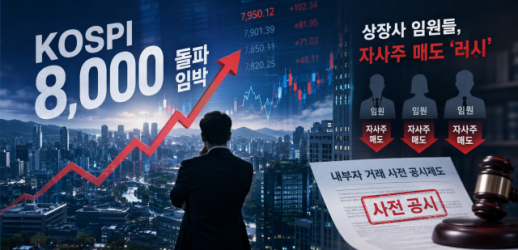 Executives Sell Shares as KOSPI Approaches 8,000 Mark As the KOSPI index approaches the 8,000 mark, executives at listed companies are increasingly selling their shares. This trend of insider profit-taking has resurfaced amid a recent surge in the stock market, raising concerns among general investors who view it as a potential signal of a market peak. According to the Financial Supervisory Service's electronic disclosure system, there have been 39 instances this month where insiders, including executives, sold shares worth over 100 million won. A review of monthly insider selling trends shows a concentration at the beginning of the year, with 80 cases in January and 83 in February, followed by a decline to 75 in March and 65 in April. However, as the stock market has sharply risen in May, previously quiet insiders are now re-entering the market to realize profits. Industry experts agree that insider stock sales cannot be dismissed as mere personal decisions. Executives, who are the first to receive information about a company's management and undisclosed data, may indicate potential declines in stock prices through their sales. Indeed, stocks of companies that have recently disclosed insider sales have consistently faced downward pressure. A notable example is LS Electric, which saw its stock price soar due to favorable conditions in the power equipment sector. On May 12, LS Electric disclosed that Vice President An Gil-young, Executive Director Lee Yoo-mi, and Executive Director Seo Jang-cheol sold their shares. The amounts they liquidated were 353.54 million won for Vice President An, 355.07 million won for Executive Director Lee, and 330.20 million won for Executive Director Seo. On the day of the disclosure, LS Electric's stock price fell by 7.07% compared to the previous trading day. The company stated that the executives sold a portion of the shares awarded as performance bonuses based on personal judgment. Other companies, such as Doosan Enerbility and Nuriplex, which have also recently disclosed insider sales, have continued to experience stock declines following their announcements. This has led to a perception that those with insider information are exiting at the peak of stock price increases. To mitigate market shocks from insider trading, the 'Pre-disclosure System for Insider Trading of Listed Companies' was introduced in July 2024. However, there are concerns about its effectiveness, as it primarily protects minority shareholders from significant stock price drops due to large-scale sales, while smaller transactions remain in a regulatory blind spot. Kim Min-ki, a researcher at the Capital Market Research Institute, noted that the current pre-disclosure system focuses on large transactions exceeding 1% of total issued shares or 5 billion won. He explained that the main purpose is to prevent sharp stock price declines that occurred with past block trades and to enhance market transparency. Kim assessed that the introduction of a cooling-off period of up to 30 days has reduced the frequency of sudden stock price crashes. He added that the increase in pre-disclosure of insider sales, even in a bullish market, has positive aspects for general investors by lessening sudden shocks and addressing information asymmetry. Additionally, it reduces suspicions of insider trading for the insiders themselves. However, Kim pointed out that if the sale amount does not meet the 5 billion won threshold, there is no obligation for pre-disclosure, resulting in only post-sale disclosures. He highlighted that the system does not prevent all insider sales, leaving small and non-targeted transactions subject to market reactions only after the fact. Experts emphasize that discussions are needed to eliminate these regulatory gaps while preserving the system's intent. There are calls to lower the pre-disclosure threshold from 5 billion won or to enhance monitoring based on cumulative trading volumes over a certain period. Additionally, there are suggestions to reform regulations to focus on actual owners to prevent 'split sales' or proxy trading using family members or associates. A financial industry official stated, "Even with pre-disclosure, the signal of insider sales remains, which can still impact stock prices. However, it allows investors to recognize this in advance, increasing predictability and making it harder for insiders to trade at favorable times, thus enhancing market transparency and fairness."* This article has been translated by AI. 2026-05-14 17:58:43
 -
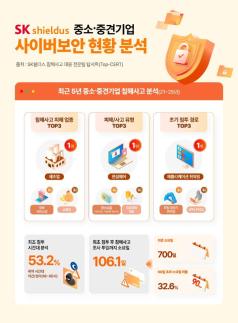 SK Shieldus Highlights Importance of Continuous Security for SMEs Amid Cyber Threats SK Shieldus announced on May 14 that it has analyzed major cyber threat trends affecting small and medium-sized enterprises (SMEs) based on data accumulated over the past five years, coinciding with SME Week. The analysis revealed that SMEs take an average of 106.1 days to recognize and investigate security incidents after they occur. In some cases, the delay reached as long as 700 days, with 32.6% of incidents taking more than 90 days to address. As the use of artificial intelligence (AI) expands, the complexity of corporate systems increases, placing a greater burden on SMEs, which often have limited security personnel and infrastructure. According to the Korea Internet & Security Agency (KISA), approximately 89.4% of ransomware reports last year came from SMEs. This analysis was conducted by SK Shieldus' incident response team, Topsert, using data from domestic corporate incident responses between 2021 and 2025. Over the past five years, the primary types of incidents affecting SMEs were ransomware (44.9%) and data breaches (42.9%), followed by cryptocurrency mining attacks. The main infiltration routes for attacks were application vulnerabilities (20.8%), file upload vulnerabilities (18.9%), and VPN vulnerabilities (15.4%). Additionally, malicious emails, watering hole attacks, and externally exposed URLs were identified as significant attack vectors. This year, notable incidents included data breaches from malicious emails and watering hole attacks, ransomware infections through brute force attacks, and cryptocurrency mining attacks stemming from supply chain breaches. Notably, the initial infiltration times were concentrated during nighttime and early morning hours (6 PM to 5 AM), accounting for 53.2% of all attacks. SK Shieldus highlighted the potential response gaps during these hours but noted that attack attempts continue throughout the day, underscoring the need for a 24/7 monitoring system. By industry, the manufacturing sector accounted for the highest proportion of incidents at 47.4%, followed by information services (15.8%) and finance (10.5%). Incidents were also reported across various sectors, including education and retail, indicating that security threats are spreading across industries. SK Shieldus explained that in manufacturing, the close connection between production equipment and operational systems means that security incidents can lead to production line shutdowns, delivery delays, and disruptions in the supply chain. In response, SK Shieldus is supporting the establishment of continuous security response systems for SMEs through its managed detection and response (MDR) service, which offers threat detection, analysis, and response 24/7, available on a subscription basis. A representative from SK Shieldus stated, "As AI technology spreads, cyber attacks are becoming increasingly sophisticated, making it difficult for limited personnel to respond to all threats. We will continue to expand support for SMEs to help them build professional security response systems while alleviating their burdens."* This article has been translated by AI. 2026-05-14 17:55:57
 -
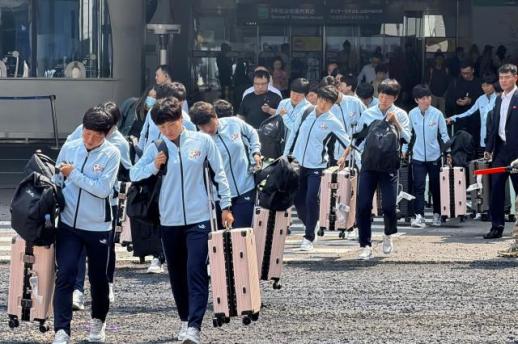 North Korea Women's soccer team to visit South Korea for AFC semifinal this weekend SEOUL, May 14 (AJP) - The Unification Ministry here has approved a visit by North Korea's women's soccer team to participate in the Asian Football Confederation (AFC) Women's Champions League next week. A total of 39 North Korean footballers and sports officials are set to arrive on Sunday for the tournament's semifinal match against Suwon FC Women, scheduled for May 20 in Gyeonggi Province. They will be allowed to stay in South Korea until May 24. It will be the first time in seven years and five months that a North Korean team has visited South Korea for a sports event, since the International Table Tennis Federation (ITTF) World Tour Grand Finals in Incheon in December 2018. It will also be the first visit by a North Korean women's soccer team since the 2014 Asian Games in the same port city, 12 years ago. The ministry said up to 300 million won will be spent from the inter-Korean cooperation fund to help cover cheering-related expenses, with about 3,000 people from some 200 civic groups expected to participate. The ministry said it has provided guidance on "generally prohibited items" and advised a ban on political or religious messages under AFC regulations. 2026-05-14 17:54:16
 -
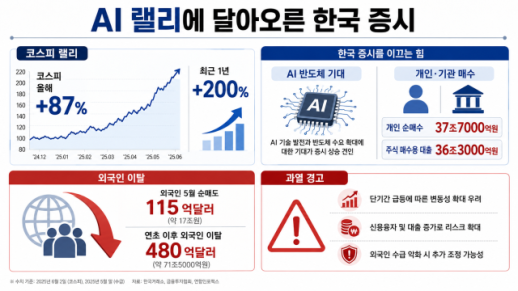 KOSPI Rises to World's Highest Amid AI Semiconductor Rally, Foreign Investors Exit The South Korean stock market is experiencing the steepest rise in the world, driven by a rally in artificial intelligence (AI) semiconductors. While domestic retail and institutional investors are pushing the index higher, foreign capital is quickly exiting the market. There are warnings that the stock market may be overheating as borrowing for investment increases. According to Bloomberg, the KOSPI index has surged 87% this year, the highest among major global indices tracked by the outlet. The index's increase over the past year has reached approximately 200%. The total market capitalization of the South Korean stock market has grown to $4.6 trillion (about 6,850 trillion won), with Samsung Electronics surpassing a market cap of $1 trillion (approximately 1,490 trillion won), making it the second most valuable company in Asia. At the heart of this surge is the semiconductor sector. The expansion of AI investments has led to a significant increase in demand for memory chips, boosting expectations for the performance of Samsung Electronics and SK Hynix. SK Hynix reported a fivefold increase in quarterly profits due to rising memory prices. President Yoon Suk Yeol's expectations for stock market support and financial reforms have also stimulated domestic investor sentiment. Notably, retail investors are rapidly entering the market. Domestic individuals have purchased 37.7 trillion won worth of Korean stocks this year. Many who had been cautious for much of last year are now joining the AI rally. Domestic institutions have also joined the buying spree. Loans for stock purchases have reached unprecedented levels. According to the Korea Financial Investment Association, the balance of loans for stock purchases was 36.3 trillion won at the beginning of May, a 32% increase from the end of last year. There are concerns that the actual scale of leveraged investments may be even larger when considering unreported loans. The investment fervor is even spreading to accounts held by minors. Data from Toss Securities indicates that new account openings for individuals under 18 increased nearly tenfold in the first quarter compared to a year ago. Trading volumes have surged to record levels, and daily fluctuations of over 5% in the KOSPI have become more frequent. Bloomberg reported that the KOSPI has emerged as the index with the largest price swings among major global indices. In contrast, foreign investors are pulling out of the South Korean stock market. According to Bloomberg, foreign investors sold off $11.5 billion (approximately 17 trillion won) worth of Korean stocks in May. If the current trend continues, May is projected to see the third-largest monthly outflow of foreign capital on record. In February and March, there were unprecedented levels of foreign exits. The cumulative outflow this year has also been substantial. Foreign capital has exited the South Korean stock market by approximately $48 billion (about 71.5 trillion won) since the beginning of the year. If this trend continues, it could set a record for the largest annual outflow. The scale of foreign exits from the South Korean stock market is more than double the amount sold off in the Indian market, which is less directly connected to the AI investment trend. Despite the foreign exit, some analysts believe that stock prices are not excessively high compared to earnings. Bloomberg noted that the KOSPI is trading at about 8.5 times projected earnings for the next year, which is lower than the 21 times for the S&P 500 index. Some Wall Street banks have raised their KOSPI targets to 8,500, 9,000, and even as high as 10,000 in optimistic scenarios. However, the risk of a significant price drop following the surge has increased. Just the day before, Kim Yong-beom, head of the presidential office's policy office, mentioned the possibility of a 'citizen dividend' utilizing excess AI profits, leading to a loss of approximately $300 billion (about 447 trillion won) in KOSPI market capitalization within two hours. The stock prices later recovered more than half of that loss, and the government clarified that the statement was a 'personal opinion, not policy.' The key issue in the market is whether the memory semiconductor sector has entered a long-term boom. Domestic investors are optimistic about further gains based on the expansion of AI demand and improvements in semiconductor performance. In contrast, foreign investors are wary of the potential for the memory market to continue its cycle of booms and busts.* This article has been translated by AI. 2026-05-14 17:53:46
 -
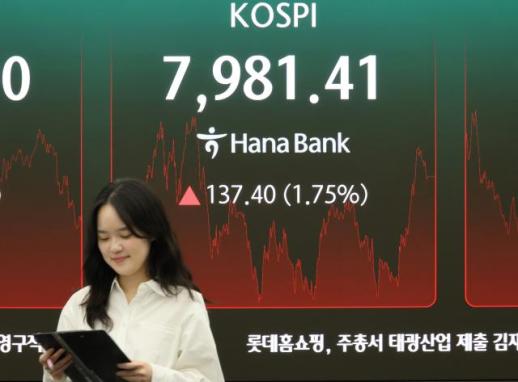
 KOSPI closes at record high, approaches 8,000 on AI rally SEOUL, May 14 (AJP) - South Korea's main KOSPI extended its record-setting climb to outshine regional and global peers as it moved closer to a new four-digit milestone. The benchmark index touched a high of 7,991.04 before settling at 7,981.41 Thursday, up 137.40 points, or 1.75 percent from the previous session. Retail investors bought 1.84 trillion won ($1.26 billion) worth of shares and institutions added 190.6 billion won, while foreign investors sold 2.14 trillion won. Samsung Electronics rose 4.23 percent to 296,000 won and briefly touched 299,500 won during the session, approaching the closely watched 300,000-won threshold. The rally followed a JP Morgan note reaffirming its buy rating on the stock despite ongoing labor disputes at Samsung’s chip operations. The bank said stronger memory pricing and the broader AI-driven semiconductor upcycle would likely outweigh near-term operational risks. SK hynix slipped 0.30 percent to 1,970,000 won after briefly hitting a record high of 1,994,000 won. The divergence between Samsung and SK hynix reflected a broader rotation within semiconductor shares, as investors shifted toward Samsung after SK hynix’s recent AI-driven rally. AI-related software and infrastructure shares also gained sharply. LG CNS surged 17.1 percent to 86,100 won after unveiling a new enterprise AI platform and a Korean-language large language model developed with Cohere. The company said internal testing showed competitive performance against leading global AI models. Elsewhere, LG Display gained 8.3 percent to 15,340 won on expectations of stronger demand for advanced display panels tied to AI devices, while Jeju Semiconductor jumped 28.4 percent to 75,600 won as speculative buying continued in smaller chip-related stocks. Airline shares also advanced. Korean Air rose 6.02 percent to 27,300 won as investors focused on the planned integration of Hanjin Group’s three low-cost carriers, Jin Air, Air Busan and Air Seoul, which analysts expect could reduce competition and improve profitability in Korea’s budget airline market. Construction shares moved higher on renewed momentum in Seoul’s redevelopment market. Daewoo E&C climbed 12.6 percent to 32,600 won after strong subscription demand and rising apartment prices in Seoul’s Seocho district boosted sentiment toward builders with major residential exposure. On the downside, shipbuilding and power equipment shares pulled back following recent gains. HD Hyundai Heavy Industries fell 8.5 percent to 671,000 won, while Doosan Enerbility slipped 2.4 percent to 117,100 won and Samsung Heavy Industries dropped 2.9 percent to 30,150 won as investors locked in profits after a sharp rally tied to defense and energy infrastructure themes. The junior KOSDAQ rose 1.20 percent to close at 1,191.09 after moving between 1,162.20 and 1,194.03 during the session. Retail investors bought 91.3 billion won worth of shares and institutions added 58.9 billion won, while foreign investors sold 135.4 billion won. Alteogen surged 8.76 percent to become the KOSDAQ market’s largest stock by capitalization, while EcoPro BM and EcoPro gained 6.04 percent and 5.41 percent, respectively. Elsewhere in Asia, Hong Kong’s Hang Seng Index rose 0.2 percent to 26,439.80, Japan’s Nikkei 225 fell 1.0 percent to 62,654.10, and China’s Shanghai Composite slipped 0.9 percent to 4,205.40. The rally in Seoul followed another strong session on Wall Street, where the S&P 500 rose 0.58 percent to a record 7,444.25 and the Nasdaq Composite climbed 1.20 percent to 26,402.34 as investors continued to bet that AI-driven earnings growth would offset inflation concerns. NVIDIA rose 2.3 percent overnight, while Micron Technology climbed 4.8 percent. The Korean won closed little changed at 1,491.00 per dollar, up 0.40 won from the previous session. 2026-05-14 17:53:16
 -
 AI Reshapes Asia's Industrial Landscape When the U.S. market falters, the KOSPI often follows suit. A downturn in China's economy typically leads to sell-offs in South Korea. This year, however, is different. Neither the Middle East conflict nor the U.S.-China power struggle has managed to shake the markets. This week, the key variable was expected to be the U.S.-China summit. Yet, the KOSPI continues its march toward an all-time high. Having already surged nearly 80% this year, it is achieving the best performance among major global indices. South Korea has surpassed the United Kingdom to become the eighth-largest stock market in the world, valued at $4.04 trillion. Six of the world's top ten stock markets are now in Asia. The market is beginning to prioritize AI over geopolitical concerns. This is not merely a thematic rally; the industrial order itself is changing. Even a single response from ChatGPT relies on GPUs, memory, power grids, and data centers to function. While AI may appear to be software, it actually operates on a vast hardware supply chain, with Asia at its core. Taiwan dominates the foundry sector. Without TSMC, there is no AI. Over 90% of the world's most advanced chip production passes through this company. In the first quarter of 2026, TSMC's revenue increased by 35% year-on-year to $35.6 billion, with net profit soaring by 58%. This year, its capital expenditure guidance is set to reach up to $56 billion, a 40% increase from the previous year. TSMC's clients are expected to spend over $1.2 trillion on data center capital expenditures by 2028. South Korea controls the memory bottleneck. In the AI era, High Bandwidth Memory (HBM) is not just a common component; it is a critical infrastructure that determines processing speed. SK Hynix is projected to surpass Samsung for the first time in operating profit in 2025, reaching 47.2 trillion won, with its stock price rising by 210%. The company holds a market share of 57-62% in HBM, and its production for 2026 is already sold out. Bank of America has labeled this year as a "1990s-style memory supercycle." This fervor is spreading beyond semiconductors to power equipment, transformers, shipbuilding, and batteries. This is why HD Hyundai Electric and LS ELECTRIC have backlogs filled for several years. Japan supplies the equipment needed to manufacture chips. Tokyo Electron, Advantest, and Lasertec benefit every time TSMC and SK Hynix expand their operations. The Nikkei 225 index surpassed 60,000 for the first time in April 2026, soaring 5.58% on the first trading day after Golden Week, led by SoftBank, which rose 18%. JP Morgan's year-end target is set at 70,000. China and Hong Kong are building their own ecosystems. With advanced chip imports from NVIDIA blocked, China surprised the world with its DeepSeek R1. The Hang Seng Index rose by 28% in 2025. Alibaba announced a $52 billion investment in AI infrastructure over three years. The price-to-earnings ratio for Hang Seng Tech is 24, lower than the Nasdaq 100's ratio of 25-31. While the U.S. has created a leading model, China is constructing a parallel ecosystem around it. The structural logic is straightforward. Software originated in the U.S., but the supply chain that powers it is in Asia. Once, Asia was known as the "world's factory" based on cheap labor. Now, it is shifting to become the central axis of critical infrastructure supporting the global AI system. What is happening in the market is not just a technological rally; it is a once-in-a-generation shift in industrial value. The KOSPI stands at the center of this flow. This is why the market remains resilient despite bubble concerns; investors are betting on a reorganization of the industrial order rather than a short-term trend. Intelligence was born in California. However, the power, memory, semiconductors, and factories that make that intelligence operational now pulse from Asia.* This article has been translated by AI. 2026-05-14 17:51:32
 -
 Kim Jae-won Discusses His Role as Sun-rok in 'Yumi's Cells 3' Kim Jae-won, who gained fame as the "first love memory manipulator" in the drama "Our Blues," has now earned the title of the nation's favorite younger man. Since his debut in "Our Blues," he has steadily built his filmography, recently achieving success with Netflix's "Lady Dua" and TVING's "Yumi's Cells 3," solidifying his unique presence in the industry. His ability to create chemistry with co-stars and evoke the excitement of relationships showcases his new potential."I’m really happy to receive so much attention and love, being called the 'nation's favorite younger man.' Besides that, this project being the third season makes it significant as it wraps up the long journey from seasons 1 and 2. I feel proud that we concluded that journey well," he said.TVING's original series "Yumi's Cells 3," written by Song Jae-jung and Kim Kyung-ran and directed by Lee Sang-yeob, depicts the romance between Yumi (played by Kim Go-eun), now a star writer, and Sun-rok (played by Kim Jae-won), who unexpectedly enters her mundane life. Based on the webtoon of the same name, "Yumi's Cells" has captured Yumi's life, love, and growth from its first season in 2022 to its third season in 2026."I often thought about how deeply one can become attached to a character. I really hope Sun-rok and Yumi can live happily together. As a long-time viewer of 'Yumi's Cells,' I wish for Yumi to live happily for her entire life," he expressed.Each season of "Yumi's Cells" has built on Yumi's relationships, showcasing her journey of love and growth. In season 1, she met her boyfriend Gu-woong (played by Ahn Bo-hyun) through a blind date, while season 2 featured Yu-babi (played by Park Jin-young), who supported Yumi's aspirations as a writer. Season 3 focuses on Yumi's relationship with her younger boyfriend, Shin Sun-rok. Kim Jae-won portrays the beloved character Shin Sun-rok, adding excitement to Yumi's final romance."It would be a lie to say I felt no pressure. It felt like being introduced as 'my boyfriend' to relatives during a family gathering. So many people were watching and had expectations for this character. In the original work, Sun-rok is depicted as a unicorn-like younger man, almost perfect without flaws. While there was pressure regarding that, I also saw it as a great opportunity to portray such a fantasy-like character. Therefore, I prepared for this role with a unique commitment, giving 200% instead of 100%," he said.Unlike the previous seasons, which each had 14 episodes, season 3 consists of only 8 episodes. Fans expressed disappointment at the shorter format, wishing for more time to explore Yumi and Sun-rok's story. Kim Jae-won acknowledged that a longer format could have allowed for more detailed storytelling but emphasized that the priority was to accurately portray Sun-rok within the given episodes."Personally, I think Sun-rok is a bit different from the characters Yumi has encountered so far. He is the type to move forward without hesitation once he is sure. Since he is not a calculating character, I believe we could present his story more compactly. While a longer format would have been nice, I focused on expressing Sun-rok well, regardless of the length of the episodes," he explained.Kim Jae-won identified Sun-rok's greatest charm as his straightforwardness. He believes that the essence of Sun-rok lies in his unwavering commitment to Yumi once he decides to love her, rather than any physical attributes."Many people mention his height and appearance, but I see those as secondary charms. Sun-rok's biggest strength is his ability to move forward without hesitation once he is sure of his feelings. Although there must have been realistic challenges, from the moment he decided, 'I love this person' and 'I will protect Yumi for life,' he moved forward without calculation. I think that’s the main reason Sun-rok could reach marriage with Yumi," he said.Given that the series is based on a webtoon, achieving a visual resemblance to the original character was also a significant task. Kim Jae-won mentioned that he carefully considered his hairstyle, glasses, and clothing, as well as his demeanor at work and after hours, to embody the character Sun-rok as envisioned by fans of the original work."I made a lot of effort to match the physical appearance. At work, Sun-rok has a half-up hairstyle and wears angular glasses to appear somewhat cold. Conversely, after work, he has curly hair down and wears pajamas, adopting a relaxed posture that he wouldn’t show at the office. While I’m not a homebody, I found moments of exhaustion after work relatable to Sun-rok, so I infused some of my own experiences into the character," he shared."Yumi's Cells" differs from other dramas in its filming approach. The 'cells' representing characters' emotions require actors to consider their presence even when off-screen. Unlike the seasoned production team, Kim Jae-won, who joined in season 3, needed time to adapt to this unique style."I knew from behind-the-scenes footage that the staff read the cells' lines, but I discovered that some lines were read while others were not. Curious, I asked the director, who explained that it depended on whether the scene would be split later. For instance, in scenes where the cells express Sun-rok's feelings or when he seems to deny them, the director requested specific details, like turning his head in a certain direction. Watching the broadcast, I realized how it was directed to show that 'I love this person enough to ignore the cells.' Those aspects were really interesting," he noted.The romance between Yumi and Sun-rok progressed more rapidly after their mutual confirmation of feelings. Within the 8-episode structure, they had to convincingly navigate their relationship from initial feelings to marriage. Kim Jae-won said he tried to genuinely believe in Sun-rok's love by focusing on his emotions while acting alongside Kim Go-eun."Once Sun-rok and Yumi started meeting with certainty, there was hardly any time left. We had to compact everything into just two episodes. Since fans of the original work already know the ending, I thought they would expect to see how the couple reaches marriage and the atmosphere surrounding it. So, I pondered how much Sun-rok could love Yumi and thought about actually loving Go-eun noona as Sun-rok," he explained.In expressing Sun-rok's love, Kim Jae-won emphasized the importance of loving genuinely rather than focusing on age differences or seniority. He noted that Kim Go-eun's charming presence greatly contributed to shaping Sun-rok's emotions."I aimed to love Go-eun noona as she is. The age difference didn’t matter at all. She is such a lovely person, making it easy to immerse myself in the role. During filming, she had a short haircut that reminded me of Ponyo from the animated film 'Ponyo on the Cliff by the Sea,' so I affectionately called her 'Ponyo.' I tried to capture that lovely feeling and gaze in my performance," he said.In concluding the interview, he cautiously shared his future aspirations. Rather than confining himself to specific genres or characters, he expressed a desire to continue discovering new facets of himself as an actor. For Kim Jae-won, what matters now is becoming an actor who is unafraid to make new choices and not remain stuck in a familiar image."What I most clearly desire is to be recognized as an actor who always challenges himself with new roles. I don’t have a specific goal in mind, but as a newcomer, there’s so much I want to try. I’ve never seriously attempted action, so I want to challenge myself in that area, and I’d also like to try historical dramas. I’ve wanted to explore film as a genre, and I recently had the opportunity to do so, filming without regrets. I want to continue challenging myself with things I haven’t done before and become someone who isn’t afraid to take risks."* This article has been translated by AI. 2026-05-14 17:49:25
 -
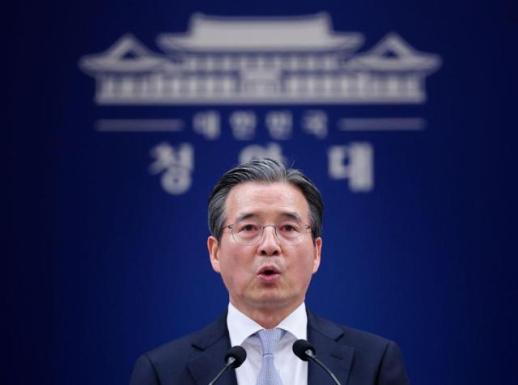 BLUE HOUSE INSIGHT: Dialogue on 'excess profits, excess tax revenues, and future of South Korea in AI age' SEOUL, May 14 (AJP) - The recent Facebook essays by presidential policy chief Kim Yong-beom have stirred unusual debate in Seoul's financial and policy circles. Some dismissed them as overly ambitious. Others saw them as one of the first serious attempts to grapple with a profound question now emerging before advanced economies: What happens when artificial intelligence transforms not only industries, but the fiscal structure and social contract of an entire nation? At its core, Kim's argument begins with a deceptively simple observation. The rise of the KOSPI toward 7,500 points — and even speculative discussion of 10,000 — may not merely reflect market exuberance. It may instead signal something far more structural: the possibility that South Korea is entering a new economic era shaped by artificial intelligence infrastructure and semiconductor dominance. The central concept is what Kim calls "structural excess profits." If companies such as Samsung Electronics and SK hynix continue generating extraordinary profits from AI memory chips, high-bandwidth memory technologies, and next-generation data-center infrastructure, the implications extend far beyond equity markets. Such profits would produce massive increases in corporate tax revenues, income-tax receipts from highly paid engineers and specialists, and expanding trade surpluses. Together, these would generate what Kim describes as "excess tax revenues." The deeper question, however, is not whether such revenues may emerge. The deeper question is what kind of nation South Korea chooses to become if they do. Kim's writings are therefore neither stock-market prophecy nor technological utopianism. They are, rather, an attempt to begin a national conversation about how the gains from the AI era should be distributed, institutionalized, and transformed into a new social contract. To better understand that argument, AJP imagines the following extended conversation between Kim Yong-beom and "Financial Master ABC," a fictional but analytically minded interlocutor representing the broader public. The core point is straightforward. What is happening in the Korean economy today cannot be understood merely through the old framework of cyclical booms and busts. Exports are rising. Semiconductors are thriving. The KOSPI is climbing. Anyone can observe those things. But the more important question is this: what if South Korea's industrial structure itself is changing in the age of AI? If that is true, then taxes, welfare systems, entrepreneurship policy, education, and even national strategy must all be reconsidered. So the real issue is not whether the KOSPI reaches 7,500 or even 10,000? Exactly. Stock indices are outcomes, not causes. What truly matters is corporate profitability. Ultimately, stock prices are a function of earnings. If semiconductor firms begin generating profits on a scale fundamentally different from the past, then the benchmarks through which we interpret Korean markets must also change. The real problem is that we are still trying to understand today's economy using the psychological framework of the KOSPI 2,000 or 3,000 era. Critics argue that this is simply another semiconductor cycle — that Korea has seen booms before. That criticism is understandable. Korean semiconductors have always moved through cycles of expansion and contraction. But the current AI-driven demand structure is fundamentally different from the smartphone or PC cycles of the past. Artificial intelligence is not merely a software phenomenon. It is becoming a vast industrial infrastructure system connected to data centers, electric grids, cooling technologies, advanced memory, batteries, robotics, and industrial automation. Products such as high-bandwidth memory do not create one-time demand. They require continuous upgrades and generational replacement. That is what differentiates this moment from earlier memory cycles. But at the level of national economies, AI resembles electricity, railroads, or telecommunications infrastructure more than a traditional software industry. As AI increasingly moves into the physical world, what matters is not only algorithms. It is also memory semiconductors, power systems, batteries, precision machinery, sensors, and robotics manufacturing capacity. Very few countries possess this full physical supply chain. And you believe South Korea is uniquely positioned? South Korea occupies an unusually strategic position because it possesses integrated strengths across memory semiconductors, batteries, displays, shipbuilding, power equipment, precision manufacturing, and industrial automation. The U.S. dominates design and platforms, but its manufacturing base is comparatively limited. China possesses vast manufacturing scale but faces geopolitical trust constraints. Japan remains strong in materials and industrial equipment. Taiwan leads in foundries. Korea, however, possesses multiple pillars of the AI infrastructure ecosystem simultaneously. That is not merely industrial competitiveness. It is geopolitical leverage. Then what exactly are "excess profits"? In most industries, competition eventually compresses margins. But industries characterized by high technological barriers, limited suppliers, and structurally expanding demand can sustain profits far above historical norms for prolonged periods. That is what I mean by excess profits. If Korean firms secure such positions within AI memory and infrastructure industries, then Korea's economy may enter an entirely different phase from the one we have historically known. And those excess profits become excess tax revenues? When corporations earn extraordinary profits, corporate-tax revenues surge. Highly paid engineers and workers generate larger income-tax receipts. Expanding exports strengthen trade balances, affect exchange rates, and increase national purchasing power. The effects spread far beyond corporate balance sheets. They reshape national revenues, household incomes, asset markets, inflation dynamics, and fiscal capacity. That is how excess profits can become excess tax revenues. But Korea has experienced semiconductor windfalls before. Yes. In 2021 and 2022, Korea already experienced unusually large tax surpluses linked to semiconductor strength. But at the time, policymakers treated them largely as temporary cyclical gains rather than part of a potentially deeper structural transformation. Boom years generated excess revenues. Downturns produced fiscal shortfalls. The cycle repeated itself. If the current AI-driven cycle proves larger and longer-lasting, then we cannot continue responding with the same reactive framework. What, then, should government do? First, policymakers must look beyond traditional GDP metrics alone. Exports, trade balances, corporate earnings, nominal income growth, and terms of trade may provide a more accurate picture of what is happening. Second, if excess tax revenues emerge, governments should establish principles in advance regarding how those resources will be used. Third, Korea must redesign institutions for the AI era — entrepreneurship systems, educational transitions, cultural ecosystems, immigration policy, and social welfare frameworks. Why do you believe GDP alone is insufficient? Industries such as semiconductors evolve so rapidly that traditional statistical systems struggle to capture reality in real time. When performance, density, and energy efficiency all improve simultaneously, it becomes increasingly difficult to separate price changes from quality improvements. Corporate profits may surge dramatically while real GDP appears comparatively modest. The issue is not that statistics are wrong. It is that they may lag behind structural transformation. The most controversial idea in your essays is the so-called "national dividend." Is this universal basic income? Not necessarily. The important issue is not the label, but the principle. The excess profits generated by AI infrastructure industries are not solely the result of individual corporations. They are built upon half a century of collective national investment — education, taxation, industrial policy, infrastructure, and social sacrifice. If so, then part of those gains should eventually be returned to society in some structured form. Critics may interpret that simply as redistribution. Which is precisely why careful institutional design matters. The resources could support youth entrepreneurship, AI transition education accounts, rural revitalization, artists and creators, strengthened pensions, or regional innovation infrastructure. The essential point is this: if extraordinary fiscal gains emerge, they should not simply be consumed politically year by year without long-term principles or social consensus. So is this fundamentally about growth or redistribution? It is about both. In the AI era, growth and distribution cannot be separated cleanly. Excess profits naturally concentrate. Shareholders, elite engineers, and owners of metropolitan assets may receive enormous gains, while many middle-class households and regional communities fall behind. A country can become richer overall while internal inequality deepens sharply. If that imbalance is ignored, even growth itself becomes unsustainable. You also stress entrepreneurship and culture. Why? Because AI changes the nature of human value creation itself. If AI automates routine labor, expanding public-sector jobs alone cannot sustain long-term vitality. What remains uniquely human are judgment, creativity, relationships, aesthetics, meaning, and expression. That is why entrepreneurship and culture become central. AI tools are beginning to give individuals and small teams productivity once available only to large corporations. Governments should therefore lower the risks of entrepreneurial failure and create systems allowing innovation to emerge outside Seoul as well. Culture, too, is no longer a peripheral leisure industry. In the AI age, it becomes part of the infrastructure of human identity itself. You also raised immigration. Low birth rates and aging demographics are among Korea's greatest structural constraints. Korea must attract high-level technological talent while also ensuring stable labor supply in caregiving and essential services. This is not merely labor importation. It is national redesign. If Korea becomes a genuine AI infrastructure hub, it may also become one of Asia's most attractive destinations for global talent. In the end, what kind of country should Korea become? Korea should aspire to become more than simply a supplier of AI infrastructure. It should become the first country capable of transforming AI-era excess profits into broader human flourishing. Technology may be created by corporations. But civilization is ultimately built by society. If Korea designs this transition wisely, it could evolve beyond a successful export economy into one of the defining national models of the AI era itself. Kim's essays initially feel unfamiliar because they combine ideas rarely discussed together in Korean public discourse: KOSPI 10,000, AI infrastructure monopolies, national dividends, demographic redesign, entrepreneurial safety nets, cultural investment, and fiscal transformation. Yet beneath the complexity lies a remarkably coherent framework. First, the AI era is binding semiconductors, data centers, electric grids, batteries, robotics, and advanced manufacturing into a single infrastructure ecosystem. Second, South Korea is one of the very few nations capable of supplying that ecosystem comprehensively. Third, if this strategic position strengthens structurally, Korean firms may generate excess profits on a scale historically unfamiliar to the country. Fourth, those profits may produce unprecedented tax revenues. And fifth, Korea must begin deciding now how those gains should be institutionalized and distributed. The central issue is therefore not whether the government should "hand out money." The deeper issue is how an advanced society manages structurally generated abundance. Industrial-era states built highways, ports, factories, and schools. Information-era states built broadband networks and digital infrastructure. AI-era states may need to build entrepreneurial safety nets, lifelong transition education, regional innovation ecosystems, cultural resilience, and new immigration frameworks. Two dangers must be avoided simultaneously. The first is excessive optimism — the belief that AI demand will expand forever, that Korean firms will permanently dominate, and that tax surpluses will arrive automatically. The second is excessive cynicism — dismissing every structural change as merely another semiconductor cycle or reducing every conversation about national dividends to simplistic populism. Serious national strategy emerges between those extremes. If excess tax revenues materialize, some portion should strengthen fiscal stability and future sovereign reserves. But another portion may need to support the social transition costs of the AI age itself. Young people may require entrepreneurial opportunities and second chances. Middle-aged workers may need retraining pathways. Elderly citizens may need stronger retirement security. Regional communities may require new industrial and cultural anchors. Ultimately, the most important question raised by Kim's essays is not whether Korea can become wealthier again. The deeper question is whether Korea, if it does become wealthier, will finally learn how to use that wealth wisely. South Korea successfully navigated industrialization. It successfully navigated digitization. Now it stands before a third historical threshold: the age of AI infrastructure. Beyond that threshold lies a choice. Korea may remain a conventional cyclical export economy. Or it may evolve into something historically new — a technological civilization-state capable not only of generating extraordinary wealth, but also of transforming that wealth into a richer and more humane society. Excess profits emerge from corporate excellence. But the use of excess tax revenues reveals the character of a nation itself. When governments merely collect those resources, it is finance. When societies reinvest them into people, regions, culture, and the future, it becomes civilization. 2026-05-14 17:46:41
 -
 Director Jung Juri and Cast of 'Dora' Set for Cannes Film Festival Premiere Film 'Dora' is set to have its world premiere at the 79th Cannes Film Festival's Directors' Fortnight. Director Jung Juri, who previously debuted with 'Dohiya' and followed up with 'Next Sohee,' will be joined by actors Kim Do-yeon and Ando Sakura to meet local audiences.On May 14, the production team for 'Dora' announced that Director Jung Juri and actors Kim Do-yeon and Ando Sakura are departing for Cannes, sharing their thoughts on the festival invitation. 'Dora' has been officially invited to the Directors' Fortnight at this year's Cannes Film Festival for its world premiere.Director Jung previously gained recognition at Cannes with her debut feature 'Dohiya' (2014), which was selected for the Un Certain Regard section, and her second feature 'Next Sohee' (2022), which was the closing film of the Critics' Week. With 'Dora,' she continues her relationship with Cannes, marking her third feature film at the festival. Jung expressed, "I am thrilled to be able to showcase the film right after its completion. I look forward to meeting audiences from around the world and returning to greet our local viewers soon."Kim Do-yeon, who plays the title role of Dora, will walk the Cannes red carpet for the first time with this film. She stated, "It means a lot that my first Cannes experience coincides with Dora's first steps. Director Jung allowed me to fully embody Dora on set, and senior actor Ando Sakura awakened me with new energy in every scene. I am excited to see what the moment will be like when the Cannes audience meets Dora. I hope the time we spent together resonates honestly in that space."Ando Sakura, who plays another lead character, Nami, also expressed his anticipation. He said, "Last summer, even in situations where language was a barrier, I found myself looking deeper at my surroundings to share feelings in any way possible. While films transcend language and culture, I realized that the space in front of the camera can also be a place to share our hearts without words. I sincerely hope to meet you all at my first Directors' Fortnight screening."Ando Sakura returns to Cannes after starring in 'Shoplifters' (2018) and 'Monster' (2023). This marks his first appearance in a Korean film with 'Dora.''Dora' tells the story of a family that leaves Seoul for a summer vacation at a seaside villa, where Dora, who suffers from an unknown illness, experiences love for the first time, causing everything to gradually unravel. The film explores the cracks and emotional turmoil that begin within the closest of relationships—family.The project is an international co-production involving four countries: South Korea, France, Luxembourg, and Japan. It is produced by South Korea's Red Peter, in collaboration with France's The French Connection and ARTE France Cinéma, and Luxembourg's Les Films Fauves. The production team from various countries worked together from filming to post-production, with French cinematographer Irina Lubtchansky handling the camera. Visual effects (VFX) were created in South Korea and France, sound work was done in South Korea and Luxembourg, and color grading took place in France.This year, several Korean films have also been invited to Cannes. Na Hong-jin's 'Hope' is in the competition section, while Yeon Sang-ho's 'Goonjeon' is featured in the Midnight Screenings. Park Chan-wook has been appointed as the first Korean jury president. In an interview with AFP on May 11, a day before the festival's opening, Park stated, "Awards should be given to works that will remain for 50 or 100 years. Ultimately, the artistic achievement of the film is what matters most."'Dora,' primarily funded by Solaire Partners through K-Wave Media, aims for a domestic release in the second half of 2026 following its Cannes world premiere. Domestic distribution will be handled by Episode Company, which is presenting 'Dora' as its first distribution project, while international distribution will be managed by Finecut.* This article has been translated by AI. 2026-05-14 17:45:48