

Journalist

Imran Khalid
-
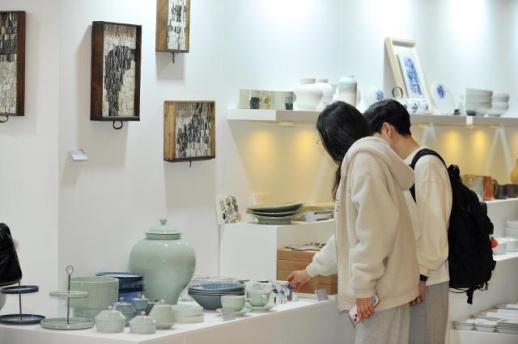 Kookmin University to hold third ceramic craft exhibition and sale SEOUL, April 23 (AJP) - Kookmin University will host the 2026 3rd Ceramic Craft Fair from May 14 to May 17 to showcase the work of emerging artists and facilitate the sale of student and alumni projects, the university said Thursday. The four-day event will take place in the lobby of the Kookmin University (KMU) Administration Hall in Seoul, South Korea. Students and alumni from the Department of Ceramic Craft within the College of Design are set to participate in the exhibition, which functions as an art platform where visitors can view and purchase various ceramic works. The fair is organized to provide students with practical market experience and help identify new talent in the field of ceramic arts. Revenue generated from the sales will be shared between the artists and the university to support a creative environment for local artists. Graduate students and alumni will serve as docents throughout the event to provide explanations of the production processes and the meaning behind specific works. The university will also utilize campus cafe spaces to integrate the exhibition into the daily environment of the campus. A hands-on workshop for children and families is scheduled for May 16 and May 17. Participants can design custom mugs using ceramic transfer techniques in sessions limited to 16 people, held five times per day. The exhibition has increased in size and participation since its launch. During the second annual fair held last year, singer and KMU alumna Lee Hyo-ri visited the campus to view the student projects. KMU President Jeong Seung-ryul said design and content are among the eight core specialized fields the university is prioritizing for its future development. "This fair will provide practical market experience for students and alumni while offering visitors the pleasure of owning art," President Jeong said. "KMU will continue to take the lead in expanding its role as a platform that connects art and industry." 2026-04-23 16:59:37
 -
 Hyundai Rotem Enters Vietnam Rail Market With Ho Chi Minh City Metro Line 2 Deal Hyundai Rotem said it signed a contract on April 23 (local time) with Vietnam’s THACO Group for the Ho Chi Minh City Metro Line 2 project, marking its first entry into Vietnam’s rail market. The deal is worth about 491 billion won. Metro Line 2 is a major rail infrastructure project being developed with a target opening in 2030. The line is planned to span 64 kilometers with 36 stations. Construction began in January, and the project is to be built in three phases. THACO Group, one of Vietnam’s leading conglomerates, is overseeing the Line 2 buildout. Hyundai Rotem will supply driverless electric multiple units for the line. Hyundai Rotem also signed a memorandum of understanding with THACO Group to supply the line’s signaling system, its first overseas supply of an unmanned driving signaling system. The company said it has worked to expand into Vietnam’s rail business since signing a localization agreement last year with THACO Group covering urban rail and high-speed rail rolling stock. Hyundai Rotem said the latest order provides a foothold for broader expansion and could support bids for large projects expected to be tendered, including the North-South high-speed rail project. The North-South high-speed rail project is estimated to total about 100 trillion won, making it Vietnam’s largest infrastructure development to date. "Entering Vietnam’s rail market for the first time, we have broadened our business base and built a meaningful foundation for local cooperation," a Hyundai Rotem official said. "We will work to establish ourselves as a partner contributing to the growth of Vietnam’s rail industry, seek new business opportunities, and help create a solid foundation for the development of Korea’s rail industry as well." Hyundai Rotem said it is also working with more than 500 partner companies to develop overseas markets and support joint expansion, including through a shared-growth fund, joint research and development, and other technical assistance.* This article has been translated by AI. 2026-04-23 16:58:16
 -
 Seoul High Court cancels 234.9 billion won fine in Samsung Wellstory catering case The Seoul High Court has ruled that the Fair Trade Commission must cancel fines totaling more than 200 billion won imposed on Samsung affiliates over allegations they funneled in-house catering contracts to Samsung Wellstory. According to the legal community on April 23, the court’s Administrative Division 3, led by Presiding Judge Yoon Kang-yeol, ruled for four affiliates — Samsung Electronics, Samsung Display, Samsung Electro-Mechanics and Samsung SDI — and Samsung Wellstory in lawsuits seeking to overturn the FTC’s corrective orders and other measures. The panel said the catering transactions, while sizable, could not be seen as providing Samsung Wellstory with excessive economic benefits. It added that the deals could not be recognized as unfair support likely to significantly undermine fair trade. The ruling lifts the burden of total fines of 234.927 billion won previously imposed by the FTC. The FTC had argued in 2021 that Samsung affiliates, under the direction of Samsung’s Future Strategy Office, steered work to Samsung Wellstory through private contracts to shore up its profits. It imposed fines totaling about 234.9 billion won: 101.22 billion won on Samsung Electronics, 22.86 billion won on Samsung Display, 10.51 billion won on Samsung Electro-Mechanics, 4.37 billion won on Samsung SDI and 95.97 billion won on Samsung Wellstory. The court rejected that reasoning, saying the evidence submitted was insufficient to accept the FTC’s claims about instructions from the Future Strategy Office or the alleged motive for the support. The decision is viewed as close to a final ruling because antitrust administrative cases in South Korea follow a two-tier structure in which the Seoul High Court reviews FTC decisions before any appeal to the Supreme Court. While the FTC may still appeal, the ruling is expected to affect a related criminal trial now underway. In 2021, the FTC also filed a complaint with prosecutors against Samsung Electronics as a corporate entity and Choi Gee-sung, a former head of the Future Strategy Office. Prosecutors indicted Choi and Samsung Electronics in 2022 on charges of violating the fair trade law, and a first trial is in progress.* This article has been translated by AI. 2026-04-23 16:53:37
 -
 South Korea flags 746 suspected illegal home deals in capital region probe The South Korean government said it found more than 700 suspected illegal housing transactions, including disguised gifts, in a targeted probe of deals in and around the capital. The Ministry of Land, Infrastructure and Transport said on the 23rd it conducted a planned investigation into home purchase reports filed from July to October last year, identifying 746 suspected illegal transactions involving 867 suspected violations. It said it notified relevant agencies. The ministry said the probe was launched amid concerns that market-disrupting practices would spread after measures such as tighter lending rules and an expansion of land transaction permit zones. An earlier review of reports filed from January to June last year covered Seoul and six areas in Gyeonggi Province — Gwacheon, Suji District in Yongin, Bundang and Sujeong districts in Seongnam, Dongan District in Anyang, and Hwaseong. The latest probe added nine more Gyeonggi areas: Gwangmyeong, Uiwang, Hanam, Namyangju, Guri, Jungwon District in Seongnam, and Jangan, Paldal and Yeongtong districts in Suwon. By type, the suspected violations included: disguised gifts and excessive borrowing from related parties (572 cases); false reporting of prices or contract dates (191); misuse of loan funds (99); violations of the Licensed Real Estate Agents Act (4); and a violation of the Real Name Real Estate Transactions Act (1). In one case, a buyer purchased a Seoul apartment for 11.75 billion won and financed 6.77 billion won by borrowing from a company where the buyer was registered as an inside director. The case was referred to the National Tax Service over suspected excessive related-party borrowing. In another, a buyer purchased a Seoul apartment owned by the buyer’s mother for 2.34 billion won, while signing a jeonse lease deposit contract for 1.7 billion won with the mother as tenant. Authorities said the deal could amount to a gift due to an underpriced transaction and referred it to the tax agency. Separately, the ministry said it reviewed about 250,000 apartment transactions reported nationwide in the first half of last year and found 306 unregistered deals. It said it notified local governments and requested further investigations and administrative action. The ministry said it is also conducting a planned probe into transaction reports filed in November and December last year for Seoul and Gyeonggi Province, and plans to continue investigations into deals reported this year.* This article has been translated by AI. 2026-04-23 16:52:48
 -
 Democratic Party’s Jung Won-oh vows Seoul will match Tokyo within five years, criticizes Oh Se-hoon Democratic Party Seoul mayoral candidate Jung Won-oh said Wednesday he aims to put Seoul “shoulder to shoulder” with Tokyo within five years, while accusing Seoul Mayor Oh Se-hoon of failing on “space, the industrial ecosystem and management philosophy.” Jung made the remarks at a policy event at the National Assembly Members’ Office Building in Seoul’s Yeouido district, titled “Jung Won-oh’s G2 Seoul vision declaration, a major transformation for global city Seoul.” He said he would make Seoul “Asia’s No. 1 economic and cultural city” that “outpaces Tokyo,” adding, “Seoul’s counterpart is New York.” He said Seoul has been stagnant, claiming it has “stagnated for 14 years” and that since the COVID-19 pandemic, the city’s growth rate under Oh has “dragged down the overall average.” Jung attributed the slowdown to what he called structural failures in Oh’s administration, saying Oh has tried to solve city issues only within Seoul’s boundaries rather than the broader capital region, failed to foster new industries such as artificial intelligence and finance, and lacked a management philosophy, allowing stagnation to persist. As an alternative, Jung proposed a “1-2-3-4 strategy”: developing Seoul into Asia’s top economic and cultural capital by 2030; creating two additional urban centers; building three youth startup clusters; and establishing a pipeline for four special zones. He said the city would add Sinchon-Hongdae and Cheongnyangni-Wangsimni as new centers beyond the existing three — central Seoul, Yeouido-Yeongdeungpo and Gangnam. He also proposed youth startup innovation clusters in Sinchon (content), Cheongnyangni (bio and innovation) and Gwanak (deep-tech startups). On the four-zone pipeline, he said Hongneung, Yangjae and Yongsan would be designated as special zones, while Guro would be pursued through a Seoul city ordinance.* This article has been translated by AI. 2026-04-23 16:52:02
 -
 Xi Calls Yiwu Growth Model a Benchmark for ‘Correct View of Political Achievements’ Chinese President Xi Jinping has urged officials to treat the development model of Yiwu in Zhejiang province — home to what China calls the world’s largest small-commodities wholesale market — as a benchmark for a “correct view of political achievements.” The concept, which Xi has repeatedly stressed in public, calls for evaluating officials by sustainable, practical results rather than short-term gains or showpiece projects. According to China’s state-run Xinhua News Agency on Wednesday, Xi said in recent instructions that Yiwu’s small-commodities sector “opened up a huge market” and grew into a major industry, forming what he called the “Yiwu development experience.” He praised it as a successful example of developing a county-level economy in line with local conditions. Xi said the “Yiwu development experience” should be summarized more systematically and used effectively in connection with study and education programs aimed at establishing and practicing the “correct view of political achievements.” He said regions should build on their own resource advantages, respect grassroots and public creativity, and pursue reform, innovation and concrete implementation. He also called for sustained effort to find high-quality development paths suited to local conditions, and for better alignment with national development strategies. Xi has shown long-standing interest in Yiwu’s economy, visiting the city 12 times while serving as a party chief in Zhejiang and Shanghai. Xinhua said he personally compiled Yiwu’s development experience at the time and directed that it be studied and promoted among officials, and he has repeatedly cited Yiwu in public remarks. Yiwu, described as the world’s largest export base for small commodities, is often called a barometer of China’s foreign trade and the global economy because orders and production there are seen as reflecting broader trends. The Yiwu market covers 6.4 million square meters — about the size of 900 soccer fields — and contains about 1.26 million shops, with trade involving more than 230 countries and regions. The report said many goods tied to the World Cup, U.S. elections and Christmas are produced and exported from Yiwu. It added that the term “Yiwu index” is used because export orders there are sometimes cited to predict outcomes of major international events, such as U.S. election dynamics and World Cup winners. While Yiwu was held up as a model, the cities of Yichun in Jiangxi province and Nanning in the Guangxi Zhuang autonomous region were cited as examples of a “wrong view of political achievements” for wasteful investment, the report said. China Central Television said Tuesday that Hozon New Energy Automobile, the parent company of Chinese electric vehicle maker Neta, posted losses of 18.3 billion yuan over three years and went bankrupt last year. CCTV said Yichun and Nanning poured tens of billions of yuan into attracting a Neta auto plant, including special policies offering subsidies, but the effort ultimately worsened local finances and led to industrial homogenization. CCTV criticized some local governments for fixating on political achievements, ignoring fiscal realities and relying on borrowing and subsidy competition, while focusing on large short-term projects aimed at visible results.* This article has been translated by AI. 2026-04-23 16:51:17
 -
 Taiwan’s UMC Weighs Producing 2D NAND Flash Memory at Japan Plant Taiwan foundry United Microelectronics Corp. is believed to be considering producing NAND flash memory at its plant in Mie, Japan, the Economic Daily reported. The company is said to be looking at so-called mature products that memory makers in South Korea and Japan, including Samsung Electronics and Kioxia, have scaled back or exited. The product under review is a flash memory known as “2D NAND.” While competitors such as Samsung and Kioxia have shifted production toward higher-margin “3D NAND,” 2D NAND still has demand in long-life electronics such as automotive, home appliances and industrial control equipment. With supply tight, prices have been surging. The report said UMC plans trial production in the second half of this year (July-December) and aims to start mass production from 2027. UMC is expected to make the 2D memory based on circuits designed by its partner, Taiwan-based fabless chip designer eMemory. The report said UMC has been studying the plan after receiving a request from a major Japanese memory maker to help maintain domestic 2D NAND production capacity. UMC’s Mie plant was originally a Fujitsu facility that produced 12-inch wafers. UMC acquired it in 2019 and made it a subsidiary, United Semiconductor Japan Corp., or USJC. The plant currently focuses on logic chips for smartphones and vehicles, with capacity of 39,800 12-inch wafers a month. A USJC spokesperson told NNA that the report “was not announced by UMC or our company,” adding, “We cannot respond to market speculation.”* This article has been translated by AI. 2026-04-23 16:48:14
 -
 Honda Korea to Exit Auto Sales in South Korea by Year-End, Focus on Motorcycles Honda Korea will end its automobile business in South Korea about 23 years after entering the market, shifting its focus to motorcycles. The company plans to stop car sales by the end of 2026. CEO Lee Ji-hong announced the plan at a news conference on the 23rd at COEX in Seoul’s Gangnam district. “It was decided yesterday,” Lee said, adding that the company “will end its automobile sales business in Korea as of the end of 2026.” Honda Korea entered South Korea with its motorcycle business in 2001 and began selling cars in 2004. It later became the first brand in the imported-car market to join the “10,000-unit club,” but has struggled in recent years. The company said it made the decision to reflect changes in the local market and to maintain mid- to long-term competitiveness by concentrating management support on more core areas. Honda Korea said it will continue to strengthen motorcycles as its key business. From April last year through March this year, it sold about 43,000 motorcycles, accounting for about 40% of the market. The company also said it will continue after-sales operations, including maintenance service, parts supply and warranty support. Unwinding ties with local dealers remains a key task. Lee said he had just held a briefing that included discussions with dealers for an hour before the news conference. “With trust, we want to work to part on good terms,” he said, adding that the company will begin addressing issues that need to be resolved starting next week. * This article has been translated by AI. 2026-04-23 16:46:07
 -
 Samsung Electronics Majority Union Rally Draws 40,000 at Pyeongtaek Plant Over Bonus Cap Samsung Electronics' cross-company union, which has secured majority-union status for the first time at the company, held a rally Thursday afternoon outside the firm's Pyeongtaek site, demanding the abolition of a cap on performance bonuses and other changes. Police and the union estimated attendance at about 40,000. The union held a preliminary gathering until 2 p.m., followed by the main rally from 2 p.m. to 3 p.m. The union is calling for performance bonuses equal to 15% of the company's operating profit and for the bonus cap to be scrapped. If it fails to reach an agreement with management, the union plans a general strike from May 21 to June 7. The union said a strike could halt semiconductor production lines and cause losses of 20 trillion won to 30 trillion won. The cross-company union has become Samsung Electronics' first majority union. As of the end of last year, Samsung Electronics had about 128,800 employees in South Korea, including about 78,000 in its DS (Device Solutions) semiconductor division. The union said it has secured about 74,000 members, mainly in the DS division. Police blocked both directions of roads near the rally and deployed about 300 officers for traffic control and to prepare for unexpected incidents. Pyeongtaek city also sent a safety alert message Thursday afternoon, notifying residents of traffic controls near the Samsung Electronics site and urging drivers to use detours. Union Chairman Choi Seung-ho said in a speech that the union had negotiated in good faith for four months since last December to build a better Samsung Electronics, but "nothing" came back. He argued the bonus system remains opaque and that management tried to wrap up talks under the banner of one-time compensation. He said the union would keep fighting until its demands are met, calling for fair compensation based on performance to revive the company's "talent first" principle. Separately, Samsung Electronics shareholders held a counter-rally near the union gathering. Around 10 a.m., some members of the Korea Shareholder Activism Headquarters voiced opposition to the union's strike move and called for protecting shareholder rights. Minority shareholders held a banner reading, "Samsung stands with 5 million shareholders in Korea," and placards that read, "Samsung shareholder dividends 11 trillion won! Samsung employee dividends 40 trillion won?" They said shareholder rights and interests should be protected within a reasonable range, and argued the union seeks excessive bonuses when results are strong but does not share responsibility when results are weak. * This article has been translated by AI. 2026-04-23 16:45:15
 -
 DL E&C Offers Fixed Construction Cost, 150% LTV for Seoul’s Apgujeong 5 Redevelopment Bid DL E&C has unveiled its proposal for the Apgujeong District 5 redevelopment project in Seoul, pitching a fixed construction price and aggressive financing terms under its high-end ACRO brand as it steps up its bid to win the contract. The company said April 23 it is offering the “ACRO Apgujeong” plan for the project in Gangnam-gu. The complex would span six basement levels to 68 stories above ground across eight buildings, with 1,397 households. The site is considered the largest redevelopment project in the broader Apgujeong area. DL E&C proposed a fixed construction cost of 11.39 million won per 3.3 square meters. The company said that is more than 1 million won lower than the association’s planned cost, and that the builder would absorb additional expenses tied to inflation. The move is aimed at reducing uncertainty as disputes over construction costs have spread across the redevelopment market. The financing package includes a loan-to-value ratio of 150% for relocation loans, and a deferral of members’ payments for up to seven years after move-in. DL E&C also proposed a 57-month construction period, four months shorter than Apgujeong District 2, in a bid to reduce financing costs. To strengthen profitability in a district with limited general-sale units, DL E&C emphasized maximizing retail revenue. It said it would expand retail space by 1,696 pyeong to a total of 5,069 pyeong and cover the full construction cost for the retail portion. The company projected that retail sales profit per association member would rise by about 660 million won. DL E&C also said it would increase total usable residential area by 1,535 pyeong to enhance asset value. A DL E&C official said, “Apgujeong is a symbolic area at the pinnacle of high-end housing in Korea,” adding, “We have concentrated all of the company’s capabilities to deliver a top-level complex.” The official said the company presented “terms rarely seen” centered on fixed conditions that minimize members’ burdens and project risk, and pledged to complete Apgujeong District 5 as “Korea’s best high-end residential complex.” Apgujeong District 5 is currently in the process of selecting a builder. DL E&C said it plans to present additional product design proposals following the release of its business terms.* This article has been translated by AI. 2026-04-23 16:44:28