

Journalist

Imran Khalid
-
 InterBattery 2026 Draws Record 77,250 Visitors as Battery Uses Expand Beyond EVs InterBattery 2026, South Korea’s largest battery exhibition, ended after setting records for both participation and attendance. The Korea Battery Industry Association said Friday that the 14th edition of the event, held at COEX in Seoul’s Gangnam district, featured 667 companies from 14 countries across 2,382 booths, the largest lineup in the show’s history. Total attendance over the three-day event reached 77,250, also a record. The exhibition highlighted battery applications beyond electric vehicles, including energy storage systems, AI data centers, robotics, drones and urban air mobility. Companies showcased next-generation technologies such as all-solid-state batteries, higher-performance and safer battery designs, strategic upgrades to lithium iron phosphate (LFP) batteries, and manufacturing innovations including dry electrode processes. Organizers said interest from abroad was strong, with visits by overseas government agencies and global companies. Joint national pavilions were organized by the U.S. Embassy in Seoul and the embassies of the Netherlands, Australia and Canada, among others. A total of 182 foreign companies set up large booths to present key mineral resources and advanced battery technologies. The show also featured discussions on cross-border cooperation in technology and supply chains, along with presentations of future technology road maps by South Korea’s three major battery makers: LG Energy Solution, Samsung SDI and SK On. At the third InterBattery Awards 2026, 12 innovations were selected, including LG Energy Solution’s “JF2 DC LINK 5.0 power-grid ESS,” Samsung SDI’s “700Wh/L high-energy prismatic battery,” and SK On’s “prismatic on-vent cell.” “InterBattery 2026 showed that battery technology is a core foundational technology for the AI era, beyond electric vehicles,” said Park Tae-seong, executive vice chairman of the Korea Battery Industry Association. He said the association will work to help InterBattery grow into a platform for next-generation battery technology, supply chain security and global business. * This article has been translated by AI. 2026-03-13 21:06:23
 -
 Citi Korea, Yanolja Expand Global B2B Payments Partnership With Virtual Cards Korea Citibank said Friday it is strengthening cooperation with global travel tech company Yanolja on business-to-business payments and will expand the use of Citi’s virtual card solution to Yanolja’s enterprise solution member companies. The companies formalized the partnership at the “Citi Asia Digital Leaders Summit 2026” in Shenzhen, China, with senior executives attending, including Mark Luet, Citi’s head of cluster and banking for Japan, North Asia and Australia, and Lee Soo-jin, Yanolja’s group co-CEO. Yanolja will integrate Citi’s global B2B payment framework across its enterprise solution members, allowing them to maintain consistent operating processes and control standards in multi-country transactions, the bank said. Citi said its virtual card solution helps companies expand into new markets without major system overhauls, while keeping existing operations in place. It also enables clients to manage transactions by country, legal entity and business unit, while centrally overseeing global payment flows. “This partnership is a key example of how Citi supports the global growth strategies of mid-sized companies worldwide,” said Gunjan Kalia, Citi’s head of commercial banking for Japan, North Asia, Australia, South Asia and the region. He said it underscores the importance of an integrated global payments infrastructure that supports both stability and speed in international expansion. The two companies said they plan broader cooperation to support overseas expansion, including stronger risk management using artificial intelligence for suspicious-transaction detection, automated settlement and cost optimization, as well as expanded global finance and payments infrastructure.* This article has been translated by AI. 2026-03-13 17:51:45
 -
 Korean bond yields soar as if in tightening cycle amid widening Gulf war SEOUL, Mar. 13 (AJP) — South Korean government bond yields are climbing sharply as investors demand higher risk premiums amid intensifying conflict in the Middle East and a renewed rise in global interest rates. Yields on sovereign debt have followed a steep upward trajectory since the beginning of the year, reflecting both external shocks and shifting global capital flows. According to the Korea Financial Investment Association (KOFIA) on Friday, the three-year government bond yield rose 6.7 basis points to close at 3.338 percent, while the 10-year yield gained 5.2 basis points to finish at 3.701 percent. The benchmark 10-year yield has breached the 3.7 percent threshold four times this year, including a sharp 12.3 basis point surge on March 9. The pace of the increase has been striking. From the market close on Jan. 2 to the March 9 peak, three-year and 10-year yields rose by 48.5 basis points and 35.3 basis points, respectively — a rapid adjustment even by the standards of recent global tightening cycles. The March 9 jump marked the largest single-day spike since Sept. 26, 2022, when global bond markets were roiled by the United Kingdom’s ill-fated “mini-budget.” At that time, Korean yields surged by 34.9 basis points for the three-year tenor and 22.3 basis points for the 10-year bond in a single session. Market participants say the current move is less about domestic growth optimism and more about rising geopolitical risk and inflation concerns as the Middle East conflict pushes oil prices back toward the $100-per-barrel mark. The yield spread between South Korea and the United States has also narrowed considerably. As of March 9, the gap between the U.S. 10-year Treasury yield, at 4.13 percent, and Korea’s 10-year government bond yield stood at roughly 39.5 basis points. Under normal circumstances, a narrowing differential would lend support to the Korean won by making local assets relatively more attractive. The currency’s continued weakness, however, suggests that investors are demanding additional compensation for risk rather than expressing confidence in the domestic outlook. In other words, the market is repricing geopolitical uncertainty rather than rewarding growth prospects — a dynamic that could accelerate the global shift toward traditional safe-haven assets. Foreign capital flows remain a critical variable. According to the Bank of Korea (BOK), overseas investment in South Korean government bonds recorded seven consecutive months of net inflows through February. But traders say the heightened volatility in yields and the exchange rate this month raises the risk of a reversal. The pressure is compounded by a renewed climb in U.S. Treasury yields. The U.S. 10-year benchmark has recently risen to 4.277 percent, potentially widening the yield gap again and drawing global liquidity back toward dollar assets. Even so, policymakers stress that the current market turbulence bears little resemblance to the systemic stress seen during the 1997 Asian Financial Crisis. Bank of Korea Governor Rhee Chang-yong noted that South Korea’s macroeconomic fundamentals remain significantly stronger today. The country now holds more than $400 billion in foreign exchange reserves, compared with roughly $20 billion at the height of the 1997 crisis, and has since become a net external creditor. “If you are referring to the risk of national sovereign default, I do not agree,” Rhee said during a press briefing on inflation at the Bank of Korea on Dec. 17 last year, dismissing alarmist interpretations of rising yields. Still, with oil prices surging, shipping routes through the Strait of Hormuz under strain and global bond markets resetting higher, Korean debt markets are likely to remain sensitive to external shocks in the weeks ahead. 2026-03-13 17:34:51
 -
 Asian stocks fall as oil nears $100 and tensions loom large in the second war week SEOUL, March 13 (AJP) — Asian stock markets ended lower Friday as oil prices climbed back toward the $100 mark and tensions in the Middle East continued to unsettle investors across the region with little sign of easing in the second week. The Strait of Hormuz remained severely disrupted, raising alarms about Asian economies relying heavily on crude imports from the Gulf. U.S. benchmark West Texas Intermediate crude traded around $95 per barrel, while global benchmark Brent crude hovered near $100, keeping inflation risks firmly in focus. The cautious mood followed losses on Wall Street overnight. The Dow Jones Industrial Average fell 1.6 percent, the S&P 500 dropped 1.5 percent and the Nasdaq Composite slid 1.8 percent as investors reacted to rising energy costs and prolonged geopolitical uncertainty. Technology shares led the decline. The Philadelphia Semiconductor Index fell 3.4 percent, reflecting concerns that escalating tensions in the Gulf could disrupt supply chains and global demand. In Tokyo, the Nikkei 225 slid 1.4 percent to 53,693, with exporters and technology stocks under pressure following weakness in U.S. equities. Chinese and Hong Kong markets also closed lower. The Shanghai Composite Index fell 0.9 percent to 4,090.2, while Hong Kong’s Hang Seng Index lost 0.9 percent. Taiwan’s TAIEX slipped 0.5 percent. Malaysia was among the few regional markets to avoid the broader decline. In Seoul, the benchmark KOSPI fell 1.7 percent to close at 5,487.24 after swinging sharply during the session. The index briefly dropped to an intraday low of 5,392.52 before trimming some losses later in the day. Investor flows showed a clear divergence. Foreign investors sold 1.46 trillion won ($980 million) worth of KOSPI shares and institutions offloaded 1.03 trillion won, while retail investors stepped in aggressively, purchasing a net 2.45 trillion won and helping cushion the decline. The tech-heavy KOSDAQ edged up 0.4 percent to 1,152.96 after recovering from early losses. Institutions were net buyers of 275.6 billion won, while foreign and retail investors sold 108.2 billion won and 131.2 billion won, respectively. Trading activity remained heavy as investors repositioned portfolios amid global uncertainty. Turnover reached 22.97 trillion won ($15.4 billion) on the KOSPI and 14.25 trillion won on the KOSDAQ. South Korean equities have swung sharply in recent sessions as investors reacted to developments in the Middle East and rapid moves in energy markets. The KOSPI plunged 6 percent Monday to 5,251.87 as geopolitical tensions rattled markets, before rebounding to 5,532.59 Tuesday and climbing further to 5,609.95 on Wednesday. Among Seoul heavyweights, Samsung Electronics fell 2.34 percent to 183,500 won and SK hynix declined 2.2 percent to 910,000 won, reflecting weakness in global semiconductor shares. Battery maker LG Energy Solution dropped 3.9 percent to 369,000 won, while automakers Hyundai Motor and Kia slipped 0.8 percent and 1.6 percent, respectively. Samsung Biologics also fell about 2 percent, adding pressure on the index. Internet platform operator Naver bucked the broader market trend, rising 0.5 percent to 223,000 won. Energy markets remained a key driver of sentiment. West Texas Intermediate crude rose from around $81 per barrel at the start of the week to about $96.7 by Friday, after briefly spiking as high as $115.4 during intraday trading. Brent crude climbed from roughly $85.1 to about $101, touching a weekly peak of $117. The surge revived concerns about inflation and potential disruptions to global supply chains, particularly for energy-importing economies across Asia. The Korean won weakened to 1,496.5 per dollar Friday, revisiting levels last seen in the aftermath of the global financial crisis. The U.S. dollar index rose from 99.17 to 99.89, underscoring stronger demand for safe-haven assets. 2026-03-13 17:30:11
 -
 T’way Air, Catalonia Tourism Board Launch Barcelona Flight Promotion T’way Air said Friday it will offer limited-time promotional fares and a discount code of up to 5% for its Incheon-Barcelona route through March 29 on its website and mobile app (web). Under a first-come, first-served deal, one-way tickets start at 391,600 won, including fuel surcharges and airport taxes. The travel period runs from March 13 through Oct. 24 this year. Customers who miss the special fare can still receive up to 5% off by entering the discount code “MAR26.” The code applies to both one-way and round-trip tickets and can be used for bookings at the Smart fare level or higher. T’way Air will also provide a 60,000-won coupon, on a first-come basis, that can be used for an additional discount when paying for a round-trip ticket. The airline currently operates the Incheon-Barcelona route four times a week on Monday, Wednesday, Friday and Saturday. It is also posting travel information on its website for Catalonia destinations including Barcelona, Tarragona, Figueres, Sitges and Montserrat. Details on flight schedules and the promotion are available on T’way Air’s website and mobile app (web). A T’way Air official said the joint promotion is intended to help more customers experience the appeal of Catalonia, including Barcelona, and added that the airline will continue to prioritize safe operations while improving travel satisfaction through convenient schedules and various benefits. * This article has been translated by AI. 2026-03-13 17:06:18
 -
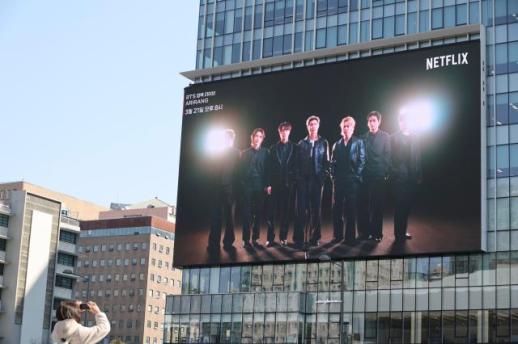 BTS Comeback D-8: Concert economy visible across Gwanghwamun accommodations SEOUL, March 13 (AJP) — Hotel rooms with views overlooking Gwanghwamun Square were the first to sell out and are still sought at steep premiums as foreign fans treat BTS’s upcoming comeback concert as a once-in-a-lifetime event. “Some foreign guests ask if they can rent the hotel’s rooftop pool area to watch the concert. Some even say they’re willing to pay a rental fee as a group,” said Kim Kyllian, a manager at Somerset Palace Seoul near Gwanghwamun. Many guests, he added, are specifically asking whether rooms facing Gwanghwamun Square are still available on the day of the performance. The phenomenon reflects what the global music industry increasingly calls the “concert economy.” Large-scale tours by superstar artists can generate significant spillover spending in host cities — boosting demand for hotels, restaurants, transportation and tourism services. U.S. pop star Taylor Swift’s recent global tour produced such economic effects that analysts coined the term “Swiftonomics.” Swift is estimated to have built a fortune of around $1 billion through touring, music royalties and real estate, with her concerts widely credited for lifting tourism spending in host cities. While on a smaller scale, BTS is generating similar ripples in Seoul. Ahead of the group’s comeback concert scheduled for March 21 at Gwanghwamun Square, accommodation prices around the venue have surged while reservations fill rapidly. According to AJP’s reporting, the average weekend room rate at Lotte Hotel Seoul is typically around 540,000 won, but rises to roughly 960,000 won on the concert date. Shilla Stay Gwanghwamun has climbed from about 270,000 won to 620,000 won, while Koreana Hotel jumped from roughly 320,000 won to about 1.35 million won. At Monthliv Jongno Jonggak Station Hotel Stay, rates increased from around 250,000 won to about 450,000 won. Somerset Palace Seoul was fully booked for March 20 and 21 — the night before and the day of the concert — more than one to two months in advance. “We’ve been receiving booking requests from a wide range of countries, including Japan, North America and South America,” Kylian said. At The Westin Josun Seoul, PR manager Soojin Bae said the hotel is also fully booked, with reservations made well ahead. “Room rates have increased by about 10 to 20 percent,” she said, adding that more than 80 percent of current guests are foreigners, though she noted the surge was not necessarily tied solely to the concert. Demand has spread to nearby districts as well. Hotels in Myeongdong, about a 20-minute walk or 10-minute drive from Gwanghwamun Square, are seeing similar spikes. Room rates at Hotel Thomas jumped from around 310,000 won to roughly 1.09 million won — an increase of more than 250 percent. Even smaller accommodations are feeling the surge. Hana Days Jongno-Gwanghwamun, a two-star hostel near the square known for its modest prices, had only one triple room left two days before the concert, with nightly rates reaching about 530,000 won. A manager at Soo Song Guest House near the venue said some visitors specifically requested rooms facing the square, with Japanese tourists making up a large share of bookings. “We didn’t even realize there was going to be a concert at first,” the manager said. “One day we suddenly became overbooked, and only later we realized that a BTS performance had been announced.” The guesthouse was already fully booked even before the concert date was officially confirmed, the manager added. Although online reservations closed once rooms sold out, inquiries have continued, with roughly five additional groups contacting the guesthouse seeking availability. Hotels in nearby Itaewon, a district popular with international visitors about a 20-minute drive from the venue, are also seeing an influx of foreign guests. A manager at Hamilton Hotel said the number of international customers during the concert period has increased about 40 percent compared with typical levels. At A-One Hotel nearby, standard room rates have risen from about 170,000 won a month ago to around 300,000 won for the concert date. Not all hotels, however, attribute the surge entirely to the BTS event. Officials at Four Seasons Hotel Seoul said most of its rooms had already been booked due to the spring high season, noting that the concert was only one of several factors affecting occupancy. Still, the pattern reflects how large K-pop concerts increasingly ripple beyond the stage. As fans travel across borders to attend performances, demand for accommodation, transportation and local tourism rises around host cities — offering a glimpse of how a single show can generate its own kind of “BTSnomics.” 2026-03-13 17:03:22
 -
 Kang Chan-hee on ‘Method Acting’: Clashing With Lee Dong-hwi Made the Film Work Actor Kang Chan-hee is taking on a new screen persona in the film 'Method Acting,' playing Taemin, a top star who can be irritating but not easy to hate. Director Lee Ki-hyeok and cast members Lee Dong-hwi, Kang and Yoon Kyung-ho attended a press screening and news conference Friday afternoon at Megabox COEX in Seoul’s Gangnam district. '’Method Acting’ is a black comedy about actor Lee Dong-hwi, who is eager to be recognized for sincere acting rather than being boxed in as a comedy performer, and the chaos that follows as he becomes overly immersed in a role. Kang, who plays Taemin, Lee’s on-screen rival, said he was struck by the premise when he first read the script. “It felt really fresh and surprising that senior actor Lee Dong-hwi would play ‘Lee Dong-hwi’ under his own name,” he said, adding that he chose the project because he wanted to work with the veteran actors. Known largely for upright, “model student” roles, Kang said he focused on making Taemin “annoying, but not simply hateful,” as he built the character. Kang, who is active as both an idol and an actor, said he related to Taemin’s background of having started acting young and staying in the business. He said he anchored the character in feelings of loneliness and emptiness, and viewed Taemin’s small acts of revenge and on-set sparring as “minor deviations.” Kang also described a warmer off-camera dynamic with Lee despite their sharp exchanges in the film. He said it was difficult because he is not the type to speak harshly on set, but credited Lee’s consideration for helping him finish the shoot smoothly. Kang said the film captures a range of emotions and situations in ways that are both entertaining and moving, and he hopes audiences enjoy the novelty of watching Lee portray himself. 'Method Acting' opens in theaters March 18.* This article has been translated by AI. 2026-03-13 17:01:31
 -
 Toss Unveils Stablecoin Road Map, Eyes Borderless Finance ‘Super App’ Toss said it is preparing for what it called the “Money 3.0” era, in which programmable money and stablecoins take the lead beyond cash and electronic money. The company said on 13 that it presented its future finance vision at the “2026 Blockchain Meetup Conference” held at the Seoul Textile Center. Seo Chang-hoon, an executive director at Toss in charge of new business, outlined next-generation financial services that combine stablecoins and artificial intelligence, saying the company will build a “borderless finance super app” by redesigning money without boundaries of “borders, products, time and actors.” It was the first time Toss has publicly disclosed its stablecoin strategy. Seo said the company, backed by about 30 million users, is laying out a blueprint for “programmable money” combined with AI. Programmable money refers to digital currency in which preset transaction conditions are executed automatically. Seo described it as a structure in which “logic is embedded in the money itself,” so the money can “think and move on its own” without people making each decision. Seo also said financial services are likely to emerge in which AI agents and blockchain-based stablecoins automate decision-making and execution for payments, remittances and investments. He said Toss will “boldly replace the rails” of its existing financial capabilities to create a borderless financial environment and deliver innovation that makes previously impossible transactions a reality.* This article has been translated by AI. 2026-03-13 16:42:00
 -
 Coupang's interim chief volunteers for overnight delivery SEOUL, March 13 (AJP) - Harold Rogers, Coupang's interim chief in South Korea, volunteered to participate in a dawn delivery at its logistics center on the outskirts of Seoul early Friday. Rogers visited the center near Seongnam in Gyeonggi Province, where he helped load goods and deliver orders alongside workers. His visit became known after photos were posted on social media by a person believed to be a staffer, and the e-commerce giant confirmed that Rogers visited the site to inspect its dawn-delivery operations and encourage workers. The visit is widely seen as a preliminary inspection ahead of a planned visit by lawmakers slated for next week. Rogers previously said he would take part in a delivery run when asked by lawmakers during a hearing at the National Assembly, shortly after the company's massive data leak was discovered late last year. 2026-03-13 16:31:25
 -
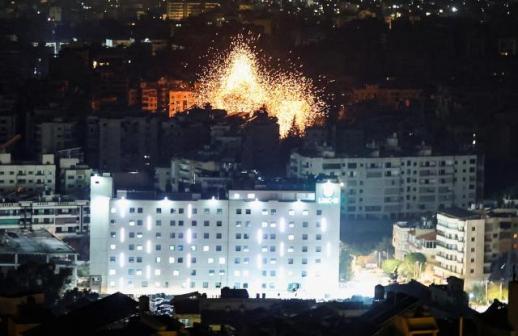 Iran war offers lesson and warning for Asia's U.S. allies SEOUL, March 13 (AJP) - As the war in Iran stretches longer and wider than expected, security analysts are increasingly applying its battlefield dynamics to other flashpoints — raising concerns among Asian countries that host U.S. military bases. For some strategists, Iran’s retaliatory missile and drone strikes on American facilities across the Middle East offer a preview of how a future conflict in the Taiwan Strait could unfold — and how Washington’s Asian allies might be drawn into it. The concern was highlighted in the South China Morning Post, which noted that Iran’s attacks on U.S. bases could serve as a template for potential escalation in Asia. In a Taiwan contingency, Beijing could similarly target American military assets hosted by U.S. allies, including Japan, the Philippines and South Korea. “Analysts said the retaliatory strikes could serve as a template for a potential conflict in the Taiwan Strait, as Beijing might consider actions against U.S. allies hosting American military assets such as Japan, the Philippines and South Korea,” the newspaper reported. Although the Trump administration has not released detailed damage assessments from the Iranian attacks, international media reports indicate that at least 11 U.S. bases in the Middle East — more than half of Washington’s facilities in the region — sustained damage. The scale and precision of the strikes have prompted renewed debate over the vulnerability of American military infrastructure abroad. The implications extend far beyond the Gulf. A 2024 report by the Congressional Research Service notes that the United States maintains 24 permanent military bases in the Indo-Pacific and has access to another 20 facilities. Key installations include Kadena Air Base in Okinawa and Camp Humphreys in Pyeongtaek, South Korea. The Philippines has also expanded American access to nine military sites since 2023, including three located on Luzon, close to Taiwan. Lyle Goldstein, a senior research fellow at Brown University’s Watson Institute for International and Public Affairs, said Iran’s strikes underscore how U.S. bases could become early targets in a Taiwan crisis. “These moves by Iran against nearby U.S. military bases in the Persian Gulf region do absolutely highlight the possibility that in a Taiwan scenario China would likely target U.S. bases throughout the Asia-Pacific region,” he said. For years, military planners have warned that U.S. forces stationed in Japan, South Korea and the Philippines could be vulnerable to large-scale missile strikes from China in the early stages of a regional conflict. The Iranian attacks, some analysts argue, show how even a middle power can challenge American military infrastructure through precision strikes. Yet the debate unfolding in Seoul and Tokyo is not solely about military vulnerability. It is also about the risks inherent in alliance politics — particularly the fear of becoming entangled in a conflict they did not initiate. Spencer D. Bakich, a professor at the Virginia Military Institute, notes that the concept of “entrapment” has long shaped U.S. alliance strategy in Asia. During the early Cold War, Washington worried that strongly anti-communist leaders such as South Korea’s Syngman Rhee and Taiwan’s Chiang Kai-shek might provoke confrontations with their adversaries and pressure the United States to intervene. To manage that risk, the United States constructed a network of bilateral alliances designed to maximize American leverage over its partners. Today, however, Bakich argues the concern may be reversing direction. Many policymakers in South Korea and Japan fear that conflicts elsewhere — including the war in the Middle East — could pull them into wars they would prefer to avoid. “I assess that it is highly unlikely that either South Korea or Japan will find themselves directly committed to this war,” Bakich said. Both countries, he noted, face immediate security challenges closer to home — North Korea in South Korea’s case and China in Japan’s. As a result, a division of labor has gradually taken shape within the alliance: the United States focuses on security challenges in the Middle East, while its Asian allies concentrate on maintaining stability in the Indo-Pacific. Practical constraints reinforce this arrangement. South Korea and Japan possess powerful militaries designed to address regional threats, but they have limited capacity to contribute forces to conflicts beyond their immediate neighborhood. That reality, Bakich argues, provides both governments with leverage in negotiations with Washington. Instead of direct military participation, their most likely contribution to a U.S.-led war effort against Iran would be financial support — similar to the role both countries played during the 1990–1991 Gulf War. Not all analysts, however, view the situation solely through the lens of alliance entrapment. Jennifer Murtazashvili, a professor at the University of Pittsburgh who is currently conducting research in Tel Aviv, argues that focusing exclusively on the risk of being dragged into war may obscure a larger strategic question: what happens if Iran emerges from the conflict stronger. “The entrapment problem in alliance politics is well established,” she said. “But South Korean and Japanese policymakers should resist framing their calculus purely around alliance obligation alone.” Iran’s nuclear ambitions, ballistic missile program and expanding partnerships with China and North Korea could have direct implications for Northeast Asia’s security architecture. An Iran emboldened by the conflict, she argues, would not simply be an American problem. In that sense, engagement by U.S. allies may serve their own strategic interests — but the form of participation matters. Murtazashvili suggests that Seoul and Tokyo should seek clarity about war aims before offering support. Entrapment risks are highest, she argues, when allies join open-ended military campaigns with vague objectives. At the same time, allies possess a range of options short of direct combat participation. Logistical assistance, intelligence sharing and financial support can demonstrate alliance solidarity without exposing them to the full risks of military escalation. Domestic politics will also shape the calculus. Leaders in both countries must balance alliance expectations with public opinion, which historically has been cautious about overseas military operations. The result, analysts say, is a delicate strategic calculation. For America’s Asian allies, the war with Iran is both distant and immediate — geographically far away, yet rich with lessons about the vulnerabilities of U.S. military power and the enduring complexities of alliance politics. In that sense, the conflict may prove to be more than a Middle Eastern war. It could also serve as a rehearsal for the geopolitical dilemmas Washington and its allies may one day face in the Indo-Pacific. 2026-03-13 16:22:21