

Journalist

Jack L. Rozdilsky
-
 Korea Private Equity Council Chief Backs Tighter Rules, Warns Against Disadvantaging Local Firms Public sentiment toward private equity funds, or PEFs, has turned sharply negative since last year, with criticism increasingly framing them as “predatory capital.” The Homeplus controversy has added to the backlash, and the government has moved to tighten regulation of the sector. Industry officials warn that rules could undermine the foundation Korea’s PEF market has built over two decades. Others say the sector must strengthen accountability and rebuild trust to ensure its role in corporate restructuring and industrial reorganization is properly recognized. Park Byeong-geon, chairman of the Private Equity Fund Council and CEO of Daishin Private Equity, met with Aju Economic Daily on the 20th. He said he broadly agrees with tougher oversight but warned against regulatory imbalance with foreign managers, while urging socially responsible investing, or SRI, to support long-term returns and restore confidence. “I agree with tighter rules, but there must be no reverse discrimination” Park said he shares “consensus” with the government and ruling party’s push to strengthen PEF regulation “in the big picture,” but added that the industry needs to weigh in on details. “The most important principle is that there should be no reverse discrimination compared with foreign managers,” he said, stressing that the goal is not to block competition but to ensure “fair competition under the same rules.” He said regulation could curb investment activity by domestic managers if it ends up favoring overseas firms. “In the process of applying certain regulations to the market, a structure could form in which domestic managers are disadvantaged and foreign managers gain a windfall,” Park said, calling that an outcome that could run counter to policy intent. Park also warned that if compliance requires excessive disclosure of trade secrets, local firms could lose competitiveness. He said disclosure of key information during fund operations could put domestic managers at a disadvantage in bidding for deals or lead to talent losses to foreign rivals. He said Korea’s PEF market was formed in the mid-2000s under government leadership, as concerns grew about protecting domestic investors and preventing an outflow of national wealth amid rising foreign capital inflows. Since then, he said, a local ecosystem has taken root, supported by domestic institutional investors such as the National Pension Service and mutual aid associations. “PEFs backed by domestic capital have a structure that must consider domestic stakeholders such as pension funds, while managers centered on foreign capital inevitably prioritize the interests of their home-country investors,” Park said. “If homegrown PEFs grow properly, positive effects can flow back to domestic investors and the broader industrial base.” “PEFs will be a key pillar of the National Growth Fund” Park said that despite the poor public perception, domestic PEFs have played a meaningful role and that leveraging those strengths can help Korea’s industrial development. He said domestic PEFs can also work effectively with policy finance initiatives the current government is emphasizing. “Policy funds such as the National Growth Fund require venture capital and PEFs to play roles together,” Park said. “If venture firms identify early-stage companies, PEFs should supply large-scale capital at the growth stage to support scale-ups.” He said some promising startups, including in AI, seek overseas funding at the scale-up stage because of a domestic investment gap. That, he said, can increase financing burdens and lead to growth and returns flowing abroad. Park said PEFs, with experience executing large investments, can play a central role in the National Growth Fund. He said about 70% of PEF investment goes to small and midsize companies, and 40% to 50% to technology companies, adding that the industry will mobilize its capabilities accordingly. He said the National Growth Fund is expected to channel capital across key national industries including artificial intelligence, semiconductors, biotech, aerospace and defense. If such an investment ecosystem takes hold, he said, it could become an important foundation for Korea’s push to join the ranks of advanced economies. “The National Growth Fund is not simply a supply of capital, but a policy to strengthen the entire growth stage of Korean industry,” Park said, adding that the PEF industry is ready to contribute. “Social responsibility is performance” Park emphasized the need for socially responsible investing to restore long-term trust after major controversies in the private equity industry. He also argued that SRI can support returns. “Comparing the returns of general funds and funds that consider ESG, the performance of funds that consider ESG is actually higher,” Park said. “The existing perception that social responsibility conflicts with profitability needs to be reconsidered.” He said overseas markets, including Europe, already show data supporting the performance of responsible investing, and predicted a similar trend could emerge in Korea within three to five years given private equity’s long-term investment horizon. “Socially responsible investing is morally right, but it does not necessarily move in inverse proportion to profitability,” he said, adding that the industry will continue to strengthen such investment. Industry data in Korea also point in that direction, he said. According to the industry, employment at companies backed by PEFs rose an average 9.1% a year, well above the overall market average in the 4% range. Wages increased an average 9.3% a year, above the national average in the 3% range, and the share of regular workers was about 94%, indicating stronger job stability. Park attributed the trend to policy and market shifts. He said government regulation is also providing incentives that consider environmental and social factors, and consumers are increasingly assigning higher brand value to companies that demonstrate responsibility, which he said can support corporate value and returns over the long term. Park said 251 institutions in Korea participate in the stewardship code, including 75 PEFs, the largest participation by sector. He said that reflects continued emphasis by major institutional investors, including the National Pension Service, on responsible investment and stewardship code implementation. He added that the industry plans to further strengthen self-regulation and responsible investment in line with efforts to advance the code, including what he described as “Stewardship Code Season 2” presented by National Pension Service Chairman Kim Seong-ju. “There will be no repeat of the Homeplus incident” Park also underscored private equity’s economic role. He said PEFs account for more than half of Korea’s M&A market, and annual investment totals about 30 trillion won, far exceeding venture investment. He said the industry has invested a cumulative roughly $57 billion in high-risk, high-growth sectors such as AI, semiconductors and renewable energy, serving as a “risk absorber” in areas difficult to fund with public resources alone. He added that research and development investment and capital expenditures have increased an average 16% and 10% a year, respectively, strengthening long-term growth foundations. Park said self-regulation and greater transparency are needed. “Ultimately, the goal is to compete on equal terms with foreign managers while establishing ourselves as responsible investors that contribute to the Korean economy,” he said. “We must ensure something like Homeplus never happens again,” Park said. “In particular, homegrown PEFs have a very strong will to prevent any recurrence.” 2026-04-22 13:47:25
 -
 PEF Council Chair Park Byeong-geon Says Group Aims to Launch Industry Association in Second Half The private equity fund (PEF) industry’s biggest issue this year is launching an industry association. The sector is working to convert the existing PEF council into a formal association, with a target of launching in the second half of the year. The move is aimed at unifying the industry’s policy-response channel as financial authorities tighten regulation. Park Byeong-geon, chairman of the private equity council, said he is confident the association can be launched within the year. “Views cannot match 100% on the transition, but a large number of member firms agree with the purpose,” he said. Park said an association would have broad impact across the industry by strengthening its role as a single window for conveying the sector’s views to policymakers. He said the group would speak up “so that reverse discrimination does not occur” against domestic managers compared with overseas firms during the process of introducing new rules. He also cited stronger self-regulation as a reason for the push. “The industry’s own self-regulation must also go hand in hand,” Park said, adding that firms should strengthen internal controls and help establish sound market order to prevent a repeat of cases such as the Homeplus incident. Park said the association would also seek to improve the industry’s image. He said perceptions of private equity have been shaped more negatively than warranted and that its positive roles — including corporate restructuring, growth support and industrial reorganization — have not been sufficiently recognized. He added that buying struggling companies, improving their fundamentals and transferring them to more suitable investors can play a meaningful economic role and should be properly evaluated. Park said the group also plans to more actively publicize results related to expanding socially responsible investment. “The PEF industry is already carrying out various socially responsible investment activities, but they tend to be undervalued,” he said, adding that the industry will use related data to more clearly communicate its contributions. “We will work to launch the association within the second half of this year,” Park said. “We will strive for private equity to take root as a sound member of the Korean economy.” * This article has been translated by AI. 2026-04-22 13:46:32
 -
 Hanwha Asset Management Highlights Investment Strategy for Korea Manufacturing Amid Supply Chain Shift Hanwha Asset Management said it held an investment strategy seminar to assess opportunities in South Korean manufacturing as global supply chains are reshaped. The firm said Tuesday it hosted the two-day seminar, titled “The New Cold War Era and the Revival of Korean Manufacturing,” starting Monday at The Plaza Hotel. The seminar was planned as supply chains are being rapidly reorganized amid U.S.-China tensions and rising geopolitical strains. Hanwha Asset Management said South Korea has built competitiveness across manufacturing, including semiconductors, power equipment, nuclear power, defense and shipbuilding, and is emerging as a key partner to help fill gaps in U.S. manufacturing. As a product aligned with that trend, the firm highlighted the Hanwha K-Manufacturing Core PLUS Fund. It is structured to focus on semiconductors, power and energy, which it said are expected to benefit from expanding AI infrastructure, as well as strategic industries such as defense, robotics and biotech. Since its launch in March, the fund has posted a 14.62% return in about a month. “As global companies reduce their dependence on China, the strategic value of Korean manufacturing is becoming more prominent,” Vice President Choi Young-jin said. “It is moving beyond a simple cyclical rebound and entering a phase of structural growth.” * This article has been translated by AI. 2026-04-22 13:45:45
 -
 Mirae Asset Venture Investment Jumps on SpaceX IPO Hopes; Other Related Shares Rise Shares seen as beneficiaries of a potential SpaceX listing surged in South Korea on Tuesday. According to the Korea Exchange, Mirae Asset Venture Investment was up 11,150 won, or 23.55%, at 58,500 won as of 1:01 p.m., compared with the previous session. The stock touched 61,500 won during the session, setting a new 52-week high. At the same time, Aju IB Investment rose 18.65% and YJ Link gained 6.63%. The rally was attributed to buying in companies that have invested in SpaceX after reports that the aerospace company led by Tesla CEO Elon Musk could go public as early as June. SpaceX plans to raise a total of $75 billion through an initial public offering and seek a valuation of $1.75 trillion. Reuters also reported Tuesday that SpaceX would adopt a dual-class share structure. Class A shares for general investors would carry one vote per share, while Class B shares held by Musk and others would carry 10 votes per share. * This article has been translated by AI. 2026-04-22 13:45:15
 -
 South Korea’s Constitutional Court to Hear Yoon Challenge to Special Insurrection Trial Law The Constitutional Court will formally hear a petition filed by former President Yoon Suk Yeol’s legal team challenging the law that provides the basis for a special appellate panel in his case on charges of leading an insurrection. According to legal officials on Tuesday, the court sent Yoon’s constitutional complaint on the Act on Special Cases Concerning Criminal Procedure for crimes including insurrection, foreign aggression and rebellion to a full hearing the previous day. The court first uses a three-justice panel to determine whether a petition meets legal requirements. If it finds no procedural defects, the case is referred to the full bench of nine justices for review. Yoon’s team filed the petition on March 31. His lawyers argued that provisions such as forming a dedicated panel, live broadcasting of trials and excluding de-identification measures impose procedures that differ sharply from ordinary criminal trials and infringe on the rights to a fair trial, equality and one’s portrait rights. The law, pushed through the National Assembly by the Democratic Party in December and effective in January, requires two dedicated panels each at the Seoul Central District Court and the Seoul High Court to handle insurrection, foreign aggression and rebellion cases deemed nationally significant, as well as related matters. After a meeting of all judges, the Seoul High Court designated its Criminal Division 1 and Criminal Division 12 as the dedicated panels through a random draw. Yoon’s appeal will be heard by Criminal Division 12. In the first trial, Yoon was sentenced to life in prison. A separate constitutional complaint filed by Yoon’s side challenging provisions in a special prosecutor law, including clauses on the scope of investigations and the appointment process, also passed preliminary screening Monday and was referred for a full hearing. * This article has been translated by AI. 2026-04-22 13:42:19
 -
 Seoul High Court vows swift handling of Yoon insurrection appeal amid delays The Seoul High Court on Tuesday addressed criticism over delays in scheduling hearings in the appeal of former President Yoon Suk Yeol, who is charged as the ringleader of an insurrection. At a press briefing at the court in Seoul, spokesperson Yu Jemin said that under the special counsel law on insurrection, the deadline to submit an appellate brief in cases indicted by a special prosecutor has been shortened to seven days from 20. Yu said rules requiring a sentencing date do not apply, but procedures under a special act still do. With multiple defendants and mandatory service of documents on defense lawyers, he said, the scheduling may appear slow because the court must follow legal steps to protect defendants’ rights. He added that the panel has been moving as quickly as possible, including preparing proof plans before deadlines expire. Yoon’s case has drawn public criticism because no first hearing had been set even after the first trial verdict was delivered Feb. 19. The Seoul High Court issued its first public explanation on the matter Tuesday. The appeal is being handled by the Seoul High Court’s Criminal Division 12-1. In materials separately released by the court, it said pretrial hearings will run from April 27 through May 7, with trial dates to be set from May 14. Yu also outlined operations and administrative support for the court’s “insurrection-dedicated panel,” established Feb. 23. The court said it is concentrating its resources to process special counsel and insurrection-related cases quickly and fairly. The dedicated panel is based on the “Special Act on the Trial of Criminal Cases, Including Insurrection and Foreign Aggression Cases,” promulgated in January 2016. Under the law, the Seoul High Court must operate at least two dedicated panels, with members selected after deliberation by the full judges’ meeting. The court said it held multiple full judges’ meetings after the law took effect to set selection principles and adopted random draws to ensure transparency. The Seoul High Court said it expanded its criminal trial divisions to 16 from 14 and designated the two newly added divisions as insurrection-dedicated panels to handle only those cases, aiming to prevent delays in ordinary criminal trials. Four cases have been assigned to the dedicated panels and are under review, the court said, adding that not every case investigated by a special prosecutor is automatically sent to those panels. To improve efficiency, the court said it has provided unusual levels of administrative support. It doubled staffing compared with ordinary panels and assigned four court reporters to each dedicated panel, compared with fewer than one per panel in typical cases. It also said it deploys four to six court security officers on major hearing days and has added another courtroom equipped for overflow viewing. The court said it upgraded West Annex Courtroom 103 to enable relay viewing to meet the public’s right to know. The court said it livestreams major proceedings on YouTube and has added on-screen captions to guide viewers through steps such as defendant questioning, witness examination and closing arguments. On how much of the appeal ruling will be released, Yu said the court is conducting a comprehensive review balancing anonymization guidelines and the public’s right to know. The court said verdicts in major special counsel cases will be concentrated starting next week, beginning with a ruling related to first lady Kim Keon Hee on April 27. A Seoul High Court official said operation of the dedicated panels will not delay other criminal cases and that the court will mobilize its administrative capacity to deliver fair and swift results. 2026-04-22 12:45:22
 -
 PPP Floor Leader Song Eon-seok Visits Fasting Lawmaker Ahn Ho-young, Urges Him to Stop Song Eon-seok, floor leader of the People Power Party, visited Democratic Party lawmaker Ahn Ho-young on the 22nd and urged him to end his hunger strike, saying, “You need to be healthy first. Please get up soon.” Song went with Yoo Sang-beom, the PPP’s senior deputy floor leader for parliamentary operations, to Ahn’s protest site outside the National Assembly, where Ahn has been on a hunger strike for 12 days. Song, looking grim, sat at the site, held Ahn’s hand and spoke with him for about two minutes. Ahn greeted them while lying down, unable to get up. Afterward, Song told reporters he came “as a fellow lawmaker and as the head of a negotiating bloc” to pay a visit and offer encouragement. He said they discussed that Ahn needs to protect his health “to do bigger politics” and to work together on politics that can “set South Korea on the right path.” Ahn began the hunger strike on the 11th, demanding a renewed internal audit into allegations that Rep. Lee Won-taek covered meal expenses during the party’s primary for North Jeolla Province governor. As the strike has continued for more than 10 days, figures from both parties have visited the site. The day before, National Assembly Speaker Woo Won-shik visited and urged Ahn to end the fast.* This article has been translated by AI. 2026-04-22 12:33:19
 -
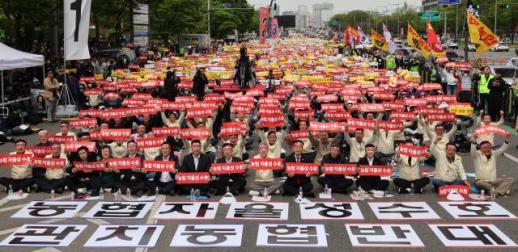 20,000 Farmers rally in Yeouido against agricultural cooperatives act revision SEOUL, April 21 (AJP) - About 20,000 farmers and agricultural cooperative heads gathered in Yeouido on Tuesday to strongly oppose the government's push to revise the Agricultural Cooperatives Act, calling it an "infringement on autonomy." According to the National Agricultural Cooperative Federation (NACF) on April 21, agricultural cooperative heads and farmers from across the country held the 'Farmers' Rally to Defend Agricultural Cooperative Autonomy' in Yeouido, Seoul, that afternoon, officially expressing their opposition to the government's proposed revision. Participants presented five key demands through a resolution statement: halting government oversight that infringes on agricultural cooperative autonomy, abolishing toxic provisions that undermine legal stability, maintaining supervisory authority over subsidiaries, withdrawing the creation of an inefficient audit body, and stopping attempts to change the direct election system for the federation president. 2026-04-22 12:28:09
 -
 CATL Unveils Semi-Solid Battery With 1,500 km Range and 6-Minute Fast Charge Up to 1,500 km on a single charge, full charge in 6 minutes 30 seconds, sodium battery mass production within the year... CATL (Ningde Shidai), China’s top battery maker by global market share, on the 21st unveiled new battery technologies and a product roadmap as competition in electric-vehicle batteries intensifies. The company’s announcements were widely seen as an effort to widen its lead. According to Chinese media including 21st Century Business Herald, CATL held a “Super Tech Day” event on the 21st. The main highlight was a “condensed-state” version of its flagship Qilin battery. CATL described the technology as a high-performance semi-solid battery — widely viewed as a step just short of an all-solid-state battery. CATL said it applied its own semi-solid electrolyte technology, combining an ultra-high-concentration nickel cathode with a silicon-based anode. The company put the energy density at 350 Wh/kg, among the highest levels for mass-produced batteries. Gao Huan, CATL’s chief technology officer, said the company upgraded from a liquid electrolyte to a condensed-state electrolyte to address safety issues “at the root.” Using a condensed-state electrolyte instead of a liquid reduces leakage risk and can significantly lower the chance of fire, he said. In driving tests, CATL said a premium sedan equipped with the battery traveled up to 1,500 km on a single charge. CATL also said the battery pack weighs less than 650 kg and has a volume of 309 liters — about 400 kg lighter and 225 liters smaller than a lithium iron phosphate, or LFP, battery capable of about 1,500 km under the same conditions. The company said the battery retains more than 85% of its capacity at minus 20 degrees Celsius and supports ultra-fast charging at 10C output, allowing a charge to 80% in about 10 minutes. CATL said the condensed-state battery is slated for premium models such as the Nio ET9 and Huawei M9, with mass production planned from the third quarter of this year. It also said the pilot production line has achieved a yield of more than 95%. Industry observers described the announcement as a potential turning point as power-battery technology moves from liquid electrolytes toward solid electrolytes. They said higher energy density and longer range could accelerate adoption of premium EVs and broaden potential uses in emerging markets such as low-altitude aircraft and ultra-long-haul commercial vehicles. CATL also unveiled its third-generation Shenxing ultra-fast-charging battery. The company said it achieved a full charge in just six minutes at room temperature, setting a new benchmark for charging speed. That would be faster than the roughly nine-minute full charge claimed last month by rival Chinese automaker BYD for its second-generation Blade battery. CATL also announced plans to begin mass production of sodium-ion batteries within the year. Sodium batteries are seen as a next-generation technology that could reduce reliance on lithium, cobalt and nickel, drawing attention for cost stability and supply-chain considerations. CATL also said it will accelerate expansion of battery swapping and charging infrastructure. Working with Chinese automakers, it plans to build 100,000 charging and battery-swap stations by the end of 2028. CATL attributed its technology push to heavy research and development spending. Chairman Zeng Yuqun said the company invested more than 100 billion yuan in R&D over the past decade, including 20 billion yuan last year. He said CATL holds more than 60,000 patents and has ranked No. 1 for six consecutive years in patent application growth. 2026-04-22 12:27:19
 -
 Police Seek Arrest Warrant on Murder Charge in Cargo Truckers Union Death Police have launched a full investigation into a fatal incident at a rally by the Cargo Truckers Solidarity Division of the Korean Confederation of Trade Unions’ Public Transport Workers’ Union. South Gyeongsang Provincial Police said Tuesday that its major crimes unit applied for an arrest warrant for a nonunion man in his 40s, identified as A, on suspicion of murder after he drove a cargo truck into the crowd during a rally on April 20 in front of the CU Jinju Logistics Center (BGF Logistics Jinju Center) in Jinju’s Jeongchon-myeon. Police said one union member died and two others were injured. A was initially arrested on an emergency basis on suspicion of aggravated assault. Police later applied the murder charge after concluding there was implied intent, according to the report. Investigators reviewed video from the scene and analyzed the truck’s digital tachograph (DTG) data, it said. In questioning, A was quoted as saying the scene was chaotic and he drove to get out quickly, and that he did not intend to injure anyone. Police also applied for arrest warrants for two union members, identified as B, in his 60s, and C, in his 50s, on suspicion of offenses including obstructing official duties with violence. B is accused of driving a van during the rally and injuring some police officers. C is accused of using a weapon at the same rally site on April 19 to attempt self-harm or of threatening police by saying he would harm unspecified people.* This article has been translated by AI. 2026-04-22 12:18:17