

Journalist

Jack L. Rozdilsky
-
 Seoul leads Asian selloff as Trump speech lacks Hormuz roadmap SEOUL, April 02 (AJP) -Asian stocks sank Thursday, with Seoul bearing the brunt after U.S. President Donald Trump’s primetime address on the Iran war failed to offer clarity on the endgame or a strategy to restore traffic through the Strait of Hormuz, a critical artery for global oil trade. Japan’s Nikkei 225 fell 2.38 percent to 52,463.27, reversing earlier gains as selling accelerated in the afternoon. Hong Kong’s Hang Seng Index dropped 0.83 percent to 25,085.28, while China’s Shanghai Composite declined 0.74 percent to 3,919.29. South Korea’s benchmark KOSPI tumbled 4.47 percent to 5,234.05, erasing most of the previous session’s rally. The tech-heavy KOSDAQ slid 5.36 percent to 1,056.34, with a sharp afternoon drop triggering a sell-side sidecar after simultaneous declines in KOSDAQ 150 futures and the underlying index at 2:34 p.m. Despite declaring Iran’s military capabilities “neutralized,” Trump warned of potential large-scale attacks within two to three weeks. Markets, which had priced in a signal toward de-escalation, instead reacted to renewed uncertainty and the absence of a clear reopening timeline for Hormuz by unloading risk assets. The reaction underscored Seoul’s vulnerability to energy shocks and external demand swings, given its heavy reliance on Middle East crude and export-driven tech sector. Tech shares led the decline. Samsung Electronics fell 5.91 percent to 178,400 won, while SK hynix plunged 7.05 percent to 830,000 won. Samsung Electronics preferred shares dropped 6.98 percent to 118,600 won. Automakers also retreated, with Hyundai Motor down 4.61 percent at 465,500 won, Kia falling 3.03 percent to 150,600 won, and Hyundai Mobis losing 4.77 percent to 389,500 won. Battery and energy stocks were mixed. LG Energy Solution edged down 0.61 percent to 404,500 won and SK Square dropped 6.29 percent to 469,500 won, while Samsung SDI rose 2.55 percent to 443,000 won. In biopharma, Samsung Biologics gained 0.83 percent to 1,585,000 won, while Celltrion fell 4.51 percent to 196,700 won. Defense and heavy industry names showed divergence. Hanwha Aerospace surged 6.30 percent to 1,417,000 won, supported by expectations of prolonged geopolitical tension, while HD Hyundai Heavy Industries fell 2.77 percent to 439,000 won, Hanwha Ocean dropped 6.06 percent to 119,300 won, and Doosan Enerbility declined 6.02 percent to 93,600 won. Financials were broadly weaker, with KB Financial down 1.21 percent to 146,500 won, Shinhan Financial slipping 1.71 percent to 91,700 won, Samsung Life falling 4.41 percent to 217,000 won, and Mirae Asset Securities plunging 7.51 percent to 61,600 won. The Korean won weakened sharply, with the dollar rising to 1,515.90 won from 1,501.3 won, reflecting heightened risk aversion and dollar demand tied to energy imports. 2026-04-02 17:02:31
 -
 Seoul forced to swallow Trump's call, increase US share in energy SEOUL, April 02 (AJP) - South Korea is scrambling to shore up dwindling energy supplies and diversify away from the Middle East after U.S. President Donald Trump ruled out an immediate end to the Iran war, vowing instead to hit Iran "extremely hard over the next two to three weeks." In a primetime address from the White House on Thursday, Trump made clear the operation would last through April, destabilizing not just Iran's military infrastructure but also the core Middle East shipping pipeline — and, by extension, the global energy market. For South Korea — Asia's fourth-largest economy, which imports over 90 percent of its energy from abroad — the message was blunt. Rather than pledging to reopen the chokepoint through which about 20 percent of the world's oil and liquefied natural gas flows, Trump offered fuel-starved nations two options: buy American oil or secure the strait themselves. The remarks are reinforcing a structural shift already underway in Seoul's energy sourcing, with U.S. crude emerging as a key alternative. A senior trade official said domestic refiners are "scouring global markets" to secure replacement cargoes, adding that U.S. oil is taking up a growing share of substitute supply. The United States has rapidly gained ground in Korea's import mix, rising from just 0.2 percent in 2016 to over 16 percent last year, as Seoul has pushed to diversify away from Middle Eastern dependence. Industry sources say refiners including GS Caltex, HD Hyundai Oilbank and SK Energy are actively expanding U.S. procurement. Trump has been blunt in his message to allies that failed to support the U.S. war effort and are now grappling with supply disruptions. "So to those countries that can't get fuel, many of which refused to get involved in the decapitation of Iran, I have a suggestion," Trump said. "Number one, buy oil from the United States of America. We have plenty. And number two, build up some delayed courage. Go to the Strait and just take it, protect it, use it for yourselves." Seoul sources roughly 70 percent of its crude oil and 20 percent of its LNG from the Middle East, with virtually all of it transiting the now-blocked strait. Brent crude surged back above $105 a barrel after the speech, up from about $70 before the conflict erupted on Feb. 28. The Korean won hovered near 1,510 per dollar on Thursday, close to its weakest since 2009. The cascading damage to South Korea's industrial base is already severe. Naphtha, the petrochemical feedstock used in everything from plastics to automotive parts, has surged about 60 percent since February, while ethylene costs have doubled. Several naphtha crackers have gone into shutdown, requiring weeks to restart. Following shortages, Seoul has imposed a temporary ban on naphtha exports and designated the material as an "economic security" item. "Supply itself has been cut off, halting production entirely," said Jung Jun-hwan, a senior researcher at the Korea Energy Economics Institute. "Shutdowns could cascade across manufacturing sectors where raw material costs account for a large share of total expenses." The government has responded with a 26.2 trillion won ($17.2 billion) supplementary budget targeting fuel price caps, expanded subsidies, cash handouts for about 70 percent of the population and industrial support. Seoul has also lifted the 80-percent operating cap on coal-fired power plants, raised nuclear utilization rates above 80 percent and pledged to release 22.46 million barrels from its strategic petroleum reserve in coordination with the International Energy Agency. Officials said alternative supply is being secured at a pace that could cushion the immediate shock, albeit below normal levels. "Alternative supply for April is estimated at around 50 million barrels, and a significant volume for May is also being secured," Yang Ki-wook, deputy minister for energy security at the Ministry of Trade, Industry and Energy, said at a briefing on Thursday. That compares with a typical monthly import level of around 80 million barrels, but Yang stressed that the gap is manageable under current demand conditions. "The 80 million barrels is a normal benchmark, not an absolute requirement," he said, noting that lower refinery utilization and demand management measures limit the immediate impact. He added that remaining shortfalls can be bridged through stockpile swaps, allowing refiners to draw on government reserves before incoming cargoes arrive. With Russian crude emerging as a stopgap — made possible by a U.S. sanctions waiver issued in mid-March — Seoul is exploring supply routes it had abandoned after the invasion of Ukraine. However, industry experts say most Russian crude already has committed destinations and imports carry various restrictions, dimming the option. Even if the Strait of Hormuz were to be reopened tomorrow, experts say industry recoveries would come slowly. "Fully loaded tankers must first pass through, and empty vessels must then enter and drain the stockpiles before oil-producing states can resume output," said Yoon Jae-sung, an analyst at Hana Securities. "Given that a voyage to Asia takes four weeks and that 30 to 40 percent of Gulf refining capacity has been damaged — with normalization expected to take at least three months — restoring the supply chain will require considerable time. Crude oil and gas would take priority, pushing petrochemical products and naphtha further down the queue." 2026-04-02 16:25:57
 -
 Korea’s National Growth Fund faces criticism over bank sales channel selection The Financial Services Commission’s retail-focused National Growth Fund is drawing criticism over how its sales channels were chosen. Although the policy fund is designed to combine public money with household investment to foster advanced strategic industries, some banks were left out as distributors, raising questions about fairness. At the same time, because policy funds typically depend on fast fundraising and efficient sales early on, asset managers may have prioritized channels with stronger distribution capacity. According to the financial industry on Wednesday, iM Bank, Jeonbuk Bank, Suhyup Bank and Jeju Bank were not included among banks set to sell the fund starting in May. The five major commercial banks — KB Kookmin, Shinhan, Hana, Woori and NH NongHyup — secured sales rights, along with Busan Bank, Kyongnam Bank and Gwangju Bank. The retail National Growth Fund will total 600 billion won, with 120 billion won in government fiscal funds structured to absorb losses first. The goal is to share investment gains from advanced strategic industries with the public. Three managers — Mirae Asset Global Investments, Samsung Asset Management and KB Asset Management — were selected and will determine sales channels. Critics say excluding some regional and specialty banks could create blind spots in policy finance. While iM Bank has converted into a commercial bank, it still has more branches outside major cities. The fund is being promoted as part of balanced national development, but residents in rural and mountainous areas could be left out of policy benefits. Others note that expanding non-face-to-face sales may limit the impact on access. Some in the industry also say managers screened sales channels using criteria tied to their own performance — such as the share of their funds sold and overall fund sales volume — rather than the capabilities of the banks themselves. “They allocated channels while looking at the sales-share rankings,” an asset management industry official said. Still, analysts say it is common for policy funds to favor financial firms with broad sales networks and strong investor reach to build early momentum and raise money quickly. Another official said the three managers coordinated “so their sales outlets would not overlap,” adding that they could add more selling banks later. Some banks excluded from the sales list have expressed disappointment. The fund is seen as likely to sell well because it offers tax benefits, including an income deduction of up to 18 million won and a dividend income tax rate of about 9.9%. With the added symbolism of participating in a government-backed initiative, many financial firms are said to have wanted to join. Meanwhile, even banks selected as sellers are uneasy that the sales schedule is moving ahead before the product structure and tax requirements are finalized. Concerns have also been raised about transparency in the selection process and the need for prior consultation. Kim Dae-jong, a professor at Sejong University, said the fund must emphasize stability and verification given the risk of mis-selling, and called for clear guidelines on selection standards and internal control requirements. 2026-04-02 16:18:00
 -
 Hanmi Pharmaceutical CEO Hwang Sang-yeon makes first official visits to plants, R&D center Hanmi Pharmaceutical said Thursday that its new CEO, Hwang Sang-yeon, carried out his first official schedule by visiting the company’s production plants in Paltan and Pyeongtaek, Gyeonggi Province, and its research and development center in Dongtan. Hwang on Tuesday visited the Paltan Smart Plant, the Pyeongtaek Bio Plant and the Dongtan R&D Center in sequence, inspecting production lines and listening to employees at research sites. He arrived at the Paltan site at about 7:30 a.m., greeting employees as they came to work. He then checked the information and communications technology-based drug manufacturing process and the radio-frequency identification logistics and delivery system. At the Pyeongtaek Bio Plant, he toured manufacturing facilities with capacity of up to 12,500 liters and a production line that makes more than 24 million prefilled syringes a year. At the Dongtan R&D Center, he held a meeting with researchers. Hanmi said Hwang also attended an event on the evening of March 31, his first day in office, for outstanding employees from Beijing Hanmi Pharmaceutical. After completing his first official schedule, Hwang emphasized to employees his commitment to continuing R&D and quality management based on the late founder and former chairman Lim Seong-gi’s management principles of “respect for humanity” and “value creation.” “As CEO of Hanmi Pharmaceutical, I will focus on management grounded in law and common sense, and I will do my utmost to ensure we can establish our standing as a global Hanmi,” Hwang said. He pledged “open management centered on the workplace and employees,” and “organic, active discussions among the group’s holding company and affiliates” to pursue advanced management practices.* This article has been translated by AI. 2026-04-02 15:52:09
 -
 Violinist Pinchas Zukerman Returns to Korea for Beethoven Concert With KG Philharmonic World-renowned violinist Pinchas Zukerman will return to the Korean stage for the first time in about eight years. KG Philharmonic Orchestra said it will present “KG Philharmonic Orchestra with Pinchas Zukerman — Masterpiece Series: Beethoven” on May 31 at the Seoul Arts Center Concert Hall. Ticket sales begin April 2 with a presale for paid Seoul Arts Center members, followed by general sales on April 3. The one-day performance pairs Zukerman with the KG Philharmonic (KG Philharmonic), a young orchestra that has been drawing attention as a rising ensemble. The concert launches KG Philharmonic’s first Masterpiece Series and features major works by Ludwig van Beethoven. In the first half, Zukerman will perform Beethoven’s only violin concerto, the Violin Concerto in D major, Op. 61. In the second half, the orchestra will play Symphony No. 7 in A major, Op. 92. KG Philharmonic was founded in 2025 by the Kwak Jaesun Cultural Foundation, based on KG Group’s sustainable management philosophy, and is made up of young musicians who graduated from leading music universities in Korea and abroad. Zukerman said of the collaboration, “Playing with an orchestra made up of young musicians is always my pleasure.” A foundation official said, “The depth of a master and the drive of a young orchestra will come together to deliver an unforgettable experience for audiences.” Tickets range from 40,000 won to 150,000 won and are available through the Seoul Arts Center website and NOL Interpark. The program is expected to draw interest from newcomers to classical music as well as longtime listeners. 2026-04-02 15:39:19
 -
 Korean Banks Shift From Household Loans to Corporate Lending as Rules Tighten Banks are rapidly reshaping lending strategies toward corporate credit and away from household loans as tighter financial rules make it harder to expand consumer lending. With regulators planning to further rein in this year’s overall growth in household lending, the shift into business finance is expected to accelerate. As of the end of last month, outstanding corporate loans at the five major banks — KB Kookmin, Shinhan, Hana, Woori and NH NongHyup — totaled 859.7737 trillion won, up 5.4449 trillion won from 854.3288 trillion won a month earlier, the financial sector said Wednesday. Loans to large companies rose 3.4270 trillion won to 179.0119 trillion won by the end of March. Small- and midsize-business lending increased 2.0179 trillion won to 680.7618 trillion won. Household lending moved the other way. Outstanding household loans, including mortgages and unsecured credit, fell about 136.4 billion won from the prior month to 765.7290 trillion won. The decline was attributed to the government’s push for a “productive finance” shift that prioritizes corporate lending. Industry officials largely expect business lending to keep growing after regulators set this year’s household loan growth target at 1.5% and began separate oversight of mortgage lending, raising the bar for new consumer loans. Banks must manage annual lending volumes within the target, and violations bring strong penalties. Companies, meanwhile, are leaning more on bank loans as the bond market tightens. The Korea Financial Investment Association said the three-year government bond yield, a benchmark for corporate bonds, climbed from 2.953% at the end of last year to 3.370% as of April 1. Banks have responded by offering preferential rates and setting up dedicated teams to attract corporate clients. KB Kookmin Bank recently decided to expand its productive-finance preferential-rate program to 6 trillion won from 3 trillion won. Combined with its existing 4 trillion won branch-level preferential-rate program, the bank would provide a total of 10 trillion won in support. Shinhan Financial Group said it launched a “Seongguan Team” to strengthen execution of productive finance through an industry value chain-based sales system. Woori Financial Group recently formalized plans to create a 500 billion won “Woori Regional Development Infrastructure Fund” to expand investment in renewable energy and national strategic infrastructure. Hana Financial Group raised its productive-finance supply target to 17.8 trillion won earlier this year and has also moved to create a 500 billion won infrastructure fund. A financial industry official said household lending will be difficult to expand as before now that the government has announced tighter rules, while deposits are also harder to attract as their appeal fades. “From a bank’s perspective, there is little choice but to turn to corporate lending, so this trend is likely to continue for the time being,” the official said. 2026-04-02 15:27:00
 -
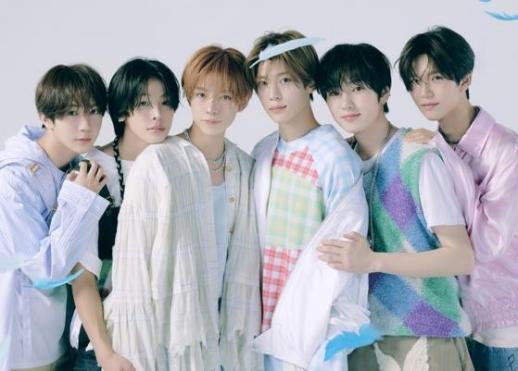 NCT WISH to release first studio album 'Ode to Love' on April 20 SEOUL, April 02 (AJP) -K-pop boy band "NCT WISH" will release its first studio album "Ode to Love" on April 20, marking a key milestone for the rookie act as it continues to build its presence in the global market, its agency SM Entertainment said Thursday. NCT WISH, a six-member boy group consisting of Sion, Riku, Yushi, Jaehee, Ryo and Sakuya, debuted in 2023 under SM Entertainment. The group has been recognized for its refreshing, youth-driven concept and performance-focused identity, with tracks such as "Wish," "Songbird," and "Steady." The group kicked off its comeback rollout by unveiling a schedule video titled “WISH Upon A Dream” at midnight through its official social media channels. The video features illustrated visuals reflecting the group’s signature kitsch and playful aesthetic, alongside a timeline of upcoming promotional content. According to the agency, teaser materials will begin rolling out on April 6, including concept images, a promotional website titled "Ode Diary," a music video for the track "Sticky," and teaser content for the title track, "Ode to Love." The 10-track album is set for release at 6 p.m. (0900 GMT) on April 20 across major music platforms, with a physical version also scheduled for the same day. Pre-orders are currently available through online and offline music retailers. 2026-04-02 15:20:55
 -
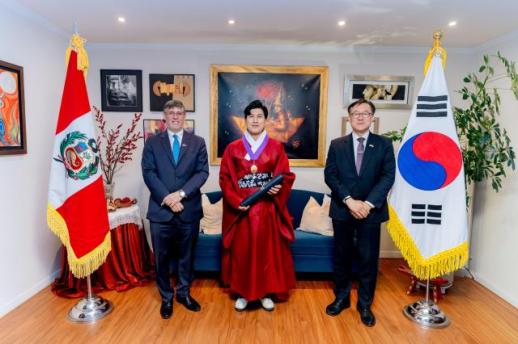 Peru honors Samuel Chung for contributions to Korea–Peru ties SEOUL, April 02 (AJP) - The Peruvian government has awarded Samuel Chung, president of the Korea Culture Association, the Order of Merit at the Comendador level in recognition of his contributions to strengthening ties between South Korea and Peru. The decoration was presented Wednesday by Peruvian Ambassador to Korea H.E. Paul Duclos at his residence in Seoul, on behalf of the president of Peru. The award coincided with the inaugural “Korea–Peru Friendship Day,” established by the Peruvian Congress in 2025 to commemorate diplomatic relations between the two countries, first forged on April 1, 1963. Chung has long been engaged in promoting cultural exchanges between Korea and Peru, working closely with the Peruvian Embassy in Seoul on a range of bilateral programs. His activities have included events linked to the 2024 APEC summit in Peru and celebrations marking the 60th anniversary of diplomatic ties, including a reception for the Peruvian naval training ship B.A.P. Unión. Ambassador Duclos praised Chung’s sustained efforts, saying he has “served as a bridge between the two countries over many years,” helping to boost interest in Korean culture among younger generations in Peru. Choi Joon-ho, director-general for Latin American affairs at South Korea’s foreign ministry, also congratulated Chung, expressing hope that bilateral cooperation would continue to expand. “This honor does not belong to me alone, but to everyone who has worked to promote cultural diplomacy between Korea and Peru,” Chung said. “I will continue to support exchanges that deepen mutual understanding.” Established in 1950, the Order of Merit is awarded to individuals — civilian or military, domestic or foreign — who have made distinguished contributions to the nation or demonstrated excellence in fields such as the arts, science, industry and commerce. 2026-04-02 15:20:47
 -
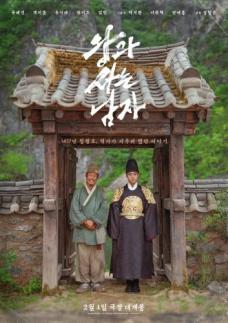 IBK Bank Eyes Potential 400% Return as 'King and the Man Who Lives With Him' Tops 15 Million Viewers As the film 'King and the Man Who Lives With Him' ("Wangsanim") passed 15 million moviegoers, attention has turned to the investment results of IBK Industrial Bank of Korea, one of its main backers. Industry watchers are cautiously raising the possibility that its return could surpass the current No. 1, 'Extreme Job.' According to the Korean Film Council’s integrated box office system, Wangsanim had drawn a cumulative 15.78 million viewers as of April 1. At the current pace, it is expected to top 16 million after the weekend. Cumulative revenue was tallied at 152.2 billion won. With a net production cost of 10.5 billion won and a break-even point of about 2.6 million admissions including marketing, the film recouped its investment early in its run, and most additional revenue is being booked as profit. With the film posting standout box-office results, investors’ profit expectations have also risen. IBK invested 1 billion won in the project, and the industry estimates the final rate of return could be around 400%. IBK’s previous best performer was 'Extreme Job.' The bank invested 790 million won and posted a 337% return. The film’s revenue was 15.5 times its total production cost, the highest ratio on record for a Korean film. Wangsanim’s total production cost has not been finalized, but the industry puts it at about 13 billion won. On that basis, revenue would be about 11.7 times production cost. The film is still in theaters, and additional income remains from overseas sales and OTT rights, which could lift the final return. For Korean films, theater revenue typically accounts for 60% to 70%, while exports and ancillary rights distribution make up 30% to 40%. That is why expectations are growing that Wangsanim could overtake 'Extreme Job' as the top-returning film. As IBK-backed films continue to succeed, the bank’s investment approach is also drawing renewed attention. The bank is known for closely reviewing production structure and risk factors rather than relying only on budget size or star casting. It is reported to consider whether small and midsize firms participate in production, whether the film contains political or religious elements, and whether the director or actors have a history of controversy. In the final adjustment stage, IBK applies unusual criteria, including a 10% deduction if the director is 60 or older, a 10% deduction if the director has had three consecutive hits, and a 10% addition if the director’s previous film failed to break even. In that sense, director Jang Hang-jun’s prior film 'Rebound' failing to reach break-even is described as having helped lead to IBK’s investment. Based on these standards, IBK has directly or indirectly invested in 13 of the 16 Korean films that have surpassed 10 million admissions, including 'The Admiral: Roaring Currents,' 'Ode to My Father' and 'Along With the Gods.' The average return on the bank’s investments in those 10-million-viewer films stands at 172%. 2026-04-02 15:09:00
 -
 Who Is Park Seo-hwi? Former Girl Group Member and Announcer Shares Shamanism Story Park Seo-hwi has drawn attention for an unconventional resume that spans a girl group, broadcast work and, most recently, shamanism. On April 1, MBN’s official channel posted a teaser titled, “Announcer Park Seo-hwi, formerly of a girl group, on why she underwent a spirit-receiving ritual for her family.” In the video, Park said she repeatedly dreamed that members of her family were dying. She said that when she went to get a fortune reading, the first words she heard were, “You’re full of spirits, aren’t you?” Park said she struggled with the decision. “What if I don’t receive it?” she said, referring to the ritual. “My family is everything to me. I’ve lived for my family.” She added, “I want to live my life as I used to, working in broadcasting. But I have to go, so I’m taking this path,” describing her feelings about entering a shaman’s life. Park worked in 2013 as a member of the girl group LPG under the stage name Ayul. In 2015, she worked as a reporter for SPOTV Games and took on drama appearances and hosting roles. In 2016, she appeared on tvN’s “Society Game” Season 1 under the stage name Park Ha-el. The report said Park can speak five languages, citing her experience living in places including the United States and France, and that she gained popularity as a SPOTV announcer. Her account of why she became a shaman will be aired on “Unusual World Exclusive” at 9:10 p.m. on April 2. 2026-04-02 15:06:23