

Journalist

Jinkyu, Myung
-
 A Bio Materials Launches Plant-Derived Exosome Inner-Beauty Brand in Vietnam The global beauty industry is increasingly expanding beyond topical cosmetics into “inner beauty,” a category often described as ingestible beauty products. Industry observers say the inner-beauty market is being reshaped quickly around functional ingredients and biotechnology. Against that backdrop, South Korean biomaterials company A Bio Materials is moving into Southeast Asia. The company partnered with food brand NOWLAB and Vietnamese distributor OMB GROUP to introduce the inner-beauty brand “EXO QUEEN” in Vietnam. The three companies held a seminar for influencers in Hanoi on April 14 to present the products and underlying technology. Discussions also covered how to use content and coordinate marketing partnerships, according to the companies. The newly unveiled products apply plant-derived exosome ingredients. Exosomes are known for their role in cell-to-cell signaling, and their potential use is being studied not only in cosmetics but also as food ingredients. A Bio Materials said it used its in-house technology to formulate the ingredient in a food format. The key ingredient is derived from Centella asiatica, and related research has suggested potential links to anti-inflammatory effects and skin improvement. However, the use of exosomes in foods remains at an early stage, making national regulations and safety verification critical. In the health functional food market, whether an ingredient is recognized for functionality and supported by clinical evidence is a major factor in competitiveness. The project is structured as a division of roles across materials, branding and distribution. A Bio Materials supplies the ingredient, NOWLAB handles product planning and brand operations, and OMB GROUP manages local distribution and marketing. Vietnam has been seeing growing consumption of K-beauty products, with rising interest among younger consumers in health functional foods and skin-care items. Influencer marketing on social media has become a key sales channel. OMB GROUP, which is handling local distribution, is known for experience distributing K-beauty brands. The companies said the product’s ability to gain a foothold will depend on local consumer response. Industry watchers say collaboration models between biomaterials firms and brand and distribution companies are increasing as the inner-beauty market expands around functional ingredients. Southeast Asia is widely viewed as a high-growth region, drawing continued entries by global companies. A Bio Materials said it plans to broaden its lineup using a range of plant-derived ingredients. Industry sources said the project is being watched as one test of how South Korean biotechnology can be applied overseas.* This article has been translated by AI. 2026-04-23 14:18:16
 -
 Fashion mogul Park Sun-ho’s rise from poverty to 1 trillion won in sales and 40 billion won in giving Park Sun-ho, known as South Korea’s “fashion king” for building a major fashion group from nothing, shared his life story on television, including his rise in business and decades of philanthropy. On the April 22 broadcast of EBS’ “Seo Jang-hoon’s Next-Door Millionaire,” the program traced Park’s path from poverty to business success. Born the fourth of seven children in a poor family, he said he struggled even to eat as a child. Unable to attend middle school, he began farm work at 14 to help support his family and took a job at 16 at an underwear wholesaler in Masan. Park recalled working in harsh conditions without a salary, but said he was grateful simply to be fed three meals a day while learning the trade. Two years later, he moved to Busan to pursue his own business. Seeking a shop, he pleaded with a landlord to wait “three to four months” for the deposit, and said the landlord’s decision allowed him to enter Busan’s largest market, Jungang Market, without paying a deposit upfront. He later secured exclusive supply deals with 130 retailers and expanded into the wholesale market, saying he kept his promise. Park said he was called a “kid tycoon” in his 20s and recalled that he “scooped up money in sacks.” After establishing himself in wholesale, Park moved into apparel manufacturing. He said he became the second in South Korea to succeed in producing cotton T-shirts, and that a self-developed “seamless turtleneck” became a major hit. He said the success enabled him to buy a two-story house and marry, marking his peak in his 20s. The momentum did not last. After long-sleeve T-shirts sold well in spring, he produced short-sleeve versions, but the thick fabric failed in the summer market, leaving him with large inventories. Park said unpaid factory bills totaled 38 million won at the time, which he said would be worth “tens of billions of won” today. He said he pushed on, urging the fabric mill owner to invest more so he could repay the debt. After running the factory around the clock, he said he repaid the full amount in four years. His business then rebounded, he said, reaching 10 billion won in sales in 1987, surpassing 100 billion won in 1995, and hitting 1 trillion won in annual sales in 2011. His life also drew attention after being made into the 2005 drama “Fashion 70s,” the program said. The broadcast also highlighted Park’s giving, describing him as a “sharing king.” It said he has donated a cumulative 40 billion won over about 40 years. The program said Forbes Asia named him a “top Asian philanthropist” in 2010, and that he received honors including a presidential commendation for volunteer service and the Order of Civil Merit, Dongbaek Medal. It also said he has helped renovate homes for marginalized people, providing new housing for 300 households to date. When the show revealed he ranks fifth nationwide in the Honor Society, Seo Jang-hoon said, “I’m a member too, but the chairman’s amount is enormous.” Near the end of the program, Park said, “Growing a company and making money are important, but I want to be remembered as someone who does what society truly needs.” He added, “You can’t take money with you when you die. What matters is using the money you earned through sweat and hard work in a meaningful way.”* This article has been translated by AI. 2026-04-23 14:16:12
 -
 South Korea watchdog refers executives to prosecutors over alleged sham sale, hidden debt South Korea’s financial authorities said they have uncovered alleged unfair trading by executives at a listed company during a push to split and relist the firm, and have referred the case to prosecutors. The Financial Services Commission’s Securities and Futures Commission said Thursday it decided at its 8th regular meeting on April 22 to file a criminal complaint against four people, including executives of Company A, for alleged violations of the Capital Markets Act’s ban on fraudulent trading. The commission said the suspects are accused of artificially propping up Company A’s value by making it appear its financial condition would improve after selling a troubled subsidiary at an inflated price to a third party unrelated to Company A. According to the authorities’ findings, executives at Company A and its subsidiary, Company B, planned to sell loss-making Company B as part of a plan to split Company A into two listed companies and relist them. In the process, they allegedly used funds from Company A’s largest shareholder and an affiliate to have a paper company, Company C — with no real business operations or financial capacity — acquire Company B. The commission said Company A continued to support Company B even after the sale by providing ongoing debt guarantees and loans, including operating funds. The commission said the suspects intentionally left large debts off financial statements, inflating the value of Company B’s shares. Authorities said the group then made it look as if Company B had been sold at a high price to an unrelated third party, suggesting Company A’s finances had improved, and succeeded in the split-and-relisting plan. The commission said it confirmed allegations that Company A’s share price surged sharply for a time and that the suspects reaped substantial illicit gains. The commission noted that accounting violations tied to omitting Company B’s liabilities from Company B’s financial statements and Company A’s consolidated financial statements had already led to measures in July last year, including administrative penalties and a notice to prosecutors. Under the Capital Markets Act, using fraudulent means in trading financial investment products, or making false statements or omitting material information to obtain money or other property gains, can be punished by at least one year in prison or fines of up to six times the illicit profit, the commission said. Financial authorities said they will keep a close watch for unfair trading and will thoroughly investigate confirmed violations and impose strict measures to help maintain market order. They also urged the public to actively report suspected unfair trading in capital markets. * This article has been translated by AI. 2026-04-23 14:15:18
 -
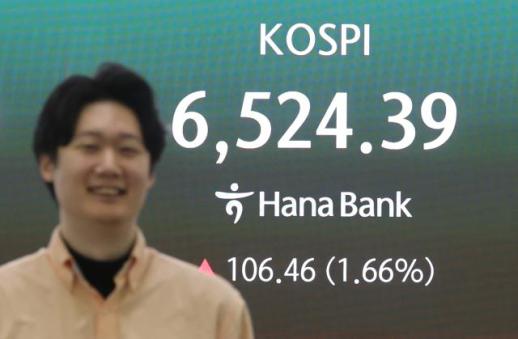 Korea’s chip-led boom masks weak consumer demand and rising household debt South Korea’s headline numbers look strong. First-quarter gross domestic product grew a surprise 1.7%, the highest in five years, and the Kospi surged past 6,500. But the gains are heavily concentrated in one industry, leaving the broader economy uneven and vulnerable. Semiconductor giants posted outsized results. SK hynix reported first-quarter revenue of 52 trillion won and operating profit of 37.6 trillion won, both records. Its operating margin of 72% is far above typical manufacturing levels. Samsung Electronics is estimated to have posted first-quarter operating profit of 57.2 trillion won, already exceeding its total profit for all of last year. Together, the two companies are taking about 67% of total first-quarter earnings among listed firms, underscoring a deepening concentration. Outside chips, key engines are sputtering. Major manufacturing sectors such as autos and batteries have lost momentum. Stripping out the semiconductor boost, the figures show weak service-sector growth (0.4%) and modest private consumption (0.5%). The gap between hot macro indicators and strained household conditions suggests the economy is being misread by top-line peaks. The Bank of Korea’s April consumer sentiment index fell 7.8 points from the previous month to 99.2, dropping below the 100 baseline for the first time in a year. The decline was the steepest since the shock during the political turmoil following the December 2024 declaration of martial law. Even as chip exports hit record highs and stocks climbed, public sentiment sank sharply. Details point to broader stress. Indexes tied to household finances fell, including current living conditions (91) and the outlook for living conditions (92). The index for current economic conditions dropped 18 points to 68. The article also cited a Middle East-driven energy shock as an external risk that could add to supply-side inflation pressure and further erode real purchasing power. Financial risks are also building. Credit-financed stock buying has reached a record, and even high-credit borrowers are turning to high-interest card loans, the article said. If asset prices fall after being pushed up by leverage, the impact could spread through household debt. The government, the article argued, should look beyond record export and profit figures and focus policy on rebuilding domestic demand and diversifying the industrial base, warning that a downturn in the semiconductor cycle could shake the economy’s main pillar. 2026-04-23 14:13:44
 -
 Samsung E&A Q1 2026 Operating Profit Rises 19.6% to 188.2 Billion Won Samsung E&A said it posted solid results as all business segments grew despite global uncertainty. In a preliminary earnings filing on April 23, the company said first-quarter 2026 revenue rose 8.1% from a year earlier to 2.2674 trillion won. Operating profit climbed 19.6% to 188.2 billion won, and net profit increased 3.9% to 163.3 billion won. The company attributed the steady growth to the fuller reflection of revenue from large petrochemical plants and domestic advanced-industry plant projects. By segment, petrochemicals accounted for 1.1299 trillion won of revenue, while the advanced-industry and new energy segments posted 574.2 billion won and 563.3 billion won, respectively, out of total revenue of 2.2674 trillion won. Samsung E&A also reported strong new orders. It booked 4.6 trillion won in new orders in the first quarter, reaching about 40% of its annual target. Its order backlog stood at 20.6 trillion won, equivalent to about 2.3 years of work. A company official said Samsung E&A is achieving ongoing cost improvements by differentiating execution through innovative technology and will pursue sustainable growth by responding actively to changes in the global energy market. 2026-04-23 14:12:59
 -
 More tax incentives for butane to support small businesses amid surging global prices SEOUL, April 23 (AJP) - Tax cuts on liquefied petroleum gas (LPG) butane products will be raised to 25 percent from around 10 percent to ease fuel costs for small trucks and other commercial vehicles, the Ministry of Finance and Economy said on Thursday. According to the ministry, the cut will take effect on May 1 and run through the end of June, lowering butane prices by about 51 won per liter from previous levels. Butane is widely used by freight and commercial vehicles, meaning price swings would directly affect logistics costs and the prices of goods and services, hitting many small and medium-sized business owners the hardest. Citing a sharp rise in international LPG prices with butane climbing to US$800 per ton in April from US$540 in March, the ministry predicted that the increase would be felt by consumers starting in May. But tax incentives for gasoline and diesel will remain unchanged at 15 percent and 25 percent, respectively, through the end of next month. There will be no additional tax breaks for propane, which is already subject to the maximum tax cut of 30 percent. Government authorities have also strengthened monitoring to crack down on those hoarding fuel for profit amid soaring prices, with inspections of nearly 6,000 gas stations nationwide this month uncovering around 99 violations, including falsified records, improper storage, and other business malpractice. 2026-04-23 14:12:36
 -
 KOSPI Slips After Brief Record High as Foreign Selling Intensifies; KOSDAQ Also Falls After opening above 6,500 and setting an intraday record high, South Korea’s benchmark KOSPI turned lower on April 23 as foreign investors stepped up selling. According to the Korea Exchange, the KOSPI was down 47.63 points, or 0.74%, at 6,370.30 as of 12:23 p.m., compared with the previous session. The index opened up 70.90 points, or 1.10%, at 6,488.83 and extended gains on institutional buying before reversing course. In the main board market, individuals and foreigners were net sellers of 86.3 billion won and 363.5 billion won, respectively, while institutions were net buyers of 530.1 billion won. Among top market-cap stocks, SK hynix fell 2.13%, Hyundai Motor dropped 1.94%, LG Energy Solution slid 4.54%, Hanwha Aerospace lost 0.64% and Samsung Biologics declined 1.47%. Samsung Electronics rose 0.69%, SK Square added 0.14% and Doosan Enerbility gained 2.85%. The tech-heavy KOSDAQ was down 20.87 points, or 1.77%, at 1,160.25 at the same time. It opened up 7.98 points, or 0.68%, at 1,189.10 but quickly turned lower. In the KOSDAQ market, foreigners and institutions were net sellers of 265.3 billion won and 114.0 billion won, while individuals were net buyers of 412.2 billion won. Among leading KOSDAQ shares, EcoPro fell 5.30%, EcoPro BM dropped 5.73%, Alteogen slipped 0.56%, Rainbow Robotics lost 1.01% and Lino Industrial declined 0.75%. ABL Bio rose 1.06%, Kolon TissueGene added 0.20% and LigaChem Biosciences gained 1.75%.* This article has been translated by AI. 2026-04-23 14:12:17
 -
 Democratic Party gubernatorial and mayoral candidates pledge unity for June 3 local elections The Democratic Party of Korea’s candidates for 16 metropolitan mayors and provincial governors in the June 3 local elections pledged to act as “one team,” saying they will help ensure the success of the Lee Jae-myung government. They said they aim for a decisive victory by campaigning in coordination and creating synergy across regions. The candidates made the remarks at a joint meeting held April 23 at the National Assembly. Daegu mayoral candidate Kim Boo-kyum and South Gyeongsang governor candidate Kim Kyung-soo did not attend due to local schedules; they were represented by Heo So, head of the Daegu party committee, and Heo Sung-moo, head of the South Gyeongsang party committee. Kim Boo-kyum and Kim Kyung-soo delivered video messages about their resolve for the campaign. At the event, candidates staged a performance by placing blocks representing their respective regions onto a board showing a map of South Korea. Party leader Jung Cheong-rae concluded by attaching a block labeled “normalization of the Republic of Korea.” “We were born on this land with a historic mission to win the June 3 local elections and ensure the success of the Lee Jae-myung government,” Jung said. He added that the public “raised up” the constitution and democracy and launched the Lee government through what he called a “revolution of light,” and said the party must repay that support. Jung also said the nomination process was calmer than in the past, noting it was difficult to find scenes such as protest rallies outside party headquarters or hunger strikes and head-shaving demonstrations. “Because you were chosen through the most democratic procedures, I believe you are the most competitive candidates,” he said. Jung urged eight candidates who are sitting lawmakers to resign their parliamentary seats on April 29 and focus on their campaigns. “Set your goals high, keep your posture low, and show the public you are working even harder with humility,” he said. Under the current Public Official Election Act, first-half by-elections are held for vacancies confirmed by April 30. However, the deadline for incumbent lawmakers to resign in order to run in the local elections is May 4, prompting speculation that the party could strategically delay resignations. Jung’s remarks were seen as a renewed push for a coordinated resignation date. Candidates also argued that local governments should actively support the Lee government. Seoul mayoral candidate Jung Won-oh said a capable local government is needed to work in step with the central government and “prove results on the ground.” Gyeonggi governor candidate Choo Mi-ae said the party “must win” to support what she called a “people’s sovereignty government.” Incheon mayoral candidate Park Chan-dae said local governments must become “one team” to help the government’s agenda reach people’s daily lives. They also pledged efforts on balanced national development, overcoming regionalism and building a “mega-city” in the Busan-Ulsan-South Gyeongsang area, and asked for support. After a closed-door session, senior spokesperson Kang Jun-hyun told reporters that Jung told candidates the party would provide active support and urged them to boost synergy through interregional cooperation. 2026-04-23 14:10:09
 -
 Seoul Apartment Prices Rise 0.15% as Outer Districts Lead Gains; Songpa Turns Up Seoul apartment prices rose 0.15% from a week earlier, led by continued strength in midpriced districts such as Seongbuk, Dongdaemun, Gangbuk and Gangseo, where such housing is concentrated. According to the Korea Real Estate Board’s weekly apartment price trend report released on the third week of April (as of the 20th), Seoul’s sales prices increased 0.15%, accelerating from a 0.10% rise the previous week. Outer districts with relatively affordable apartments drove the gains. Seongbuk-gu rose 0.27%, led by Gil-eum and Hawolgok; Dongdaemun-gu gained 0.25% on strength in Dapsimni and Hwigyeong; Gangbuk-gu climbed 0.24% around large complexes in Mia and Beon; Gwangjin-gu added 0.22% in Guui and Gwangjang; and Nowon-gu rose 0.22% near subway stations in Wolgye and Junggye. Among the 11 districts in the broader Gangnam area, increases were more pronounced in outlying parts. Gangseo-gu rose 0.31% around Gayang and Yeomchang, and Gwanak-gu gained 0.28% led by large complexes in Bongcheon and Sillim. Songpa-gu rose 0.07% in the third week, ending an eight-week decline. By contrast, Gangnam-gu fell 0.06%, led by Apgujeong and Yeoksam, and Seocho-gu slipped 0.03% around transit areas in Banpo and Bangbae. Nam Hyeok-woo of Woori Bank’s real estate research institute said sellers in Seoul’s mid-tier areas that showed strong prices in the first half of the year moved to buy, focusing on distressed listings in Seongdong, Gwangjin, Dongjak and Mapo. He said that as distressed listings in popular parts of Songpa were largely absorbed, demand shifted to less popular, relatively cheaper areas, with transactions extending into nearby Gangdong. Gyeonggi Province rose 0.07%, unchanged from the previous week. Preferred areas led the gains, including Dongtan in Hwaseong (0.41%), Gwangmyeong (0.34%) and Yeongtong-gu in Suwon (0.31%). Guri (0.29%) and Hanam (0.29%) also increased. Outside the capital region, apartment prices fell. The five major metropolitan cities, which were flat the previous week, slipped 0.01% in the third week. Sejong fell 0.07% after rising 0.02% a week earlier, turning negative. Nam said the solid price trend in Seoul’s lower-to-mid tier areas is spreading in part to outlying areas of Gyeonggi, adding that the current “catch-up” pattern centered on those Seoul districts could gradually extend further into Gyeonggi’s outskirts. 2026-04-23 14:09:18
 -
 South Korea Seeks to Supply Trains for Ho Chi Minh City Metro Line 2, Expand Vietnam Infrastructure Ties South Korea and Vietnam have agreed to broaden cooperation across infrastructure, including railways, roads, ports and smart cities, with discussions ranging from supplying trains for Ho Chi Minh City’s Metro Line 2 to technology transfer, joint smart-city development and participation in social housing projects. Vietnamese outlet Vneconomy reported that Tran Hong Minh, Vietnam’s construction minister, met April 21 in Hanoi with Kim Yun-deok, South Korea’s minister of land, infrastructure and transport. Kim said cooperation has become more urgent amid global instability, including supply-chain and energy-security concerns tied to conflict in the Middle East. He also cited momentum from Communist Party General Secretary To Lam’s visit to South Korea in August last year and more recent rail-cooperation talks involving South Korea’s rail bureau chief and Vietnam’s ambassador to South Korea. ◆ Proposal to supply Metro Line 2 trains; technology transfer and training In rail cooperation, the International Contractors Association of Korea presented specific proposals. The group said South Korea introduced high-speed rail in 2004 based on foreign technology and later developed its own capabilities in construction, operations, maintenance and rolling-stock manufacturing, and now exports high-speed trains to multiple countries. As a first step, the association said it hopes to supply trains for Ho Chi Minh City’s Metro Line 2. It said it also wants deeper cooperation, including workforce training and technology transfer, to help Vietnam build a self-reliant rail industry. Citing a rail memorandum of understanding signed by the two countries in 2025, it formally proposed holding the first Korea-Vietnam Rail Cooperation Conference in June. South Korea also expressed interest in expanding cooperation beyond rail to road transport infrastructure, ports and aviation. On financing, it proposed a mix of official development assistance and public-private partnership models, along with policy support and training programs. ◆ Cooperation to widen to smart cities, social housing and urban challenges Beyond transport, South Korea asked Vietnam’s construction ministry to help create conditions for Korean companies to participate more actively in urban development. It listed smart-city construction, investment in housing development, joint work on urban issues such as waste, environment and energy, and support for capacity building and policy improvements. South Korea also formally proposed establishing a Korea-Vietnam Infrastructure and Technology Cooperation Committee as a standing channel to improve information sharing and coordination. It said institutionalizing cooperation would help build a stable, long-term framework beyond one-off projects. Tran said the meeting would both reinforce past cooperation and open new directions. He said South Korea has been Vietnam’s second-largest bilateral donor supporting transport infrastructure development since 1996, adding that nine projects totaling more than $1 billion in loans have been completed and six projects worth about $600 million are underway. The two countries have also worked together in urban development and housing. South Korea’s land ministry said it cooperated in 2023 by providing training support and sharing experience during Vietnam’s research and development process for its Housing Law and revised Real Estate Business Law, efforts that were assessed as improving the investment environment for domestic and foreign companies. The Korea Land and Housing Corp. is pursuing a new-town development project in the southeastern part of Hung Yen province, and three ODA technical assistance projects are already underway in smart-city and social-housing fields. Tran said he would designate relevant agencies under the construction ministry as coordination points with the South Korean side. He also instructed officials to focus on key tasks, including forming the proposed committee, holding the rail cooperation conference in June, pursuing PPP projects in transport and urban development, and establishing a Korea-Vietnam Smart City Cooperation Center. 2026-04-23 14:07:36