

Journalist

Jong Eun Lee
-
 LH Reform Delays Raise Concerns Over Housing Supply Shortfalls Delays in appointing a new CEO for the Korea Land and Housing Corporation (LH) and the announcement of its reform plan have disrupted the timeline for organizational restructuring and supply policies. The failure to present a candidate for the CEO position at the recent Public Institution Management Committee (PIMC) meeting has raised concerns about the weakening momentum for reform. Additionally, the government's key strategy for stabilizing the rental market, the supply of rental housing, has only met 10% of its annual target this year, intensifying worries over a leadership vacuum. According to the Ministry of Land, Infrastructure and Transport and LH, the candidate for the new CEO was not presented at the PIMC meeting scheduled for May 29. The CEO position has been vacant for several months since the re-application process began at the end of last year, marking an unusually long absence within LH. Speculation is growing that the delay in appointing a CEO could also postpone the announcement of the reform plan. The ministry initially aimed to finalize the LH reform plan by March but later adjusted the timeline to the first half of the year. If inter-departmental discussions and candidate vetting take longer, the announcement of the reform plan and the CEO appointment may not occur until after the local elections. However, the ministry maintains that it plans to announce the reform plan within the first half of the year. An official stated, "There has been no change to the schedule for the announcement within the first half of the year," adding that there is no confirmation of any possibility of postponement to the second half. The core of the reform involves splitting LH into separate entities. Currently, a proposal is being considered to divide the organization into a development entity that acts as a public developer and a management entity responsible for rental and reserve functions. There are also discussions about a three-way split involving LH, the Land and Housing Bank, and the Housing Management Corporation. Internally, there is a view that the management entity responsible for rental and reserve functions may need to operate as a public corporation funded by the government, as it is unlikely to generate its own revenue. One LH official remarked, "An organization focused solely on rental and management functions is unlikely to be self-sustaining. It is likely to require budget support in the form of a public corporation." The challenges following the split are significant. New personnel and increased costs will be unavoidable with the establishment of new organizations, and the financial independence of the management entity must also be addressed. Direct government funding is not easily secured, and it has been reported that the surplus funds in the Housing and Urban Fund have decreased from 49 trillion won in 2021 to around 14 trillion won currently. The impact of the reform delays is also being felt in the supply sector. According to the Ministry and LH, the performance of rental housing agreements in the metropolitan area from January to April this year totaled 3,217 units, representing only 10.4% of the annual target of 30,014 units. Of this, 2,678 units were new agreements, while 539 were for existing properties. The government has set a goal to supply 90,000 rental housing units in the metropolitan area by 2027. While agreements tend to concentrate towards the end of the year, the current gap from the target indicates a need for a more effective execution system to accelerate supply. Industry insiders warn that as the CEO vacancy and uncertainty over organizational restructuring prolong, the effectiveness of LH's supply policies, including the expansion of rental housing, the third new town project, and public land development, may weaken. An industry representative stated, "As the CEO vacancy continues, there are limits to simultaneously pursuing the split design and the expansion of rental housing. To prevent supply failures, it is urgent to align the direction of reform and establish a control tower to lead execution."* This article has been translated by AI. 2026-06-01 15:36:00
 -
 Trump Faces Domestic and International Pressures Amid Iran Negotiations Donald Trump is facing simultaneous challenges from both international and domestic fronts, including tensions over Iran and political conflicts at home, CNN reported on May 31. According to the report, Trump’s second term is at risk of stagnation due to backlash surrounding his exercise of power. The most pressing issue is negotiations with Iran. CNN noted that Trump recently sent back a draft agreement with Iran, requesting revisions. He sought stronger language regarding Iran's commitment to abandon nuclear weapons and reopen the Strait of Hormuz, while also expressing concerns over potential financial relief measures for Iran. However, the situation has become more complicated as the Iranian regime remains resilient despite U.S. and Israeli airstrikes, and Iran has enhanced its negotiating power by threatening to block the Strait of Hormuz. Senator Chris Coons, the Democratic chair of the Senate Armed Services Committee, stated on Fox News, "Iran is stronger now than it was 90 days ago before this war. They have closed the Strait of Hormuz using cheap, deadly drones and have attacked U.S. partners and allies in the region, as well as targeting oil and gas infrastructure and U.S. embassies and bases." Domestically, Trump's political standing is also under threat. A notable example is the backlash from within the Republican Party regarding a fund aimed at supporting victims of what Trump calls 'weaponized justice.' This fund emerged during negotiations to settle a lawsuit with the Department of Justice over leaked tax returns, amounting to approximately $1.776 billion. The Trump administration claims it is intended to assist those harmed by the alleged political misuse of judicial power during the Biden administration. However, concerns have arisen over the lack of clarity regarding the beneficiaries, with fears that individuals involved in the January 6 Capitol riot could receive compensation, leading to increased criticism from both sides of the political aisle. CNN reported that Republican opposition in the Senate over this fund has disrupted attempts to address immigration enforcement legislation before the Memorial Day recess. Dissatisfaction with Trump's unilateral leadership style is also growing. Trump has attempted to oust Republican senators he perceives as insufficiently loyal in primary elections, but this strategy is reportedly exacerbating dissent within the party. As the midterm elections approach, there are concerns that deepening divisions within the Republican Party could jeopardize their majority in the Senate. Controversy is also surrounding the planned 250th anniversary celebration. Trump is reportedly planning to set up a large UFC arena on the South Lawn of the White House for the event, which coincides with his 80th birthday on June 14. Critics argue that this national celebration is being used to bolster his personal image. Democrats are looking to highlight this issue in the midterm elections. Senator Cory Booker appeared on ABC, criticizing Trump for attempting to create a "slush fund" of $1.776 billion, claiming he wants to insert his name into our money, passports, and park admission tickets.* This article has been translated by AI. 2026-06-01 15:36:00
 -
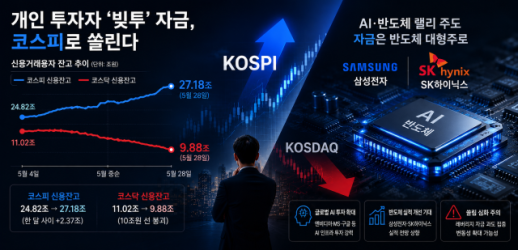 Investors Shift to KOSPI Amid Semiconductor Rally, KOSDAQ Margin Balance Falls Below 10 Trillion Won As the artificial intelligence (AI) semiconductor rally continues, individual investors are concentrating their leveraged investment funds in large-cap stocks on the KOSPI. With strong performances from Samsung Electronics and SK Hynix, margin trading balances on the KOSPI have risen, while those on the KOSDAQ have fallen below 10 trillion won. According to the Korea Financial Investment Association, as of May 28, the margin trading balance on the KOSPI was recorded at 27.184 trillion won, an increase of 2.367 trillion won from 24.816 trillion won on May 4. In contrast, the KOSDAQ margin balance decreased from 11.022 trillion won to 9.846 trillion won during the same period, falling below the 10 trillion won mark. Until early May, both the KOSPI and KOSDAQ margin balances were on the rise. However, since mid-May, the KOSPI margin balance has continued to grow while the KOSDAQ balance has declined, highlighting a clear divergence. Experts believe that the concentration of investments in the semiconductor sector due to the expansion of AI investments has prompted this shift in individual investors' funds. Kim Min-ki, a researcher at the Capital Market Research Institute, stated, "Recently, Samsung Electronics and SK Hynix have effectively driven the index up, but there are not many stocks that have actually risen. Individual investors are actively net buying on the KOSPI while selling on the KOSDAQ, leading to a movement of funds from KOSDAQ to KOSPI." He added, "In past liquidity-driven markets, funds tended to spread from large-cap to small-cap stocks, but currently, liquidity is concentrated solely on the AI and semiconductor themes. This trend is reflected in margin trading, with KOSPI balances increasing and KOSDAQ balances decreasing." The influence of the semiconductor sector on the stock market is growing stronger. According to Heo Jae-hwan, a researcher at Eugene Investment & Securities, the market capitalization share of domestic semiconductors has expanded from 25% in June of last year to 54% recently. It is also projected that semiconductors will account for the high 60% range of the total operating profit of the KOSPI this year. Heo noted, "The combined market capitalization of the three major memory semiconductor companies has surpassed 1 trillion dollars, yet their price-to-earnings ratios (PER) based on 12-month expected earnings remain at 6 to 10 times. This indicates a high investment appeal for the semiconductor sector." In the KOSDAQ market, a trend of capital outflow is also evident. The KOSDAQ index fell to 1,074.80 on May 29 and continued to decline, closing at 1,050.03. On that day, institutions continued to net sell major semiconductor-related stocks such as Rino Industrial, EoTechnics, Wonik IPS, and Juseong Engineering. Market analysts suggest that the ongoing global AI investment expansion and expectations for improved semiconductor performance may sustain the current trend of capital concentration for the time being. Kim remarked, "The global AI infrastructure investment cycle, led by companies like NVIDIA, Microsoft, and Google, remains strong, and the earnings outlook for Samsung Electronics and SK Hynix is being revised upward. Unless there are clear positive developments in other sectors, the current movement of funds is likely to continue in the short term." However, he cautioned, "The excessive concentration of leveraged funds in specific sectors and the rapid rise in stock prices could pose risks to the overall stock market in the future. As this concentration deepens, it is essential to be mindful of the potential for increased volatility."* This article has been translated by AI. 2026-06-01 15:36:00
 -
 Naver Enters Defense AI Market with New Initiative Naver is entering the defense artificial intelligence (AI) market. According to the IT industry on June 1, Naver Cloud has established a dedicated organization for defense AI transformation (AX) and is expanding its AI business tailored for the defense sector. This new team will be led by Kim Yoo-won, the CEO of Naver Cloud, who oversees all AI operations at Naver. Naver's move into the defense AI market is driven by the growing demand for sovereign AI and public AX solutions. The defense AI sector is sensitive to security and regulations, making it challenging to apply foreign cloud or overseas AI technologies, thus presenting opportunities for domestic companies. This shift allows Naver to establish a stable business-to-government (B2G) revenue base, moving away from consumer-focused AI services. After Naver Cloud was not selected for the Ministry of Science and ICT's 'Independent AI Foundation Model' support project, the company assessed that its infrastructure, models, and services could be effectively applied to the defense AI field. A Naver representative stated, "We believe that the defense AI sector is a suitable area for applying our capabilities across all fields from infrastructure to services, which is why we established a security organization. With our full-stack AI capabilities based on domestic cloud infrastructure, we are preparing to enter the defense sector." An industry insider noted, "It seems feasible to design cloud solutions or generative AI models specifically tailored for the defense environment. The government's increasing demand for defense AI will also positively impact Naver." However, there are cautious perspectives regarding the introduction of defense AI. The nature of defense is sensitive to security, making it difficult to approach simply by implementing high-performance AI models. Utilizing classified information for AI training or inference could lead to issues such as data leaks, misjudgments, and accountability concerns. Experts believe that AI utilization will proceed after classifying security levels and data grades, considering the defense environment. If discussions on collaboration between Naver and defense AX operations progress, a phased learning approach based on information types will be necessary. Initially, AI is expected to be used for administrative and operational improvements. Kwak Jin, a professor at Ajou University’s Cybersecurity Department, stated, "Defense AI can be utilized for both administrative and operational improvements, as well as in actual battlefield environments, so its application range is diverse. However, simply introducing AI does not solve all problems. In military contexts, caution is essential from the outset of the implementation process."* This article has been translated by AI. 2026-06-01 15:33:00
 -
 Early voting for local elections hits record high, but final turnout remains to be seen SEOUL, June 1 (AJP) - Early voting for South Korea's June 3 local elections wrapped up with a record-high turnout, fueling speculation that final turnout could surpass a previous record of 60.2 percent seen in the 2018 local elections, the highest level in nearly three decades. The National Election Commission (NEC) on Sunday said 10.49 million of the country's 44.64 million eligible voters cast ballots during the two-day early voting period held Friday and Saturday, for a turnout rate of 23.5 percent. The figure was 2.9 percentage points higher than the previous record of 20.6 percent set in the 2022 local elections. Since early voting was introduced nationwide in 2014, the highest early voting rate in any national election was 36.9 percent in the 2022 presidential election. South Jeolla Province recorded the highest early voting rate among the country's 16 major administrative regions at 39.0 percent, followed by North Jeolla Province at 35.1 percent and the southwestern city of Gwangju at 27.8 percent. The southeastern city of Daegu had the lowest turnout at 18.7 percent. Other southeastern regions, including Busan at 21.3 percent, North Gyeongsang Province at 22.4 percent and Ulsan at 22.5 percent, also fell below the national average. In the Seoul metropolitan area, Gyeonggi Province recorded 21.0 percent, Incheon 21.6 percent, and Seoul 23.8 percent. Early voting in 14 by-elections held alongside the local elections reached 24.1 percent, slightly higher than the rate for the local elections. Of the 2.26 million eligible voters, about 546,000 cast early ballots. Among the by-election districts, Buan, Gimje and Gunsan in North Jeolla Province recorded the highest early voting rate at 42.6 percent, followed by Buyeo, Cheongyang and Gongju in South Chungcheong Province at 30.2 percent. Busan Buk Gap, where candidates including the Democratic Party (DP)'s Ha Jung-woo, the conservative People Power Party (PPP)'s Park Min-sik and independent candidate Han Dong-hoon are competing, posted a relatively high early voting rate of 25.6 percent. Busan's fiercely contested Buk district, where candidates including Ha Jung-woo of the ruling Democratic Party (DP), Park Min-sik of the main opposition People Power Party (PPP) and independent candidate Han Dong-hoon are competing, saw a relatively high early voting rate of 25.6 percent. By contrast, Daegu's Dalseong district recorded the lowest early voting rate in the by-elections at 17.6 percent. Pyeongtaek in Gyeonggi Province, where candidates from five parties are running, also saw relatively low participation at 18.4 percent. Meanwhile, strong turnout has raised expectations that overall participation in this year’s local elections could rise significantly. Local elections in South Korea have traditionally seen lower turnout than presidential or general elections. Only two local elections have recorded turnout above 60 percent: the first nationwide local elections in 1995, which saw 68.4 percent turnout, and the 2018 local elections, which recorded 60.2 percent. In the 2022 local elections, final turnout was just 50.9 percent despite record early voting of 20.6 percent, suggesting that early voting mainly changed the timing of participation rather than significantly boosting overall turnout. Experts say the high early voting turnout reflects the establishment of stable early voting, as voters become more familiar with it. Ha Sang-eung, a professor of political science and international relations at Sogang University, said, "In effect, the voting period extends to three days when the two-day early voting period is counted." Ha predicted that final turnout would be higher than in the previous local elections, but not exceptionally high. "In closely contested regions, many people may still vote on election day even if early voting turnout is high. But in less competitive regions, turnout is unlikely to be high even if early voting participation is strong," he said. "Contrary to conventional wisdom, high turnout does not necessarily benefit any particular political party," he also said. "Especially in local elections, regional differences are significant, so a high overall turnout does not favor any specific party," he added. But Ha dismissed claims by some far-right conservatives linking early voting to election fraud as "the most absurd and groundless rumor imaginable." 2026-06-01 15:31:34
 -
 KakaoBank Partners with Seoul to Enhance Youth Financial Literacy KakaoBank announced on June 1 that it will collaborate with the Seoul Metropolitan Government to provide financial education aimed at enhancing the financial capabilities of youth.Under this agreement, KakaoBank and Seoul will implement tailored financial education and support programs for young people. Starting in May and running through September, the city will operate an 'Economics and Finance Academy' for approximately 360 youths across 21 municipal youth centers.The Economics and Finance Academy is designed to teach essential financial skills such as saving, investing, and spending. The theoretical classes will utilize custom-made materials that include case studies of KakaoBank's financial services. Additionally, hands-on practical sessions will be conducted using Nexon Korea's coding platform 'Hello Maple' for an engaging learning experience.Furthermore, beginning in July, the city will provide financial fraud prevention education, focusing on issues like voice phishing and illegal loans, to vulnerable youth at 19 youth shelters and independent living support centers. The program will also include 1:1 financial mentoring to assist youths in improving their financial habits and achieving economic independence.KakaoBank will offer access to the youth information platform 'Youth All-in-One' through its app, which provides information on youth experience programs and career and academic guidance. In addition to educational initiatives, KakaoBank plans to introduce youth-specific financial services called 'Mini' to attract potential customers.KakaoBank stated, "We have developed this initiative in partnership with Seoul to ensure that young people acquire essential financial knowledge and cultivate proactive financial habits. We will continue to support the healthy development of future generations in various ways."* This article has been translated by AI. 2026-06-01 15:24:00
 -
![[6·3 Local Elections] Democratic Party Targets Kim Kwan-young and Cho Kuk Ahead of Elections](https://image.ajunews.com//content/image/2026/06/01/20260601150336960630_518_323.jpg) [[6·3 Local Elections]] Democratic Party Targets Kim Kwan-young and Cho Kuk Ahead of Elections On June 1, as the June 3 local elections and National Assembly by-elections approach, the Democratic Party has intensified its efforts to counter independent candidate Kim Kwan-young and Cho Kuk of the Cho Kuk Innovation Party in Jeonbuk and Pyeongtaek, Gyeonggi Province. With the elections nearing, the party is mobilizing all resources to secure votes amid the rising momentum of progressive candidates. The Democratic Party emphasized that Kim Kwan-young's portrayal as a victim shows no signs of ending, reiterating that the party leadership's decision to expel him was justified. Spokesperson Han Min-soo stated in a briefing, "Kim has made statements suggesting that the party intentionally cut him off to promote candidate Lee Won-taek. If he spreads false information under the guise of victimhood, we will hold him legally accountable. How much more do we need to clarify? If there had been no illegal cash distribution, would there have been a reason to expel him?" Cho Sung-rae, the party's secretary-general, warned during a press conference that the Jeonbuk gubernatorial election is a contest between the ruling party and independent candidates. He stated, "Wise voters will choose the ruling party candidate, and even if Kim Kwan-young wins, he will have to face a re-election." Regarding Cho Kuk, who is in a tight race with candidate Kim Yong-nam in Pyeongtaek, Cho Sung-rae noted, "Kim Yong-nam has maintained his support despite the negative campaign from the Innovation Party. In fact, Democratic supporters in Pyeongtaek are rallying around Kim Yong-nam as the Democratic candidate." He added, "Party members supporting Kim Yong-nam should also support this candidate. Both candidates are receiving full backing from the party." Previously, on May 31, the Democratic Party had criticized both Kim Kwan-young and Cho Kuk, stating, "We cannot show leniency to someone who has been disciplined for illegal cash distribution," and urged Cho Kuk to compete under the name of the Innovation Party instead of hiding behind the Democratic Party's name. In response, Lee Hae-min, secretary-general of the Cho Kuk Innovation Party, held a press conference at the National Assembly, stating, "As the election draws to a close, they are resorting to name-calling." 2026-06-01 15:21:00
[[6·3 Local Elections]] Democratic Party Targets Kim Kwan-young and Cho Kuk Ahead of Elections On June 1, as the June 3 local elections and National Assembly by-elections approach, the Democratic Party has intensified its efforts to counter independent candidate Kim Kwan-young and Cho Kuk of the Cho Kuk Innovation Party in Jeonbuk and Pyeongtaek, Gyeonggi Province. With the elections nearing, the party is mobilizing all resources to secure votes amid the rising momentum of progressive candidates. The Democratic Party emphasized that Kim Kwan-young's portrayal as a victim shows no signs of ending, reiterating that the party leadership's decision to expel him was justified. Spokesperson Han Min-soo stated in a briefing, "Kim has made statements suggesting that the party intentionally cut him off to promote candidate Lee Won-taek. If he spreads false information under the guise of victimhood, we will hold him legally accountable. How much more do we need to clarify? If there had been no illegal cash distribution, would there have been a reason to expel him?" Cho Sung-rae, the party's secretary-general, warned during a press conference that the Jeonbuk gubernatorial election is a contest between the ruling party and independent candidates. He stated, "Wise voters will choose the ruling party candidate, and even if Kim Kwan-young wins, he will have to face a re-election." Regarding Cho Kuk, who is in a tight race with candidate Kim Yong-nam in Pyeongtaek, Cho Sung-rae noted, "Kim Yong-nam has maintained his support despite the negative campaign from the Innovation Party. In fact, Democratic supporters in Pyeongtaek are rallying around Kim Yong-nam as the Democratic candidate." He added, "Party members supporting Kim Yong-nam should also support this candidate. Both candidates are receiving full backing from the party." Previously, on May 31, the Democratic Party had criticized both Kim Kwan-young and Cho Kuk, stating, "We cannot show leniency to someone who has been disciplined for illegal cash distribution," and urged Cho Kuk to compete under the name of the Innovation Party instead of hiding behind the Democratic Party's name. In response, Lee Hae-min, secretary-general of the Cho Kuk Innovation Party, held a press conference at the National Assembly, stating, "As the election draws to a close, they are resorting to name-calling." 2026-06-01 15:21:00 -
 South Korea to Institutionalize Financial Counseling for Youth The South Korean financial authorities plan to institutionalize financial counseling for youth starting in the second half of this year, shifting youth financial policy from product support to integrated management. However, there are concerns about whether this counseling can effectively address the complex financial issues faced by young people, which include savings, loans, consumption, and investment.According to the financial sector on June 1, the Financial Services Commission and the Korea Financial Welfare Agency intend to launch the 'Financial Counseling for All Youth' program later this year. This initiative will provide tailored advice on asset formation, debt, and credit management based on the financial status of young individuals, including their income, expenditures, and debts. A pilot program was conducted from May 18 to 29 at three universities and three industrial complexes, and detailed operational plans are currently being developed.This marks a significant step forward from previous youth financial policies, which primarily focused on individual product support or one-time educational programs. Historically, youth financial policies have centered around policy financial products like the Youth Leap Account and Sunshine Loan for Youth, along with financial education programs.However, the reality of young people's financial lives is that savings, loans, consumption, and investments are often intertwined. Many young individuals use loans to cover rent and living expenses while simultaneously investing in stocks or cryptocurrencies. Critics argue that merely providing individual financial products is insufficient to resolve these complex financial issues.Given this context, the shift in policy focus from supplying individual products to assessing the overall financial situation of youth is seen as a positive development. The introduction of a preferential interest rate of 0.2 percentage points for those who complete financial counseling on the upcoming Youth Future Savings Account, set to launch on June 22, is also viewed as part of this integrated support system.Nevertheless, it remains uncertain whether financial counseling will lead to tangible policy outcomes. Experts point out that vulnerable groups, such as young individuals on the brink of default, those with multiple debts, and platform workers, often face barriers to accessing institutional counseling. They emphasize the need for a post-counseling management system that goes beyond simple advice to continuously monitor savings, debt, and credit management plans, linking them to policy financial support or debt adjustment systems.Kim Dong-hwan, a senior researcher at the Korea Financial Research Institute, stated, "To establish effective youth financial policies, it is essential to build a comprehensive and sustainable support system for self-reliance."* This article has been translated by AI. 2026-06-01 15:18:00
 -
 Cully Acquires AI Firm 1Z LABS to Accelerate AI Transformation Cully has acquired the artificial intelligence (AI) solutions company 1Z LABS to accelerate its AI transformation (AX). Cully announced on June 1 that it has decided to exchange shares with 1Z LABS to enhance its business competitiveness and operational efficiency through AI technology. The share exchange ratio for common stock between Cully and 1Z LABS is set at 1 to 1.8437990. To facilitate this, Cully will issue 453,518 new common shares. The share exchange date is scheduled for August 4. Following this, 1Z LABS will remain a wholly-owned subsidiary of Cully. Through this acquisition, Cully plans to expedite its efforts in automating operations and enhancing services based on AI. Cully is currently strengthening its AX capabilities across the organization. The company is working to integrate AI into its services, establish an AI governance framework, and identify new business opportunities and services based on AI. Cully and 1Z LABS are jointly developing creative AI, AI customer service (AICS), and an in-house advertising system to improve operational efficiency. Among these, AICS has been applied to Cully's one-on-one inquiries, with AI handling about 40% of customer inquiries, including cancellations and returns. To enhance AX execution, Cully has appointed Kwak Geun-bong, CEO of 1Z LABS, as the head of Cully's AX Center. A Cully representative stated, "Once 1Z LABS is fully integrated as a subsidiary, swift decision-making and close collaboration will allow us to advance our current AX action plan more rapidly." Cully CEO Kim Seul-ah emphasized, "We aim to lead innovation in the e-commerce market by combining commerce with AI technology." In the first quarter, Cully reported an operating profit of 24.2 billion won, a 1,277% increase compared to the same period last year. This figure represents 1.9 times last year's total operating profit. During the same period, sales rose by 28.4% to 745.7 billion won.* This article has been translated by AI. 2026-06-01 15:18:00
 -
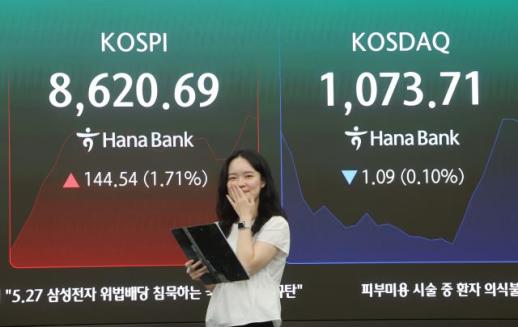 Young Investors Face Risks as Savings Become Insufficient for Financial Goals A 32-year-old man, known as A, invested his savings in stocks and virtual assets after completing his military service, achieving significant profits initially. He turned 600,000 won into 100 million won and later grew 400,000 won to 140 million won. However, in pursuit of even greater returns, he increased his investment scale and ultimately lost all his assets. In a recent television appearance, he expressed regret, stating, "I have been focused solely on coins for the past six years." As the perception grows that saving alone is insufficient for purchasing homes or funding weddings, the asset formation strategies among young people are rapidly changing. While traditional savings accounts were once the starting point for building wealth, there is now a strong trend toward investing in riskier assets like stocks and virtual currencies for quick returns. According to Mirae Asset Securities, the return rates for customer accounts holding over 1 million won from January 2 to May 7 this year showed that investors in their 50s had the highest return rate at 36.77%, followed closely by those aged 60 and above at 36.35%. In contrast, investors in their 20s and 30s reported much lower returns of 25.08% and 24.06%, respectively. This disparity is attributed to the investment tendencies of younger generations. Investors aged 50 and above tend to focus on high-quality domestic stocks, while those in their 20s and 30s are more inclined to invest in volatile thematic stocks, small-cap stocks, and leveraged ETFs, aiming for a significant payoff. Young investors are also actively participating in the highly volatile virtual asset market. According to the Financial Intelligence Unit's survey on virtual asset businesses, over half of the users trading virtual assets at the end of last year were in their 30s and 40s, with those under 20 accounting for 19%. The primary reason young people are turning to riskier assets is the belief that saving alone will not allow them to achieve their life goals. Housing prices in Seoul and the surrounding metropolitan area remain high, and the financial burden of marriage and child-rearing is increasing. As the perception grows that saving a salary is insufficient to keep pace with rising asset prices, funds are shifting toward investment markets that promise higher returns. The issue is that when risky asset investments combine with the fragile cash flow of young people, the impact can be significantly greater. Without sufficient assets or a stable income base, investment losses can lead to a lack of buffers to absorb the shock. Consequently, there is a heightened likelihood of relying on overdraft accounts, credit card loans, or small personal loans to cover losses or living expenses. Experts emphasize the need for a financial safety net to reduce excessive risk-taking while expanding asset formation opportunities for young people. In a situation where the starting point for asset formation is unstable, relying solely on short-term high-return investments is unlikely to secure financial stability. Im Na-yeon, a researcher at the Capital Market Research Institute, stated, "As capital markets become a key means of asset accumulation, the gap in financial asset size and management methods formed during youth could lead to more severe asset inequality in the future. It is crucial to implement policy efforts that support the practical financial asset formation of low- to middle-income young people to prevent this gap from widening."* This article has been translated by AI. 2026-06-01 15:12:00