

Journalist

Jong Eun Lee
-
 Investigators Suspect Gas Explosion in Uiwang Apartment Fire That Killed 2 Authorities said a gas explosion is the leading suspected cause of an apartment fire in Uiwang, south of Seoul, that killed two people and injured six others. Police, fire officials and the National Forensic Service inspected the unit on the 14th floor where the fire started and confirmed the kitchen gas valve was open, officials said. With no flammable materials found at the scene, they are presuming the blaze was triggered by a gas explosion. The fire broke out with an explosion about 10:30 a.m. the previous day in the 20-story apartment building with one basement level. A man in his 60s who lived in the 14th-floor unit, identified only as A, died after falling. His wife, in her 50s, was found dead in a bathroom. Authorities believe she had already died before the fire. Six other residents suffered minor injuries, including smoke inhalation. After receiving the report, fire authorities issued a Level 1 response and deployed about 30 pieces of equipment and about 110 personnel. The fire was fully extinguished about two hours later, at 12:35 p.m. A note was reportedly found on A’s clothing describing personal despair, including financial hardship.* This article has been translated by AI. 2026-05-01 16:57:07
 -
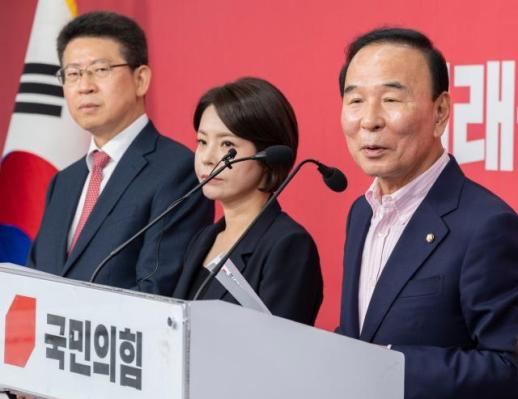 People Power Party Nominates Lee Jin-sook, Lee Yong for June 3 By-elections; Park Min-sik to Face Primary The People Power Party on April 30 finalized candidates for seven of the districts holding June 3 parliamentary by-elections, including Daegu Dalseong. Lee Jin-sook, who previously served as chair of the Korea Communications Commission, was nominated in Daegu Dalseong, and Lee Yong, a former lawmaker, was nominated in Gyeonggi Province’s Hanam Gap. The party put nominations on hold in South Chungcheong’s Gongju-Buyeo-Cheongyang, where Chung Jin-suk, who previously served as presidential chief of staff, applied. The party’s nomination committee met at headquarters in Seoul’s Yeongdeungpo district and approved screening results for eight by-election districts. It decided on single-candidate nominations for Lee in Daegu Dalseong; Park Jong-jin, head of the party’s Incheon chapter, in Incheon Yeonsu Gap; Shim Wang-seop, chairman of the Environmental Landscaping Development Foundation, in Incheon Gyeyang Eul; Ahn Tae-uk, who previously led the party’s Gwangju chapter, in Gwangju Gwangsan Eul; Kim Tae-gyu, who previously served as vice chair of the Korea Communications Commission, in Ulsan Nam Gap; Lee Yong in Hanam Gap; and Ko Gi-cheol, head of the party’s Jeju chapter, in Jeju Seogwipo. In Busan Buk Gap, where former party leader Han Dong-hoon is running as an independent, the party said its nominee will be chosen through a primary between Park Min-sik, who previously served as minister of patriots and veterans affairs, and former KBS reporter Lee Young-pung. In Gongju-Buyeo-Cheongyang, seven people applied for the nomination, including Chung. The committee said it would suspend screening after an objection was filed. Committee chair Park Deok-heum said the matter was being handled through party ethics procedures and that a final decision would be made on May 7. The party also said it would reopen applications in North Jeolla’s Gunsan-Gimje-Buan district. The party accepted applications for the by-elections on April 30 and announced single-candidate picks a day later. While it had initially emphasized primaries, only one of the eight districts will hold a primary under the plan announced Friday. The nominations also included figures some classify as aligned with former President Yoon Suk Yeol, prompting renewed debate over a so-called “Yoon again” push. Kim Hyun-jung, floor spokesperson for the Democratic Party, said in a written briefing that the People Power Party had promised to break with the Yoon Suk Yeol government but was “returning to ‘Yoon again,’” and urged the party to “clear out” those forces if it was serious about reform. Asked about the controversy, Park said he was not sure “who is ‘Yoon again,’” adding that the party selected candidates with strong overall results based on document reviews and interviews. Separately, the committee nominated incumbent Mayor Lee Beom-seok for the North Chungcheong city of Cheongju. It said it would reopen recruitment for mayoral candidates in Siheung, Gyeonggi Province, and Jeonju, North Jeolla Province. The single-candidate recommendations announced Friday will be finalized after approval by the party’s supreme council.* This article has been translated by AI. 2026-05-01 16:18:19
 -
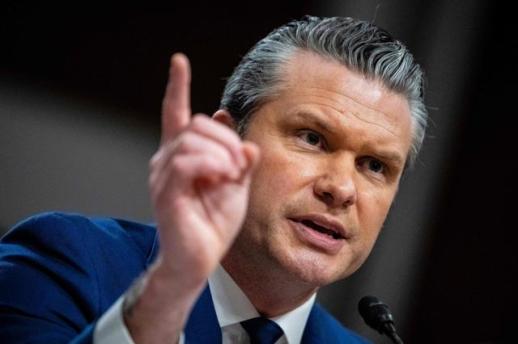 U.S. Tests Its Own War Rules as Trump Administration Cites Iran Ceasefire Wars are often launched in the name of principle, but when major powers act, they can also reshape the meaning of order itself. That is the argument now surrounding the Trump administration’s approach to the Iran war and its claim that military action can remain legitimate even at the edge of U.S. law and international norms. At the center is the War Powers Resolution, which requires a president to end military action within 60 days or obtain congressional approval if Congress has not authorized it. The Trump administration argues that the “60-day clock” stops during a ceasefire with Iran. Defense Secretary Pete Hegseth told a Senate hearing that “in a ceasefire, the 60-day count is paused.” Criticism has been sharp. Opponents question how continued maritime blockade and military pressure can be treated as a nonwar situation. Under international law, a blockade is widely regarded as an act of war. In Washington, skepticism has come not only from Democrats but also from some Republican lawmakers. The administration’s position, however, is framed as strategic rather than simply dismissive of legal limits. Washington does not describe the situation as a new war of aggression. In its view, Iran is not only a Middle Eastern state but a strategic factor that could threaten the Strait of Hormuz, a key artery for global energy flows. If the strait is destabilized, the broader international economy could be jolted. The United States casts its actions not as a regional fight but as a deterrence operation to protect maritime order and energy security. The logic is straightforward: “If we do not act, the global economy will pay a higher price.” Trump allies also argue that today’s security environment differs from the Cold War era. Cyberattacks, drones, asymmetric capabilities and threats of maritime blockade can disrupt markets and supply chains within hours. In that setting, they say, waiting for extended congressional debate and approval does not match reality, and the president needs the ability to act quickly as commander in chief. U.S. constitutional practice has long moved in that direction. After the Vietnam War, Congress passed the War Powers Resolution to limit presidential authority. Yet subsequent presidents repeatedly carried out military operations in Libya, Syria, Iraq and Afghanistan without an explicit congressional declaration of war, reflecting how U.S. power has often moved faster than statutory language. That history also helps explain international unease. Critics say the United States condemns power politics by China and Russia while seeking to exercise “exceptional authority” itself. Washington’s view is different: It sees itself not merely as another country but as the ultimate guarantor of the international order — both subject to rules and responsible for acting to prevent their collapse. That is a central dilemma of U.S. hegemony today. Markets, meanwhile, are already pricing in the costs. Oil prices and shipping rates have been unstable, and supply-chain risks are rising again. Economies heavily dependent on energy imports, such as South Korea’s, are especially sensitive. Central banks are again being pushed into difficult choices between inflation and slowing growth. Even so, the United States has not backed down. Washington fears costs larger than those already visible. If a perception spreads that the United States cannot control risks around the Strait of Hormuz, confidence in the dollar system and in the credibility of the U.S. security umbrella could be shaken. That, the argument goes, is why the Trump administration is maintaining a hard line despite congressional disputes and international legal criticism. The core issue is not only whether the actions are legal. International order is not sustained by norms alone. Rules without power can become mere declarations, while power without rules can slide into arrogance. The United States is now walking that boundary — and the global economy is being buffeted by the strain. * This article has been translated by AI. 2026-05-01 15:33:23
 -
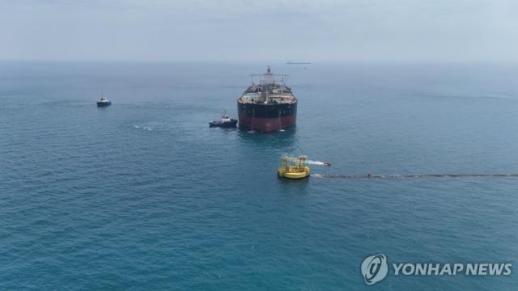 Understanding Iran's Strategy in the Strait of Hormuz: Geopolitical Implications To understand Iran, one must first look beyond the map and delve into its history. A single strait cannot encapsulate this nation. Iran's perspective is always focused on the road ahead. The road is not merely a passage; it represents a structure of power, the flow of wealth, and the center of order. Persia has long stood at the crossroads of Eastern and Western civilizations. Rather than expanding its territory, it sought to control the routes and manage the flow of goods. This memory persists today. The modern Strait of Hormuz embodies this historical legacy. Recently, some members of the Iranian parliament suggested, "Let’s buy oil passing through Hormuz at $110 and sell it at $200." This notion is not merely a random thought; it reflects a deeper issue of control rather than just price, resembling a geopolitical declaration rather than simple market logic. The ancient Silk Road principle that those who control the passage set the prices has been revived. Iran does not see itself merely as a nation in the Middle East; beneath its collective memory lies an imperial consciousness that asserts, "We were the masters of the road, and we must reclaim our central position." Ancient Persia accumulated wealth through two primary methods: tolls and intermediary trade. Those who controlled the routes imposed fees on passing caravans, blocking or plundering them if they refused to pay. The second method involved securing goods from mountainous regions, re-pricing them at strategic locations for profit. These methods were not mere commercial practices but exercises of structural power, determining who could pass, what costs were justified, and what was permissible. Today's strategy in the Strait of Hormuz closely mirrors these two pillars. The 'toll' that Iran suggests is not merely monetary; it encompasses currency systems, payment networks, and financial sovereignty. The mention of not only the dollar but also the yuan, euro, and rial indicates an intention to diversify payment systems. This resembles the financial and information networks established by Sogdian merchants along the ancient Silk Road. When logistics, finance, information, and diplomacy converge into a single network, the road transforms from a mere passage into a platform. Iran is now attempting to redesign that platform. Logically, this strategy appears consistent. The Strait of Hormuz is a vital artery, with over 20% of the world's maritime oil traffic passing through it. While alternative routes exist, they cannot be fully replaced in the short term. Historically, nations controlling such passages have demanded costs. However, the challenge lies in the dissonance between logical validity and practical feasibility. The most significant difference between the past and present is the counterpart. In the past, the counterpart was trade groups with limited means of retaliation. Today, the counterpart is nation-states, particularly the United States and the G7, backed by global naval power. International law exists, and both financial sanctions and military responses are in play. While the power of controlling the passage remains, the costs of exercising that power have escalated dramatically compared to the past. This is where the concept of 'reverse blockade' by the United States comes into play. Attempts to close Hormuz will inevitably clash with the force that seeks to keep it open. The U.S. possesses the capability to militarily ensure the passage remains open, going beyond merely protecting the strait. In a structure where maritime insurance, financial networks, and global shipping orders are controlled, a blockade risks self-harm. The longer a blockade persists, the more accelerated the release of strategic oil reserves and the establishment of alternative supply chains become, potentially diminishing the strategic value of the passage itself over time. The figure of "$200" proposed by Iran encapsulates this dilemma. To raise prices, supply must be restricted. However, the moment supply is curtailed, the international community will respond immediately. Consequently, attempts to raise prices paradoxically deplete negotiating power. Excessive tolls along the ancient Silk Road prompted the exploration of new routes. The historical transition from the overland Silk Road to maritime routes, and Portugal's discovery of the Cape of Good Hope, which disrupted the intermediary trade order, reiterate the same lesson. When those who control the road cannot restrain their greed, the road itself may vanish. Shifting focus to the present, all these theories are already being tested in reality. The Strait of Hormuz has become not just a historical metaphor but the heart of a world economy in turmoil. As of 2026, this strait embodies a battlefield where actual control, blockades, and reverse blockades are simultaneously at play. Iran selectively opens and closes the strait, controlling passage, while the U.S. responds by blocking vessels entering Iranian ports. Traffic has noticeably decreased, with some ships turning back or rerouting, and others engaging in what is termed 'shadow navigation' by turning off their signals. Oil prices have reacted sharply, surging in the short term, and financial and maritime insurance markets are experiencing ripple effects. This is not merely a blockade; it is a 'modern Silk Road war' over control of the passage. Iran's approach is clear. It does not completely sever the road but maximizes uncertainty. Some vessels are allowed passage while others are blocked, thereby controlling both price and fear. This is the essence of the 'gray zone gateway control strategy.' However, this time, a decisively different scenario is unfolding. In ancient times, those who controlled the road held absolute power, but that is no longer the case. The U.S. is responding by blocking Iranian ports without directly closing the strait. Thus, while Iran holds the 'entrance,' the U.S. has seized control of the 'exit.' This situation is not merely a military clash; it is a high-stakes strategic game over 'control of the road.' Iran's calculation is clear: to maintain a grip on the upper price limit without fully closing the strait. The idea of "buying at $110 and selling at $200" is a condensed expression of a strategy to secure pricing power through control of the passage. Yet, reality is far more complex than logic. The longer a blockade lasts, the more the international community will respond. The release of strategic oil reserves, diversification of supply chains, and enhanced military escorts will occur simultaneously. Some logistics will shift to long-distance detours, increasing costs but not entirely halting the flow. Ultimately, control may raise prices but simultaneously weaken the exclusive value of the passage. This is where China's calculations come into play. While China is an ally of Iran, it is also the world's largest energy importer. Iran's control may enhance its negotiating power in the short term, but long-term instability could be detrimental to the Chinese economy. Therefore, China adopts a 'dual strategy,' cooperating in payment networks while promoting diversification in supply chains, neither fully supporting Iran nor completely aligning with U.S. interests. Ultimately, Iran, the U.S., and China are each pursuing the same goal through different means: 'to dominate the road.' Iran seeks physical control, the U.S. aims for military and financial order, and China focuses on payment and supply chain dominance. The point of collision for these three powers is the Strait of Hormuz. The essence of this conflict is not about guns and missiles but about who opens the road, who blocks it, and who determines the costs. The answer to this question remains unresolved. Iran is holding firm, the U.S. is tightening its grip, and China is calculating its next move. However, one undeniable fact remains unchanged: the road is power. But the moment that road is held too tightly, the world will inevitably seek alternative routes. Iran's 5,000-year history has repeatedly demonstrated this truth. And now, that ancient principle is once again being tested. 2026-05-01 15:21:18
 -
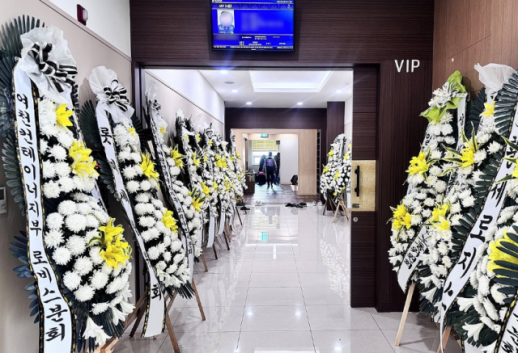 Funeral Begins for Cargo Truckers Union Member Killed at Jinju Logistics Center Rally Funeral rites began May 1, Labor Day, for a Cargo Truckers Union member who died at a rally outside the BGF Logistics CU distribution center in Jinju, South Gyeongsang Province. Yonhap News Agency reported that the South Jeolla headquarters of the Korean Confederation of Trade Unions set up a memorial altar that afternoon at a funeral home in Suncheon, South Jeolla Province. The start of the funeral came 11 days after the union member was killed April 20 when struck while trying to block a transport vehicle at the rally. It also coincided with the first Labor Day designated as a legal public holiday by the Ministry of Employment and Labor. The funeral is being held as a joint labor and civic society service, with the memorial altar to remain open through May 3. To honor the deceased, the union will hold a memorial cultural event at 7 p.m. May 2 on a road near the funeral home. About 500 union members and residents who knew the person are expected to attend, with eulogies and performances by labor singers planned. The funeral procession is scheduled for the morning of May 3. After cremation in Gwangyang, South Jeolla Province, the remains are to be buried at the Mangwol-dong National Cemetery for Democratic Martyrs in Buk District, Gwangju.* This article has been translated by AI. 2026-05-01 14:42:16
 -
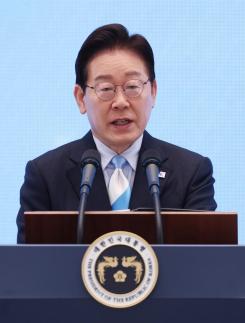 Lee Jae-myung says voice phishing losses down, vows to push toward zero President Lee Jae-myung, citing recent reports that voice phishing losses have fallen, said it was "truly fortunate" that public losses dropped in a short period and praised government workers for their efforts. In a post Thursday on X, formerly Twitter, Lee shared a news report saying voice phishing losses in January-March fell 45% from a year earlier, attributing the decline to results from arrests focused on higher-level figures. "This is thanks to the dedication of frontline public officials, including the police, the National Intelligence Service and the Foreign Ministry," Lee wrote. "You worked hard. Thank you." He added, "We should work a bit more until losses reach zero," and asked the public to encourage civil servants, saying they would do so. In March, Lee told aides in a meeting that voice phishing was one of the "seven major abnormalities" and ordered swift implementation of measures to eradicate the crime.* This article has been translated by AI. 2026-05-01 14:39:16
 -
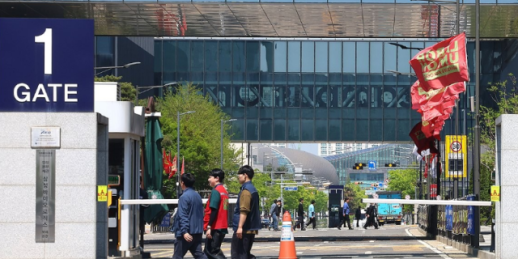 Samsung Biologics union launches first full strike as labor dispute escalates Samsung Biologics’ labor union began its first full strike since the company’s founding, intensifying a standoff in which both sides are trading blame. The union says management is responsible and is urging talks, while the company is calling for restraint and warning of heavy losses. Yonhap reported May 1 that the Samsung Biologics branch union will hold a five-day full strike from May 1 through May 5. Rather than a traditional walkout, members are participating by using annual leave. The union said about 2,800 of its roughly 4,000 members have indicated they will take part. The Songdo plant area in Incheon appeared quieter than usual, with only some employees seen entering and leaving. Banners and flags reading “ONE TEAM ON STRIKE” were posted inside the facility. While essential staffing is being maintained due to the nature of biopharmaceutical production, overall operations appeared subdued. The union said the dispute is rooted not in wages but in what it called management failures. It cited decisions that did not reflect conditions on the ground, chronic understaffing and excessive cost-cutting as factors that hurt competitiveness. The union said it sought negotiations for more than a month after mediation broke down, but the company focused on legal action and pressure instead of substantive talks. “If the company is concerned about losses and damage to customer trust, it should not shift responsibility to employees but come to the negotiating table,” the union said, calling for an immediate resumption of bargaining. The company has said a prolonged strike could result in losses of up to 6.4 trillion won. A previous partial strike in the material aliquoting unit disrupted production of 23 products, including anticancer drugs and HIV treatments, and was expected to cause about 1.5 trillion won in losses, according to the report. Chief Executive John Rim issued an apology message to employees the previous day, saying a strike is an individual choice but could have impacts that would be difficult for both the company and its members to recover from. He urged careful judgment and said the company would continue dialogue with the union to rebuild trust. The two sides have held more than 10 rounds of talks since late last year without reaching an agreement. The company sought a court injunction to ban strike action over concerns about production disruptions, and the court limited strikes only in some core processes. Labor and management are scheduled to meet again May 4 to discuss the direction of negotiations, but with positions far apart, a quick compromise remains uncertain.* This article has been translated by AI. 2026-05-01 14:06:00
 -
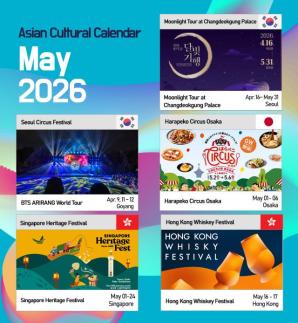 Asian Culture Calendar SEOUL, April 30 (AJP) - South Korea Apr. 8 - May 27 Gyeongbokgung Saenggwabang Apr. 16 - May 31 Moonlight Tour at Changdeokgung Palace May. 2 - 3 Ajou Motor College Festival May. 4 - 5 Seoul Circus Festival May. 5 - 10 Hangang River Festival May. 13 - 24 Suragan Sisik Gonggam May. 16 - 17 Yeon Deung Hoe May. 22 - 25 Hwaseong Boating Festival Japan May. 1 - 6 Harapeko Circus Osaka May. 2 - 3 Nyanko Expo May. 2 - 5 Saku Hot-Air Balloon Festival May. 3 - 4 Hakata Dontaku Festival May Hong Kong May. 16 - 17 Hong Kong Whiskey Festival May. 24 Cheung Chau Bun Festival Singapore May. 1 Mayday SG Festival 2026 May. 1 - 24 Singapore Heritage Festival May. 15 - 30 Singapore International Festival of Arts (SIFA) 2026-05-01 13:33:03
 -
 South Korea's exports top $80 billion for second straight month SEOUL, May 01 (AJP) - South Korea's exports surged 48 percent year-on-year in April to $85.89 billion, breaching the $80 billion threshold for a second consecutive month as a semiconductor supercycle powered by global artificial intelligence investment continued to underpin the trade-dependent economy. The Ministry of Trade, Industry and Energy reported Friday that the April figure trailed only the all-time high of $86.6 billion set in March, making it the second-largest monthly tally on record. Imports rose 16.7 percent to $62.11 billion, yielding a trade surplus of $23.77 billion and extending the country's streak of monthly surpluses to 15. Chip shipments drove the bulk of the gains. Semiconductor exports soared 173.5 percent to $31.9 billion, eclipsing the $30 billion mark for a second month in a row on surging demand for high-bandwidth memory, DDR5 and NAND flash used in AI server infrastructure. Computer exports also rocketed 515.8 percent to $4.08 billion, propelled by brisk enterprise demand for solid-state drives. Rising crude oil prices stemming from the prolonged Middle East conflict lifted petroleum product exports by 39.9 percent to $5.11 billion, though analysts noted the increase was driven largely by unit-price gains rather than higher volumes. Automobile shipments, by contrast, slipped 5.5 percent amid logistics disruptions in the Middle East and the overhang of U.S. tariff measures. By destination, exports to China jumped 62.5 percent on robust appetite for semiconductors and IT products, while shipments to the United States climbed 54 percent on the strength of chips and computers. Exports to the Middle East, however, tumbled 25.1 percent as the war disrupted trade routes. "South Korea saw its monthly exports surpass the $80 billion mark, along with a trade surplus of over $20 billion, for the second straight month for the first time in history in April even amid the persisting conflict in the Middle East," said Kim Jung-kwan, Minister of Trade, Industry and Resources. Analysts cautioned that the export boom remains heavily tethered to semiconductors and elevated oil prices, leaving it vulnerable to additional U.S. tariffs, a protracted Middle East war and a broader global slowdown in the second half of the year. 2026-05-01 12:59:59
 -
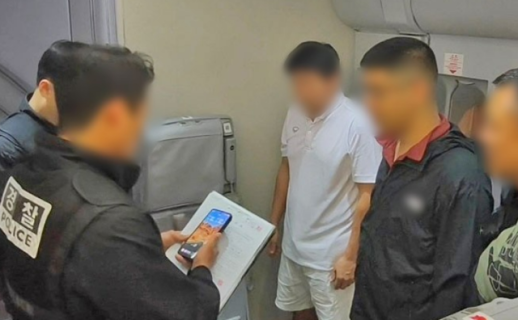 Alleged Supplier to ‘Drug Kingpin’ Park Wang-yeol Deported From Thailand to South Korea A man in his 50s accused of supplying drugs to Park Wang-yeol, described by police as a “drug kingpin,” has been arrested in Thailand and sent back to South Korea, authorities said. Investigators said securing the alleged key supplier will help expand the probe into the broader distribution network. The National Police Agency said Choi, 51, arrived at Incheon International Airport on May 1. Wearing a hat and mask, he was escorted by officers and did not answer reporters’ questions before being taken to investigators. Police said Choi used the Telegram names “Cheongdam” and “Cheongdam Boss” and is suspected of bringing into South Korea, or taking part in distributing, about 22 kilograms of methamphetamine and other drugs since around 2019. The drugs were valued at 10 billion won, police said, an amount they believe could support hundreds of thousands of doses. Police said they identified Choi as a major supply line while questioning Park after Park was deported from the Philippines. The Gyeonggi Nambu Provincial Police Agency consolidated related cases and tracked Choi after obtaining information that he was in Thailand. Authorities are also investigating how he stayed overseas without an official record of leaving South Korea. South Korean and Thai investigators narrowed the search to the Samut Prakan area near Bangkok and arrested Choi after surveillance in an upscale residential neighborhood, police said. He was detained on allegations of illegal stay, and deportation procedures moved quickly. Police said an arrest warrant was served as he returned on a Korean airline. At the time of his arrest, police said they seized a passport in another person’s name and 13 mobile phones. Investigators plan digital forensic analysis to check for additional crimes and possible accomplices, and to examine how the passport was used and the actual travel process. Police said they will focus on clarifying the supply structure and the scale of transactions centered on the alleged link between Choi and Park, including whether there were overseas production or distribution bases. Authorities said they are also tracing money flows with relevant agencies and will move to recover confirmed illegal proceeds. Police said they are considering seeking a warrant to detain Choi. “We are continuing the investigation under the principle that we will track and arrest suspects to the end even if they are overseas,” a police official said. “We will concentrate our investigative resources on identifying the entire drug distribution organization.”* This article has been translated by AI. 2026-05-01 12:00:12