
Journalist

Kwon Gi-won
-
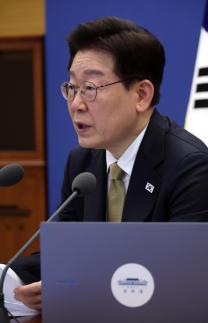 President Lee Calls for Reform of Agricultural Cooperatives Amid Corruption Issues President Lee Jae-myung on May 14 criticized the opaque decision-making structure and corruption issues within agricultural cooperatives, urging swift reforms including direct elections for members.During a senior advisors meeting at the Blue House, President Lee stated, "The transformation of rural areas and agriculture must begin with correcting the structural ailments present in our agricultural sector."He identified the normalization of agricultural cooperatives as a prerequisite for this transformation."Normalizing agricultural cooperatives, which support the foundation of agriculture, is of utmost importance," President Lee emphasized. "Agricultural cooperatives have a significant responsibility to protect farmers' rights and promote sustainable rural development."He acknowledged, however, that the current situation is lacking. "Due to the opaque decision-making structure and corruption among some employees, we have continuously faced criticism for not fulfilling our fundamental roles," he noted.President Lee called for a return to a farmer-centered organization. He stated, "We must quickly return the agricultural cooperatives, built by the sweat and dedication of farmers, back to the farmers themselves."He also stressed the need for rapid improvements in governance from the perspective of member sovereignty and the swift implementation of normalization measures, including strengthening democratic oversight.President Lee urged, "Please accelerate reforms such as direct elections for members, so that agricultural cooperatives can truly become leaders in agricultural development and improving the quality of life for farmers."Additionally, President Lee expressed condolences regarding the recent murder of a high school student in Gwangju, saying, "I pray for the victim and extend my deepest sympathies to the bereaved family."He also wished for the quick recovery of another student who was injured, emphasizing the need for a comprehensive response to crimes targeting vulnerable groups, including youth and women. "We must declare a war on such crimes and significantly strengthen our prevention and response systems," he asserted.President Lee stated, "Until public anxiety is alleviated, we will continue thorough special security operations in areas of crime concern, and we will take strict action against online harassment targeting victims." He added, "I once again pray for the victim's soul, and I hope all public officials will commit themselves to ensuring the safety of the nation, which is our primary duty."Earlier, on May 5, at around 12:11 a.m., a suspect named Jang Yoon-ki was arrested for fatally stabbing a 17-year-old high school student, identified as A, near a university in Gwangju's Gwangsan District. Jang also seriously injured another 17-year-old student, B, who came to A's aid upon hearing her screams.The Gwangju Police Agency announced that starting at 7 a.m. that day and continuing for 30 days until June 12, they would post Jang's name, age, and mugshot on their website.* This article has been translated by AI. 2026-05-14 20:34:31
 -
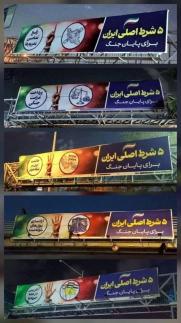 Iran Displays 'Five Key Conditions for Ending War' in Tehran, Excluding Nuclear Issues A large sign outlining Iran's key conditions for ending the war has appeared in the capital city of Tehran. According to local media, including Eghtesad News, the sign, installed on major roads and overpasses in Tehran, lists the "Five Key Conditions for Ending the War" under its title. The conditions proposed by Iran include: 1) Lifting all sanctions, 2) Payment of war reparations by adversaries, 3) Establishing Iran's control over the Strait of Hormuz, 4) Release of frozen funds, and 5) Ending conflicts on all fronts. These demands align with the consistent assertions made by Iranian leadership in negotiations with the United States regarding ending the war. The public display of these conditions on a large sign can be seen as a confirmation of Iran's commitment to uphold these demands in negotiations with the U.S. Notably, the five key demands do not include any references to Iran's nuclear program. Previously, Iran suggested prioritizing immediately actionable issues, such as the reopening of the Strait of Hormuz and a ceasefire in Lebanon, while postponing the more complex negotiations regarding its nuclear program until after the war is concluded. In contrast, the United States views the nuclear issue as a central point in the negotiations. U.S. Vice President JD Vance stated at a White House press briefing that while he believes progress is being made in negotiations with Iran, the fundamental question remains whether sufficient advancements can be made to satisfy the red lines set by President Donald Trump.* This article has been translated by AI. 2026-05-14 20:32:54
 -
 Seragem Establishes 'Recovery Lounge' to Support National Athletes Seragem has upgraded the experience zone at the Jincheon National Training Center, creating the 'Seragem Champions Recovery Lounge.'According to Seragem, the newly unveiled 'Seragem Champions Recovery Lounge' features a complete renovation of the existing space under the slogan, "A new level of relaxation completes victory." The lounge includes the latest healthcare products, such as the premium massage chairs from the 'Pauze M Collection' (M10, M8 Fit, M6) and spinal care medical devices from the 'Master V Collection' (V7, V5), all aimed at supporting athletes' recovery and performance enhancement through relaxation.The Pauze M Collection chairs utilize patented direct heating technology to quickly deliver thermal stimulation, aiding muscle relaxation and recovery. They help alleviate tension in key areas such as the neck, shoulders, and back, providing an effective environment for fatigue recovery and condition management before and after training. The Pauze M10 is designed to focus on the neck, shoulders, and back simultaneously, while the Pauze M8 Fit offers customizable styling options with 12 different side cover choices to harmonize with the lounge's interior. The Pauze M6 features a built-in design that enhances space utilization by eliminating armrests and hiding the footrest.The Master V Collection spinal care devices provide deep, targeted massages for the back, neck, and shoulders. These products have been recognized by the Ministry of Food and Drug Safety for their effectiveness in aiding the treatment of herniated discs, degenerative stenosis, and muscle pain relief, which can help alleviate physical strain during training and assist in recovery management. As a result, it is expected that national athletes will benefit from improved spinal care and muscle pain relief during their training.Prior to establishing the 'Seragem Champions Recovery Lounge,' Seragem has collaborated with the Korean Sports Council to support the condition management of national athletes and promote the expansion of domestic sports. In August 2023, Seragem signed an agreement with the Korean Sports Council to donate 13 healthcare appliances to the Jincheon National Training Center, creating a relaxation space. They also plan to provide an experience zone for the national team training camp ahead of the 2024 Paris Olympics.Meanwhile, thanks to its diversified business strategy, Seragem reported consolidated revenues of 549.8 billion won and an operating profit of 25.8 billion won last year. Revenue increased by 0.7% year-on-year, while operating profit surged by 1,091%. The net profit was 1.9 billion won, marking a return to profitability.A Seragem representative stated, "We focused on restructuring the space into a relaxation-centered environment that directly impacts athletes' performance. We plan to continue supporting athletes in achieving their best condition on the world stage through our collaboration with the Korean Sports Council."* This article has been translated by AI. 2026-05-14 20:31:15
 -
 Vietnam Turns to Korean Agricultural Model Amid Durian Export Challenges As China's tightened cadmium import standards disrupt durian exports from Vietnam's Dong Thap province, local authorities are looking to a "Korean-style soil restoration model" as a solution. The aim is to shift focus from agricultural expansion to improving soil quality itself. According to Vietnamese media outlet Zing News on May 13, the Dong Thap People's Committee is establishing a laboratory to analyze agricultural soil quality and is developing a long-term plan for tailored improvement strategies for different crops. This initiative comes in response to China's strict enforcement of a cadmium limit of 0.05 mg/kg for imported fruits, increasing the demand for quality control from the production stage. Nguyen Phuc Tien, vice chairman of the Dong Thap People's Committee, stated that the cadmium residues in durians are a result of long-term soil contamination from farming practices. He emphasized the need to review the management of cultivation area codes and promised strict measures against regions that do not comply with regulations. Additionally, he proposed a plan to periodically analyze soil samples by cultivation area, similar to practices in South Korea. Deputy Minister of Agriculture and Rural Development Bo Van Hung also identified the source of the problem during a "2026 Export Promotion Meeting" held over the weekend. He noted that "the fundamental cause of cadmium contamination is primarily the residues left in the soil," stressing the need for soil improvement research, crop rotation, and control of input materials. He added that, in the short term, the management system would be refined to prevent logistics disruptions due to inspection delays. Experts believe that the current situation reflects accumulated gaps in the management of fertilizers and pesticides. Nguyen Dang Nghia, former director of the Tropical Agriculture Research and Consulting Center, remarked that "the current crisis clearly shows the results of uncontrolled expansion in the durian industry over the years." He pointed out that cadmium naturally exists in soil and is also found in some fertilizers and pesticides. He explained that the high cadmium content in certain imported DAP fertilizers used in the Mekong Delta, along with saline intrusion at the end of the dry season and prolonged use of phosphate fertilizers, has compounded the issue. Interest in Korean Soil Restoration Policies In this context, South Korea's soil restoration policies are being presented as a reference model. This strategy focuses on improving soil quality rather than merely increasing production area. South Korean agriculture has transitioned from excessive use of chemical fertilizers and pesticides to prioritizing the restoration of natural soil fertility. In this process, organic fertilizers, compost, and microbial agents have been actively utilized to enhance organic matter content and beneficial microbial environments. The core of the Korean model lies in a technology-based precision management system. Farmers regularly analyze their soil to assess nutrient content, pH levels, organic matter content, and chemical residue risks. Based on these results, specialized institutions provide specific recommendations on the types and amounts of fertilizers and cultivation methods. This approach allows for tailored management that reflects regional characteristics. Nghia noted that soil restoration technologies have already been implemented in Vietnam. He described biochar as a high-carbon material created by pyrolyzing biomass in oxygen-limited environments, which can help stabilize pH and capture heavy metals when added to soil. He also mentioned that some companies are implementing models that combine cadmium-free selective fertilizers with biochar, which are gradually spreading to the Mekong Delta region. Meanwhile, durian has already established itself as a key crop in Vietnam's agricultural exports. Thus, the cadmium issue is seen not merely as a one-time setback but as a turning point that could reshape the entire industry. Attention is focused on how the advanced agricultural policies modeled after South Korea, encompassing soil diagnosis, restoration, and cultivation area code management, will yield results in Dong Thap province.* This article has been translated by AI. 2026-05-14 20:29:52
 -
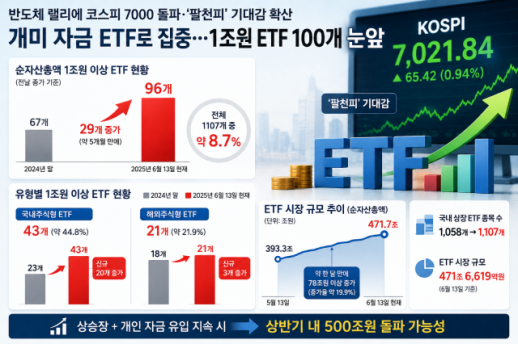 Retail Investors Shift Focus to ETFs Amid Market Surge As the domestic stock market continues to rise sharply, driven by semiconductor stocks, retail investor funds are rapidly flowing into the exchange-traded fund (ETF) market. Following the KOSPI's historic breach of the 7,000 mark, expectations for the '8,000 KOSPI' have grown, with nearly 100 ETFs surpassing 1 trillion won in total assets under management (AUM). According to the Korea Exchange on May 14, the number of ETFs with AUM exceeding 1 trillion won reached 96 as of the previous day's closing. This represents about 8.7% of the total 1,107 ETFs listed in South Korea. The number of ETFs exceeding 1 trillion won was only 67 at the end of last year, but it has increased by 29 in just five months, indicating rapid growth. Market analysts attribute this surge to the influx of retail investor funds into the ETF market amid the recent rise in the domestic stock market. The most notable growth has been seen in domestic equity ETFs. Of the 96 ETFs, 43 are focused on investing in companies listed on the Korean stock market, accounting for approximately 44.8% of the total. In contrast, overseas equity ETFs remain limited to around 21. At the end of last year, the number of ETFs with AUM over 1 trillion won was nearly equal between domestic (23) and overseas (18) equity ETFs. However, this year, as the domestic stock market rally centered on semiconductor and large technology stocks continues, 20 new domestic equity ETFs have surpassed the 1 trillion won mark. This shift is interpreted as a movement of investment funds towards the domestic ETF market due to the relatively superior returns of the Korean stock market compared to overseas markets. The overall size of the ETF market is also expanding rapidly. The number of listed ETFs has increased from 1,058 at the end of last year to 1,107 currently. The total AUM has surged as well, with the ETF market recently surpassing 450 trillion won and expanding to 471.66 trillion won as of the previous day. Notably, the total AUM of ETFs increased by over 78 trillion won in about a month, rising from 393.33 trillion won on April 13. This represents an increase rate of approximately 19.9%. The simultaneous strength of the stock market, particularly in the semiconductor sector, and the large influx of retail investor funds have accelerated the expansion of the ETF market. Industry experts suggest that if the current trend of fund inflows continues, the domestic ETF market could surpass 500 trillion won by the end of the first half of the year.* This article has been translated by AI. 2026-05-14 20:27:41
 -
 Oh Se-hoon Proposes Debate with Jung Won-o Ahead of Local Elections Oh Se-hoon, the People Power Party candidate for Seoul mayor, reiterated his call for a one-on-one debate with Jung Won-o, the Democratic Party's candidate, on May 14, just six days before the local elections. Oh suggested that Democratic Party leader Jung Cheong-rae could moderate the debate, stating, "I hope at least one or two debates can be held." Speaking at a forum hosted by the Korean Newspaper and Broadcasting Editors Association in central Seoul, Oh said, "I am open to any format, time, place, or topic for the debate." He expressed frustration, saying, "Whenever I propose a debate, Jung gives evasive answers. Considering the public's right to know, I hope he reconsiders and shows at least a minimum level of courtesy." Oh emphasized the significance of the upcoming election, stating, "This election is a crossroads for whether the Lee Jae-myung administration will adopt a humble approach or transition into a more overt form of soft dictatorship. Absolute power corrupts absolutely; this is a historical truth." He warned that if Democratic Party candidates win in major local governments like Seoul and Busan, the current soft dictatorship under President Lee Jae-myung could become more severe. "I hope a minimum foothold for checking the government can be secured," he added. Oh also highlighted the choice between returning to the past of former Mayor Park Won-soon or moving toward the future. He pointed out that during Park's ten-year tenure, 389 redevelopment and reconstruction projects were canceled, leading to a significant reduction in housing supply and contributing to the current real estate crisis. He noted, "The people who implemented those policies are still within the Democratic Party and have joined Jung's campaign. Now that the election is approaching, they promise to increase housing supply and expedite projects, but there is a high likelihood they will revert to their old ways without reflection." Regarding electoral cooperation with the leadership of Jang Dong-hyuk, Oh stated, "We have entered a phase where strategic role division between the central party and candidates is necessary." He remarked, "With only about three weeks left until the election, it is now the candidates' time. The party's role is secondary." He added, "Elections are filled with the candidates' brands, policies, pledges, and messages. If the central party can assist, it should focus on the electoral landscape, such as actively fighting against the recent special prosecution law on canceled indictments and promoting its negative impacts." On the recent controversy over the 'national dividend,' Oh stated, "The central party needs to address whether the distribution related to semiconductors is a desirable government stance for the nation's future and articulate a vision for a better future as the opposition party."* This article has been translated by AI. 2026-05-14 20:25:09
 -
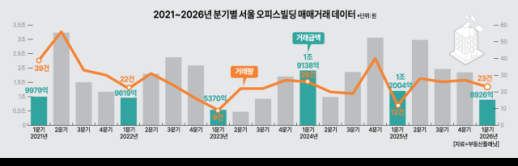 Seoul Office Transactions Plummet as Q1 Sales Halve In the first quarter of 2026, the Seoul office sales market experienced a significant contraction, with transaction amounts dropping by more than 50% compared to the previous quarter, alongside a decline in office sales. According to a report released on May 12 by Real Estate Planet, a commercial real estate platform, based on data from the Ministry of Land, Infrastructure and Transport, the volume of office building transactions in Seoul totaled 23 cases, with a transaction amount of 892.6 billion won in the first quarter of this year. This represents a 14.8% decrease in transaction volume and a 51.6% decrease in transaction amount compared to the previous quarter (27 cases, 1.8435 trillion won). However, compared to the same period last year (12 cases, 1.2004 trillion won), transaction volume increased by 91.7%, while transaction amount decreased by 25.6%. Regionally, the Gangnam and Seocho areas (GBD) maintained the same transaction volume as the previous quarter with 8 cases, while other regions recorded 12 cases. In contrast, the Yeongdeungpo and Mapo areas (YBD) dropped from 3 cases to 1, and the Jongno and Jung-gu areas (CBD) decreased from 4 cases to 2. Transaction amounts fell across all regions, with the CBD experiencing a dramatic decline from 942 billion won in the previous quarter to 64.5 billion won, a drop of 93.2%. The YBD saw a decrease to 16.5 billion won (down 62.2%), the GBD recorded 386.8 billion won (down 8.5%), and other regions totaled 424.8 billion won (down 2.4%). The office market also showed weakness, with the volume of office transactions in Seoul reaching 271 cases and a transaction amount of 499.2 billion won. This reflects a 20.3% decrease in transaction volume and a 25.8% decrease in transaction amount compared to the previous quarter (340 cases, 673.2 billion won). Compared to the same period last year, transaction volume increased by 0.4%, but transaction amount decreased by 11.6%. Corporations dominated both office building and office transactions. In the office building market, 15 out of 23 transactions were corporate purchases, accounting for 65.2%. In terms of transaction amount, corporate transactions totaled 766.4 billion won, representing 85.9% of the total. In the office market, corporate purchases were also the most prevalent, with 142 cases, while individual purchases were active with 126 cases, making up about 46.5% of the total. In terms of transaction amount, corporate transactions reached 421.9 billion won, accounting for 84.5% of the total. However, the REIT market continued to expand its office assets. As of March 2026, the total assets of REITs in the Seoul area amounted to 123.24 trillion won, a 4.2% increase from the previous month. Among these, office assets reached 43.45 trillion won, up 5.1% from the previous month and 32.8% from the same period last year. The supply of office facilities also showed an upward trend. According to building permit data from the Ministry of Land, Infrastructure and Transport, the total floor area of office facilities approved for use in the first quarter of this year was 221,476 square meters, a 159.3% increase from the previous quarter. The planned new supply of office facilities is also set to expand by 15.0% to 452,303 square meters compared to the previous quarter, particularly concentrated in Yeongdeungpo, Jongno, and Seongdong districts. The market contraction is also reflected in investment yield indicators. An additional review of the Real Estate Planet report revealed that the average investment yield for Seoul offices in the first quarter of this year was 2.35%, up from 1.84% in the previous quarter, although there were notable regional disparities. The investment yield in the CBD was 2.45%, in the GBD it was 2.65%, and in the YBD it was 2.20%, while other regions remained at 1.78%. In specific commercial areas, Gwanghwamun recorded a relatively high yield of 3.27%, and Gangnam-daero followed with 3.21%, while most other areas reported yields in the 1-2% range. Jung Soo-min, CEO of Real Estate Planet, stated, “In the first quarter of this year, the Seoul office sales market saw a decrease in large asset transactions, causing the transaction amount for office buildings to fall below 1 trillion won on a quarterly basis. As the expansion of office assets within REITs continues, along with an increase in the area of approved office facilities and a corporate-driven purchasing trend, the adjustment of price expectations between buyers and sellers and the resumption of large transactions in key regions will influence market trends in the second quarter.”* This article has been translated by AI. 2026-05-14 20:23:10
 -
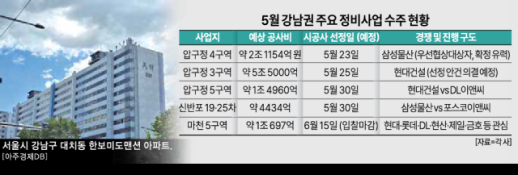 Major Reconstruction Projects in Gangnam Set to Begin in May The reconstruction market in Seoul's Gangnam district is entering a competitive phase this May. With the selection meetings for construction companies for Apgujeong districts 3, 4, and 5 scheduled throughout the month, major reconstruction projects in Shinbanpo and Songpa are also gaining momentum. Industry experts are viewing this month as a critical turning point for Gangnam reconstruction. According to the construction industry on May 12, selection meetings for construction companies are set to take place in Apgujeong and Shinbanpo, the two main battlegrounds for reconstruction in Gangnam. Specifically, districts 3 to 5 of the Apgujeong reconstruction project will finalize their construction companies this month. The six districts in Apgujeong are expected to accommodate between 11,000 and 12,000 households, with the construction costs for the three districts currently in the selection process exceeding 10 trillion won. The symbolic significance of the prime riverside location has intensified brand competition among construction firms. The first meeting will be held for Apgujeong district 4 on May 23, where Samsung C&T, selected as the preferred bidder last month, is likely to be confirmed as the construction company. On May 25, Apgujeong district 3 will hold a meeting to vote on selecting Hyundai Engineering & Construction as its contractor. This district, with a planned 4,121 units, is considered the largest single reconstruction site in Gangnam, with construction costs estimated at approximately 5.5 trillion won. The most intense competition is expected in Apgujeong district 5, where construction costs are around 1.496 trillion won. A meeting will take place on May 30 to decide between Hyundai Engineering & Construction and DL E&C. Both companies will hold a joint briefing on May 16, followed by a second briefing on the day of the meeting to sway the opinions of the members. Recently, competition has intensified over high-end brands, community features, and specialized designs, leading to rapidly increasing bidding conditions. According to the Gangnam District Office's housing construction project status, as of January, districts 2 to 5 in Apgujeong have all completed the establishment of their associations. Notably, Apgujeong district 3, which has faced delays since receiving its establishment approval in 2021, is expected to gain momentum with the upcoming selection process. There are expectations that the projects in the Apgujeong area, which have been stalled due to changes in maintenance plans and regulatory issues, will finally move forward following this bidding war. The selection meetings for the Shinbanpo districts 19 and 25 will also take place on May 30. Although this project involves a smaller scale of 614 units and construction costs of about 443.4 billion won compared to Apgujeong, its riverside location allows for a potential 49-story design, making it likely to become a landmark in the Seocho area. In this project, Samsung C&T and POSCO E&C will compete against each other. This marks the first time since January 2024 that the two companies have faced off at the same site, where POSCO E&C previously won a bid. The reconstruction fervor is also rapidly spreading to Songpa District. The redevelopment of the Machon 5 area has received its association establishment approval in January after 19 years of efforts. The association announced a bidding notice last month, with six construction firms, including Hyundai Engineering & Construction, Lotte Engineering & Construction, DL E&C, IPARK Hyundai Industrial Development, Jeil Construction, and Kumho Construction, attending the site briefing. The estimated construction cost is around 1.069 trillion won, with the bidding deadline set for June 15. This area is expected to emerge as a significant battleground following the major bids in Gangnam. In the Seongsu Strategic Maintenance Zone, Daewoo Construction and Lotte Construction have resumed their bidding processes, and the selection of a construction company for the Mokdong reconstruction site is also expected to gain traction in the second half of the year. Ko Jun-seok, a professor at Yonsei University's Sangnam Business School, stated, "The project conditions and design standards presented in the Apgujeong bidding war are likely to set benchmarks for future maintenance project bids."* This article has been translated by AI. 2026-05-14 20:20:14
 -
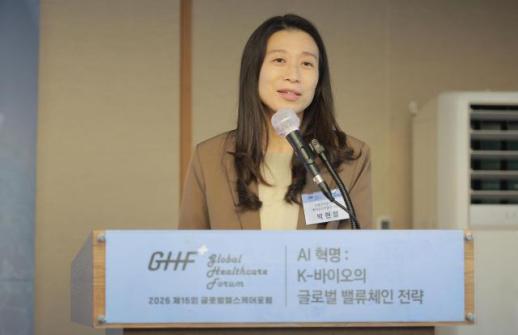 Korea's Drug Safety Agency Official Advocates for Fast-Track Approval System to Boost K-Bio Global Competitiveness "To secure market leadership opportunities, a fast-track approval system is essential for domestic pharmaceutical and biotech companies," said Park Hyun-jung, head of the Bio-Pharmaceutical Approval Division at the Ministry of Food and Drug Safety (MFDS). She made these remarks on May 14 during the 16th Global Healthcare Forum (2026 GHF) held at the Korea Press Center in Seoul, organized by Aju Economic Daily. Park emphasized the necessity of establishing a fast-track approval system to facilitate the rapid growth of domestic pharmaceutical and biotech companies. The global pharmaceutical market is projected to expand to approximately $2.66 trillion by 2030. She noted that the export volume of domestic pharmaceuticals is also increasing rapidly, particularly in high-value sectors such as biopharmaceuticals and toxins. The export value rose from $7.04 billion in 2021 to a record $10.41 billion last year. The MFDS has been implementing the first phase of its "Drug Approval Review Innovation" initiative since January 2025. This initiative aims to enhance the speed and transparency of drug approvals, viewing expedited approvals as a foundation for global competitiveness in the pharmaceutical industry. Park pointed out that with many global blockbuster biopharmaceutical patents set to expire in the near future, new opportunities are emerging for the domestic biosimilar industry. She stressed the importance of increasing the speed and predictability of the approval process to secure market leadership. A key focus is on reducing the approval review period. The average time for new drug approvals has been cut from over 400 days to 295 days. "We operate dedicated review teams for each product and provide specialized consultations at each approval stage, including pre-review of supplementary submission materials," Park explained. "We have also prioritized the evaluation of Good Manufacturing Practices (GMP) and Good Clinical Practices (GCP) to reduce the burden on companies and enhance review efficiency." Following the first phase, the MFDS plans to implement a second phase of innovation. This will be discussed at the second core regulatory rationalization strategy meeting chaired by the President, focusing on fostering the biohealth industry and transitioning to a consumer-centered approval review system while significantly shortening the drug approval review period. The agency is gathering industry feedback on new drugs and biosimilars and plans to significantly increase the number of specialized review personnel. In April, the MFDS hired new staff for drug approval reviews and is pursuing additional recruitment. Park also introduced plans to simplify Phase III clinical trials for biosimilars. "With advancements in quality analysis technology and accumulated regulatory experience since the introduction of biosimilars, it has been confirmed that equivalence can be demonstrated for certain products without Phase III clinical trials," she said. She added, "We plan to demonstrate equivalence between new biopharmaceuticals and biosimilars primarily through quality comparisons and Phase I clinical trials, conducting Phase III trials only when sufficient evidence is lacking. We will also allow for pre-review requests of equivalence demonstration plans by the MFDS." Park concluded, "Through these regulatory improvements, patients will be able to access new drugs and biosimilars more quickly, and the industry will reduce its burden through shortened development and approval timelines. We also expect this to facilitate the early entry of domestic companies into the global market and expand exports."* This article has been translated by AI. 2026-05-14 20:18:00
 -
 Emart Plans 500 Billion Won Capital Increase for Shinsegae Construction Emart is moving forward with a capital increase of 500 billion won for its subsidiary, Shinsegae Construction. According to a filing with the Financial Supervisory Service on May 14, Emart will participate in the capital increase through cash and asset contributions. The cash contribution will amount to 240 billion won (48%), while the asset contribution will be 260 billion won (52%). The assets being contributed include land and buildings owned by Emart at the Myungil branch. Emart will provide these assets in exchange for newly issued shares from Shinsegae Construction. Shinsegae Construction plans to issue 10 million common shares at a price of 50,000 won per share. Emart, as the major shareholder, will fully subscribe to the new shares. The payment deadline for the new shares is set for June 25. An Emart representative stated, "This decision aims to enhance financial structure and secure management stability through increased construction capital, thereby boosting market confidence and enabling stable business operations in the future." In related news, Emart reported a consolidated operating profit of 178.3 billion won for the first quarter, an 11.9% increase compared to the same period last year. Although net sales decreased by 1.3% to 7.1234 trillion won, profitability showed significant improvement. This marks the highest first-quarter operating profit since 2012. On a standalone basis, operating profit also rose by 9.7% to 146.3 billion won, achieving the highest first-quarter figure in eight years since 2018. Standalone total sales increased by 1.9% to 4.7152 trillion won.* This article has been translated by AI. 2026-05-14 20:13:58