

Journalist

Lee Baek-soon
-
 Naver Enters Defense AI Market with New Initiative Naver is entering the defense artificial intelligence (AI) market. According to the IT industry on June 1, Naver Cloud has established a dedicated organization for defense AI transformation (AX) and is expanding its AI business tailored for the defense sector. This new team will be led by Kim Yoo-won, the CEO of Naver Cloud, who oversees all AI operations at Naver. Naver's move into the defense AI market is driven by the growing demand for sovereign AI and public AX solutions. The defense AI sector is sensitive to security and regulations, making it challenging to apply foreign cloud or overseas AI technologies, thus presenting opportunities for domestic companies. This shift allows Naver to establish a stable business-to-government (B2G) revenue base, moving away from consumer-focused AI services. After Naver Cloud was not selected for the Ministry of Science and ICT's 'Independent AI Foundation Model' support project, the company assessed that its infrastructure, models, and services could be effectively applied to the defense AI field. A Naver representative stated, "We believe that the defense AI sector is a suitable area for applying our capabilities across all fields from infrastructure to services, which is why we established a security organization. With our full-stack AI capabilities based on domestic cloud infrastructure, we are preparing to enter the defense sector." An industry insider noted, "It seems feasible to design cloud solutions or generative AI models specifically tailored for the defense environment. The government's increasing demand for defense AI will also positively impact Naver." However, there are cautious perspectives regarding the introduction of defense AI. The nature of defense is sensitive to security, making it difficult to approach simply by implementing high-performance AI models. Utilizing classified information for AI training or inference could lead to issues such as data leaks, misjudgments, and accountability concerns. Experts believe that AI utilization will proceed after classifying security levels and data grades, considering the defense environment. If discussions on collaboration between Naver and defense AX operations progress, a phased learning approach based on information types will be necessary. Initially, AI is expected to be used for administrative and operational improvements. Kwak Jin, a professor at Ajou University’s Cybersecurity Department, stated, "Defense AI can be utilized for both administrative and operational improvements, as well as in actual battlefield environments, so its application range is diverse. However, simply introducing AI does not solve all problems. In military contexts, caution is essential from the outset of the implementation process."* This article has been translated by AI. 2026-06-01 15:33:00
 -
 Early voting for local elections hits record high, but final turnout remains to be seen SEOUL, June 1 (AJP) - Early voting for South Korea's June 3 local elections wrapped up with a record-high turnout, fueling speculation that final turnout could surpass a previous record of 60.2 percent seen in the 2018 local elections, the highest level in nearly three decades. The National Election Commission (NEC) on Sunday said 10.49 million of the country's 44.64 million eligible voters cast ballots during the two-day early voting period held Friday and Saturday, for a turnout rate of 23.5 percent. The figure was 2.9 percentage points higher than the previous record of 20.6 percent set in the 2022 local elections. Since early voting was introduced nationwide in 2014, the highest early voting rate in any national election was 36.9 percent in the 2022 presidential election. South Jeolla Province recorded the highest early voting rate among the country's 16 major administrative regions at 39.0 percent, followed by North Jeolla Province at 35.1 percent and the southwestern city of Gwangju at 27.8 percent. The southeastern city of Daegu had the lowest turnout at 18.7 percent. Other southeastern regions, including Busan at 21.3 percent, North Gyeongsang Province at 22.4 percent and Ulsan at 22.5 percent, also fell below the national average. In the Seoul metropolitan area, Gyeonggi Province recorded 21.0 percent, Incheon 21.6 percent, and Seoul 23.8 percent. Early voting in 14 by-elections held alongside the local elections reached 24.1 percent, slightly higher than the rate for the local elections. Of the 2.26 million eligible voters, about 546,000 cast early ballots. Among the by-election districts, Buan, Gimje and Gunsan in North Jeolla Province recorded the highest early voting rate at 42.6 percent, followed by Buyeo, Cheongyang and Gongju in South Chungcheong Province at 30.2 percent. Busan Buk Gap, where candidates including the Democratic Party (DP)'s Ha Jung-woo, the conservative People Power Party (PPP)'s Park Min-sik and independent candidate Han Dong-hoon are competing, posted a relatively high early voting rate of 25.6 percent. Busan's fiercely contested Buk district, where candidates including Ha Jung-woo of the ruling Democratic Party (DP), Park Min-sik of the main opposition People Power Party (PPP) and independent candidate Han Dong-hoon are competing, saw a relatively high early voting rate of 25.6 percent. By contrast, Daegu's Dalseong district recorded the lowest early voting rate in the by-elections at 17.6 percent. Pyeongtaek in Gyeonggi Province, where candidates from five parties are running, also saw relatively low participation at 18.4 percent. Meanwhile, strong turnout has raised expectations that overall participation in this year’s local elections could rise significantly. Local elections in South Korea have traditionally seen lower turnout than presidential or general elections. Only two local elections have recorded turnout above 60 percent: the first nationwide local elections in 1995, which saw 68.4 percent turnout, and the 2018 local elections, which recorded 60.2 percent. In the 2022 local elections, final turnout was just 50.9 percent despite record early voting of 20.6 percent, suggesting that early voting mainly changed the timing of participation rather than significantly boosting overall turnout. Experts say the high early voting turnout reflects the establishment of stable early voting, as voters become more familiar with it. Ha Sang-eung, a professor of political science and international relations at Sogang University, said, "In effect, the voting period extends to three days when the two-day early voting period is counted." Ha predicted that final turnout would be higher than in the previous local elections, but not exceptionally high. "In closely contested regions, many people may still vote on election day even if early voting turnout is high. But in less competitive regions, turnout is unlikely to be high even if early voting participation is strong," he said. "Contrary to conventional wisdom, high turnout does not necessarily benefit any particular political party," he also said. "Especially in local elections, regional differences are significant, so a high overall turnout does not favor any specific party," he added. But Ha dismissed claims by some far-right conservatives linking early voting to election fraud as "the most absurd and groundless rumor imaginable." 2026-06-01 15:31:34
 -
 KakaoBank Partners with Seoul to Enhance Youth Financial Literacy KakaoBank announced on June 1 that it will collaborate with the Seoul Metropolitan Government to provide financial education aimed at enhancing the financial capabilities of youth.Under this agreement, KakaoBank and Seoul will implement tailored financial education and support programs for young people. Starting in May and running through September, the city will operate an 'Economics and Finance Academy' for approximately 360 youths across 21 municipal youth centers.The Economics and Finance Academy is designed to teach essential financial skills such as saving, investing, and spending. The theoretical classes will utilize custom-made materials that include case studies of KakaoBank's financial services. Additionally, hands-on practical sessions will be conducted using Nexon Korea's coding platform 'Hello Maple' for an engaging learning experience.Furthermore, beginning in July, the city will provide financial fraud prevention education, focusing on issues like voice phishing and illegal loans, to vulnerable youth at 19 youth shelters and independent living support centers. The program will also include 1:1 financial mentoring to assist youths in improving their financial habits and achieving economic independence.KakaoBank will offer access to the youth information platform 'Youth All-in-One' through its app, which provides information on youth experience programs and career and academic guidance. In addition to educational initiatives, KakaoBank plans to introduce youth-specific financial services called 'Mini' to attract potential customers.KakaoBank stated, "We have developed this initiative in partnership with Seoul to ensure that young people acquire essential financial knowledge and cultivate proactive financial habits. We will continue to support the healthy development of future generations in various ways."* This article has been translated by AI. 2026-06-01 15:24:00
 -
![[6·3 Local Elections] Democratic Party Targets Kim Kwan-young and Cho Kuk Ahead of Elections](https://image.ajunews.com//content/image/2026/06/01/20260601150336960630_518_323.jpg) [[6·3 Local Elections]] Democratic Party Targets Kim Kwan-young and Cho Kuk Ahead of Elections On June 1, as the June 3 local elections and National Assembly by-elections approach, the Democratic Party has intensified its efforts to counter independent candidate Kim Kwan-young and Cho Kuk of the Cho Kuk Innovation Party in Jeonbuk and Pyeongtaek, Gyeonggi Province. With the elections nearing, the party is mobilizing all resources to secure votes amid the rising momentum of progressive candidates. The Democratic Party emphasized that Kim Kwan-young's portrayal as a victim shows no signs of ending, reiterating that the party leadership's decision to expel him was justified. Spokesperson Han Min-soo stated in a briefing, "Kim has made statements suggesting that the party intentionally cut him off to promote candidate Lee Won-taek. If he spreads false information under the guise of victimhood, we will hold him legally accountable. How much more do we need to clarify? If there had been no illegal cash distribution, would there have been a reason to expel him?" Cho Sung-rae, the party's secretary-general, warned during a press conference that the Jeonbuk gubernatorial election is a contest between the ruling party and independent candidates. He stated, "Wise voters will choose the ruling party candidate, and even if Kim Kwan-young wins, he will have to face a re-election." Regarding Cho Kuk, who is in a tight race with candidate Kim Yong-nam in Pyeongtaek, Cho Sung-rae noted, "Kim Yong-nam has maintained his support despite the negative campaign from the Innovation Party. In fact, Democratic supporters in Pyeongtaek are rallying around Kim Yong-nam as the Democratic candidate." He added, "Party members supporting Kim Yong-nam should also support this candidate. Both candidates are receiving full backing from the party." Previously, on May 31, the Democratic Party had criticized both Kim Kwan-young and Cho Kuk, stating, "We cannot show leniency to someone who has been disciplined for illegal cash distribution," and urged Cho Kuk to compete under the name of the Innovation Party instead of hiding behind the Democratic Party's name. In response, Lee Hae-min, secretary-general of the Cho Kuk Innovation Party, held a press conference at the National Assembly, stating, "As the election draws to a close, they are resorting to name-calling." 2026-06-01 15:21:00
[[6·3 Local Elections]] Democratic Party Targets Kim Kwan-young and Cho Kuk Ahead of Elections On June 1, as the June 3 local elections and National Assembly by-elections approach, the Democratic Party has intensified its efforts to counter independent candidate Kim Kwan-young and Cho Kuk of the Cho Kuk Innovation Party in Jeonbuk and Pyeongtaek, Gyeonggi Province. With the elections nearing, the party is mobilizing all resources to secure votes amid the rising momentum of progressive candidates. The Democratic Party emphasized that Kim Kwan-young's portrayal as a victim shows no signs of ending, reiterating that the party leadership's decision to expel him was justified. Spokesperson Han Min-soo stated in a briefing, "Kim has made statements suggesting that the party intentionally cut him off to promote candidate Lee Won-taek. If he spreads false information under the guise of victimhood, we will hold him legally accountable. How much more do we need to clarify? If there had been no illegal cash distribution, would there have been a reason to expel him?" Cho Sung-rae, the party's secretary-general, warned during a press conference that the Jeonbuk gubernatorial election is a contest between the ruling party and independent candidates. He stated, "Wise voters will choose the ruling party candidate, and even if Kim Kwan-young wins, he will have to face a re-election." Regarding Cho Kuk, who is in a tight race with candidate Kim Yong-nam in Pyeongtaek, Cho Sung-rae noted, "Kim Yong-nam has maintained his support despite the negative campaign from the Innovation Party. In fact, Democratic supporters in Pyeongtaek are rallying around Kim Yong-nam as the Democratic candidate." He added, "Party members supporting Kim Yong-nam should also support this candidate. Both candidates are receiving full backing from the party." Previously, on May 31, the Democratic Party had criticized both Kim Kwan-young and Cho Kuk, stating, "We cannot show leniency to someone who has been disciplined for illegal cash distribution," and urged Cho Kuk to compete under the name of the Innovation Party instead of hiding behind the Democratic Party's name. In response, Lee Hae-min, secretary-general of the Cho Kuk Innovation Party, held a press conference at the National Assembly, stating, "As the election draws to a close, they are resorting to name-calling." 2026-06-01 15:21:00 -
 South Korea to Institutionalize Financial Counseling for Youth The South Korean financial authorities plan to institutionalize financial counseling for youth starting in the second half of this year, shifting youth financial policy from product support to integrated management. However, there are concerns about whether this counseling can effectively address the complex financial issues faced by young people, which include savings, loans, consumption, and investment.According to the financial sector on June 1, the Financial Services Commission and the Korea Financial Welfare Agency intend to launch the 'Financial Counseling for All Youth' program later this year. This initiative will provide tailored advice on asset formation, debt, and credit management based on the financial status of young individuals, including their income, expenditures, and debts. A pilot program was conducted from May 18 to 29 at three universities and three industrial complexes, and detailed operational plans are currently being developed.This marks a significant step forward from previous youth financial policies, which primarily focused on individual product support or one-time educational programs. Historically, youth financial policies have centered around policy financial products like the Youth Leap Account and Sunshine Loan for Youth, along with financial education programs.However, the reality of young people's financial lives is that savings, loans, consumption, and investments are often intertwined. Many young individuals use loans to cover rent and living expenses while simultaneously investing in stocks or cryptocurrencies. Critics argue that merely providing individual financial products is insufficient to resolve these complex financial issues.Given this context, the shift in policy focus from supplying individual products to assessing the overall financial situation of youth is seen as a positive development. The introduction of a preferential interest rate of 0.2 percentage points for those who complete financial counseling on the upcoming Youth Future Savings Account, set to launch on June 22, is also viewed as part of this integrated support system.Nevertheless, it remains uncertain whether financial counseling will lead to tangible policy outcomes. Experts point out that vulnerable groups, such as young individuals on the brink of default, those with multiple debts, and platform workers, often face barriers to accessing institutional counseling. They emphasize the need for a post-counseling management system that goes beyond simple advice to continuously monitor savings, debt, and credit management plans, linking them to policy financial support or debt adjustment systems.Kim Dong-hwan, a senior researcher at the Korea Financial Research Institute, stated, "To establish effective youth financial policies, it is essential to build a comprehensive and sustainable support system for self-reliance."* This article has been translated by AI. 2026-06-01 15:18:00
 -
 Cully Acquires AI Firm 1Z LABS to Accelerate AI Transformation Cully has acquired the artificial intelligence (AI) solutions company 1Z LABS to accelerate its AI transformation (AX). Cully announced on June 1 that it has decided to exchange shares with 1Z LABS to enhance its business competitiveness and operational efficiency through AI technology. The share exchange ratio for common stock between Cully and 1Z LABS is set at 1 to 1.8437990. To facilitate this, Cully will issue 453,518 new common shares. The share exchange date is scheduled for August 4. Following this, 1Z LABS will remain a wholly-owned subsidiary of Cully. Through this acquisition, Cully plans to expedite its efforts in automating operations and enhancing services based on AI. Cully is currently strengthening its AX capabilities across the organization. The company is working to integrate AI into its services, establish an AI governance framework, and identify new business opportunities and services based on AI. Cully and 1Z LABS are jointly developing creative AI, AI customer service (AICS), and an in-house advertising system to improve operational efficiency. Among these, AICS has been applied to Cully's one-on-one inquiries, with AI handling about 40% of customer inquiries, including cancellations and returns. To enhance AX execution, Cully has appointed Kwak Geun-bong, CEO of 1Z LABS, as the head of Cully's AX Center. A Cully representative stated, "Once 1Z LABS is fully integrated as a subsidiary, swift decision-making and close collaboration will allow us to advance our current AX action plan more rapidly." Cully CEO Kim Seul-ah emphasized, "We aim to lead innovation in the e-commerce market by combining commerce with AI technology." In the first quarter, Cully reported an operating profit of 24.2 billion won, a 1,277% increase compared to the same period last year. This figure represents 1.9 times last year's total operating profit. During the same period, sales rose by 28.4% to 745.7 billion won.* This article has been translated by AI. 2026-06-01 15:18:00
 -
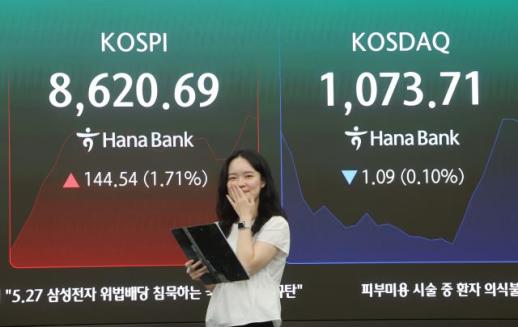 Young Investors Face Risks as Savings Become Insufficient for Financial Goals A 32-year-old man, known as A, invested his savings in stocks and virtual assets after completing his military service, achieving significant profits initially. He turned 600,000 won into 100 million won and later grew 400,000 won to 140 million won. However, in pursuit of even greater returns, he increased his investment scale and ultimately lost all his assets. In a recent television appearance, he expressed regret, stating, "I have been focused solely on coins for the past six years." As the perception grows that saving alone is insufficient for purchasing homes or funding weddings, the asset formation strategies among young people are rapidly changing. While traditional savings accounts were once the starting point for building wealth, there is now a strong trend toward investing in riskier assets like stocks and virtual currencies for quick returns. According to Mirae Asset Securities, the return rates for customer accounts holding over 1 million won from January 2 to May 7 this year showed that investors in their 50s had the highest return rate at 36.77%, followed closely by those aged 60 and above at 36.35%. In contrast, investors in their 20s and 30s reported much lower returns of 25.08% and 24.06%, respectively. This disparity is attributed to the investment tendencies of younger generations. Investors aged 50 and above tend to focus on high-quality domestic stocks, while those in their 20s and 30s are more inclined to invest in volatile thematic stocks, small-cap stocks, and leveraged ETFs, aiming for a significant payoff. Young investors are also actively participating in the highly volatile virtual asset market. According to the Financial Intelligence Unit's survey on virtual asset businesses, over half of the users trading virtual assets at the end of last year were in their 30s and 40s, with those under 20 accounting for 19%. The primary reason young people are turning to riskier assets is the belief that saving alone will not allow them to achieve their life goals. Housing prices in Seoul and the surrounding metropolitan area remain high, and the financial burden of marriage and child-rearing is increasing. As the perception grows that saving a salary is insufficient to keep pace with rising asset prices, funds are shifting toward investment markets that promise higher returns. The issue is that when risky asset investments combine with the fragile cash flow of young people, the impact can be significantly greater. Without sufficient assets or a stable income base, investment losses can lead to a lack of buffers to absorb the shock. Consequently, there is a heightened likelihood of relying on overdraft accounts, credit card loans, or small personal loans to cover losses or living expenses. Experts emphasize the need for a financial safety net to reduce excessive risk-taking while expanding asset formation opportunities for young people. In a situation where the starting point for asset formation is unstable, relying solely on short-term high-return investments is unlikely to secure financial stability. Im Na-yeon, a researcher at the Capital Market Research Institute, stated, "As capital markets become a key means of asset accumulation, the gap in financial asset size and management methods formed during youth could lead to more severe asset inequality in the future. It is crucial to implement policy efforts that support the practical financial asset formation of low- to middle-income young people to prevent this gap from widening."* This article has been translated by AI. 2026-06-01 15:12:00
 -
 Hugel Accelerates North American Expansion with Olive Young's U.S. Launch Hugel is accelerating its North American strategy by launching its cosmetic brand, Wellage, in Olive Young's U.S. stores. Pharmaceutical companies are diversifying their growth engines by expanding core medical technologies like fillers and Botox into the dermacosmetic market.On June 1, Hugel announced that Wellage completed its entry into the Olive Young store in Pasadena, California, on May 29, marking its first physical presence in the U.S.The Olive Young U.S. locations will feature nine core products from the Wellage brand, which are formulated with high concentrations of active ingredients. The lineup includes the flagship product, the 'Real Hyaluronic Blue 100 Ampoule,' along with six products from the Real Hyaluronic line, two from the Cica Calming line, and one from the PDRN line.Wellage is now present in 12 countries, having established a foothold in U.S. offline retail following its presence on Amazon and in Costco Canada. A Hugel representative stated, "The entry into Olive Young in the U.S. is significant as it expands our offline distribution network to the U.S. mainland, following Costco Canada, thereby increasing our engagement with North American consumers. We aim to rapidly enhance brand recognition and consumer connections in the global market based on Wellage's unique clinical technology."The rapid pace at which pharmaceutical companies are entering the cosmetics sector is driven by the explosive growth of the dermacosmetic market. According to Euromonitor, while the domestic skincare market grew at an average annual rate of 2.1% from 2020 to 2025, the dermacosmetic market expanded at an average annual rate of 15.7%, outpacing general cosmetics by seven times.A similar trend is observed globally. The global dermacosmetic market surpassed $74.14 billion last year and is projected to grow at an average annual rate of over 10.3% until 2035.* This article has been translated by AI. 2026-06-01 15:12:00
 -
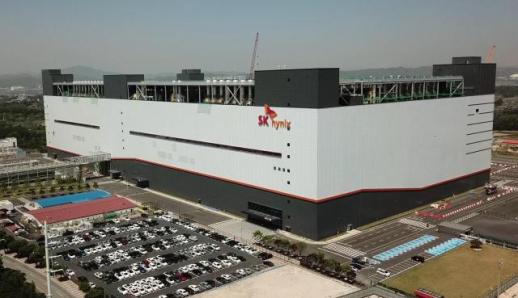 SK hynix reports no production disruption after minor spark at Cheongju plant SEOUL, June 01 (AJP) - SK Hynix confirms no production disruption after minor pipe spark at Cheongju plant SK Hynix reported zero disruptions to semiconductor production following a minor spark at its Cheongju plant in South Korea, despite the incident triggering the evacuation of 3,600 employees. The company stated that no major injuries occurred during the maintenance work and manufacturing operations remain fully intact. The incident began at 10:32 a.m. on the 1st in a sixth-floor gas room connecting the M15 and M15X facilities at the Cheongju 4 campus. A slight spark during pipe maintenance caused a fire and a toxic hydrogen fluoride gas leak, which reached a concentration of 5 ppm. Sprinklers immediately activated and extinguished the fire. Ten employees were working at the scene when the incident occurred. Five workers experienced stinging eyes, while two others showed no symptoms. All seven individuals were transported to an affiliated in-house hospital for precautionary medical checkups due to their proximity to the leak. Immediately after the gas was detected, SK Hynix evacuated all personnel from the two factory buildings. "We are operating environmental purification equipment to carry out disaster prevention work," an SK Hynix official said. Employees will return to work once air quality measurements and safety inspections are complete. The company emphasized that the root cause was a minor pipe spark and that all medical evaluations were strictly preventative. "There is no major impact, factory disruption, or production volume issue," the official said. 2026-06-01 15:11:26
 -
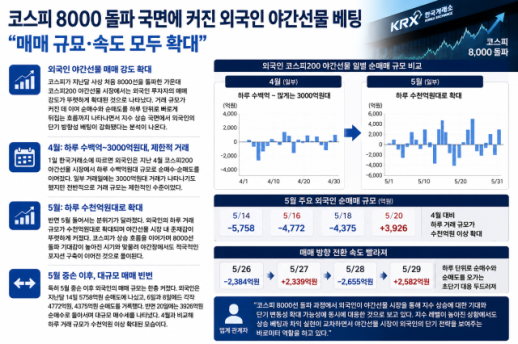 Foreign Investors Increase Bets in KOSPI 200 Night Futures as Index Surpasses 8000 As the KOSPI index surpassed the 8000 mark for the first time last month, foreign investors have significantly increased their trading activity in the KOSPI 200 night futures market. The trading volume has expanded, with foreign investors rapidly flipping between net buying and selling, indicating a strengthened short-term directional betting amid the index's upward trend. According to the Korea Exchange, foreign investors engaged in net buying and selling worth hundreds of billions of won daily in the KOSPI 200 night futures market in April. While some trading days saw transactions exceeding 300 billion won, the overall trading volume remained relatively limited. However, the situation changed in May. The daily trading volume for foreign investors surged into the trillions of won, marking a notable presence in the night futures market. This shift coincided with the KOSPI's continued upward momentum and rising expectations for surpassing the 8000 mark. Particularly since mid-May, the trading volume by foreign investors has increased further. On May 14, they recorded a net selling of 575.8 billion won, followed by net sales of 477.2 billion won and 437.5 billion won on the 6th and 8th, respectively. Conversely, on the 20th, they returned to net buying with 392.6 billion won, showcasing a substantial buying trend. Compared to April, the daily trading volume has expanded by several hundred billion won. The speed of trading direction changes has also accelerated. In April, foreign investor trading patterns tended to persist for several days, but by late May, rapid shifts between net buying and selling on a daily basis became prominent. For instance, on May 26, foreign investors recorded a net selling of 238.4 billion won, only to switch to a net buying of 233.9 billion won the next day. They then sold off 265.5 billion won on the 28th, before returning to net buying of 258.2 billion won on the 29th. This pattern of alternating buying and selling demonstrates their quick response to market changes. An industry insider noted, "During the process of the KOSPI surpassing 8000, foreign investors have responded to both the expectations of index increases and the potential for short-term volatility through the night futures market. Even as the index level rises, the interplay between bullish bets and profit-taking is evident, with the night futures market serving as a barometer for foreign investors' short-term strategies."* This article has been translated by AI. 2026-06-01 15:06:00