
Journalist

Lee Jaeho
-
 Samsung Electronics Shares Surge After Labor Agreement Samsung Electronics' stock has risen more than 6%. This surge follows a tentative wage agreement reached between management and labor unions, alleviating fears of a total strike and boosting investor sentiment. According to the Korea Exchange, as of 10:29 a.m. on May 20, Samsung's shares were trading at 293,000 won, up 6.16% from the previous day. During pre-market trading, the stock even touched 300,000 won. The sharp increase in Samsung's stock price is attributed to the tentative wage agreement reached late on May 21, after final negotiations mediated by Minister of Labor Kim Young-hoon. Previously, on May 14, Samsung's stock had approached the 300,000 won mark but dropped 6.76% due to prolonged disputes over performance bonuses and macroeconomic uncertainties. Notably, foreign investors sold off 7.8621 trillion won worth of Samsung shares between May 15 and 20. Han Ji-young, a researcher at Kiwoom Securities, stated, "The news of the tentative agreement in labor negotiations has eased strike risks, creating a positive supply-demand environment, particularly for semiconductor stocks." Analysts are optimistic about Samsung's performance, raising their target prices based on anticipated improvements in earnings and favorable memory market conditions. Shinhan Investment Corp. raised its target price by 83.3% to 550,000 won. Analyst Kim Hyung-tae noted, "The expected rise in memory prices, stable earnings visibility from long-term contracts, and expectations for enhanced shareholder returns have all contributed to this outlook, alongside the resolution of labor-related concerns." Mirae Asset Securities also increased its target price from 400,000 won to 480,000 won. Analyst Kim Young-gun highlighted that the growth rates for server and enterprise solid-state drives (SSDs) in May were 22.3% and 41.5%, respectively, showing additional growth compared to the previous month. On the same day, Korea Investment & Securities raised its target price to 570,000 won, the highest among brokerages, in light of expectations for a significant increase in memory prices in the second quarter. Chae Min-sook, a researcher at Korea Investment & Securities, stated, "We have revised our forecast for the average selling price increase of general-purpose DRAM from 30% to 60% for the second quarter, leading us to raise our operating profit estimates for Samsung Electronics to 377 trillion won and 573 trillion won for this year and next year, respectively."* This article has been translated by AI. 2026-05-21 12:15:00
 -
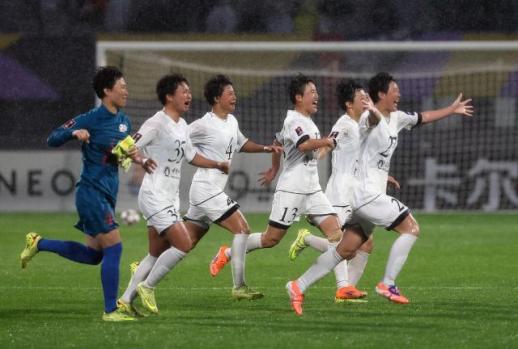 North Korea's 'My Hometown Women's Football Team' Advances to Finals North Korean state media reported that the 'My Hometown Women's Football Team' has advanced to the finals after a match held in South Korea. The Korean Central News Agency announced on May 21 that the team won 2-1 against Suwon FC Women in the semifinals of the 2025-26 Asian Football Confederation (AFC) Women's Champions League (AWCL) held the previous day. This marks the first time in nearly eight years that North Korean athletes have participated in a sports event in South Korea, with the last instance being in December 2018 during the International Table Tennis Federation (ITTF) World Tour Grand Finals in Incheon. In football, it is the first visit by North Korean players to South Korea since the 2014 Incheon Asian Games. This is also the first time a North Korean women's football club has traveled to the South. The Central News Agency noted, "The semifinal match between our My Hometown team and the South Korean Suwon team took place on May 20 in South Korea. Despite conceding a goal in the second half, our players intensified their cooperation and launched a strong offensive." The report mentioned that players Choi Geum-ok and Kim Kyung-young scored goals, and the finals are scheduled for May 23. However, the Central News Agency did not provide details about the atmosphere at the match, including the support from a joint cheering squad organized by civilian groups from both Koreas. The name 'Suwon FC Women' was abbreviated to 'Suwon team,' and the venue was referred to simply as 'South Korea.' The Rodong Sinmun, which is read by North Korean citizens, also published the Central News Agency's article on its third page, featuring photos of My Hometown players celebrating in the rain and competing in the wet conditions.* This article has been translated by AI. 2026-05-21 12:12:18
 -
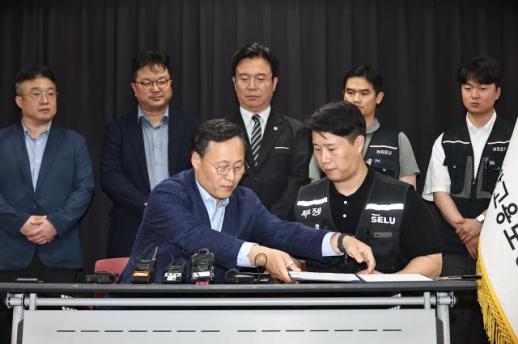 AJP Focus: Samsung's bonus war and the price of AI prosperity "Money often costs too much." Ralph Waldo Emerson wrote that line in the 19th century, but it reads today almost like a warning for the age of artificial intelligence. The real cost of the AI boom is no longer measured only in capital expenditures, GPU prices or trillion-dollar market valuations. It is increasingly measured in resentment, polarization, labor conflict and the quiet erosion of social cohesion — socially, politically, psychologically. South Korea's recent labor showdown at Samsung Electronics exposed that reality more sharply than perhaps any other event in Asia so far. What appeared on the surface to be a dispute over bonuses inside the world's largest memory-chip maker was in fact something far larger: a collision between industrial-era labor systems and the new economics of AI wealth. Under a provisional agreement reached after marathon negotiations, Samsung semiconductor employees stand to receive stock-based bonuses approaching 600 million won this year if profit targets are met. The framework allocates 10.5 percent of agreed business performance to a new special semiconductor incentive pool with effectively no upper ceiling — mirroring, and in some respects exceeding, the uncapped compensation model introduced by rival SK hynix. The numbers themselves explain why the dispute became a national issue. The AI boom is producing concentrations of profit unprecedented in modern industrial history. Nvidia on Wednesday posted quarterly net income of $58.3 billion as AI demand exploded globally, with CEO Jensen Huang describing demand as "parabolic." The problem is that modern democratic societies were never designed to absorb wealth concentration occurring at this speed. And that is where the costs begin. The first cost is individual and psychological. At the center of the Samsung conflict was not merely money, but the perception of fairness. The union argued that semiconductor workers who helped restore Samsung's competitiveness in the AI memory race deserved transparent participation in the profits they generated. Workers increasingly rejected opaque bonus formulas whose standards appeared to shift year by year, subject to management discretion. In the AI era, employees no longer want merely stable salaries. They want ownership of upside. From the workers' perspective, that demand is rational. Semiconductor profits can now surge by tens of trillions of won within a single cycle. When AI transforms a company into a strategic global bottleneck, employees inevitably begin asking why their compensation systems still resemble those of the manufacturing era. First-quarter profit from chip operations at Samsung Electronics and SK hynix combined reached $63 billion, with operating margins topping 70 percent. The same phenomenon creates a second cost: social fragmentation. According to National Tax Service data for 2024, the average annual salary of Korean workers stood at around 45 million won. But the median — the point at which half of workers earn less — was only 34.17 million won, or roughly 2.85 million won a month before tax. In practical terms, nearly half of Korean workers take home less than 3 million won a month before tax. That reality inevitably deepens feelings of relative deprivation when semiconductor employees are potentially pocketing bonus payouts worth double-digit multiples of an ordinary annual salary in a single cycle. Estimates that Samsung memory-chip employees could theoretically receive more than 2.6 billion won in cumulative bonuses over three years under the union's preferred formula triggers immediate public sensitivity. Even if such projections rely on optimistic assumptions about sustained AI demand, the psychological effect is already real. To many ordinary Koreans struggling with inflation, housing costs and stagnant wages, the dispute increasingly resembled not a labor negotiation but a symbol of how unevenly the gains of the AI revolution are being distributed. That perception matters politically. Because the third cost is institutional and democratic. The administration of President Lee Jae-myung understood that a strike involving tens of thousands of semiconductor workers at a company responsible for roughly one-fifth of Korea's exports could rapidly evolve into a national crisis. A prolonged disruption at Samsung would not merely have delayed memory-chip shipments. It could have affected AI server production, hyperscaler expansion plans, semiconductor pricing and broader investor confidence across Asia. That is why the government treated the dispute not as a routine wage conflict but as a matter of national strategic stability — and notably, it chose to manage that crisis democratically rather than coercively. The National Labor Relations Commission exhausted the formal mediation procedures required under Korean labor law. When talks stalled, Labor Minister Kim Young-hoon personally stepped in for nonbinding negotiations, seeking voluntary compromise rather than imposing state authority. In many countries, governments confronting strategic industrial unrest instinctively choose either suppression or populist escalation. Korea attempted something more difficult: preserving labor rights while preventing economic self-destruction. The labor ministry repeatedly emphasized dialogue "until the very end," in hopes of establishing a democratic precedent for managing AI-era labor conflict through institutional legitimacy rather than raw confrontation. The symbolism mattered — because the fourth cost is economic and structural. Once SK hynix removed bonus caps, compensation expectations spread rapidly across corporate Korea. Unions at Hyundai Motor Company demanded bonuses tied to 30 percent of net profit. Workers at LG Uplus pushed for operating-profit-linked pay. Unions across Kakao affiliates approved simultaneous strike votes in what could become the company's first group-wide walkout. Large conglomerates possess pricing power, strategic leverage and global market dominance. Smaller firms do not. Samsung alone operates through hundreds of suppliers and tens of thousands of subcontracted workers who are entirely outside the semiconductor bonus framework. Smaller manufacturers, suppliers and nonunion workers watch from the outside as AI profits accumulate within a narrow circle of strategic firms and organized labor. That widens Korea's already severe labor-market dualism. Samsung and SK hynix may stand at the summit, but the mountain beneath them was collectively built — through decades of state-backed tax incentives, national talent cultivation, university research, supplier ecosystems and the cooperation of equipment, materials and logistics firms across the broader economy. Which brings us to the final cost: the erosion of the old social contract itself. Korean conglomerates historically functioned not merely as employers but as quasi-familial institutions, promising stability in exchange for loyalty. Compensation systems emphasized organizational harmony and relative equality over radical differentiation. The AI economy destabilizes that model at its foundation. In Silicon Valley, superstar engineers increasingly resemble elite athletes, their compensation reflecting strategic scarcity. American firms aggressively deploy stock options, equity incentives and individualized rewards to compete for AI talent. Korea's labor culture still largely belongs to the industrial era. That mismatch is becoming unsustainable. Industrial-era labor laws were designed around fixed factories, predictable productivity and long employment cycles. AI economies behave differently. Profits surge unevenly. Strategic talent shifts rapidly. Compensation increasingly depends on intangible contribution rather than standardized hierarchy. The labor market itself is growing more fluid, asymmetric and psychologically transactional. Rigid compensation systems cannot survive indefinitely under such conditions. But neither can purely winner-take-all systems imported wholesale from Silicon Valley. The United States offers extraordinary upside — and extraordinary instability: layoffs, collapsing valuations, brutal volatility. Korea's collective model emerged partly to guard against precisely that insecurity. The challenge now is not choosing between American-style capitalism and old industrial paternalism. It is finding a new equilibrium capable of preserving legitimacy. Korea must build compensation systems transparent enough to feel fair, flexible enough to reward strategic talent and broad enough to prevent AI prosperity from deepening social fracture. The Samsung negotiations, for all their tension, offered at least one encouraging sign: the system bent without breaking. The government resisted both anti-labor crackdowns and populist escalation. Institutional mediation processes were exhausted before they were abandoned. Management eventually acknowledged that AI-era competition is now fought not only through technology but through compensation structures. And unions ultimately chose negotiated compromise over industrial paralysis. That democratic process may ultimately matter more than the size of the bonuses themselves. Because the defining question of the AI era is no longer whether extraordinary wealth will be created. The real question is how much social, political and human cost societies are willing to pay for it. 2026-05-21 11:35:42
 -
 2026 Local Elections: AI and Deepfakes Transforming Democracy The 2026 local elections indicate that South Korean politics is on the brink of an "AI election" era. In the past, campaigns were conducted through rallies, market visits, TV debates, and newspaper editorials. Candidates appealed for support in person, while voters made judgments based on print and broadcast media. Democracy moved slowly, but at least it operated within a shared reality where it was generally possible to verify who said what, which scenes were real, and what constituted the truth.However, today's elections unfold in an entirely different arena—within algorithms rather than public squares.During this local election cycle, the National Election Commission has initiated special measures to combat the distribution of AI deepfake videos. Videos that synthesize the faces and voices of actual candidates have spread across social media and YouTube, prompting the commission to report these incidents to the police. This is no mere prank; it signals that AI technology is beginning to disrupt the information order of democracy.Yet, the essence of the issue is not the deepfakes themselves. A more significant change is that democracy has fully entered the marketplace of the "attention economy." Economically, the core asset of platform companies is not their factories but people's time. Platforms like YouTube, TikTok, and Instagram generate revenue by selling user engagement. The problem is that content that captures human attention the longest is not always truthful or balanced. Outrage, hatred, fear, and shock spread much faster than nuanced explanations.Policy is slow. Stimuli are fast.Voters may not read a candidate's detailed policy proposals, but a short video mocking an opponent can quickly rack up millions of views. A single line of conspiracy theory can be more powerful than complex local financial policies. Democracy is shifting from a deliberative process to a competition of emotional speed.AI exacerbates this trend.In the past, propaganda and manipulation required substantial resources—broadcasting stations, organizations, and funding. Now, all that is needed is generative AI and a smartphone. Voice replication can be achieved in seconds, and video synthesis has become accessible to the average user. The barriers to political manipulation have effectively vanished.The world is already experiencing these dangers. In the United States, ahead of the 2024 election, AI-generated robocalls mimicking President Joe Biden's voice circulated among voters, urging them not to vote. The Federal Communications Commission (FCC) imposed hefty fines on the political consultant responsible. Early in the Ukraine war, a deepfake video falsely depicting President Volodymyr Zelenskyy declaring surrender was disseminated. In India, AI avatars of politicians campaigned in multiple languages, while in the Philippines, AI-generated political messages emerged.South Korea faces particularly perilous conditions. The combination of world-class digital infrastructure, a rapid information consumption culture, a YouTube-centric political consumption structure, and declining trust in traditional media creates a perfect storm for elections to increasingly shift toward "platform politics."This raises a crucial question: Is YouTube a media outlet or a platform? They often claim, "We are just a technology platform." However, in reality, YouTube has become the largest political media outlet in the world, surpassing television in influence and outpacing newspapers in dissemination speed. Yet, like traditional media, it bears little public responsibility.This is the fundamental contradiction of platform capitalism. While railroads, electricity, and telephone networks served as the infrastructure of the industrial age, algorithms now constitute social infrastructure. The problem is that this infrastructure operates on the logic of advertising revenue rather than the public good of democracy. Platforms are fundamentally industries of engagement; the longer users stay, the more advertising revenue increases. Consequently, algorithms naturally favor emotionally charged content, as outrage and hatred are consumed longer than discussions.French philosopher Jean Baudrillard referred to modern society as the age of "simulacra," where replicated images become more powerful than originals. The era of AI deepfakes exemplifies this prophecy. Manipulated candidate images can become a stronger political reality than the actual candidates.More dangerously, people are becoming increasingly desensitized to the question of "what is real?" As deepfakes proliferate, citizens may end up doubting all information. The problem is that at this moment, the "common reality" that underpins democracy begins to crumble. If society cannot discuss the same facts, politics devolves into a war of fandoms.At this juncture, it is essential to recognize that this issue should not be viewed merely as a "technological side effect." The essence lies in the market structure.Platforms are not public institutions; they are advertising companies. Therefore, relying solely on self-regulatory ethics has its limits. In fact, the European Union (EU) is strengthening regulations on platform algorithm accountability and political advertising transparency through the Digital Services Act (DSA). There is a growing trend to mandate labeling of AI-generated content and to monitor recommendation algorithms.Ultimately, the question shifts from technology to rules. The challenge for democracy in the AI era is how to balance "freedom of expression" with "information trustworthiness." Complete censorship is dangerous, but total neglect could be even more perilous. The belief that the market can solve all problems also reveals its limitations here, as the revenue structure of platforms is designed to favor sensationalism and dissemination.Thus, what is needed moving forward is not merely a moral appeal but institutional design. First, there is a need to strengthen the obligation to watermark AI-generated political content during election periods. Second, minimum transparency for platform recommendation algorithms should be required. Third, a rapid removal system for political deepfakes must be institutionalized. Fourth, education on digital literacy across schools and society is urgent.In the future, a citizen's core competency may not be the ability to consume vast amounts of information but rather the ability to discern what has been manipulated.Businesses face similar challenges. In the AI era, a company's key asset will ultimately be trust. Global companies are already establishing AI risk management teams to address the risks of fake CEO statements, manipulated videos, and false advertising. In the future, a company's crisis management capabilities are likely to hinge more on managing digital trust than on factory operations.The media must also adapt.In the AI era, mere competition for breaking news will not suffice for survival. AI can produce breaking news faster. The true competitiveness of the media lies in verification, interpretation, context, and trust. It has become more important to accurately explain reality than to be the first to report.Importantly, there is no need to view technology itself as evil. AI also has the potential to make democracy more open, enhancing political accessibility for the disabled and elderly, broadening policy understanding through multilingual translation, and increasing local community participation.The issue is not technology but philosophy. What rules, ethics, and public values will be established on top of it?This local election signifies more than just a reconfiguration of local power. It is a test of whether South Korean democracy will uphold deliberative democracy or slip into algorithmic democracy.Democracy was originally a system that trusted human reason. However, the age of AI and platforms stimulates human emotions and instincts much more rapidly. The question South Korean society must confront now is this:Will we make AI a tool for democracy, or will we accept a future where democracy becomes a product of AI algorithms?* This article has been translated by AI. 2026-05-21 11:28:21
 -
 MakinaRax Continues Strong Performance with Upper Limit Gains on Second Day of Trading MakinaRax has maintained its upward momentum, recording upper limit gains on its second day of trading on the KOSDAQ. According to the Korea Exchange, as of 10:13 a.m. on May 21, MakinaRax shares were trading at 78,000 won, up 18,000 won (30.00%) from the previous trading day. The stock opened at 78,000 won, briefly dipped to 77,700 won during the session, but quickly recovered to the upper limit level. On its debut day, MakinaRax entered the KOSDAQ market at a closing price of 60,000 won, marking a 300% increase from its initial public offering price of 15,000 won, achieving what is known as a 'double-double' (a fourfold increase from the IPO price). Founded in 2017, MakinaRax is a company that implements physical AI based on its enterprise AI operating system, Runway, designed for industrial applications. The company's current market capitalization is approximately 1.052 trillion won. MakinaRax attracted significant interest from institutional and individual investors even before its listing. During the general subscription held on May 11-12, the company garnered about 13.9 trillion won in deposits, marking a successful launch. This amount is the second-largest in KOSDAQ history, following Semifive's 15.6 trillion won in December of the previous year. Additionally, the demand forecast for institutional investors recorded a competition rate of 1,196.1 to 1.* This article has been translated by AI. 2026-05-21 11:25:43
 -
 LH to Offer 4,500 Rental Units for Low-Income Households The Korea Land and Housing Corporation (LH) is recruiting first-priority tenants for rental housing aimed at low-income households without homes. A total of 4,500 units will be available nationwide, with applications accepted from June 8 to June 12 at local administrative welfare centers based on the applicant's registered address. The rental housing program allows eligible tenants to find homes within a specified support limit. LH will then sign a lease agreement with the property owner and rent the unit back to the tenant at a lower cost. LH explained that this approach protects tenants' deposits and provides a stable living environment. Eligible applicants include recipients of livelihood and medical benefits, single-parent families, and individuals with disabilities. The program will be available in the metropolitan area, major cities, and towns with populations exceeding 80,000. The distribution of units by region includes 1,326 in Seoul, 1,203 in Gyeonggi Province, 471 in Incheon, 358 in Busan and Ulsan, 302 in Daejeon and Chungnam, 242 in Daegu and Gyeongbuk, 241 in Gwangju and Jeonnam, 136 in Gyeongnam, 90 in Jeonbuk, 66 in Gangwon, 51 in Chungbuk, and 14 in Jeju. The maximum deposit support limit is 130 million won in the metropolitan area, 90 million won in major cities, and 70 million won in other regions. Tenants will be responsible for 2% or 5% of the rental deposit within the support limit. Monthly rent will be calculated based on the supported amount with an annual interest rate of 1.2% to 2.2%. The initial rental period is two years, with the option to renew for up to 14 additional two-year terms. However, if income and asset criteria are not met at the time of renewal, the rental deposit and rent may increase. If the tenant is over 65 years old, has a severe disability, or meets first-priority criteria at the time of renewal, there is no limit on the number of renewal terms. The application period runs from June 8 to June 12. Interested applicants should visit their local administrative welfare center to apply. LH plans to announce the results of the tenant selection process after verifying eligibility in September. Meanwhile, LH's rental housing program for low-income households was introduced in 2005 as a housing support initiative.* This article has been translated by AI. 2026-05-21 11:24:00
 -
 Paik Da Bang Launches Two Smoothies Inspired by Webtoon 'Nyanhan Namja' The coffee brand Paik Da Bang, under The Born Korea, has teamed up with the Naver Webtoon characters 'Chunbae and Friends' to introduce limited-time summer beverages and fan merchandise. On May 21, Paik Da Bang announced the launch of two new menu items inspired by the webtoon 'Nyanhan Namja-Chunbae and Friends.' The new offerings include smoothies that reflect the characters' essence. The 'Nyangnyang! Chunbae Punch Chocolate Smoothie' combines a milk smoothie with chocolate sauce and chocolate balls for a rich, sweet flavor and crunchy texture. The 'Nyangnyang! Chunbae Punch Strawberry Smoothie' features a milk smoothie with a strawberry base, highlighting a refreshing taste. Both products are topped with whipped cream and white chocolate shaped like cat paw prints to enhance the character concept. In addition to the collaboration beverages, Paik Da Bang will also sell character merchandise, including a random keycap keychain set and a temperature cup, totaling three items. Customers who purchase the collaboration beverages can buy the random keycap keychain for 200 won per drink. Starting June 1, the plush keychain set and temperature cup will also be available for purchase. From now until May 27, Paik Da Bang is offering discounts on the collaboration beverages for customers using the membership app pickup order. The two collaboration beverages will be discounted by 900 won, and customers purchasing a beverage and keychain set will receive an 1100 won discount. The collaboration menu and merchandise will be available at all Paik Da Bang locations nationwide, except for select stores and at Paik Da Bang Bread Research Institute. A representative from Paik Da Bang stated, "We have captured the lovable and friendly character essence of Chunbae and Friends in our summer beverages and merchandise. We hope customers can enjoy a unique experience in their daily lives." Recently, the food industry has seen a surge in collaboration marketing utilizing popular intellectual properties (IPs). Previously, Lotte Wellfood introduced seven snack items in collaboration with Nexon’s game 'MapleStory,' and Baskin-Robbins launched collaboration ice cream and merchandise to celebrate the 30th anniversary of 'Pokémon.'* This article has been translated by AI. 2026-05-21 11:21:24
 -
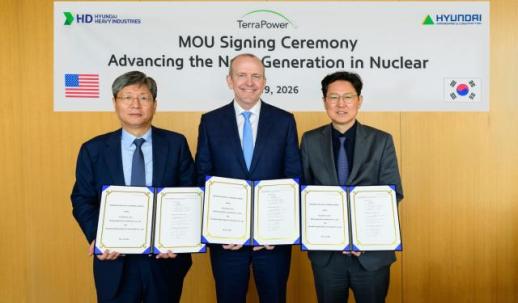 Hyundai Engineering Expands U.S. Nuclear Alliance to Next-Generation Reactors Hyundai Engineering is accelerating its entry into the global energy market by expanding its focus to advanced next-generation reactors. On May 19, Hyundai Engineering announced that it signed a memorandum of understanding (MOU) with TerraPower and HD Hyundai Heavy Industries for the commercial deployment of the next-generation reactor 'Natrium®' at Goldman Sachs headquarters in New York. The signing ceremony was attended by key executives, including Choi Young, Executive Vice President of Hyundai Engineering's New Energy Division; Chris Levesque, CEO of TerraPower; Kang Seok-joo, Executive Vice President of HD Hyundai; and Won Kwang-sik, Vice President of HD Hyundai Heavy Industries. TerraPower is a leading U.S. nuclear company known for its sodium-cooled fast reactor (SFR) technology, which utilizes liquid sodium as a coolant. HD Hyundai Group has been jointly involved in the development of sodium technology since its initial investment of $30 million in 2022, enhancing its collaboration with TerraPower by producing and supplying the reactor vessel for the first Kemerer unit and expanding its supply chain. Hyundai Engineering was selected as a strategic partner for this agreement due to its extensive experience in executing multiple nuclear EPC projects, including the Barakah nuclear power plant in the UAE, and its capabilities related to small modular reactors (SMRs). The company plans to continue discussions with TerraPower and HD Hyundai Heavy Industries to participate in the EPC execution of subsequent commercial sodium reactors. Meanwhile, Hyundai Engineering has identified securing contracts for small modular reactors (SMRs) in Palisades, Michigan, as a key strategy for the year. This project involves constructing two reactors at the Palisades nuclear site in Michigan, based on the SMR-300 model developed by U.S. nuclear firm Holtec International.* This article has been translated by AI. 2026-05-21 11:18:40
 -
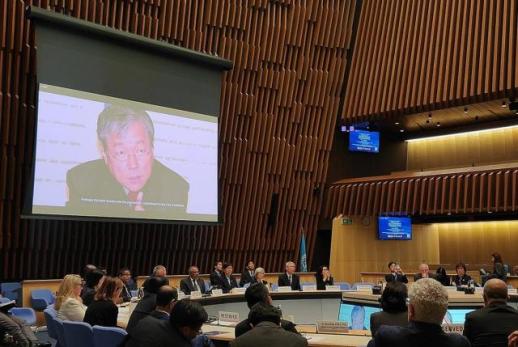 Memorial Service for Dr. Lee Jong-wook, 'Asia's Schweitzer,' Held at WHO Headquarters A memorial service commemorating the 20th anniversary of the passing of Dr. Lee Jong-wook, former Director-General of the World Health Organization (WHO), was held on May 20 at the WHO headquarters in Geneva, Switzerland. According to Yonhap News, the event was organized by South Korea's Ministry of Health and Welfare and the Korea Foundation for International Healthcare (KOFIH), with the participation of health ministries from six countries: South Korea, China, Ethiopia, Laos, Sri Lanka, and Tanzania. Attendees included WHO Director-General Tedros Adhanom Ghebreyesus, Minister Jeong Eun-kyeong, Dr. Lee's widow, Reiko Kaburaki, members of the National Assembly from both ruling and opposition parties, representatives from global health organizations, and colleagues of Dr. Lee. Prime Minister Kim Min-seok sent a video tribute. Dr. Lee began his association with WHO in 1983 as the head of the Hansen's disease eradication team in the South Pacific region. In 2003, he became the first South Korean to serve as the Director-General of WHO, holding the position until his sudden passing due to a brain hemorrhage caused by overwork in May 2006, just before the World Health Assembly. During his nearly 23 years at WHO, he worked tirelessly to combat Hansen's disease, tuberculosis, polio, and AIDS. Under Dr. Lee's leadership, the Framework Convention on Tobacco Control (FCTC), the first global health treaty, was adopted, and he played a key role in revising the International Health Regulations (IHR) in 2005, which are considered foundational for pandemic response. His dedication to global disease eradication earned him the title of 'Asia's Schweitzer.' In her tribute, Minister Jeong Eun-kyeong stated, "Many healthcare professionals are following the path that Dr. Lee paved, and the South Korean government will quietly support their efforts through various means, such as the Lee Jong-wook Public Health Award." Director-General Tedros remarked, "I may not have known Dr. Lee personally, but I feel his legacy at WHO. His time as Director-General was brief, yet his achievements continue to underpin global health efforts." Additionally, Reiko Kaburaki reflected on her time with Dr. Lee, expressing her commitment to continue his mission by supporting vulnerable populations as long as her health permits. Before the memorial service, a newly renovated strategic health operations center established by Dr. Lee was inaugurated as the 'Lee Jong-wook Strategic Situation Room,' supported by the Ministry of Health and Welfare. In an interview with Yonhap News following the event, Minister Jeong emphasized, "Dr. Lee left a significant legacy in public health and serves as a great example for future generations. I hope that healthcare professionals contributing to public health will continue to follow in his footsteps."* This article has been translated by AI. 2026-05-21 11:16:14
 -
 Lee Calls Bloomberg Correction on 'National Dividend' a Model for Domestic Media President Lee Jae-myung stated on May 21 that Bloomberg's correction regarding its reporting on the 'national dividend' should serve as a model for some domestic media outlets that engage in politically motivated manipulation and distortion while refusing to issue corrections. In a post on X (formerly Twitter), President Lee shared the article and remarked, "The claim made by Chief Policy Officer Kim Yong-beom was about distributing excess tax revenue, not excess profits, which was misreported. How admirable and commendable is this stance of a media outlet that values integrity and accuracy?" He further asserted, "Media that deliberately manipulate and distort information to favor certain groups or attack individuals cannot be considered credible." Earlier, Bloomberg had published an article on May 12 interpreting Kim Yong-beom's proposal for a 'national dividend' as a distribution of excess profits, stating that the KOSPI index fell following Kim's comments. In response, the Blue House requested an official apology and correction from Bloomberg, citing the outlet's "inaccurate framing" that led to significant confusion in the market and had a clear negative impact on investor sentiment.* This article has been translated by AI. 2026-05-21 11:13:53