

Journalist

Lester Munson
-
 Blockchain operator Sign estimates 2026 to be turning point for institutional asset tokenization SEOUL, January 20 (AJP) - Sign, a blockchain infrastructure provider, released a market analysis Tuesday projecting that 2026 will serve as a pivotal year for Real World Asset (RWA) tokenization, forecasting a shift from experimental pilots to full-scale institutional integration. The company stated that the digital asset sector is currently undergoing a structural transition. While recent years have focused on technical proof-of-concepts, Sign’s outlook suggests the coming year will see traditional financial institutions begin utilizing blockchain infrastructure for core operations rather than just speculative investment. In its analysis, Sign highlighted industry data projecting the market for tokenized assets could reach 18.9 trillion U.S. dollars by 2033. The firm attributed this growth potential to increasing regulatory clarity in major jurisdictions and a growing demand for on-chain capital efficiency among asset managers. To support this projected influx of institutional activity, Sign announced it intends to expand its proprietary "Sign Chain." The company positions this Layer 1 blockchain as a specialized network designed to handle the rigorous compliance, identity verification, and data privacy requirements of regulated assets—features often lacking in general-purpose public networks. A central component of the company's 2026 roadmap involves government-level partnerships to establish sovereign digital infrastructure. Sign referenced its ongoing collaboration with the National Bank of the Kyrgyz Republic to develop systems for a Central Bank Digital Currency (CBDC) and the "Digital SOM." The company frames this project as a test case for how blockchain can digitize administrative and financial processes at a national level. The report also identified stablecoins as a critical driver for the 2026 outlook. Sign noted that stablecoin settlement volume recently exceeded 46 trillion dollars, interpreting this as evidence that the market is ready for programmable, on-chain currency solutions that can interface seamlessly with traditional banking systems. Addressing the technical barriers to this adoption, Sign stated it is prioritizing "omnichain" connectivity. This approach aims to allow assets to move fluidly between incompatible blockchain networks, removing the technical silos that have previously fragmented liquidity and deterred institutional users. Company executives indicated that Sign plans to roll out additional tokenization services and infrastructure updates in the coming months to align with these anticipated market shifts. 2026-01-20 11:18:36
 -
 Former PM to face verdict over martial law involvement SEOUL, January 20 (AJP) - Former Prime Minister Han Duck-soo is set to face his first verdict this week over his involvement in former President Yoon Suk Yeol's botched martial law debacle in December 2024. In a nationwide televised trial scheduled for 2 p.m. on Wednesday, the Seoul Central District Court in southern Seoul is set to deliver its ruling on him. Prosecutors sought 15 years in prison at Han's final hearing in November last year, accusing Han of aiding Yoon's Dec. 3 declaration of martial law instead of preventing it, despite his duty to check abuses of presidential power. They also criticized Han for refusing to cooperate with investigators, falsifying documents to cover up the debacle, and committing perjury when he testified during Yoon's impeachment trial in February last year, claiming he had not known in advance about Yoon's late-night bid. 2026-01-20 11:17:13
 -
 Former DP lawmaker appears for questioning over alleged bribery SEOUL, January 20 (AJP) - Kang Sun-woo, a former lawmaker of the Democratic Party (DP), appeared for questioning in western Seoul on Tuesday. She is accused of receiving 100 million Korean won (US$68,500) from Seoul city official Kim Kyung in return for the DP's candidate nominations for the 2022 local elections. The money was allegedly delivered to Kang's former aide, identified only by his surname Nam. Her questioning comes nearly a month after an audio recording was abruptly revealed late last month, in which Kang is heard discussing the acceptance of the money with then–DP floor leader Kim Byung-ki, who left the party earlier this week after resigning from his post amid a spate of bribery allegations and other misconduct. Arriving at a police station in Mapo at around 9 a.m., Kang said, "I sincerely apologize for causing public concern," adding, "I will fully cooperate with the investigation." When asked whether she had received the money, she responded that she has "principles" and has "lived a life that adheres to those principles." Police are expected to investigate whether the money was delivered and later returned and, if so, why Kim was later given a single nomination. During earlier investigations, Kim and Nam gave statements that differed slightly from one another. 2026-01-20 10:22:51
 -
 Pinkfong signs deal with US entertainment firm to develop family stage shows SEOUL, January 20 (AJP) - The Pinkfong Company said on Tuesday it has signed a partnership with U.S.-based live entertainment and touring firm Terrapin Station Entertainment to jointly develop new stage productions for family audiences. Terrapin Station Entertainment has produced and toured live shows based on family-oriented intellectual property, including Disney Junior, Peppa Pig and Gabby’s Magic House, and has operated large-scale tours across North America. Under the agreement, the two companies will plan and develop a K-pop concert-style family show featuring the Pinkfong Company’s intellectual property, including Pinkfong, Baby Shark and Bebefinn. The Pinkfong Company said it has staged performances in more than 200 cities across 16 countries, attracting a cumulative audience of over 1.5 million. It said the partnership is designed to move beyond one-off events toward repeatable, large-scale touring formats and to expand global revenue streams. The new production will target families and adopt a K-pop concert format built around the concept of “a child’s first concert.” The companies said the show will combine music, dance and visual effects with audience-participation segments to recreate the energy of a K-pop performance. Pinkfong and Baby Shark will headline the show, alongside Bebefinn. Jeong Yeon-bin, head of the Pinkfong Company’s U.S. operations, said the partnership provides a “new springboard” for expanding the company’s live entertainment business globally. “We will continue to broaden our engagement with fans worldwide through high-quality performance experiences,” Jeong said in a press release. * This article, published by Aju Business Daily, was translated by AI and edited by AJP. 2026-01-20 10:14:48
 -
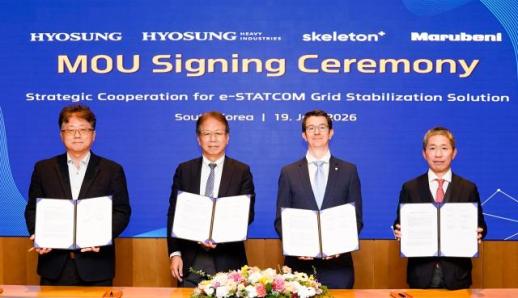 Hyosung Heavy partners with German, Japanese power grid firms SEOUL, January 20 (AJP) - Hyosung Heavy Industries said on Tuesday it has signed an agreement with Germany’s Skeleton Technologies and Japan’s Marubeni to cooperate on the development and commercialization of “e-STATCOM,” a next-generation power-compensation system. Under the deal, Hyosung Heavy Industries and Skeleton Technologies will jointly develop e-STATCOM through 2027, while Marubeni, a strategic partner of Skeleton, will provide stable supplies of supercapacitors used in the system. e-STATCOM combines a conventional static synchronous compensator, or STATCOM, with a high-performance energy storage device known as a supercapacitor. The system is designed to adjust power supply and power quality in real time, helping improve grid stability. Hyosung said global power markets are increasingly in need of advanced stabilization technologies to address supply-demand imbalances stemming from the rapid expansion of AI-driven industries and the growing share of renewable energy sources. The company said e-STATCOM is emerging as essential infrastructure for future energy markets because it can help maintain stable power systems amid sharp fluctuations in demand. Hyosung Heavy aims to complete development of e-STATCOM in 2027 and pursue South Korea’s first commercialization of the technology. The company has steadily internalized power-stabilization technologies, including STATCOM, to respond to structural changes in electricity markets driven by AI growth and renewable energy expansion. Hyosung first developed a STATCOM domestically in 2006 and has since led the South Korean market. It commercialized a 150-megavolt-ampere reactive (Mvar) STATCOM in 2015 and installed 400Mvar STATCOM units in 2018 at the Sin Yeongju and Sin Chungju substations, which it said were the world’s largest single-unit installations at the time. The company has also supplied STATCOM systems to major overseas markets, including the United States, Europe and the Middle East. * This article, published by Aju Business Daily, was translated by AI and edited by AJP. 2026-01-20 10:03:00
 -
 South Korea's Neptune sets sights on India as it scales adtech, game publishing SEOUL, January 20 (AJP) - South Korea's Neptune said on Tuesday it will expand businesses that combine advertising technology and gaming this year, centered on three new initiatives, following its acquisition by Krafton. Neptune outlined three strategic pillars: global expansion of its adtech operations, a stronger push into hybrid-casual games and the development of a new demand-side platform, or DSP, for advertisers. India has been identified as the top priority market for its adtech business. The company said its India strategy focuses on optimizing services for local mobile environments. It completed India-specific software development kits, or SDKs, and infrastructure capable of handling large-scale traffic in the third quarter of last year. The technology will be rolled out in phases, starting with popular mobile games in India in the first half of this year. The company has spent about six months establishing internal collaboration models after the takeover by Krafton and is now moving into an execution phase. In its games business, Neptune said it aims to diversify revenue by increasing investment and publishing in hybrid-casual titles that combine in-app purchases, or IAP, with in-app advertising, or IAA. It also plans to expand in-house game development to secure a steady pipeline of hit titles and user traffic. Chief Executive Kang Yul-bin said Neptune plans to leverage traffic from its parent company to gain a foothold in India’s adtech market, which he estimated to be worth about 3 trillion won ($2.2 billion). “By linking the expansion of hybrid-casual games with our India business rollout, we aim to take our adtech business to the next level,” Kang said. * This article, published by Aju Business Daily, was translated by AI and edited by AJP. 2026-01-20 09:48:48
 -
 Korea's producer prices rise nearly 2% on year amid weak won, surging memory chip costs SEOUL, January 20 (AJP) -South Korea’s producer prices rose for a fourth consecutive month in December, as a weak won lifted prices across a broad range of goods and services, while sharply higher memory chip costs added further upward pressure. According to data released Tuesday by the Bank of Korea, the producer price index for December stood at 121.76 (2020 = 100), up 0.4 percent from the previous month and 1.9 percent from a year earlier. For the full year of 2025, producer prices rose a relatively modest 1.2 percent. Fresh food prices jumped 7.5 percent on month, reflecting cold-weather conditions, while energy prices fell 0.9 percent on softer international prices despite unfavorable exchange-rate conditions. Raw material prices increased 1.8 percent on month, reversing a 0.5 percent decline recorded in November. Manufactured goods rose 0.4 percent. Gains in computer, electronic and optical equipment, which climbed 2.3 percent, and primary metal products, up 1.1 percent, were partly offset by a 3.7-percent drop in coal and petroleum products. Prices for electricity, gas, water and waste services rose 0.2 percent, led by increases in industrial city gas, up 1.6 percent, and sewage treatment services, up 2.3 percent. Service prices also rose 0.2 percent, driven by restaurants and lodging, which increased 0.4 percent, and financial and insurance services, up 0.7 percent. Among key cost drivers, production costs for DRAM surged 15.1 percent from the previous month and 91.2 percent from a year earlier. Costs for assembling flash memory rose 6 percent on month and 72.4 percent on year. By contrast, naphtha cracking costs fell 3.8 percent on month and 17.4 percent on year, reflecting a prolonged downturn in the petrochemical sector and ongoing capacity reductions under industrial restructuring. Lee Moon-hee, head of the Bank of Korea’s price statistics team, said farm product prices were influenced by seasonal supply-and-demand factors and temporary supply disruptions caused by harvest delays for certain fruit items. “Farm product prices typically tend to rise from the previous month in summer and winter, so this is not unusual,” Lee said. On the potential impact on consumer inflation, Lee said the recent rise in producer prices has been driven largely by higher prices for intermediate goods such as semiconductors and primary metals, suggesting the pass-through to consumer prices may take time. He added that international oil prices remain lower than the previous month’s average and could exert downward pressure on consumer prices through petroleum products. The won weakened overnight, with the dollar briefly rising above 1,480 won—widely viewed as a government defense line—before retreating to around 1,474.5 won. 2026-01-20 09:35:03
 -
 Snow sledding available along Seoul's Han River SEOUL, January 19 (AJP) - Kids and other visitors have been enjoying snow sledding at parks along the Han River, as the Seoul Metropolitan Government offers seasonal programs for winter sports fun. Facilities for the programs, open from 10 a.m. to 5 p.m., are available at three location - Ttukseom, Jamwon, and Yeouido - for 6,000 Korean won (about US$4) and will remain open until mid-February. Visitors can enjoy sledding on slopes of varying heights as well as a low-level play area. 2026-01-19 18:12:13
 -
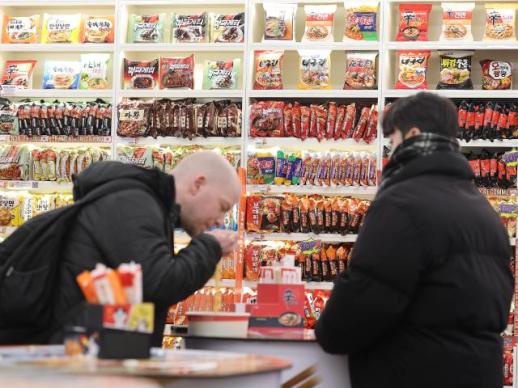 In a weak home market, K-food finds future in overseas SEOUL, January 19 (AJP) - Beneath the global rise of K-ramyeon lies a harsher reality at home: much of Korea’s food industry is shrinking, squeezed by a prolonged domestic consumption slump, rising input costs and a weak currency that has inflated import prices. On the surface, K-food appears unstoppable. Samyang Foods’ Buldak Spicy Chicken Noodles dominate convenience-store shelves worldwide, while Nongshim’s Shin Ramyun has become a staple at major U.S. retailers such as Walmart. But the export boom is far from universal. Samyang Foods now generates 81 percent of its sales overseas, with Nongshim and Pulmuone also posting steady growth abroad. Beyond this narrow group, however, many food makers remain heavily exposed to weak domestic demand. Binggrae, whose Melona brand has become an icon of “K-ice cream” in North America, still derives only 13.7 percent of its revenue from exports as of 2025. That limited overseas exposure has failed to offset falling local consumption and rising costs, prompting the company to offer voluntary retirement to employees across the organization. A similar pattern has emerged among other domestically focused firms. Lotte Wellfood reported a consolidated operating profit of 63.9 billion won in the third quarter of 2025, down 8.9 percent from a year earlier, citing higher cocoa prices and one-off costs linked to voluntary retirement programs. The contrast with export-driven peers is stark. According to the Korea Customs Service, ramyeon accounted for 13.3 percent of total K-food exports last year, followed by seaweed at 10 percent and confectionery at 6.7 percent. Together, the three categories made up roughly 30 percent of total exports — and the companies most exposed to these segments delivered the strongest earnings. Samyang Foods posted third-quarter consolidated sales of 632 billion won and operating profit of 130.9 billion won in 2025, up 44 percent and 49.9 percent, respectively, from a year earlier, driven by surging overseas demand. Nongshim reported sales of 871.2 billion won and operating profit of 54.4 billion won, with operating profit jumping 44.7 percent. Pulmuone also recorded solid growth, with sales rising 6.6 percent and operating profit up 14.4 percent. Industry observers say the outperformance was driven not only by wider distribution but also by consumer engagement strategies centered on social media. “Rather than relying on traditional marketing, we expanded by communicating with consumers through social media-linked campaigns such as the ‘Fire Noodle Challenge’,” said Lee Hye-ryeong, a manager at Samyang Foods. “We organized events like speed-eating contests at schools and other on-site activities, and the distinctive taste of Buldak created a synergy with those efforts. We plan to continue this approach in 2026.” Such direct communication helped turn online buzz into real demand abroad, accelerating Buldak’s expansion into mainstream retail channels. More broadly, analysts say exports have become the industry’s primary growth engine, fueled by rising shipments of ramyeon and beverages to the United States, Southeast Asia and China. Stronger brand recognition, aggressive overseas marketing and localization strategies have allowed leading players to scale beyond the limits of the domestic market. The message is becoming unmistakable. In an era of weak local consumption, the K-food boom belongs to those that treat overseas markets not as a supplement, but as their main stage. For companies that fail to do so, global popularity alone may not be enough to ensure survival. 2026-01-19 18:05:13
 -
 OPINION: Belgium and Korea: An Enduring Friendship SEOUL, January 19 (AJP) - Belgium is a constitutional monarchy in Western Europe, with Brussels as its capital. Yet beyond its role as a political and diplomatic hub of Europe, Belgium often enters the global imagination through a gentler and more playful symbol: the Smurfs. These small blue characters—whimsical in appearance yet enduring in influence—have become one of the country’s most recognizable cultural ambassadors, reminding us that a nation’s identity is sometimes conveyed as powerfully through imagination and humor as through history and diplomacy. Created by the Belgian cartoonist Peyo (Pierre Culliford, 1928–1992), the Smurfs are an integral part of Belgium’s rich comics tradition. Living together in a magical forest village of mushroom-shaped houses, they embody values of cooperation, friendship, and community. Beloved far beyond Belgium’s borders, the Smurfs are so closely associated with the country that they are officially regarded as a national symbol—proof that cultural soft power can sometimes be expressed most effectively through creativity and warmth. Belgium’s relationship with Korea, however, is grounded not in fantasy but in a long and meaningful shared history. Strong diplomatic ties date back to 1892, even before the two countries formally signed a treaty of friendship in 1901. Belgium opened its first legation in Korea in 1903, marking the beginning of official diplomatic engagement between the two nations. A testament to this early relationship still stands today in Nanhyeon-dong, Gwanak-gu, southern Seoul: the former Belgian Consulate building, constructed in 1905 and renovated in 1983. With its classical Ionic columns and preserved fireplaces, the structure serves not only as a window into early 20th-century Western architecture in Korea, but also as a bridge between classical heritage and modern artistic expression. Recognized as Historical Site No. 254, it remains a protected part of Korea’s architectural legacy. Since September 2004, the building has been home to the Nam(South) Seoul Living Arts Museum. Following Japan’s annexation of Korea in 1910, most foreign diplomatic missions were forced to withdraw. Belgium closed its post in Seoul in 1918, yet it was among the first nations to recognize Korea as a sovereign state after liberation and the establishment of a new government in 1948. Belgium officially re-established its embassy in Korea in 1970. Perhaps the most profound demonstration of Belgium’s dedication to Korea came during the Korean War (1950–1953). Under the United Nations Command, approximately 3,000 Belgian volunteers fought alongside Korean and the U.N. allied forces. More than 100 of them made the ultimate sacrifice. Their contribution remains a deeply respected chapter in the shared history of the two nations. In September 2011, the 110th anniversary of diplomatic relations between Korea and Belgium was commemorated with a special concert and reception at the KBS Hall. Organized jointly by the Belgian Embassy in Seoul and KBS, the event featured the KBS Symphony Orchestra under the baton of Belgian conductor Patrick Davin. The invited guests also enjoyed the distinctive flavors of Belgian beer—an art form in its own right, with over 1,000 varieties produced across the country. More recently, Korea welcomed Her Royal Highness Princess Astrid of Belgium, who led a 256-member delegation during Belgium’s fourth economic mission to South Korea, held from June 10 to 17, 2017 Since King Philippe’s accession, Princess Astrid has been entrusted with leading Belgian economic missions abroad, underscoring their strategic importance. The delegation included Deputy Prime Minister and Minister of Foreign Affairs Didier Reynders, as well as Secretary of State for Foreign Trade Pieter De Crem. During her visit, Princess Astrid was appointed an honorary citizen of Seoul. One of the most symbolic moments of the mission was her visit to Panmunjom, the Joint Security Area in the Demilitarized Zone—a place that powerfully represents both division and the enduring hope for peace. I had the honor of attending the Korea–Belgium Friendship Concert and reception on June 12, 2017, held at Kumho Art Hall at Yonsei University. Princess Astrid and many distinguished guests were present, including Belgium’s Ambassador to Korea, Adrien Théatre, and Yonsei University President Kim Yong-hak. The chamber music concert, performed by outstanding musicians from the Queen Elisabeth Music Chapel—under the honorary chairmanship of Her Majesty Queen Paola—was refined, moving, and deeply memorable. Exchanging greetings and shaking hands with Princess Astrid was a personal honor. I was particularly impressed by her genuine interest in Korean culture and media. Her visit, I believe, further strengthened the foundation for fruitful bilateral relations between Korea and Belgium. I also had the pleasure of attending the 2025 Belgian King’s Day reception in Seoul, held on November 13 at the Four Seasons Hotel, Seoul. The event celebrated the strong bilateral ties between Belgium and Korea and looked ahead to the 125th anniversary of diplomatic relations in 2026. Ambassador Bruno Jans highlighted the upcoming commemorations, including the 75th anniversary of Belgian troop involvement in the Korean War. Belgium is also a cultural crossroads, blending Germanic and Roman influences into a distinctive national identity. Like its neighbors France and Germany, it possesses remarkable diversity, yet it has forged its own unique artistic, musical, and culinary voice. That voice resonates powerfully in world music through the legacy of Adolphe Sax, the Belgian inventor of the saxophone in the 1840s. In his hometown of Dinant, saxophone sculptures line the streets, and commemorative events continue to celebrate his enduring influence, including those marking the 200th anniversary of his birth. From Smurfs to saxophones, from battlefields to concert halls, Belgium’s connection with Korea reflects not only shared history but also shared values. It is a relationship built on respect, sacrifice, creativity, and cultural exchange—one that continues to evolve with quiet strength and enduring friendship. ---About the Author--- Choe Chong-dae is a prominent columnist and a longstanding member of the Royal Asiatic Society Korea. An enthusiast of international cultural and historical affairs, he has contributed regular opinion columns to The Korea Times for more than four decades. He also serves on the editorial board of the Newsletter of the Korea-America Association and is the founding director of the Korea–Swedish Association. In 2010, he was awarded Sweden’s Royal Order of the Polar Star, one of the country’s most prestigious honors. 2026-01-19 18:00:24