

Journalist

Lester Munson
-
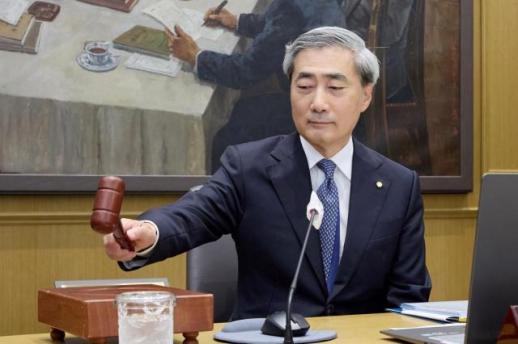 Bank of Korea Governor Shin Hyun-sung: Semiconductor Boom to Benefit All Citizens Bank of Korea Governor Shin Hyun-sung stated on May 28 that the ongoing semiconductor boom will lead to increased benefits for all citizens through fiscal measures. During a press conference following the Monetary Policy Committee meeting, Shin noted that the bonuses distributed due to the semiconductor boom will be subject to income tax, contributing to a trickle-down effect. He anticipates that these benefits will materialize through government spending next year. He added, "While the semiconductor sector will initially reap the most benefits, it is inaccurate to say there will be no trickle-down effects. The positive impact will extend to wage increases, facility investments, construction investments, and overall consumption in the economy." Regarding the significant rise in Gross Domestic Income (GDI) in the first quarter of this year, Shin explained, "The increase in GDI compared to Gross Domestic Product (GDP) is largely due to the price effect from export prices rising more than costs. Even though oil prices have increased, the substantial rise in semiconductor prices has led to a higher GDI increase this time." The Bank of Korea has revised its economic growth forecast for this year upward from 2.0% to 2.6% due to the semiconductor boom. Despite downward pressure on the economy from the conflict in the Middle East, analysts believe growth will expand thanks to the strong semiconductor market. Shin remarked, "The conflict in the Middle East is expected to lower the growth rate by 0.4 percentage points, but the stronger-than-expected semiconductor market and the resulting increase in IT exports will raise the growth rate by about 0.7 percentage points. Additionally, government supplementary budgets and a booming stock market are projected to contribute 0.2 and 0.1 percentage points to growth, respectively." He also mentioned the potential inflationary pressures arising from Samsung's bonuses, stating, "The bonuses from Samsung could lead to increased demand through higher purchasing power, which may create inflationary pressures."* This article has been translated by AI. 2026-05-28 12:21:00
 -
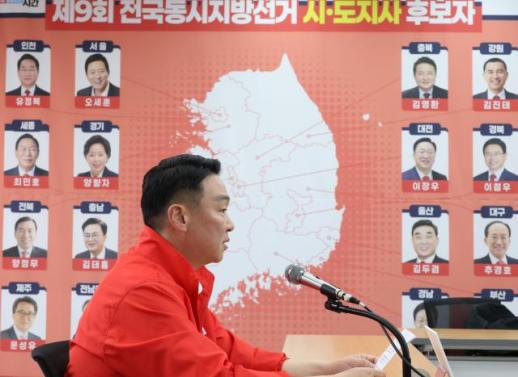 People Power Party Reports Competitive Races Ahead of Local Elections People Power Party officials classified Daegu and Gyeongbuk as strongholds and identified Seoul, Daejeon, Chungcheong, Busan, Ulsan, and Gyeongnam as competitive regions on May 28, one day before early voting for the June 3 local elections and National Assembly by-elections. For the by-elections, they deemed Daegu's Dalseong County a stronghold, while Ulsan's Nam-gu and Chungnam's Gongju, Buyeo, and Cheongyang were seen as competitive areas.Jung Hee-yong, the party's secretary-general, held a press briefing at the party's headquarters in Yeouido, Seoul, stating, "The official campaign led by Representative Jang Dong-hyuk, which began with support rallies in Daejeon and Chungnam, was primarily focused on targeting public sentiment in the central region and spreading that momentum nationwide."He added, "The passionate campaigning by our candidates, combined with recent support from former President Park Geun-hye, has led to a consolidation of our base, resulting in highly competitive races in various areas."Jung categorized the gubernatorial races as strongholds in Gyeongbuk and Daegu, while labeling Seoul, Busan, Gangwon, Chungnam, Daejeon, Ulsan, and Gyeongnam as competitive regions. For the National Assembly by-elections, he reiterated that Dalseong County in Daegu is a stronghold, while Ulsan's Nam-gu and Chungnam's Gongju, Buyeo, and Cheongyang are competitive areas.He emphasized, "Our candidates will do their utmost to regain the support of the public in every region until the very last moment. Each vote from our supporters can create a turning point for us." He also urged voters to participate in the upcoming elections, stating, "Voting begins tomorrow. Please support the People Power Party candidate, number 2, and rest assured that we will meticulously oversee the entire early voting process."Regarding candidate unification in Pyeongtaek, he mentioned, "I heard that candidates Yoo Yi-dong and Hwang Kyo-ahn communicated yesterday. If there is a role for the central party to facilitate finding common ground between the two candidates, we will approach it with a flexible and open attitude." On the Ulsan mayoral election, he called on independent candidate Park Maeng-woo to respond to the citizens' wishes and urged for unification.On the candidate unification in Busan's Buk-gu Gap, he stated, "The central party respects the candidates' positions and will work closely with the candidates for district chief, city council, and district council, including Park Min-sik, to conduct a vigorous campaign together."He concluded, "The essence of this election is clear. It is a battle to uphold the spirit of the Constitution and the rule of law against attempts to cancel the trial of the president's crimes, and to protect my home, my property, and my salary from the arrogant Lee Jae-myung administration. It is also an election to defend our regions from morally and incompetently unqualified candidates."Jung criticized the Democratic Party's candidates, stating, "The candidates presented by the Democratic Party, such as the candidate who avoids debates in Seoul, the candidate involved in power abuse allegations in Busan, the candidate facing allegations of prostitution in Ulsan, the parachute candidate in Gangwon who is unfamiliar with his own region, and the candidate linked to loan sharking in Pyeongtaek, are at a level where basic qualifications for public office are hard to expect." He urged voters to check the arrogant Lee Jae-myung administration and to deliver a stern judgment on the unqualified Democratic Party candidates through their votes.* This article has been translated by AI. 2026-05-28 12:18:00
 -
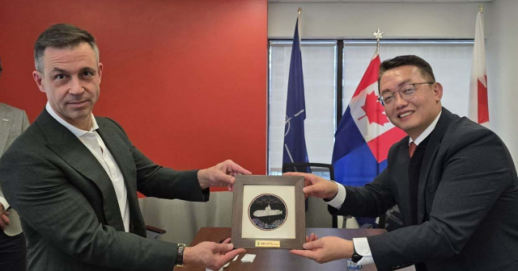 HD Hyundai Heavy Industries Intensifies Efforts to Secure Canadian Submarine Contract HD Hyundai Heavy Industries is ramping up efforts to secure a contract for the Canadian submarine acquisition project by expanding collaboration with local shipyards. On May 28, the company announced that executives from both HD Hyundai Heavy Industries and Davie Shipyard met on May 26 at Davie's Ottawa office to discuss strengthening strategic cooperation across shipbuilding and naval operations. The meeting included Park Yong-yeol, head of HD Hyundai Heavy Industries' naval business division, and James Davies, CEO of Davie Shipyard. During the discussions, HD Hyundai Heavy Industries highlighted its status as the world's leading shipbuilder and showcased the excellence of its K-Submarine technology. They exchanged in-depth opinions on potential collaboration to contribute to the development of Canada's shipbuilding industry. Davie Shipyard, located in Quebec, is Canada's largest shipyard, established in the early 19th century, with a track record of building various types of vessels, including icebreakers, offshore plants, and military support ships. Davie also owns a subsidiary in Helsinki, Finland, which is expected to enhance the partnership between HD Hyundai Heavy Industries and Davie Shipyard, combining HD Hyundai's technological expertise with Davie's local infrastructure to develop a long-term strategic partnership that spans the Arctic market. Additionally, on May 23, HD Hyundai Heavy Industries President Joo Won-ho, along with other executives, participated in the welcoming ceremony for the entry of the Dosan Ahn Chang-ho submarine at the Esquimalt naval base in British Columbia, Canada, and attended a reception hosted by the South Korean ambassador to Canada, further supporting their bid for the contract. Notably, HD Hyundai Heavy Industries is enhancing its competitiveness by proposing offset trade initiatives that include not only the export of naval vessels but also the expansion of imports of Canadian crude oil, technology transfer, and collaboration with the local shipbuilding industry. This move is seen as an effort to strengthen the solid partnership between the two countries ahead of the expected decision in June regarding the selection of a contractor for the Canadian Patrol Submarine Project (CPSP), which is valued at up to 60 trillion won. HD Hyundai Heavy Industries is participating in the CPSP project as part of a 'one team' effort with Hanwha Ocean. Joo Won-ho stated, "We are committed to sharing capabilities and expanding business areas with leading Canadian shipyards like Davie and Irving. We will do our utmost to secure the Canadian submarine project as part of the K-defense one team." 2026-05-28 12:18:00
 -
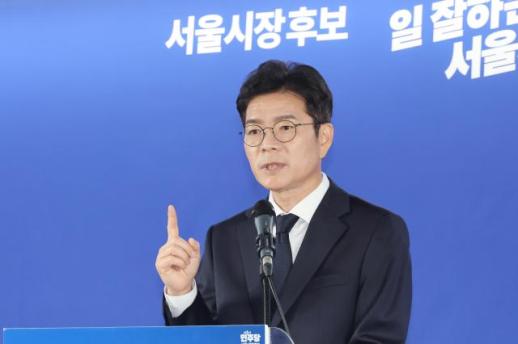 Jung Won-o Urges Against Political Conflict Over Seosomun Incident Jung Won-o, the Democratic Party's candidate for Seoul mayor, firmly stated on the 28th that the political conflict surrounding the Seosomun incident should not be politicized. He called on his rival, Oh Se-hoon of the People Power Party, to stop the negative campaigning. Jung resumed his campaign activities, which had been paused for two days due to the aftermath of the Seosomun overpass collapse, during a press conference held at his election office in Sogong-dong, Seoul. Focusing on safety, Jung announced his safety policies, stating, "We must correct the safety complacency that remains in the public sector and on-site, prioritizing the lives and safety of citizens." He emphasized that politicizing an incident that resulted in casualties is unacceptable, adding, "I have instructed my campaign team not to use this for electoral gain." The People Power Party has criticized Jung's supporters for allegedly discussing how to leverage the incident in a KakaoTalk group chat shortly after the accident, referring to it as a "positive development" and suggesting it could be used for aggressive campaigning. Regarding the upcoming TV debate scheduled for that evening, Jung stated, "There will be no discussion that politicizes the Seosomun incident." However, he expressed hope for discussions on improving life safety in Seoul, noting that many safety incidents occurred during Oh's administration. Jung also criticized Oh's campaign for its negative tactics, asserting, "From the beginning of the election, I proposed a policy-focused campaign without negative attacks, but it has been nothing but slander against me." He rejected Oh's repeated requests for a one-on-one debate, stating that the responsibility for the negative campaigning lies with Oh's team. He urged, "Stop the negative campaigning now." On the narrowing gap in polling numbers, which has reached a tie from a double-digit lead, Jung remarked, "I expected a close race from the start, and I have been preparing for the consolidation of supporters as we approach the final stretch." Jung affirmed, "Regardless of the polls, I will remain truthful and do my best at every moment, aiming for victory in the end." A recent poll conducted by Embrain Public on May 26-27 among 805 Seoul voters showed both Jung and Oh with equal support at 39%. The survey was conducted via mobile phone interviews, with a response rate of 14.0% and a margin of error of ±3.5 percentage points at a 95% confidence level. For more details, please refer to the Central Election Survey Deliberation Commission's website. 2026-05-28 12:18:00
 -
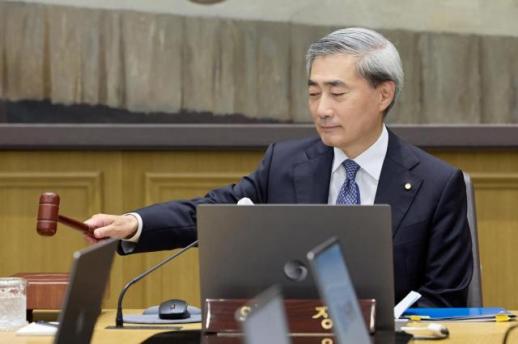 Bank of Korea Governor Shin Hyun-song Vows Firm Action Against Currency Volatility Bank of Korea Governor Shin Hyun-song stated on May 28 that he will take decisive action against the recent volatility in the won-dollar exchange rate. Following a monetary policy committee meeting where the base rate was held steady at 2.50%, Shin emphasized, "We will not tolerate exchange rate volatility, and we have the means and will to address it through various methods." He identified the ongoing conflict in the Middle East as the primary factor contributing to the weakening of the currency. "The situation in the Middle East triggers risk-averse sentiment and affects markets not only in Korea but also in countries that heavily import oil," he said. "Countries that import oil see their exchange rates significantly influenced by oil prices, and if the situation in the Middle East stabilizes quickly, there is a strong possibility that the won will appreciate considerably in the future." Regarding the recent surge in the exchange rate, Shin pointed to the non-deliverable forward (NDF) market, noting, "NDF transactions lack transparency and often require anonymity. Particularly, when NDF trading occurs in offshore markets during Korean nighttime, it necessitates hedging, which can impact the domestic market." He proposed that a key solution would be to promote the internationalization of the won, bringing it into the formal financial system. "This would involve securing won through swap market transactions with the U.S. dollar, allowing for the reinvestment of principal. To achieve this, the use of the won must be expanded and formalized," he explained. Shin also commented on remarks made by Kim Yong-beom, head of the Presidential Policy Office, who stated on May 24 that high interest rates, inflation, and exchange rates are unavoidable costs of success as the Korean economy transitions to a new phase. Shin interpreted this as a sign of foreign investors' confidence in Korea. He added, "From the central bank's perspective, the exchange rate is a crucial factor in terms of liquidity, financial stability, and its impact on import prices, which can stimulate inflation." On the recent rise in market interest rates, Shin attributed it to international conditions but emphasized the importance of balance among market participants. He noted, "The recent increase in Korean government bond yields is part of a global trend, primarily driven by the conflict in the Middle East. Concerns about inflation and fiscal stability in major countries have led to rising bond yields, and Korean bonds are following suit." He concluded, "Stabilizing the bond market fundamentally requires participants to find balance. It is desirable for buyers and sellers to reach a consensus on price determination."* This article has been translated by AI. 2026-05-28 12:06:00
 -
 34 Businesses Caught Engaging in Unpaid Labor, Owing 448 Million Won 34 businesses have been caught by labor authorities for engaging in what is termed "unpaid labor" by misusing comprehensive wage systems, including fixed overtime pay. The Ministry of Employment and Labor announced on May 28 that it identified these businesses during a two-month oversight initiative aimed at eradicating the misuse of comprehensive wage systems, which began on February 26. The total amount of unpaid wages owed by these businesses is 448 million won. Comprehensive wage systems are intended for limited use in sectors where calculating working hours is challenging. However, they have faced criticism for being exploited as a means to evade paying overtime. This raises concerns about the normalization of excessive working hours through fixed overtime or flat-rate allowances. In response, the Ministry launched targeted oversight on 79 businesses suspected of misusing comprehensive wage systems, based on external complaints, petitions, and anonymous tips. Among these, 73 utilized fixed overtime, while six employed flat-rate pay systems. It was found that 43% of these businesses misused the comprehensive wage system. Of the 34 businesses that violated overtime limits, many failed to manage overtime properly. Additionally, 27 businesses did not accurately record actual hours worked, including overtime, night, and holiday hours, violating labor time record-keeping regulations. The government focused on confirming violations related to unpaid wages due to the misuse of comprehensive wage systems, as well as breaches of overtime limits and labor time record-keeping. For instance, a software development company paid only fixed overtime without verifying actual working hours. One cosmetics manufacturer failed to maintain any records of employee attendance while neglecting to pay over 100 million won in overtime and night work allowances. The Ministry has ordered these violating businesses to rectify their labor time violations and pay all owed wages. Failure to comply will result in legal action. Businesses that have completed corrections will be subject to repeated oversight until all legal violations are resolved. The Ministry of Employment and Labor plans to establish a continuous oversight system to prevent the misuse of comprehensive wage systems from being a one-time issue. Given the high detection rate of legal violations reported through the anonymous tip-off center, efforts to promote this reporting mechanism will be strengthened. Minister of Employment and Labor Kim Young-hoon emphasized, "Ensuring that workers receive fair compensation is a fundamental principle for normalizing the labor market. Compensation for labor must not be denied under the guise of comprehensive wages."* This article has been translated by AI. 2026-05-28 12:03:00
 -
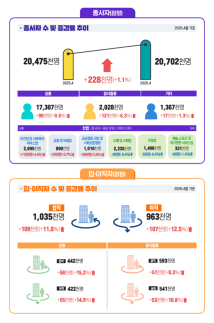 Wage Gap Widens Amid Performance Bonus Season Worker wages increased in the first quarter of this year, driven by expanded performance bonuses among large exporting companies. However, the improvement in real wages, adjusted for inflation, was limited. In March, the wage gap between businesses of different sizes exceeded 2.7 million won, indicating a growing polarization in the labor market.According to the 'April 2026 Business Labor Force Survey Results' released by the Ministry of Employment and Labor on May 28, the average nominal wage for employees in businesses with one or more regular workers was 4,555,000 won, a 3.4% increase (149,000 won) compared to the same period last year.However, real wages, which account for inflation, rose only to 3,847,000 won, reflecting a modest increase of 1.3% (49,000 won). The ongoing rise in consumer prices has significantly offset the nominal wage gains.In March, the total wage per worker across all sectors was 4,230,000 won, marking a 2.3% increase compared to the same month last year. This is a return to normal levels after a spike in February, when wage growth reached 17.8% due to the timing of holiday bonuses.March is typically a peak period for performance bonuses and special allowances, which highlighted the wage disparities based on company size.The average monthly wage for employees in businesses with 300 or more workers was 6,512,000 won, approximately 1.7 times higher than that of businesses with fewer than 300 workers, which stood at 3,743,000 won. While the wage growth rates for both categories were similar at 1.7% and 2.0%, the absolute wage gap reached 2,769,000 won.Special bonuses for regular workers averaged 526,000 won, reflecting a 4.4% increase from the previous year. This growth is attributed to the expansion of performance bonuses among large exporting firms in sectors such as semiconductors, automobiles, and shipbuilding.In contrast, small and medium-sized enterprises, facing sluggish domestic demand and high interest rates, have struggled to secure funds for performance bonuses, exacerbating the perceived wage gap. For instance, the total wage in the accommodation and food service sector in March was only 2,343,000 won, significantly below the overall average.The growth in real wages was also minimal. In March, real wages were 3,560,000 won, reflecting only a 0.1% increase compared to the same month last year. The persistent consumer price inflation, remaining in the 2% range, has limited the perceived improvement in wages.Employment trends continued to show a gradual increase. As of the last business day in April, the number of employees in businesses with one or more workers reached 20,702,000, an increase of 228,000 (1.1%) compared to the same month last year.Regular workers increased by 90,000 (0.5%), while temporary and daily workers rose by 121,000 (6.3%). By company size, businesses with fewer than 300 workers added 171,000 employees, while those with 300 or more added 57,000.By industry, the health and social welfare services sector saw the largest increase, adding 115,000 jobs. The finance and insurance sector added 32,000 jobs, and public administration, defense, and social security administration added 26,000. Conversely, the wholesale and retail sector lost 9,000 jobs, and the construction sector lost 5,000.Manufacturing, which employs the largest share of the workforce, saw an increase of 3,000 jobs, continuing its positive trend. Jeong Hyang-sook, head of the Labor Market Research Division, explained, "After adjusting the statistics to reflect the latest population data, manufacturing has shown a turnaround earlier than initially reported, marking its first increase in seven months."Last month, the number of new hires was 1,035,000, an increase of 109,000 compared to the same month last year, while the number of separations was 963,000, up by 107,000. Among these, voluntary separations totaled 339,000, an increase of 65,000 (23.7%).* This article has been translated by AI. 2026-05-28 12:03:00
 -
 Income Growth Fails to Keep Pace with Consumer Spending in Q1 In the first quarter of this year, household consumption showed signs of recovery, but income growth lagged behind, leaving many low-income families feeling significant financial strain. Notably, the trend of 'deficit spending' is deepening among lower-income households, where expenditures exceed income. According to the National Data Agency's "2026 Q1 Household Trend Survey" released on May 28, the average monthly income per household reached 5.481 million won, a 2.4% increase compared to the same period last year. However, the real income growth rate, adjusted for inflation, was only 0.4%. Household spending rose to 3.105 million won, marking a 5.3% increase that significantly outpaced income growth. Consequently, the average household surplus decreased by 3.1% to 1.239 million won, while the average consumption propensity rose by 1.7 percentage points to 71.5%. This consumption propensity indicates the proportion of disposable income spent, suggesting that households are left with less disposable income. The recovery in consumer spending, which began in the previous quarter, has become more pronounced. Notably, expenditures on transportation and logistics surged by 12.1%, while spending on entertainment and culture increased by 12.0%, and health expenditures rose by 10.4%. This reflects a simultaneous increase in car purchases, a rebound in overseas travel demand, and rising medical costs. Analysts suggest that the recovery in consumer sentiment, stock market rebounds, and rising asset prices since late last year have contributed to some increase in spending capacity. However, the benefits of this recovery are not evenly distributed across income levels. Households in the lowest income quintile saw their average monthly income rise by only 2.7% to 1.17 million won, while their spending increased by 7.3%. Their average consumption propensity stood at 155.3%, indicating that their spending exceeds their disposable income. This suggests that many households are relying on debt or depleting existing assets to cover living expenses. In contrast, households in the highest income quintile experienced a 4.2% increase in average monthly income to 12.378 million won, with disposable income rising by 5.1%. Their spending also increased by 6.9%, but their average consumption propensity remained at a stable 57.7%. This indicates that higher-income households are seeing faster income growth and relatively stable spending capacity. The income gap continues to widen, with the income quintile ratio based on equalized disposable income rising to 5.91 times, up from 5.82 times a year earlier. Equalized disposable income accounts for differences in household size, serving as a measure of actual living standards. A higher ratio indicates a deepening income polarization. Despite increases in government transfer income, the widening gap in market income remains a concern. Notably, the growth rate of earned income has slowed. In the first quarter of this year, earned income rose by only 0.3% to 3.422 million won. This reflects a base effect from last year's significant increases due to improvements in the semiconductor industry and expanded bonuses, as well as a slowdown in employment in manufacturing and construction. Conversely, transfer income increased by 9.7%, driving overall income growth. This rise is attributed to increases in public transfer income, such as national pensions and basic pensions, as well as expanded government support. In fact, a similar trend of rising transfer income was observed in the fourth quarter of last year, which helped sustain overall household income.* This article has been translated by AI. 2026-05-28 12:03:00
 -
 Climate Ministry Reveals 158 Violations of Construction Waste Law, Including Major Firms Hyosung Heavy Industries, Daebang Construction, and the Korea Land and Housing Corporation (LH) are among the 158 entities publicly identified for violating the construction waste law last year. The Ministry of Climate, Energy and Environment announced that it will disclose the names of the corporations, project names, violations, and penalties for these infractions from January to December 2025 on its website for one year starting from May 28. This disclosure represents approximately 13.1% of the total 1,203 violations of the construction waste law recorded last year, a decrease of 14.1% from the previous year's 184 cases. The disclosed violations include administrative penalties, prison sentences, fines, and fines of less than 10 million won. The list includes private construction companies such as Hyosung Heavy Industries, Daebang Construction, Jungheung Construction, and Kyeryong Construction Industry, as well as public enterprises like LH's Southern and Northern Gyeonggi regional headquarters, Korea Electric Power Corporation, and Korea Expressway Corporation's Gimpo-Paju construction project team. Local public enterprises such as Gyeonggi Housing and Urban Corporation and Incheon Urban Corporation are also included. By type of violator, waste generators accounted for the largest share with 78 cases, followed by collection and transportation companies with 48 cases, and intermediate processing companies with 32 cases. In terms of penalties, there were 55 administrative penalties, 2 fines, and 101 fines. Among specific violations, waste generators had the highest number of infractions related to non-compliance with construction waste storage standards, totaling 61 cases. Collection and transportation companies reported 28 cases of violations, including exceeding waste acceptance limits and delays in processing, as well as environmental contamination. Intermediate processing companies had the most cases of failing to comply with permit changes, with 13 instances. Notably, many of the disclosed violations focused on inadequate site management, such as non-compliance with storage standards and delays in processing, rather than illegal dumping, highlighting the need for strengthened management systems at each stage of construction. Kim Go-eung, director of the Resource Circulation Bureau at the Ministry, stated, "Construction waste accounts for about 36% of total waste generation, so transparent and lawful management from the generation stage to final disposal is essential. We will prevent similar violations from recurring through the disclosure of violations and enhanced on-site training."* This article has been translated by AI. 2026-05-28 12:03:00
 -
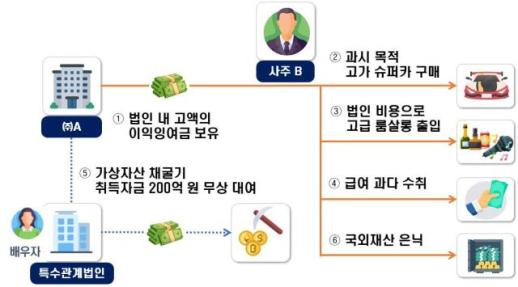 Tax Agency Targets Supercar Tax Evasion Among Corporations The National Tax Service (NTS) has launched investigations into individuals suspected of tax evasion by using corporate funds for personal luxury, including the private use of supercars registered under corporate names. Following the introduction of green license plates, there has been a resurgence in the purchase of high-value corporate vehicles, prompting the NTS to target these irregular tax practices involving 'corporate supercars.' On May 28, the NTS announced that it has selected 19 corporations suspected of supporting lavish lifestyles for their owners or engaging in improper gifting and fund misappropriation. The targeted companies collectively own 90 high-value vehicles, valued at approximately 30 billion won. The total amount of suspected tax evasion is estimated at around 300 billion won. The NTS plans to focus on several key areas during the investigation, including the use of corporate funds to support extravagant lifestyles, irregular accounting practices, and improper gifting to the owners' children. Despite the introduction of the green license plate system aimed at curbing the private use of high-value corporate vehicles, registrations have continued to rise. In fact, the number of new registrations for corporate vehicles valued over 100 million won increased from 48,894 in 2022 to 51,542 in 2023. Although the number dropped to 33,960 in 2024 due to the impact of the new license plate system, it has risen again to 39,429 this year. The NTS has also uncovered evidence that some owners have manipulated driving logs while using corporate supercars for personal visits to golf courses, entertainment venues, and luxury hotels. In one case, a corporation purchased six supercars worth 3.6 billion won using corporate funds for personal use by the owner’s family. Another company was found to have improperly classified approximately 1.5 billion won in entertainment expenses at a room salon as corporate costs over several years. Instances of overseas asset concealment and improper gifting have also been detected. One owner failed to report 17 billion won earned from overseas stock investments, hiding the funds in foreign accounts, while another individual is suspected of improperly gifting funds for the purchase of buildings worth several billion won to their underage children. The NTS noted an increase in irregular succession methods, such as transferring high-value vehicles to family companies at undervalued prices or providing large loans without interest. They plan to conduct thorough examinations of the overall flow of funds. Additionally, the NTS intends to verify fund flows through digital forensics, tracking financial accounts, and conducting on-site inspections. If intentional tax evasion is confirmed, they will pursue legal action under the Tax Offenses Punishment Act. An NTS official stated, "Using corporate vehicles and funds for personal purposes undermines tax fairness and creates a sense of relative deprivation. We will pursue luxury tax evasion relentlessly." 2026-05-28 12:03:00