
Journalist

Lim, Kwu Jin
-
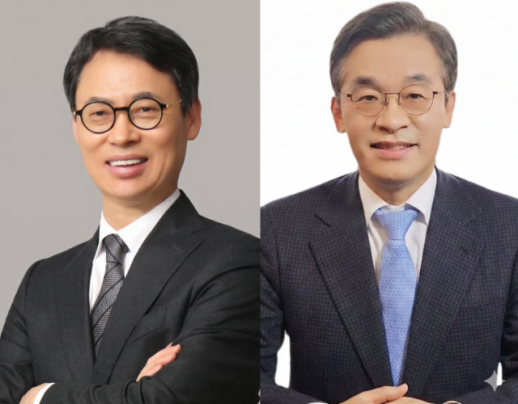 Daeryuk & Aju and Lin to Merge, Citing Limits for Mid-Sized Law Firms Daeryuk & Aju and Lin said they will merge, saying mid-sized firms face structural limits in moving into the top ranks of South Korea’s legal market. Lee Gyu-cheol, managing partner at Daeryuk & Aju, said in an interview after the firms signed a merger memorandum of understanding on the 29th that “in the current law firm market structure, it is virtually impossible for a mid-sized firm to rise into the top tier through organic growth alone.” He described the gap in scale: “If a top firm grows 10%, that’s an additional 10 billion won, but for a mid-sized firm it’s only 1 billion won,” he said, adding that “under this structure, it’s hard to narrow the gap.” Lee said Daeryuk & Aju, which he described as remaining in “Tier 2,” saw a risk of stagnating or falling behind. That assessment led to the merger push. “There are limits to recruiting individual talent, so we had no choice but to choose a merger,” Lee said. “I think this decision is our last big bet.” Lim Jin-seok, managing partner at Lin, voiced a similar view, focusing on practical constraints. “At the level of a mid-tier firm, there are clear limits to the size of cases and deals you can handle,” he said, adding that “for some large matters, the structure makes it difficult even to apply.” Lim said Lin concluded it had reached a “ceiling” at its current size. He pointed to barriers to entry. “First-tier financial institutions such as banks, and major fair-trade cases, move around the Big 6 firms,” Lim said. “Even with capability, if you’re small, you often aren’t included among the options.” Lim said Lin pursued a merger not for simple expansion but for a “tier jump.” He said Daeryuk & Aju was “the most proactive” and best-aligned partner among firms Lin contacted. Both firms said the post-merger strategy will focus on “synergy.” “A merger matters only if 1 plus 1 becomes 3, not 2,” Lim said. “If we secure scale and a brand, we can compete 충분히 with top firms.” Lee said the next task will be improving revenue per lawyer. He said the merger should broaden the range of matters the combined firm can take on. The firms plan to combine Daeryuk & Aju’s strengths in litigation and criminal matters with Lin’s strengths in corporate advisory work and mergers and acquisitions, aiming to build a “one-stop service” system. Lim said Lin has been relatively weaker in criminal work, sometimes leaving it unable to handle related matters for corporate clients in-house. After the merger, he said, the firm expects to respond to clients’ criminal, litigation and advisory needs under one roof. Lee said the firms will also prepare for risks that can come with a large merger. “Conflicts of interest can inevitably arise during the merger process, but we can minimize them through 충분한 discussion,” he said. “What matters is that the number of matters we can handle increases.” On differences in organizational culture, Lee said Lin has many lawyers who previously worked at large firms, adding that there is “a lot to learn.” He said the firms plan to integrate through collaboration and personnel exchanges. Lim said “the most important thing in a merger is will,” adding that the goal is to grow the firm and have its members prosper together. Both also addressed artificial intelligence. Lee said it would be difficult to generate direct revenue from AI and that it would mainly be used to improve efficiency. He said reducing costs and raising productivity will shape competitiveness. Lim said AI is a variable affecting the entire legal industry and warned that firms that fail to prepare could be left behind. The merger process is at an early stage. The firms said they have formed a merger promotion committee to discuss the combined firm’s name and decision-making structure, with a goal of filing merger registration in October. “Today’s agreement is only a starting point,” Lee said, stressing the need to create synergy by combining strengths. He said the long-term goal is to reach more than 200 billion won in revenue. Lim said the merger would create a foundation to compete with top firms, adding that the combined firm would now have the conditions to compete head-on on the same stage.* This article has been translated by AI. 2026-04-29 16:53:51
 -
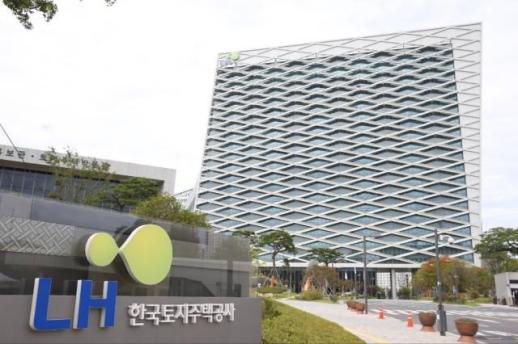 LH Signs Implementation Deal for Seoul’s Myeonmok District 9 Public Redevelopment Korea Land and Housing Corp.’s Seoul metropolitan redevelopment unit said Tuesday it signed an implementation agreement with the residents’ representative council for the Myeonmok District 9 public redevelopment project in Seoul. Myeonmok District 9 failed to make the cut in 2021 under the city’s fast-track planning program and the first round of public redevelopment candidates. It was later selected as a second-round public redevelopment candidate in 2022, backed by strong resident participation, with a 55% consent rate. LH said coordination with the local government accelerated the process. After the plan cleared review by the Seoul Metropolitan Government’s Urban Planning Commission in December, the district designation was completed about a month later. In January, LH said it also completed administrative steps including designation of the project implementer and formation of the residents’ representative council. LH said it plans to complete contractor selection this year through a public bidding process and to pursue approval of the project implementation plan next year. Under the current redevelopment plan, the area would be rebuilt into a large complex of 1,057 households, with a floor area ratio of 275.2% and buildings up to 30 stories, or 135.5 meters. LH said it also plans to reflect possible changes tied to the legislative track of the so-called “9.7 measures,” including a higher floor area ratio and a shorter project timeline, to improve project feasibility. “LH will bring its extensive public redevelopment capabilities to keep the Myeonmok District 9 project on track,” Park Hyeon-geun, head of LH’s Seoul metropolitan redevelopment unit, said in a statement. He said LH will work closely with the residents’ council to deliver faster housing supply and improved living conditions. * This article has been translated by AI. 2026-04-29 16:52:55
 -
 Daewoo Elcrew Ilsan Private Rental Project in Deogi-dong Advances Land Acquisition, Planning Steps A private rental apartment project known as “Daewoo Elcrew Ilsan,” planned for the Deogi-dong area of Goyang, Gyeonggi Province, is moving ahead with land acquisition and preparations for required administrative procedures. Real estate industry officials said on the 29th that the developer is pursuing land acquisition while also preparing steps tied to a district unit plan. Industry observers note that early-stage projects often hinge on factors such as urban planning standards, population allocation and whether land can be secured. They said progress should be assessed in context, citing similar developments that moved forward after administrative consultations and plan adjustments, ultimately leading to approvals and supply. Some past projects initially faced concerns about delays or procedural risks, but later became viable as district unit plans were revised, agencies consulted and land acquisition advanced. Experts advise against judging prospects based on limited early information, and instead recommend reviewing administrative steps, project structure and land acquisition status together. Daewoo Elcrew Ilsan is being promoted as a private rental project. Unlike typical local housing cooperative projects, where land acquisition rates, member recruitment and project plan approvals can introduce multiple uncertainties, private rental projects can vary in land-use documentation requirements and follow-up steps depending on structure and permitting stages. As a result, land acquisition progress and administrative procedures are seen as key indicators of stability. The developer said it has secured about 91% of the total project site. However, final permitting and the supply schedule may change depending on subsequent steps, including district unit plan revisions, consultations with relevant agencies and approval of the project plan. Park Byeong-rok, CEO of Yason Architecture Co., which is handling the design, said of the site, “There is no major problem in changing it in a direction that allows apartment construction through a district unit plan application.” He added, “We plan to complete the related preparations by the end of April, and then adjust the filing timing to fit the situation.” Daewoo Elcrew Ilsan is providing consultations through a promotional office set up in Dongpae-dong, Paju, Gyeonggi Province. 2026-04-29 16:48:03
 -
 LG Electronics Says AI Data Center Cooling Business Nearing Visible Results LG Electronics said on Tuesday that it has made progress in its AI data center cooling solutions business and expects to share tangible results soon. In a conference call on its first-quarter earnings, the company said certification procedures for key products are moving smoothly with major customers, including global big tech firms. LG Electronics said it is moving quickly to secure next-generation cooling technologies and develop products, while expanding cooperation to deliver total solutions that include cooling software and power management systems. The company also said it expects to reach its 2027 target of 1 trillion won ($1 trillion) in chiller sales earlier than planned, citing steady growth. It added that although its data center business remains in an early stage, sales last year rose about threefold from a year earlier.* This article has been translated by AI. 2026-04-29 16:47:17
 -
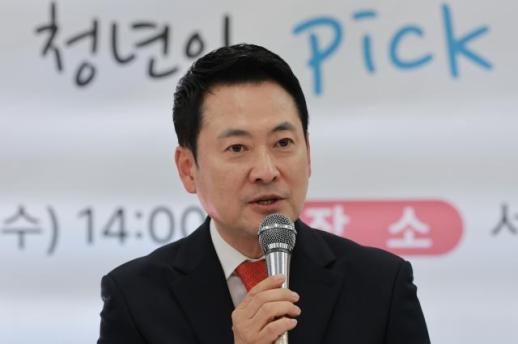 Kim Moon Soo Gains Prominence in June 3 Local Elections as Jang Dong-hyeok Keeps Low Profile Ahead of the June 3 local elections, People Power Party leader Jang Dong-hyeok has kept a low profile, avoiding regional campaign events, as former Labor Minister Kim Moon Soo’s presence has grown. With People Power Party candidates for metropolitan and provincial governor and mayor posts in Busan, Daegu and North Gyeongsang Province (TK), Gangwon and other areas asking Kim to serve as campaign chair, Jang has appeared to step back. Jang on April 29 announced regional economy and livelihood pledges at the National Assembly. “We will energize local economies so people’s lives improve,” he said, proposing steps including narrowing the housing market gap between the Seoul area and the rest of the country, introducing a production-boosting tax system described as a “Korean version of the IRA,” building a safety net for small-business succession, and cutting road occupancy fees. Later, he met with young people at a cafe in Seoul’s Seodaemun district for a discussion on everyday policy proposals. “Young people have stronger capabilities than any generation before them, but the stage to show them is narrow,” Jang said. He added that the party would “be reborn as a true youth party” where young people’s voices reach policymakers first and quickly become policy. The moves were seen as a minimal return to policy messaging after a recent controversy over a U.S. trip subsided. Kim, the party’s presidential candidate last year, has been taking on a larger role as candidates turn to him rather than Jang for campaign leadership. Kim is currently serving as honorary campaign chair for five election camps: the Busan, Daegu and Sejong mayoral races and the North Gyeongsang and Gangwon gubernatorial races. The decision to put Kim at the forefront has been interpreted as an effort to rally conservative voters. Rep. Jung Sung-kook, a lawmaker aligned with Han Dong-hoon, said on SBS radio that Kim’s broader appeal than Jang’s appeared to be a factor. “It seems there is a judgment that bringing in Kim, who has a wider spectrum than Jang, will help the election,” Jung said. A party official also said local elections typically draw lower turnout, making it difficult to bring disappointed conservative supporters to the polls, which is why candidates appear to be calling on Kim. * This article has been translated by AI. 2026-04-29 16:46:29
 -
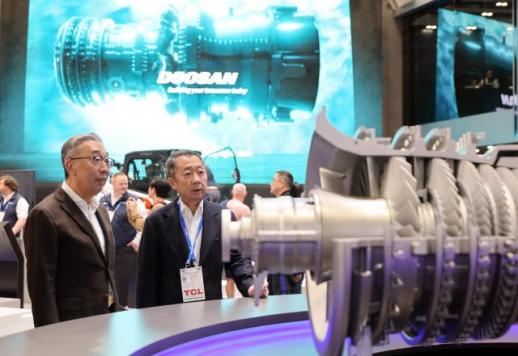 Doosan posts strong Q1 gains, ramps up semiconductor and energy investments Doosan Group is posting a sharp early-year performance lift, driven by strength in its core energy business and growth in semiconductor-related materials, parts and equipment seen as a future growth engine. The group plans to accelerate that semiconductor expansion through large-scale investment and mergers and acquisitions. According to industry officials on Tuesday, Doosan Corp. reported first-quarter consolidated revenue of 5.0603 trillion won and operating profit of 340.8 billion won, up 17.71% and 71.68% from a year earlier. Net income came to 101.5 billion won, swinging from a 106.4 billion won loss in the previous quarter. The surge was led by its Electronics BG unit, industry officials said. Demand jumped for high value-added products such as high-performance copper-clad laminate, or CCL, which is essential for printed circuit boards used in artificial intelligence semiconductors. Related results were reported to be up about 40% from a year earlier. Doosan Corp. said it will invest about 180 billion won to build a new production base in Thailand to get ahead of rising CCL demand. The company plans to break ground on a plant on a roughly 73,000-square-meter site in the Araya industrial complex in Samut Prakan province, aiming to begin mass production of CCL locally in the second half of 2028. Doosan Group also said Monday it will pursue about 400 billion won in facility investment and capacity expansion led by Doosan Tesna, as it seeks a stronger position not only in semiconductor materials but also in the back-end processing market. Doosan Tesna plans to buy about 190.9 billion won worth of semiconductor test equipment from suppliers including SEMES, a Samsung Electronics affiliate, to expand test infrastructure. A previously disclosed equipment investment plan of 171.4 billion won, announced in October, was raised to 205.3 billion won. The company also plans to invest a total of 230.3 billion won to build new facilities for a second plant in Pyeongtaek, targeting completion in November 2027. The acquisition of SK Siltron, the world’s fourth-largest wafer maker, is in its final stages. Investment banking industry officials expect Doosan Group and SK Group to announce a deal in early May after finalizing the purchase price. If the SK Siltron acquisition is completed, Doosan Group is expected to broaden its semiconductor footprint across materials such as PCBs and wafers, back-end testing and automation, including robots, in line with Chairman Park Jeongwon’s plan. Doosan’s energy business is also benefiting from growth in nuclear power and related equipment, along with expectations tied to contract manufacturing for SMRs, or small modular reactors. Doosan Enerbility posted first-quarter revenue of 4.2611 trillion won and operating profit of 233.5 billion won, up 13.7% and 63.9% from a year earlier. Net income was 60.2 billion won, turning positive from a 21.1 billion won loss a year earlier. Doosan Enerbility is working with the Ministry of Trade, Industry and Energy and Korea Electric Power Corp. as part of “Team Korea” to win an order for Vietnam’s Ninh Thuan Unit 2 nuclear power plant. To support the effort, Park Jiwon, chairman of Doosan Enerbility, joined President Lee Jae-myung’s economic delegation during a Vietnam trip on the 23rd and discussed cooperation on new nuclear power projects with Vietnamese government and energy industry officials. 2026-04-29 16:44:52
 -
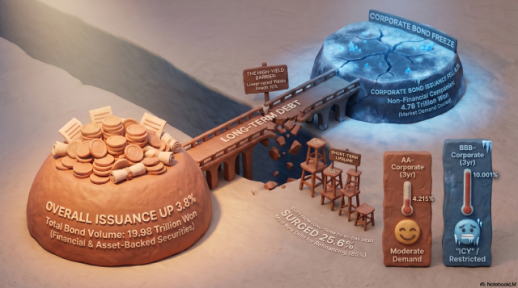 Korean Inc. turns to 91-day financing as corporate debt market remains icy SEOUL, April 29 (AJP) — South Korean companies are turning to three-month financing to meet debt obligation, as new bond issues become increasingly difficult with lower-rated yields hovering above 10 percent amid icy demand. Bond issuance by non-financial companies fell 6.5 percent from a month earlier to 4.78 trillion won in March, even as overall bond issuance rose 3.8 percent to 19.98 trillion won ($13.56 billion), according to data released Wednesday by the Financial Supervisory Service (FSS). The increase was driven largely by financial issuers and asset-backed securities (ABS), while corporate bond issuance was mostly limited to refinancing existing debt. “Excluding the first quarter, April is a period with a heavy repayment burden, with 10.7 trillion won in corporate bonds reaching maturity,” said Kim Eun-ki, a researcher at Samsung Securities. “The overall atmosphere for issuers is to wait out the storm as bond yields are rising fast.” Corporate bonds recorded a net repayment of 449 billion won in March, following a 3.41 trillion won net repayment in February, marking two consecutive months of net outflows. About 85.6 percent of general corporate bonds issued in March were used to repay existing debt, while 98.5 percent of issuance came from A-rated or higher investment-grade companies, underscoring risk aversion on both the demand and supply sides. Companies are cancelling or downsizing debt offerings as bookbuilding demand weakens and yields rise rapidly. Recent deals also point to growing market bifurcation. Mid-tier issuers such as Lotte Hi-Mart and LG HelloVision were forced to price bonds at around 20 to 40 basis points above fair value, with order books barely covering the deal size. By contrast, top-tier borrowers continued to draw demand several times the amount offered. Maturities are also getting shorter. Long-term bonds with maturities of more than five years amounted to just 120 billion won, or 2.5 percent of total issuance. Medium-term bonds of one to five years accounted for 97.5 percent, showing that companies are avoiding long-term financing amid persistent rate pressure. Issuers are raising only the minimum needed to meet debt obligations. An estimated 10.7 trillion won in general corporate bonds comes due this month, adding pressure to refinance in an unfavorable rate environment. As of Wednesday morning, the three-year government bond yield stood at 3.525 percent, while the three-year AA- corporate bond yield was 4.185 percent. The resulting credit spread of about 65 basis points has widened from around 50 basis points in the second half of last year, indicating that the credit premium paid by companies is rising again. The gap is far wider in the lower-rated market. The three-year BBB- corporate bond yield reached 10.001 percent, pushing the spread against AA- bonds to about 580 basis points. That is approaching levels seen during the 2022 Legoland crisis, when the credit market tightened sharply and the AA- to BBB- spread widened to around 600 basis points. Market watchers say access to bond financing is again becoming effectively restricted for lower-rated companies. Their lifeline are 91-day commercial papers whose rate stood at 3.06 percent, about 115 basis points lower than the AA- corporate bond yield. That makes short-term borrowing a much cheaper option for companies trying to bridge near-term maturities. Total issuance of commercial paper and short-term bonds reached 200.47 trillion won in March, up 25.6 percent from the previous month. The surge suggests that corporate funding strategies are shifting from long-term debt to short-term financing, rather than merely reflecting a temporary rise in liquidity demand. 2026-04-29 16:44:11
 -
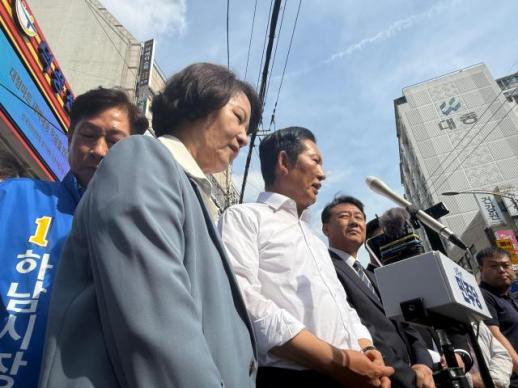 Democratic Party leader Jeong Cheong-rae campaigns in Hanam for Choo Mi-ae and Lee Kwang-jae Jeong Cheong-rae, leader of the Democratic Party, visited Hanam in Gyeonggi Province on April 29 to rally support for Choo Mi-ae, the party’s candidate for Gyeonggi governor, and Lee Kwang-jae, who is running in the Hanam-gap by-election. Jeong joined Choo and Lee that afternoon at Hanam’s Deokpung traditional market to begin campaign activities. Their first stop was a rice-cake shop, where Jeong fed rice cakes to Choo, Lee, Rep. Kim Yong-man, and Kang Byeong-deok, the Democratic Party’s Hanam mayoral candidate, among others. They then visited dried-goods and produce shops. Introducing Choo, Lee and Kang, Jeong said, “I will work for Hanam. Choo has come back bigger, and Lee has come to become bigger.” Jeong also highlighted the achievements of President Lee Jae-myung. When a produce-shop owner thanked him, saying, “Thank you for doing well. You’ve worked hard,” Jeong replied, “The president is working hard.” Some market users objected to the visit. A male vendor complained to security guards protecting Jeong, saying, “What are you doing in someone else’s market? The guards are pushing people.” A middle-aged woman, upset by the congestion caused by the Democratic Party group, scolded Jeong, saying, “Why are you doing this here? Let me shop.”* This article has been translated by AI. 2026-04-29 16:43:35
 -
 GM Korea Union Seeks 30 Million Won Bonus, 149,600-Won Monthly Base Pay Raise The GM Korea branch of the Korean Metal Workers' Union said Tuesday it has finalized its 2026 wage and labor contract demands, calling for a performance bonus of about 30 million won per union member and a 149,600-won increase in monthly base pay. The union said it confirmed the proposal through a recent meeting of interim delegates. It said the bonus was calculated by allocating 15% of 10% of GM Korea's total sales last year, which it put at 12.6 trillion won, to about 6,300 union members and others. In special demands aimed at future growth prospects and job security, the union included assigning production of follow-up models, future vehicles and next-generation engines. It also called for investing more than 50% of retained earnings in South Korea, restoring domestic market share to 10% and diversifying export markets. The proposal also includes launching the Buick Envista in South Korea, a model the company currently produces domestically and exports entirely. The union said it plans to discuss with management measures to ensure and strengthen the sustainability of the service technology center and high-tech center, as well as issues involving nonregular workers.* This article has been translated by AI. 2026-04-29 16:39:51
 -
 Nvidia executive Madison Huang meets Samsung, SK hynix and Doosan to expand physical AI ties Madison Huang, a senior director for Omniverse and robotics product marketing at Nvidia and the eldest daughter of CEO Jensen Huang, has been meeting with executives at major South Korean companies including Samsung Electronics, SK hynix and Doosan Robotics to pursue cooperation on physical artificial intelligence, industry officials said. Officials said Huang, who is visiting South Korea, met Wednesday morning with key executives from Samsung Electronics and SK hynix to discuss ways to build a physical AI ecosystem spanning semiconductors and robot platforms. The talks were seen as a review of supply chains for high-performance AI chips that serve as a robot’s “brain,” and as an effort to identify practical cooperation models that combine Nvidia’s robot simulation platform, Omniverse, with the manufacturing capabilities of South Korean hardware makers. Omniverse, sometimes described as Nvidia’s metaverse, is used to train robots in a virtual environment. Later Wednesday, Huang visited the Doosan Robotics Innovation Center for a meeting with Doosan Robotics CEO Kim Min-pyo. The two discussed ways to integrate Nvidia’s AI and robotics ecosystem into Doosan Robotics’ intelligent robot solutions and industrial humanoids, officials said. Doosan Robotics aims to link its robot-dedicated execution software, described as an “agentic robot operating system,” with Nvidia’s AI, robotics simulation and training infrastructure to build a robot execution platform that can be deployed at industrial sites. Huang held broad discussions on cooperation a day earlier with Hyundai Motor and LG Electronics. Hyundai Motor Group Executive Chair Chung Euisun met Huang in person to review ways to strengthen a next-generation physical AI partnership spanning semiconductors and mobility, the report said. Hyundai and Nvidia have recently been expanding their technology alliance from software-defined vehicles to humanoid robots, in what was described as a strategic move to go beyond product cooperation and secure an edge in physical AI standards. With LG Electronics, Huang discussed specific steps centered on robots and AI infrastructure. After meeting for about 1 hour and 10 minutes with LG Electronics President Ryu Jae-cheol and other executives, Huang said they had “fantastic discussions” on “physical AI, AI infrastructure solutions and robotics.” The report said the talks included in-depth discussion of applying Nvidia’s robotics platform, Isaac, to LG’s next-generation home robot, “Cloyd,” unveiled at CES 2026. Under the concept described, Nvidia would provide graphics processing units and simulation technology, and LG would use them to build an “AI home partner” capable of autonomous decision-making. In February, Huang also attended a meeting in Silicon Valley between SK Group Chairman Chey Tae-won and Nvidia CEO Jensen Huang. Industry watchers expect Huang’s latest trip to help turn that coordination into concrete business cooperation.* This article has been translated by AI. 2026-04-29 16:38:40