SEOUL, April 29 (AJP) — South Korean companies are turning to three-month financing to meet debt obligation, as new bond issues become increasingly difficult with lower-rated yields hovering above 10 percent amid icy demand.
Bond issuance by non-financial companies fell 6.5 percent from a month earlier to 4.78 trillion won in March, even as overall bond issuance rose 3.8 percent to 19.98 trillion won ($13.56 billion), according to data released Wednesday by the Financial Supervisory Service (FSS).
The increase was driven largely by financial issuers and asset-backed securities (ABS), while corporate bond issuance was mostly limited to refinancing existing debt.
“Excluding the first quarter, April is a period with a heavy repayment burden, with 10.7 trillion won in corporate bonds reaching maturity,” said Kim Eun-ki, a researcher at Samsung Securities. “The overall atmosphere for issuers is to wait out the storm as bond yields are rising fast.”
Corporate bonds recorded a net repayment of 449 billion won in March, following a 3.41 trillion won net repayment in February, marking two consecutive months of net outflows.
About 85.6 percent of general corporate bonds issued in March were used to repay existing debt, while 98.5 percent of issuance came from A-rated or higher investment-grade companies, underscoring risk aversion on both the demand and supply sides.
Companies are cancelling or downsizing debt offerings as bookbuilding demand weakens and yields rise rapidly.
Recent deals also point to growing market bifurcation. Mid-tier issuers such as Lotte Hi-Mart and LG HelloVision were forced to price bonds at around 20 to 40 basis points above fair value, with order books barely covering the deal size. By contrast, top-tier borrowers continued to draw demand several times the amount offered.
Maturities are also getting shorter. Long-term bonds with maturities of more than five years amounted to just 120 billion won, or 2.5 percent of total issuance. Medium-term bonds of one to five years accounted for 97.5 percent, showing that companies are avoiding long-term financing amid persistent rate pressure.
Issuers are raising only the minimum needed to meet debt obligations. An estimated 10.7 trillion won in general corporate bonds comes due this month, adding pressure to refinance in an unfavorable rate environment.
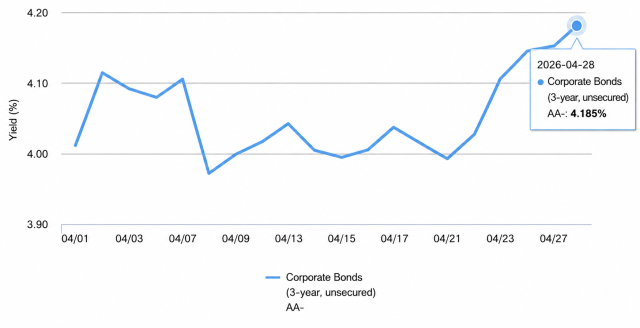
As of Wednesday morning, the three-year government bond yield stood at 3.525 percent, while the three-year AA- corporate bond yield was 4.185 percent. The resulting credit spread of about 65 basis points has widened from around 50 basis points in the second half of last year, indicating that the credit premium paid by companies is rising again.
The gap is far wider in the lower-rated market. The three-year BBB- corporate bond yield reached 10.001 percent, pushing the spread against AA- bonds to about 580 basis points. That is approaching levels seen during the 2022 Legoland crisis, when the credit market tightened sharply and the AA- to BBB- spread widened to around 600 basis points.
Market watchers say access to bond financing is again becoming effectively restricted for lower-rated companies.
Their lifeline are 91-day commercial papers whose rate stood at 3.06 percent, about 115 basis points lower than the AA- corporate bond yield. That makes short-term borrowing a much cheaper option for companies trying to bridge near-term maturities.
Total issuance of commercial paper and short-term bonds reached 200.47 trillion won in March, up 25.6 percent from the previous month. The surge suggests that corporate funding strategies are shifting from long-term debt to short-term financing, rather than merely reflecting a temporary rise in liquidity demand.

Copyright ⓒ Aju Press All rights reserved.