
Journalist

Lim, Kwu Jin
-
 KOSPI takes breath amid growing uncertainty over AI-fueled rally SEOUL, April 29 (AJP) - South Korea's benchmark KOSPI fluctuated on Wednesday after opening lower, as investors weighed an overnight Wall Street selloff amid uncertainty over the sustainability of the recent artificial intelligence (AI)-fueled rally. Investors also appeared cautious ahead of earnings reports from five major tech companies, collectively dubbed the "magnificent seven," including Alphabet, Amazon, Apple, Meta, and Microsoft this week. The main index fell 0.43 percent to 6,612.20 shortly after trading began. Foreign investors sold a net 436.4 billion won, outweighing buying by retail and institutional investors. Heavyweight semiconductor shares such as Samsung Electronics and SK Hynix came under pressure, tracking weakness in U.S. technology stocks. Samsung Electronics fell 0.90 percent to 220,000 won, while SK Hynix slipped 0.31 percent to 1,296,000 won. Sentiment had initially been dampened after U.S. equities retreated overnight, with technology shares leading losses amid renewed concerns over elevated valuations tied to the AI boom. The S&P 500 fell 0.49 percent to 7,138.80 and the Nasdaq Composite dropped 0.90 percent to 24,663.80. Among other large caps, Samsung Biologics slipped 1.20 percent to 1,486,000 won, and Hyundai Motor fell 1.08 percent to 549,000 won. LG Energy Solution also declined 1.06 percent to 467,000 won. Gains were led by defense and industrial shares, with Hanwha Aerospace rising 1.79 percent to 1,420,000 won and HD Hyundai Heavy Industries jumping 3.15 percent to 688,000 won. Samsung SDI climbed 2.50 percent to 697,000 won, while SK Square edged up 0.37 percent to 814,000 won. Power equipment shares also remained firm, with Hyosung Heavy Industries adding 0.20 percent to 3,984,000 won. The junior KOSDAQ stocks were also mostly lower, led by Juseong Engineering, which tumbled 7.13 percent to 121,200 won, and LigaChem Biosciences, down 3.83 percent to 195,700 won. Ecopro fell 2.79 percent to 157,000 won, and Alteogen slipped 1.33 percent to 381,500 won. Rainbow Robotics dropped 1.65 percent to 657,000 won, and Ecopro BM lost 1.41 percent to 210,500 won. Among others, Leeno Industrial fell 1.97 percent to 109,200 won, EO Technics dropped 1.95 percent to 503,000 won, Wonik IPS shed 2.06 percent to 118,600 won, and Caregen slipped 1.31 percent to 105,600 won. Gainers were limited, with Alteogen rising 1.33 percent to 381,500 won and ABL Bio edging up 0.14 percent to 139,600 won. The South Korean won strengthened slightly to 1,472.50 per dollar from 1,473.60 previously. Elsewhere in Asia, Hong Kong's Hang Seng Index rose 0.63 percent to 25,842.63, while China's Shanghai Composite fell 0.41 percent to 4,061.82. Japan's Nikkei 225 was closed on Wednesday for Showa Day, a Japanese public holiday honoring former Emperor Hirohito, while markets in South Korea, China, Hong Kong, and Taiwan will be closed on Friday for Labor Day. 2026-04-29 11:21:20
 -
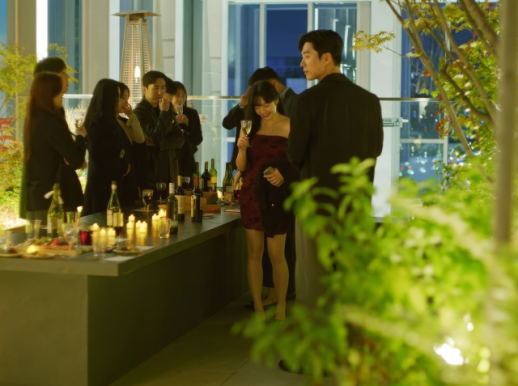 Inside Korea’s Curated Singles Parties: Dating as Risk Management “Even in a crowd, there’s one person who stands out. Here, that feeling can even lead to marriage.” “I hesitated at first, but now it feels like I’ve walked onto a TV set. I’ve already sent a ‘signal’ to two people.” Lines that sound like they belong on a hit dating show were heard one April afternoon at a lounge party in Seoul’s Samseong-dong. In a room where dozens of men and women circulated, one couple said a few words were enough to set the direction of their relationship. A mid-30s professional identified by the surname Lim and a late-30s senior researcher at a major company identified by the surname Kim said they had avoided dating apps and casual meetups because of busy schedules. Over a glass of wine, they talked about everyday life and were drawn to each other’s approach to living. Without going to a second venue, they set a dinner date for the next day. The relationship has continued for a year. “We realized how efficient it is to meet someone who’s been vetted,” the couple said. As “natural” encounters become harder to come by, many young South Koreans are shifting their search for partners from screens to curated, in-person events. Nearly 3 in 4 men in their early 30s are unmarried The push toward “designed” meetings is backed by stark numbers. According to the National Data Portal’s population and housing census, as of 2024 the unmarried rate for ages 30-34 was 74.7% for men and 58% for women. For ages 35-39, it was 46.8% for men and 29.9% for women. The unmarried rate for men ages 40-44 was 30.1%. Participants said the challenge has moved beyond simply marrying later to the difficulty of forming relationships at all. Several told reporters that in ordinary daily life, the odds of meeting a partner feel as remote as winning the lottery, making it a waste of time to wait for chance. Introverts said they are not exempt. A man surnamed Park, who described himself as extremely introverted and works at a state-run company, said organizers introduced him to a freelance announcer surnamed Choi and they became a couple. “If I hadn’t come here, I would never have met the person next to me in my lifetime,” he said. A 36-year-old participant identified by the surname Lee said she came for “trust” and “naturalness,” contrasting the experience with a marriage matchmaking company. “At those companies, you sit for an hour introducing yourself. It felt like an interview,” she said. “You end up evaluating conditions, and you think, ‘I might meet someone with better conditions tomorrow,’ so your expectations rise and it’s hard to focus on the relationship.” Lee said she once had as many as seven blind dates scheduled in a week, a structure she said turns people into “comparisons” rather than partners. At curated parties, she said, basic qualifications are checked but what matters is the feel of meeting in person. “If you dress up once and meet 20 people, you realize who you’re actually drawn to,” she said. “When you meet people who’ve built results, you feel, in the intellectual depth of conversation, ‘This person is different.’” She said the rotation format also lowers pressure. “On a one-on-one date, if you’re asked questions you have to keep answering, which is stressful. Here, if an uncomfortable question comes up, you can naturally move on,” she said. “If matchmaking felt like homework, this feels like getting to know people more naturally, so you can see a more genuine side.” From TV ‘signals’ to real life A similar scene played out on a rooftop in Yeongdeungpo, where about 40 men and women in a black-and-white dress code talked with wine glasses in hand. A participant identified as LDJ, 35, called it a “real-life Heart Signal.” “It’s highly satisfying because people with great jobs who are hard to meet privately gather here,” he said, giving it a perfect 10. Shin Hye-rin, a professor of media studies at Korea University, said the comparison is more than a metaphor. “The structure of observing multiple candidates at once, comparing chemistry and strategically exchanging interest looks a lot like the program format,” she said. She added that as dating shows present romance as something to be interpreted, participants can internalize that evaluative gaze and try to read and judge others. Shin said dating reality shows can also function as a kind of script. “For today’s generation, the awareness that ‘someone is always watching, or I am posting and showing myself’ is deeply internalized,” she said, adding that the process of signaling among multiple potential partners can take on aspects of performance. Shin described the trend as “defensive realism”: In an uncertain environment, weighing practical factors such as education, job and finances becomes an adaptation strategy to reduce the chance of failure. “It’s not that young people don’t know the contradictions of these standards,” she said. “They feel society still operates on traditional criteria, so they choose to maximize usefulness within that system.” She also framed the appeal of rotation-style dating as an “emotional portfolio” approach: reducing the risk of placing all expectations on one person by spreading emotional investment across multiple possibilities, lowering the psychological blow of rejection or failure. The premium social club that runs the events, The Grace Club, says it relies on strict verification and screening. A government ID and proof of employment are required, and applicants must pass a pre-screening of photos for appearance described as “above average.” About 65% of attendees were born in the 1990s, and many work in professional fields such as medicine and law or at major companies including Samsung Electronics, Hyundai Motor and Kakao. Organizers said the rules are meant to reduce the chance of disappointment and prevent wasted time. They said word-of-mouth has spread to the point that about six cast members from the dating show “I Am Solo” have passed through, making it a perceived must-stop in the marriage market. A man in his 30s using the nickname “Chic” said, “People who focused on studying or work have fewer chances to build connections, and gatherings like this help break through blocked social networks.” The club also kept operating during the pandemic through remote formats. It used KakaoTalk group chats in an “online rotation” system in which identities were revealed only when a match was made. Organizers said online tools could not fully convey atmosphere or emotional exchange. They added that as the AI era advances, the value of meeting in person and feeling another person’s presence is growing. After distancing rules eased, they said, offline applications surged, with a noticeable increase among women in their 30s seeking serious relationships. Shin said the trend reflects fatigue with dating apps combined with a desire for face-to-face contact. “The form is offline, but the operating logic still carries the platform optimization mindset,” she said. Instead of an app algorithm, organizers’ screening and verification act as the filter, while participants still compare multiple candidates and make choices. By 10 p.m. in Yeongdeungpo, as wine glasses clinked, some attendees were already setting their next plans. 2026-04-29 11:14:44
 -
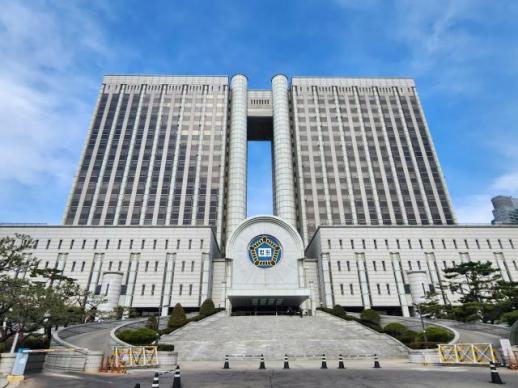 Court Grants Bail to Koo Se-hyeon in Wellbiotech Stock Manipulation Case Koo Se-hyeon, the former head of Wellbiotech accused of manipulating the company’s stock price by spreading false information, will stand trial while out of custody. According to the legal community on Tuesday, the Seoul Central District Court’s Criminal Division 32, led by Presiding Judge Ryu Kyung-jin, granted Koo’s request for bail the previous day as he faces a first-instance trial on charges of violating the Act on the Aggravated Punishment of Specific Economic Crimes (breach of trust) and the Capital Markets Act. The court’s reasons and bail conditions were not disclosed. Prosecutors allege Koo, around May 2023, misled investors and drove up the stock price by distributing information claiming participation in Ukraine reconstruction projects and entry into the secondary battery business. He was indicted in custody in November last year. In court, Koo’s side said it acknowledges the underlying facts but denied using false information to engage in unfair trading in the capital markets, arguing the information related to the Ukraine reconstruction and secondary battery businesses was not fabricated and had a real basis. * This article has been translated by AI. 2026-04-29 11:13:15
 -
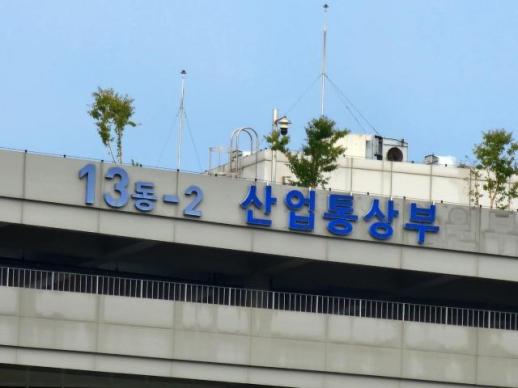 South Korea to Spend 52.75 Billion Won to Bring AI to Chip, Auto and Shipbuilding Plants The South Korean government is moving to apply artificial intelligence to production sites in key industries such as semiconductors, automobiles and shipbuilding to strengthen manufacturing competitiveness. It plans to invest 52.75 billion won in state funds next year to accelerate a broad AI shift in manufacturing. The Ministry of Trade, Industry and Energy said Tuesday it will 추진 an “AI Factory Leading Project” to support the development and rollout of industry-specific manufacturing AI technologies, as well as the adoption of AI robots, facilities and equipment. The ministry said the program was designed to lift manufacturing competitiveness as growth slows amid a shrinking working-age population and a decline in potential growth. It also cited unstable global supply chains, geopolitical risks and intensifying competition for technological leadership, which it said are increasing the importance of the ability to implement advanced technologies on factory floors and produce them at scale. Through the project, the ministry said it will push a full-scale “AI transformation” of manufacturing sites, dubbed M.AX, by developing and distributing sector-tailored manufacturing AI and introducing AI robots, facilities and equipment. It will select 32 tasks focused on industries and processes with high urgency and broad impact, and will diversify support types to better match industry demand, including models aimed at cooperation between large firms and small and midsize partners and models that delegate data and AI models. The program will operate under five types, including a “large-small cooperation” model in which major companies share AI models with small and midsize partner firms in their supply chains; a “data and AI model delegation” model that opens and delegates data and AI models to the government; and a “full-stack PoC” to build a full-stack AI factory run solely by AI. The ministry said applications for new tasks will be accepted from Feb. 6 to March 9. Details will be available on the 범부처통합연구지원시스템 website. It also said it will hold a project briefing at 2 p.m. on May 7 at the JW Marriott Dongdaemun Square, targeting manufacturing companies, AI firms and research institutions. The ministry said it will explain the new call for projects, the intent behind the request for proposals and the selection and evaluation plan, and will take questions and gather feedback to improve researchers’ understanding and encourage participation. “An era in which manufacturing and industrial competitiveness is national competitiveness,” a ministry official said, adding that the ministry will 추진 the AI Factory Leading Project without setbacks to become a top M.AX nation by 2030.* This article has been translated by AI. 2026-04-29 11:12:23
 -
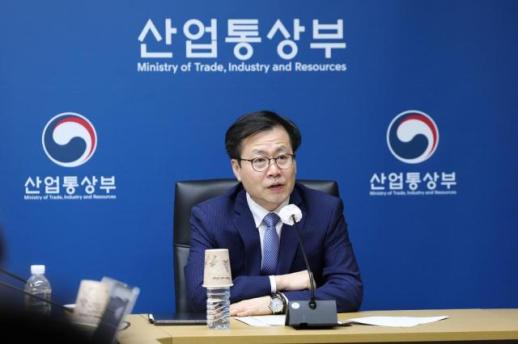 South Korea, Qatar discuss expanding investment cooperation in advanced industries Yeo Han-ku, South Korea’s minister for trade, met in Seoul on Tuesday with Ahmed bin Mohammed Al Sayed, Qatar’s minister of state for trade, to discuss ways to expand bilateral investment cooperation in advanced industries. The meeting followed up on talks held during a recent visit to Qatar by the president’s special envoy for strategic economic cooperation, aimed at turning discussions on advanced-industry investment into concrete outcomes. Yeo praised Qatar’s resilience as it moves quickly toward stability despite uncertainty in the Middle East. He also reaffirmed the close partnership built through cooperation on liquefied natural gas imports and energy infrastructure projects. The two sides agreed to broaden strategic investment cooperation by combining South Korea’s strengths in advanced industry and manufacturing with Qatar’s capital and push to diversify its economy. They discussed cooperation in future industries, including manufacturing AI transformation (M.AX) and robotics, as well as investment talks in biotech and semiconductors. Yeo said he hopes investment cooperation will grow in robotics that can be linked to AI solutions and infrastructure projects designed to help solve problems on factory floors. He also said he wants investment cooperation with promising South Korean biotech firms to expand, noting that more South Korean companies are entering Qatar in health checkups and pharmaceuticals. On semiconductors, Yeo cited the potential of South Korean AI semiconductor fabless companies with low-power, high-performance technology, and the two sides discussed ways to strengthen investment in the sector. Based on the talks, the two countries agreed to share information — including on interested companies — and to continue consultations so investment cooperation on promising projects can proceed smoothly. Yeo said the meeting would be an important milestone to reaffirm the strong trust built through the special envoy’s recent Qatar visit and to translate that trust into tangible results in advanced-industry investment. He said South Korea will keep widening the scope of economic cooperation with Qatar in future industries such as manufacturing AI and biotech, while strengthening energy security through the strategic partnership.* This article has been translated by AI. 2026-04-29 11:11:32
 -
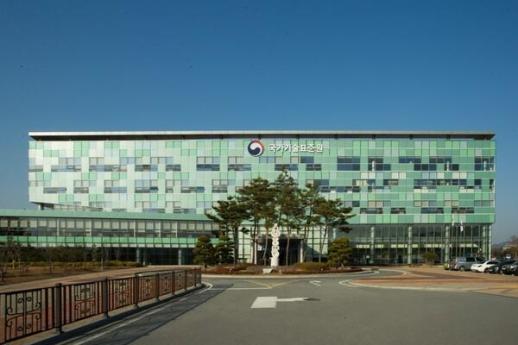 Korea to Put 30% of New Standards R&D Budget Into De Facto Standards, Agency Says The Ministry of Trade, Industry and Energy’s Korean Agency for Technology and Standards said on the 29th it held a “2026 De Facto Standardization Forum kickoff briefing and strategy meeting” to review the status of de facto standards work and discuss strategy. De facto standards are developed as companies voluntarily form groups such as forums and consortia and create standards in line with market demand and technological change. The agency said it has supported Korean companies’ responses to de facto standards through last year’s “measures to strengthen responses to de facto standards” and the “6th National Standards Master Plan” announced in March this year. It has also set up domestic response committees by sector to provide systematic support for Korean companies’ participation and activities in de facto standardization bodies in advanced industries. This year, it plans to invest more than 30% of the budget for new standards research and development projects in de facto standards to move to secure an early lead. Standardization experts attending the meeting shared sector-by-sector strategies and updates on their work. They also exchanged views on how Korean companies can strengthen global competitiveness by taking the lead in de facto standards in advanced industries. Kim Dae-ja, head of the agency, said, “De facto standards quickly reflect market needs in line with the pace of technological change,” adding, “We will continue to expand support for developing the de facto standards our companies need to lead advanced industries.”* This article has been translated by AI. 2026-04-29 11:10:46
 -
 South Korea Industry Ministry Maps 2026 R&D Budget Focus on Regional Growth, Manufacturing AI and Supply Chains The Ministry of Trade, Industry and Energy on Tuesday held its second 2026 Strategic Planning and Investment Council meeting to discuss next year’s research and development budget, chaired by Vice Minister Moon Shin-hak. The ministry has been drafting its 2026 R&D budget plan with priorities that include fostering “5 poles and 3 special zones” growth engines, expanding the Manufacturing AI Transformation initiative (M.AX), and strengthening the industrial ecosystem. To concentrate R&D spending, it said it screened new projects after reviews that included input from private-sector experts by field and internal deliberations. It also carried out performance-based restructuring of ongoing projects while integrating fragmented small-scale programs. For the “5 poles and 3 special zones” initiative, the ministry said it will launch new projects next year to provide package support by region for technology development, infrastructure and workforce training. The plan includes the 5 poles and 3 special zones growth-engine project, technical support to help regional advanced industries respond to green-transition regulations, and development of manufacturing AI models that use tacit know-how. Other proposed projects include core technology development for full-stack AI factories that optimize entire manufacturing processes, AI-based manufacturing safety systems to protect workers, and industry-specific R&D to boost productivity using AI in sectors such as shipbuilding, bio and distribution. To strengthen the industrial ecosystem and competitiveness in advanced and key industries, the ministry listed projects such as next-generation battery technology for humanoids, localization of core materials and parts for advanced aircraft engines, and core technologies to shift the chemical industry toward high value-added specialty products. The ministry also said it will respond to supply-chain issues linked to the recent Middle East war. New projects include technology and process development for preprocessing medium-to-heavy crude to support feedstock diversification in refining and petrochemicals, alternative materials technology to stabilize supplies of inputs such as naphtha, and “Industry GX Plus” to support development and demonstration of carbon-reduction technologies for high-emitting industries. “Industrial technology competitiveness is emerging as the foundation of the national economy and security, while global competition for technological supremacy is intensifying,” Moon said. “For our industries to secure a competitive edge, the public and private sectors must strategically choose areas and invest boldly and quickly.”* This article has been translated by AI. 2026-04-29 11:09:49
 -
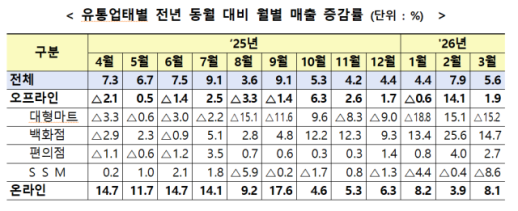 Online Sales Keep Rising; Department Store and Convenience Store Revenue Up for 9th Month Online sales extended steady growth in March, while among offline retailers, department stores and convenience stores stayed in positive territory. Big-box discount stores, however, returned to a decline after a one-month reprieve. According to the Ministry of Trade, Industry and Energy’s report on March 2026 sales trends at major retailers released Tuesday, combined sales at major retailers rose 5.6% from a year earlier. Offline sales increased 1.9% year over year. By format, department stores climbed 14.7% and convenience stores rose 2.7%, while big-box discount stores fell 15.2% and mid-sized retailers declined 8.6%. Department store and convenience store sales have risen for nine straight months since July last year. The ministry attributed department store gains largely to higher foreign tourist traffic and demand tied to spring outings and the new school term, which boosted sales of well-known overseas brands. Convenience stores posted growth in processed and ready-to-eat foods, tobacco and miscellaneous goods. Big-box discount stores weakened as spending continued to shift online, with most categories — including food and daily necessities — underperforming, pushing sales back into negative territory. Mid-sized retailers extended their slide to a fourth consecutive month. On a quarterly basis, big-box discount stores have been sluggish for eight straight quarters since the second quarter of 2024, and mid-sized retailers for three straight quarters since the third quarter of last year. Online sales rose 8.1% from a year earlier, continuing a sustained uptrend since the government began compiling the data. In addition to strong performers such as cosmetics (up 15.8%), food (up 10.6%) and home and household goods (up 9.5%), sales also increased for appliances and electronics (up 11.1%), children and baby products (up 10.7%) and books and stationery (up 4.1%). By sales share, online accounted for 60.6%, followed by department stores at 15.4%, convenience stores at 13.9%, big-box discount stores at 8.1% and mid-sized retailers at 2.0%. Compared with last year’s annual shares, online rose 1.6 percentage points while offline fell 1.6 points. * This article has been translated by AI. 2026-04-29 11:05:48
 -
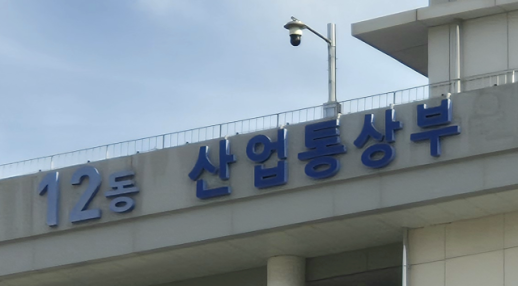 Korea Standards Agency Holds Forum on Industrial Measurement Strategy for Advanced Industries South Korea’s Korean Agency for Technology and Standards, under the Ministry of Trade, Industry and Energy, said Tuesday it held a policy forum on industrial measurement to support the advancement of high-tech industries. The agency said it used the forum to discuss strategies with industry officials in sectors including semiconductors, aviation, defense, and nuclear power. Industrial measurement refers to the infrastructure that ensures accuracy and reliability in measurements across industrial processes, enabling better quality control, improved safety, and more credible testing and certification. The agency said its importance is growing in advanced industries such as semiconductors, biotech and defense, where nanometer-level precision is required. It also said cases are increasing in which buyers, when importing aircraft and defense products, demand not only the product but also a “measurement and calibration package” that includes measurement equipment and calibration systems. The agency said such requirements are being viewed as a key factor in export competition between countries. The agency said South Korea’s industries remain heavily dependent on overseas suppliers for advanced measurement equipment and core metrology and measurement technologies, and that measurement management systems across industry have not been sufficiently upgraded. It said this could become a structural constraint on global competitiveness. At the forum, participants presented cases of applying ultra-precision metrology and measurement technologies in industrial settings and outlined the government’s policy direction. Experts from industry, academia and research institutes, including Korea Aerospace Industries (KAI), Hanwha Aerospace and Korea Hydro & Nuclear Power, discussed development strategies to meet rising demands for precision in advanced industries. The government said it plans to foster industrial measurement as a national priority by expanding related research and development and building regional support centers, while continuing to broaden field-focused support. “Industrial measurement is no longer a supporting technology but a core infrastructure that determines the competitiveness of advanced industries,” KATS Administrator Kim Dae-ja said. “We will further strengthen our industries’ global competitiveness by securing precise measurements and reliable data.” * This article has been translated by AI. 2026-04-29 11:04:59
 -
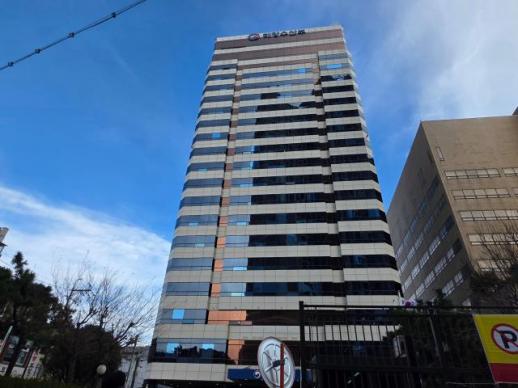 South Korea’s Oceans Ministry to Pay $100,000 in Bonuses for Busan Move, UN Ocean Summit Bid South Korea’s Ministry of Oceans and Fisheries will pay a total of 100 million won in special performance bonuses to civil servants credited with visible achievements, including the ministry’s relocation to Busan and winning the right to host the first UN ocean conference in Asia. The ministry said Tuesday it will hold its first special performance bonus awards ceremony for 2026 on Wednesday. A ministry review committee decided to award a combined 100 million won to 39 employees who carried out eight high-performing assignments. The Busan relocation task force, led by Director General Kim Seong-won and including Director Kim Han-ul, was recognized for overseeing the entire process — selecting a temporary office site, drawing up the relocation plan, moving the organization and staff, and supporting settlement conditions — and completing the move of about 800 employees and their families in about six months. Director Seo Jin-hee and Deputy Director Lee Chan-mi were credited with securing South Korea’s bid to host the fourth UN Ocean Conference, the largest and highest-level international meeting in the ocean sector. The conference is scheduled for June 2028 and would be the first held in Asia, the ministry said. Director Lee Jeong-ro and Deputy Director Lee Eun-jae were recognized for building an LTE-class high-speed internet environment about 50 times faster than existing shipboard internet, improving working conditions and welfare on board. The ministry said they reached an agreement to support high-speed internet service for 300 national essential vessels and designated international vessels starting in February. Other initiatives selected for special recognition included lifting restrictions on nighttime fishing in coastal waters off Incheon and improving navigation aids by repurposing unused lighthouses. Minister Hwang Jong-woo said the achievements were meaningful because they produced changes the public and people in the field can feel. He said the ministry will continue working to identify and improve issues so policies lead to better quality of life.* This article has been translated by AI. 2026-04-29 11:03:56