

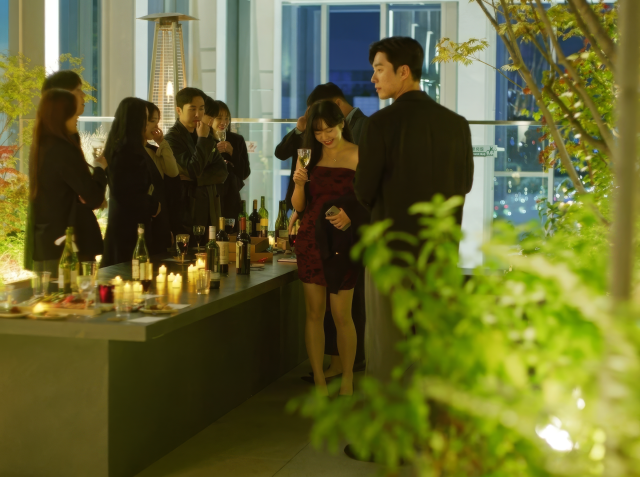
“Even in a crowd, there’s one person who stands out. Here, that feeling can even lead to marriage.”
“I hesitated at first, but now it feels like I’ve walked onto a TV set. I’ve already sent a ‘signal’ to two people.”
Lines that sound like they belong on a hit dating show were heard one April afternoon at a lounge party in Seoul’s Samseong-dong.
In a room where dozens of men and women circulated, one couple said a few words were enough to set the direction of their relationship. A mid-30s professional identified by the surname Lim and a late-30s senior researcher at a major company identified by the surname Kim said they had avoided dating apps and casual meetups because of busy schedules. Over a glass of wine, they talked about everyday life and were drawn to each other’s approach to living. Without going to a second venue, they set a dinner date for the next day. The relationship has continued for a year.
“We realized how efficient it is to meet someone who’s been vetted,” the couple said.
As “natural” encounters become harder to come by, many young South Koreans are shifting their search for partners from screens to curated, in-person events.
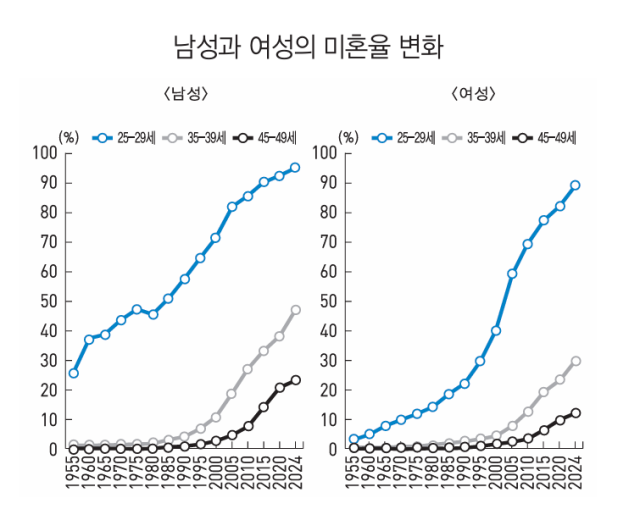
Nearly 3 in 4 men in their early 30s are unmarried
The push toward “designed” meetings is backed by stark numbers. According to the National Data Portal’s population and housing census, as of 2024 the unmarried rate for ages 30-34 was 74.7% for men and 58% for women. For ages 35-39, it was 46.8% for men and 29.9% for women. The unmarried rate for men ages 40-44 was 30.1%.
Participants said the challenge has moved beyond simply marrying later to the difficulty of forming relationships at all. Several told reporters that in ordinary daily life, the odds of meeting a partner feel as remote as winning the lottery, making it a waste of time to wait for chance.
Introverts said they are not exempt. A man surnamed Park, who described himself as extremely introverted and works at a state-run company, said organizers introduced him to a freelance announcer surnamed Choi and they became a couple. “If I hadn’t come here, I would never have met the person next to me in my lifetime,” he said.
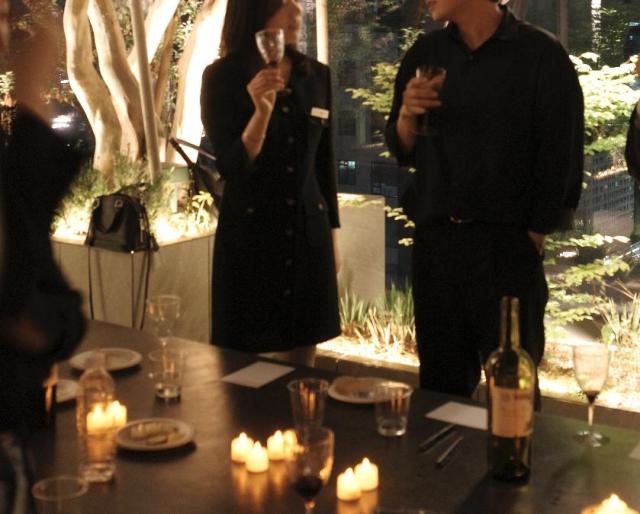
A 36-year-old participant identified by the surname Lee said she came for “trust” and “naturalness,” contrasting the experience with a marriage matchmaking company. “At those companies, you sit for an hour introducing yourself. It felt like an interview,” she said. “You end up evaluating conditions, and you think, ‘I might meet someone with better conditions tomorrow,’ so your expectations rise and it’s hard to focus on the relationship.”
Lee said she once had as many as seven blind dates scheduled in a week, a structure she said turns people into “comparisons” rather than partners. At curated parties, she said, basic qualifications are checked but what matters is the feel of meeting in person. “If you dress up once and meet 20 people, you realize who you’re actually drawn to,” she said. “When you meet people who’ve built results, you feel, in the intellectual depth of conversation, ‘This person is different.’”
She said the rotation format also lowers pressure. “On a one-on-one date, if you’re asked questions you have to keep answering, which is stressful. Here, if an uncomfortable question comes up, you can naturally move on,” she said. “If matchmaking felt like homework, this feels like getting to know people more naturally, so you can see a more genuine side.”
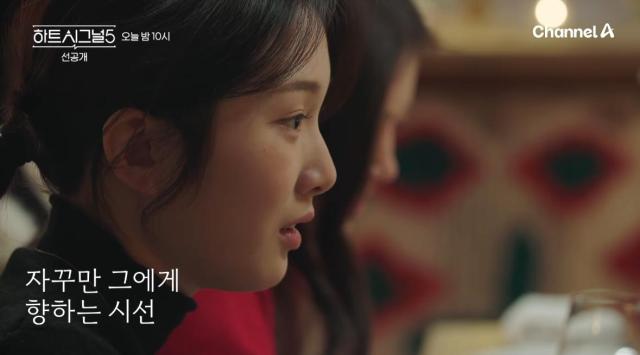
From TV ‘signals’ to real life
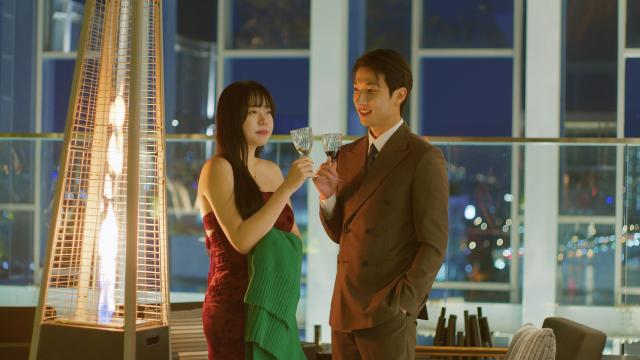
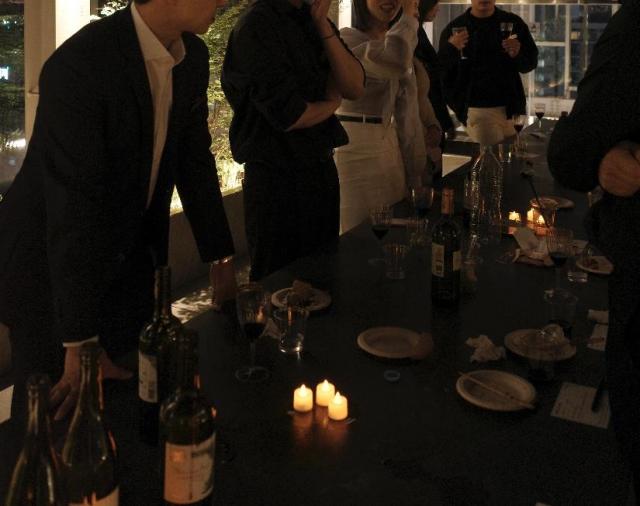
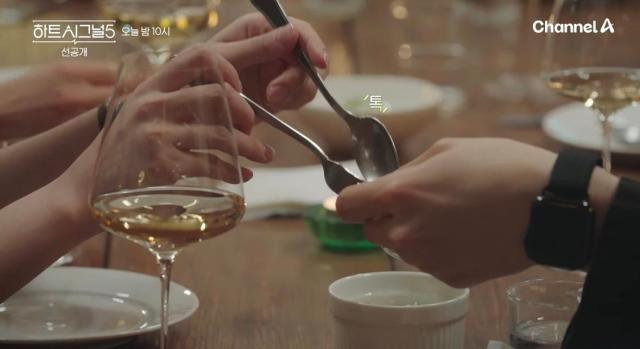
A similar scene played out on a rooftop in Yeongdeungpo, where about 40 men and women in a black-and-white dress code talked with wine glasses in hand. A participant identified as LDJ, 35, called it a “real-life Heart Signal.” “It’s highly satisfying because people with great jobs who are hard to meet privately gather here,” he said, giving it a perfect 10.
Shin Hye-rin, a professor of media studies at Korea University, said the comparison is more than a metaphor. “The structure of observing multiple candidates at once, comparing chemistry and strategically exchanging interest looks a lot like the program format,” she said. She added that as dating shows present romance as something to be interpreted, participants can internalize that evaluative gaze and try to read and judge others.
Shin said dating reality shows can also function as a kind of script. “For today’s generation, the awareness that ‘someone is always watching, or I am posting and showing myself’ is deeply internalized,” she said, adding that the process of signaling among multiple potential partners can take on aspects of performance.
Shin described the trend as “defensive realism”: In an uncertain environment, weighing practical factors such as education, job and finances becomes an adaptation strategy to reduce the chance of failure. “It’s not that young people don’t know the contradictions of these standards,” she said. “They feel society still operates on traditional criteria, so they choose to maximize usefulness within that system.”
She also framed the appeal of rotation-style dating as an “emotional portfolio” approach: reducing the risk of placing all expectations on one person by spreading emotional investment across multiple possibilities, lowering the psychological blow of rejection or failure.
The premium social club that runs the events, The Grace Club, says it relies on strict verification and screening. A government ID and proof of employment are required, and applicants must pass a pre-screening of photos for appearance described as “above average.” About 65% of attendees were born in the 1990s, and many work in professional fields such as medicine and law or at major companies including Samsung Electronics, Hyundai Motor and Kakao.
Organizers said the rules are meant to reduce the chance of disappointment and prevent wasted time. They said word-of-mouth has spread to the point that about six cast members from the dating show “I Am Solo” have passed through, making it a perceived must-stop in the marriage market. A man in his 30s using the nickname “Chic” said, “People who focused on studying or work have fewer chances to build connections, and gatherings like this help break through blocked social networks.”
The club also kept operating during the pandemic through remote formats. It used KakaoTalk group chats in an “online rotation” system in which identities were revealed only when a match was made. Organizers said online tools could not fully convey atmosphere or emotional exchange. They added that as the AI era advances, the value of meeting in person and feeling another person’s presence is growing. After distancing rules eased, they said, offline applications surged, with a noticeable increase among women in their 30s seeking serious relationships.
Shin said the trend reflects fatigue with dating apps combined with a desire for face-to-face contact. “The form is offline, but the operating logic still carries the platform optimization mindset,” she said. Instead of an app algorithm, organizers’ screening and verification act as the filter, while participants still compare multiple candidates and make choices.
By 10 p.m. in Yeongdeungpo, as wine glasses clinked, some attendees were already setting their next plans.
* This article has been translated by AI.
Copyright ⓒ Aju Press All rights reserved.