
Journalist

Lim, Kwu Jin
-
 Patriots and Veterans Affairs Ministry to Hold Public-Private Forum on Future Policy As the number of people eligible for veterans benefits declines and the policy environment shifts rapidly, South Korea’s Ministry of Patriots and Veterans Affairs will hold a forum to discuss the direction of future veterans policy. The ministry, led by Minister Kwon Oeul, said it will host the policy forum, titled “NEXT Patriots and Veterans Affairs: Asking and Answering the Future,” on April 30 afternoon at Park Jeong-mo Hall at the Seoul Regional Office of Patriots and Veterans Affairs. About 30 people are expected to attend, including the ministry’s minister and vice minister, members of its policy advisory committee, private-sector experts, and young participants described as the next generation of leaders in veterans affairs, including the 2030 Advisory Group and Innovation Avengers. The forum will open with a presentation by Kim Jeong-hae of the Korea Institute of Public Administration on “Strategic Measures for Sustainable Veterans Affairs.” Policy proposals will then follow on development plans from five subcommittees of the advisory committee: veterans culture, compensation, medical and welfare, discharged service members, and the future of veterans affairs. After the proposals, a free discussion involving all participants will be held under the moderation of Cho Hyun-jae, chair of the policy advisory committee, on “The Future Direction of Veterans Affairs as the Number of Eligible Recipients Declines.” Kwon said the forum will be “a meaningful time for the public and private sectors to seek policy directions for the future of veterans affairs from a new perspective.” He said the ministry will work to reflect innovative ideas raised at the forum in policy so that “special sacrifice receives special compensation.” * This article has been translated by AI. 2026-04-29 10:31:11
 -
 Samsung C&T Adds AI Tax Service ‘Tax AI’ to Homeniq Home Platform Samsung C&T Corp.’s construction division is expanding its home platform, Homeniq, beyond basic residential convenience features into professional asset management services. Samsung C&T said Tuesday it has partnered with AI tax solution provider New I to offer its customized tax analysis service, Tax AI, through the Homeniq app. With the partnership, Homeniq users can add tax services to existing functions such as home IoT controls, community facility reservations and vehicle management. Through a dedicated in-app page, users can run refund analyses for taxes including capital gains tax and the comprehensive real estate holding tax. For residents preparing to move into newly built complexes, the service also provides AI simulations for major move-in taxes such as acquisition tax. Samsung C&T said it expects the tool to help prevent overpayment or underpayment and reduce the risk of penalties caused by filing errors. Starting in May, the platform will also provide tax and asset price information linked to South Korea’s real estate transaction price disclosure system, the company said. Samsung C&T said Homeniq users will receive exclusive benefits, including 10 free uses of the tax simulation service, valued at 15,000 won per case. Users who complete an analysis of expected past capital gains tax refunds will receive a coffee coupon. New I said it has a proprietary AI algorithm built on analysis of 9.3 million cases. The company also holds patented technology that determines in real time whether tax reductions apply, based on daily tax law algorithms from 2020 to the present. It won the top prize, a minister’s award, at the Ministry of Land, Infrastructure and Transport’s 2024 real estate service startup competition. “Homeniq, which improves convenience in apartment living, has been upgraded further by adding professional tax services,” said Ji So-young, head of Samsung C&T’s H&B Platform Business Team. “We will continue developing it into a platform that supports customers’ overall residential lives, regardless of when they move in.”* This article has been translated by AI. 2026-04-29 10:30:06
 -
 Aju IB Investment Shares Slide Nearly 20% After Majority Owner Plans Block Trade Aju IB Investment shares fell nearly 20% in intraday trading after news that its majority owner plans a block trade, raising concerns about a large supply of shares hitting the market and a reduced controlling stake. According to the Korea Exchange, Aju IB Investment was trading at 14,980 won as of 10:02 a.m. on Tuesday, down 3,720 won, or 19.89%, from the previous session. Aju, the company’s largest shareholder, said in a regulatory filing the previous day that it plans to sell 8,480,178 shares of Aju IB Investment, equal to a 7% stake, through an after-hours block trade. Aju’s ownership would fall to 53.37% from 60.54%. The Korea Institute of Science and Technology is the second-largest shareholder with a 7.15% stake, and Aju would remain the largest shareholder after the sale. The sale price was set at 18,700 won per share, with the transaction scheduled to run from May 28 to June 26, about a month. The total deal value is expected to be about 158.6 billion won. Aju said the purpose of the transaction is to “secure strategic investment funds and support Aju IB Investment’s investments.” Aju IB Investment was founded in 1974 as Korea Technology Advancement Co. and changed to its current name in 2008. As South Korea’s first venture capital firm, it began expanding new-technology investments in earnest after 2001 by forming investment funds. As of the end of last year, it had cumulatively formed a total of 55 VC investment funds with 2.1523 trillion won and 11 private equity funds with 1.6889 trillion won, for a combined 3.8412 trillion won. * This article has been translated by AI. 2026-04-29 10:29:19
 -
 Actor Jin Tae-hyun to Leave JTBC’s ‘Divorce Consideration Camp’ After Reports Surface Early Actor Jin Tae-hyun is leaving JTBC’s “Divorce Consideration Camp.” Cast changes are common in entertainment programming, but the lingering question in this case has been less about why he is departing than about how the exit was handled. Jin said on social media on the 28th that he had planned to say goodbye after his final episode, but wrote earlier because an official article about his departure was published while he still has many episodes left to air. He said he learned of the production team’s explanation and decision through his manager, and that he left the show after his last recording in early April. His message was restrained, without public criticism of the production team. He thanked the program and viewers, saying that in his 25-year career he worked harder and approached the show with more sincerity than any other shoot. Still, his wording — including that he heard the news “through my manager” — suggested disappointment with the process. Receiving such news through a manager is not unusual in the TV industry, where schedules, contracts and casting decisions are often communicated through management. Producers may also see that route as a way to follow formal procedure and avoid misunderstandings, especially during a broader retooling that can involve departures and replacement discussions at the same time. But a process that is procedurally acceptable may still feel insufficient on a personal level. Jin was not a one-time guest; he had been a regular presence on the program as an investigator representing the husband’s side, making him part of the show’s core lineup. For long-running cast members, the way an exit is wrapped up can matter as much as the decision itself. The timing of the reporting also sharpened the reaction. Jin said he was disappointed that news of his departure came out first while he still appears in upcoming episodes. In effect, he remained on screen as a member of the program while being treated off screen as someone who had already left, losing the chance to choose when and how to deliver his own farewell. Producers have the authority to revamp a program, and rotating cast can be part of a show’s strategy. Jin said the decision was explained as being for the program’s changes, a rationale that can be understood. The unease, the article argues, lies in the gap between “official procedure” and the feeling of not being directly informed — a gap that can invite misunderstanding. Jin maintained a polite tone to the end, raising a broader question: When a long-running relationship ends, is following procedure enough, or does the manner of the goodbye also matter?* This article has been translated by AI. 2026-04-29 10:28:25
 -
 Elysian Gangchon to Host Forest Bakery Market in Chuncheon on May 24 Elysian Gangchon in Chuncheon, Gangwon Province, will hold its large-scale “Forest Bakery Market” on May 24, bringing together well-known bakeries and dessert brands from across South Korea, the resort said Tuesday. ◆ A picnic-style bakery festival in the woods First introduced in October 2024, the Forest Bakery Market has expanded each year and has drawn strong interest, with more than 20,000 visitors attending a single event. This year’s theme is “The moment forest scents meet the aroma of bread — the most atmospheric day for all five senses.” Visitors can enjoy a lawn picnic and walks away from the city while sampling breads and desserts from around the country. With interest in desserts rising amid the popularity of baking competition shows, organizers expect larger crowds than in previous years. The venue will include photo zones and rest areas aimed at younger visitors and families. Beyond food sales, the event will also feature a handicrafts flea market, live busking performances and simple baking experiences. ◆ Easy access by subway, with a push to support local businesses Organizers have credited the festival’s success to its accessibility as a “bakery trip by subway,” with visitors able to reach the site conveniently from the Seoul metropolitan area via the Gyeongchun Line. The wooded setting is also positioned as a contrast to city-based festivals. Elysian Gangchon said it partnered with the bakery-focused platform “Bbangjisullae” to produce a special “bakery pilgrimage map” for the Chuncheon area, aiming to promote local bakeries and boost dessert tourism. The organizers said the event will help expand sales channels for local merchants and small businesses while giving visitors a chance to discover new local brands. “By combining nature, food and relaxation, we plan to present an upgraded program as a lifestyle-style festival,” an Elysian Gangchon official said. “As it has become a signature spring festival, we hope many people will visit Chuncheon again this year.”* This article has been translated by AI. 2026-04-29 10:27:00
 -
 Netflix’s ‘Girigo’ Turns a Familiar Teen Horror Setup Into Korean Shamanic Occult * This review contains spoilers. There is an app called “Girigo.” Users hold a paper with their fortune written on it, speak a wish, record the moment on video and send it in. The app grants the wish — then starts a 24-hour timer. When the countdown ends, the person who made the wish dies. It is a familiar setup, common in teen horror across cultures. Netflix’s series “Girigo” opens with students in school uniforms trying the app as a prank, only to meet brutal deaths. Through the middle of Episode 2, the show appears to follow well-worn genre tracks. Then it pivots, shifting focus to shaman Haetsal (Jeon So-nee) and her partner, Bangul (Noh Jae-won), and moves decisively into a different lane. That lane is closer to “K-occult.” “Girigo” leans more heavily than expected into traditional Korean shamanism, setting it against the menace of a smartphone app. The clash between two very different kinds of “power” drives the series. The app’s threat is established with graphic violence that does not pull back. Hyeonguk (Lee Hyo-je), the first of five close friends dating back to middle school to die, slashes his own throat with a large box cutter. The scene is not obscured by editing; it is shown in close-up and repeated. Viewers sensitive to gore may drop out early. Another graphic moment follows when Geonwoo (Baek Seon-ho), under the app’s curse, rakes his own eyeball with a fingernail. Just as the show seems poised to become a straightforward slasher, Haetsal appears — a shaman portrayed as protected by a deity. With Haetsal and Bangul in the story, the series follows ritual procedures aimed at stopping the curse the app spreads. Shamanic tools, presented as carrying divine force, are used to produce what the show frames as spiritual feats. The hook is watching how an evil spirit inside a modern app collides with a distinctly Korean shaman. The curse is tied to a “red phone,” described as a kind of hexed object, and the conflict ends only if Haetsal can plant her “arrow” into it. But the “Girigo” app is not easily contained by ordinary spiritual power, and crises keep coming as four friends — Sea (Jeon So-young), Geonwoo, Hajun (Hyun Woo-seok) and Nari (Kang Mi-na) — struggle to survive. Unlike shaman characters who appear briefly to offer limited help, Haetsal and Bangul are portrayed as willing to risk their lives to protect the teenagers. That commitment helps “Girigo” stand out from routine teen horror by functioning as a more full-bodied shamanic occult series. Still, after choosing an adults-only rating and showing explicit gore, the series could have delivered more variety in its slasher and gore set pieces. The early shock softens, but the overall intensity does not fully shift into sustained occult dread. The tension often fails to stay tight. A flashback explaining the origin of the “red phone” curse takes up nearly an entire episode, and the suspense noticeably sags there. “Girigo” is violent, but it is harder to call it frightening. It plays more like an action-driven shamanic battle, with four high school friends and a two-person shaman team trying to eliminate the cursed object. Even so, it separates itself from many teen horror titles that pile on plot holes as if they were part of the décor. It offers a sturdier narrative, clearer rules and strong performances from young actors. It may be worth a look for viewers inclined to dismiss it as predictable. All eight episodes were released on Netflix on April 24. 2026-04-29 10:21:13
 -
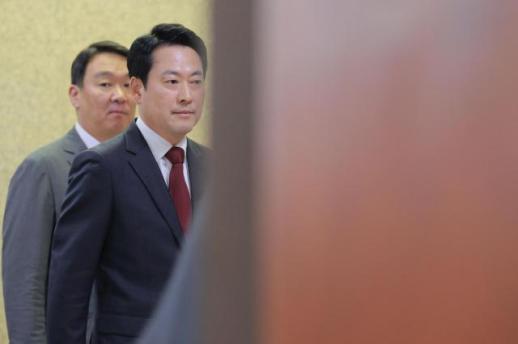 People Power Party candidates turn to Kim Moon-soo as local election face With the June 3 local elections approaching, People Power Party candidates are increasingly turning to Kim Moon-soo, a former candidate, rather than party leader Jang Dong-hyeok as the campaign’s public face. Reports say candidates in Busan, Daegu, Gangwon, Sejong and North Gyeongsang Province have asked Kim to serve as an honorary chief campaign chair or to join their stump speeches. That candidates would elevate another figure despite having a sitting party leader underscores the party’s current predicament. In party elections, the leader is typically the party’s face — traveling nationwide to back candidates, unifying messages and ultimately taking responsibility for defeat. When candidates look elsewhere, it signals more than tactics: distrust in the leadership, an internal view that the current brand is a weak asset, and an attempt to rally core supporters through a workaround. The party’s situation has been described in stark terms. In recent elections and opinion trends, conservatives have struggled to show the cohesion they once had, not only in the Seoul metropolitan area but also in traditional strongholds. Critics have pointed to weak candidate competitiveness, factional conflict and leadership confusion, saying preparations for the local elections have not been smooth. In some areas, even finalizing candidate lineups has been delayed, and sitting lawmakers have pressed the leadership to settle matters quickly. Against that backdrop, the renewed focus on Kim carries weight. During the last presidential election, Kim emerged as a symbol of consolidating conservative support and has been assessed as having mobilizing power among hard-line conservatives. For candidates in areas where votes are urgently needed, choosing a figure seen as able to draw a proven base may look like a practical option compared with the current leadership. But relying on a familiar figure also has limits. A party that repeatedly calls back past personalities can struggle to present a forward-looking vision. Elections cannot be won on nostalgia alone. Voters tend to ask less about who is more hard-line than about who can revive local economies and address transportation, housing and jobs. Local elections are a test of day-to-day governance, not simply a proxy fight for national politics. If a party leans on one person’s symbolism, its organization and policy competitiveness can only weaken further. The issue is not limited to Jang personally. If swapping out one leader could solve a structural crisis, it would have been resolved long ago. The deeper question is why candidates feel they need a star figure more than the party’s own banner. The party must examine why its message has lost force, why younger and centrist voters have drifted away, and why solutions to local issues are not coming through. A party is not meant to borrow a face each election season. It should build trust, develop talent and be judged on policy. The fact that People Power Party candidates are seeking out Kim highlights not only his presence, but the party’s absence. For conservative politics to regain its footing, the priority is not a change of signage but a change in fundamentals. A campaign that bypasses the leader to install another face is, at best, a stopgap. Voters already know that substance — not a figurehead — decides elections. 2026-04-29 10:19:58
 -
 South Korea Justice Ministry Holds 12th Legislative Drafting Contest for Students The Justice Ministry said it held the finals and awards ceremony for its 12th Legislative Drafting Academic Contest at 2 p.m. on April 28 in the ministry’s main conference room on the seventh floor. The annual contest invites university students, graduate students and law school students nationwide to submit proposals to enact or revise laws under the ministry’s jurisdiction, including the Civil Act, to gather new ideas from students. A total of 56 teams, or 191 people, took part this year, submitting proposals focused on easing everyday inconveniences and protecting vulnerable groups. After a blind preliminary review, the ministry selected nine teams for the finals. The finalists presented their proposals in person, followed by judging. Judges evaluated entries mainly on the need for revision and originality of solutions, consistency with the legal system and legal reasoning, and feasibility and usefulness. One grand prize, one top excellence award, two excellence awards and five encouragement awards were selected. Yonsei University won the grand prize for a proposed partial amendment to the Civil Act. Konkuk University received the top excellence award for a proposed partial amendment to the Civil Act. The ministry said it plans to actively use the ideas submitted through the contest in future policy efforts.* This article has been translated by AI. 2026-04-29 10:19:12
 -
 KB Kookmin Card Issues $500 Million Overseas Social ABS, Citing Inclusive Finance Push KB Kookmin Card said Tuesday it successfully issued $500 million (about 7.4 trillion won) in social asset-backed securities in overseas capital markets. The deal was jointly arranged by HSBC Hong Kong and ING. It was split into two tranches with an average maturity of two years: $250 million with a two-year tenor and the equivalent of $250 million in euros with a three-year tenor. The company said it used a cross-currency interest rate swap to hedge exchange-rate and interest-rate risks in advance. The proceeds will be used for inclusive finance programs, including expanding mid-rate loans for customers with low to mid credit and supporting vulnerable groups with limited access to financial services. A KB Kookmin Card official said the issuance, completed on competitive terms despite heightened volatility in global markets, reflected investor confidence. The official said the company will continue to diversify its funding sources and expand inclusive finance initiatives. 2026-04-29 10:18:31
 -
 Finance Ministry to Hold Generative AI Hackathon to Speed Work Innovation The government will hold an internal hackathon to drive administrative innovation using generative artificial intelligence. The Ministry of Finance and Economy said April 29 it will run a “Generative AI Service Discovery Hackathon” from June 10-12 at the Narakioum Taean Training Center. The event is aimed at identifying ministry-specific AI services to be built into the “AI-ONE platform” now under development. Organizers said the focus is on producing prototype results that can be applied to real work, rather than simple idea proposals. Services selected as top projects will be piloted and then reflected in the platform. The ministry said it plans to use AI not as a basic support tool but as a core instrument for policy development and administrative reform. It also plans to introduce “agentic AI” to support key tasks such as taxation, state contracts, state-owned property and economic trend analysis. The ministry said it aims to push AI transformation within the ministry while expanding AI use across the public sector to improve policy quality and public services. Deputy Prime Minister and Finance Minister Koo Yun-cheol called the hackathon “the opening signal of AI transformation that fundamentally changes how our ministry works,” adding that he hopes staff will actively use AI to deliver innovative policy results the public can feel. * This article has been translated by AI. 2026-04-29 10:14:12