
Journalist

Lim, Kwu Jin
-
 President Lee Accepts Resignations of Senior Aide Ha Jung-woo, Spokeswoman Jeon Eun-su Ahead of By-Elections President Lee Jae-myung on the 28th approved the resignations submitted by Ha Jung-woo, the presidential office’s senior secretary for AI and future planning, and spokeswoman Jeon Eun-su. In a notice, senior presidential spokesperson Kang Yu-jung said Lee accepted Ha’s resignation, saying he respected the “difficult decision.” According to the presidential office, Lee told Ha he hoped he would continue to serve the country and the public wherever he works. Kang added that Lee also approved the resignations of Jeon and Kim Seong-beom, vice minister of oceans and fisheries. Ha and Jeon are expected to leave the presidential office as of the 28th and begin preparing for National Assembly by-elections to be held alongside the June 3 local elections. Ha, who is widely expected to run in the Busan Buk-gu Gap by-election, told reporters he had received strong support from Lee during more than 10 months as AI senior secretary. “Some may think 10 months is short, but I have never changed my direction of wanting to build a country where there are opportunities to grow,” he said. He said that wherever he goes, he will focus on what matters most at the time to help make South Korea one of the world’s three leading AI powers, adding that Lee “coolly” let him go. Ha said Lee encouraged him by saying, “You made a big decision. Wherever you go, work for the national interest and the people.” Jeon is expected to run in South Chungcheong Province’s Asan, the constituency of presidential chief of staff Kang Hoon-sik. She told reporters she had worked alongside Lee on state affairs and would now communicate with the public “on the front lines,” adding, “I will do politics for the people.” * This article has been translated by AI. 2026-04-28 17:57:05
 -
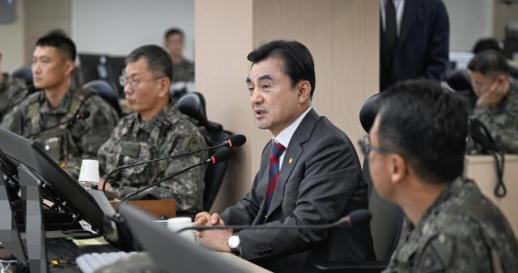 Robots to take over GOPs in Korea but computing power poses setback SEOUL, April 28 (AJP) - Robots will take over general outposts (GOPs) along the heavily fortified border with North Korea as South Korea grapples with shrinking troop numbers due to depopulation. But maintaining a robotic fleet comes with a catch — massive computing power. The Ministry of National Defense said Tuesday it is reviewing a plan to gradually reduce troops stationed at front-line GOPs and transition to an AI-enabled surveillance system. “The ministry is reviewing a plan to transform GOPs into an AI-based border security system combining manned and unmanned operations, and to pursue related force restructuring,” a ministry spokesperson said. Troop levels at GOPs could be reduced from about 22,000 to around 6,000. The ministry emphasized that the move is not simply about cutting troop numbers, but part of a broader restructuring driven by long-term demographic pressures. “GOP guard forces would be shifted to the Forward Edge of the Battle Area (FEBA), allowing troops to focus on training and preparing for combat while maintaining rapid response capabilities in emergencies,” the spokesperson said. The military is refining a roadmap for phased mid- to long-term pilot programs and complementary measures to ensure readiness during the transition. The plan, however, faces a significant infrastructure shortfall. The military estimates it will need about 50,000 graphics processing units (GPUs) to implement AI systems, but currently operates only around 500 across major defense data facilities, including the Defense Integrated Data Center, battlefield data centers and the Agency for Defense Development. The challenge extends beyond equipment shortages. Even if additional GPUs are secured, constraints in power supply, cooling systems and rack space could limit further expansion. The Agency for Defense Development, which holds roughly 480 GPUs, had planned to add another 320 last year but scrapped the plan due to insufficient installation space. Outsourcing GPU management to commercial cloud providers such as Naver Cloud and Kakao is not an option under National Intelligence Service security guidelines, which restrict such use in defense. Without new data centers, additional GPUs would be difficult to deploy, risking delays to broader military AI adoption. Given national security requirements, any new military data center would likely need to be built underground and hardened against chemical, biological and electromagnetic pulse (EMP) threats, with costs expected to exceed 2 trillion won ($1.4 billion). There are growing calls to build a facility capable of housing large volumes of GPUs, similar to one planned by the Ministry of Science and ICT. The ministry aims to invest 2 trillion won by 2028 to establish a National AI Computing Center with 50,000 GPUs. Separately, the ministry signed a memorandum of understanding Monday with Demis Hassabis, co-founder and chief executive of Google DeepMind, to cooperate on joint research in science, technology and AI, as well as talent development and the responsible use of AI. 2026-04-28 17:56:42
 -
 Appeals court convicts Kim Keon Hee in stock manipulation case, doubles prison term Kim Keon Hee, who was indicted on charges including manipulating Deutsch Motors stock and receiving valuables tied to the Unification Church, was sentenced on appeal to four years in prison. The term more than doubled from the first trial’s 20 months after the court reversed part of the stock-manipulation finding and expanded the scope of guilt on brokerage bribery charges. The Seoul High Court’s Criminal Division 15-2 (Judges Shin Jong-oh, Seong Eon-ju and Won Ik-seon) on April 28 sentenced Kim, who was detained and indicted, to four years in prison and a 50 million won fine for violations of the Capital Markets Act and the Political Funds Act, and for brokerage bribery under the Act on the Aggravated Punishment of Specific Crimes. The court also ordered the forfeiture of one Graff necklace and about 20.94 million won in additional collection. "She recognized her account could be used to manipulate prices" The appeals court, unlike the trial court, found part of the stock-manipulation charge proved. It cited that in October and November 2010 Kim provided Black Pearl Invest with an account holding 2 billion won and left trading to the firm, and that during that period 180,000 shares were sold at specific times and prices. Calling it a prearranged trade, the court said she "recognized and accepted that her account could be used to manipulate prices," and held her liable as a joint offender. The court also strengthened its ruling on the Unification Church-related brokerage bribery charge. While the trial court found guilt only in part, the appeals court found implied solicitation across the broader set of items, including a Chanel bag, and convicted her on all counts. It said there was a quid pro quo between the church’s requests for government cooperation and the provision of valuables, calling it a crime that "used the status of the president’s spouse." The court, however, upheld an acquittal on allegations involving free polling services linked to Myung Tae-kyun. It said the polls were provided to multiple people, not only Kim and her husband, making it difficult to treat them as a benefit attributable to a specific individual. It also found insufficient evidence to conclude that a nomination was promised in return for the polling. Court cites harm to "market fairness" and investor trust Explaining the heavier sentence, the court cited the seriousness of the crimes and Kim’s attitude. It said she provided large sums and an account and took part in price manipulation while refusing to acknowledge wrongdoing, adding that she "undermined the fairness of the stock market and investor trust." On brokerage bribery, it said her conduct "betrayed the public’s expectations." The court said mitigating factors included that she did not lead the price manipulation, her involvement was not lengthy, and she did not first demand the valuables. The ruling also tracked a shift in the special counsel’s approach on appeal. Prosecutors argued Kim was not a mere investor but a joint participant in the scheme, and emphasized implied quid pro quo rather than an explicit request in the brokerage bribery case. The court accepted those arguments, expanding the convictions and increasing the sentence. Kim’s side said immediately after sentencing that it would appeal to the Supreme Court. The case will now move to a final review, with key issues including whether she conspired in the stock manipulation and how broadly quid pro quo can be recognized in the brokerage bribery charge.* This article has been translated by AI. 2026-04-28 17:54:48
 -
 Korean Retailers Roll Out Payment Perks, Pop-Ups to Lure Foreign Shoppers for May Holidays Korea’s retail industry is mounting an all-out push to attract foreign tourists and spur domestic spending as holiday periods in South Korea, China and Japan overlap into a major early-May shopping peak. With more travelers visiting independently, retailers are emphasizing easier payments and pairing promotions with K-content experiences. According to the industry on April 28, Lotte Department Store will run a “Shopping Week” promotion for foreign customers timed to Japan’s Golden Week (April 29-May 6) and Labor Day holidays in China and Taiwan (May 1-5). Through May 10, foreign customers who spend at least 1,200 yuan via WeChat Pay will receive an immediately usable 50-yuan discount coupon. Customers who pay 200,000 won or more with Line Pay Taiwan at all branches will earn 10% back in Line points. From May 1-6, shoppers paying with UnionPay at the company’s main store and Jamsil store will get an immediate 10% discount and an additional 10% of their tax refund amount. Lotte is also leaning on theme marketing tied to global character intellectual property. From May 1-17, it will hold “Star Wars Day 2026” around the Jamsil Lotte World Tower area, including a large parade. Through May 6, Lotte World Mall will host Bandai Namco’s “Fancy Festa,” described as Japan’s “Disney.” Shinsegae Department Store will run its largest-ever “Global Shopping Festa” through May 10 at its main store, Gangnam, Times Square and Centum City locations, with more than 100 brands participating. It will offer 10% gift certificates by purchase tier and, in cooperation with UnionPay and WeChat Pay, up to 10% instant discounts and cash-back benefits. Working with Global Tax Free (GTF), it will also provide an additional 10% of the refund amount to accelerate visits from greater China. Shinsegae is also expanding its airport outreach. It is taking part in the “Korea Welcome Week” event at Incheon International Airport, distributing vouchers that include discount coupons of up to 10%. At its Busan Centum City store, customers who spend 300,000 won or more will receive a “K-snack package” featuring seven popular ramen varieties. At its Gangnam and main stores, it will roll out a series of K-fashion pop-ups aimed at trend-conscious foreign shoppers. Hyundai Department Store is strengthening digital convenience and fandom marketing. In February, it partnered with UnionPay to introduce a China-only Apple Pay payment service at department stores and outlets nationwide, offering discounts of up to 12% for mobile payments without a physical card. For Japanese customers, it will give mask packs to those who pay with JCB cards at five key stores, including its Apgujeong flagship. The Hyundai Seoul is running an NCT WISH pop-up store through May 3 to capture demand for merchandise. Later in May, it plans to open a foreigner-only space called “Live Seoul” offering K-beauty experiences. Lotte Mart is putting “K-food” front and center. Working with the Japanese platform Konest, it is issuing advance discount coupons, and at key stores such as Zettaplex Seoul Station it will give luggage tags or travel shopping bags to customers who spend 70,000 won or more. It has secured supplies of its exclusive snack “Cheongwoo Chewy Choco Chip Strawberry,” which previously sold out, and is expanding buy-one-get-one promotions on steady sellers such as ramen and mask packs to meet foreign demand. Shinsegae Duty Free has also strengthened tie-in benefits such as mileage accrual by partnering with global airline and hotel chains. “Because holiday periods in Korea, China and Japan overlap, the retail industry has effectively entered a battle to win foreign customers,” an industry official said. “The payment perks and the level of content differentiation each company prepared will determine sales.” * This article has been translated by AI. 2026-04-28 17:53:41
 -
 SK ecoplant to buy back 6.5 trillion won in shares to redeem convertible preferred stock SK ecoplant said April 28 it held a board meeting at its headquarters in Susong-dong, Jongno-gu, Seoul, and approved calling an extraordinary shareholders meeting to proceed with a share buyback. The buyback will cover about 1.33 million shares of convertible preferred stock, or CPS, issued in 2022. Of that, SK will purchase part of the CPS held by financial investors, valued at 200 billion won. SK ecoplant will acquire the remaining portion, valued at 650 billion won. The company said it is pursuing redemption of the CPS after weighing factors including easing future financial burdens such as dividends and protecting shareholder interests. It said the redemption will be funded with its own cash and other internal resources, without separate external financing. SK ecoplant has been accelerating a rebalancing effort to reshape its business around semiconductor and artificial intelligence infrastructure. The company said it is building semiconductor fabrication facilities and AI data centers while securing a value chain spanning key semiconductor materials, industrial gases, semiconductor module products and recycling. It said AI infrastructure-related businesses accounted for 67% of its revenue last year. An SK ecoplant official said the company will continue to raise corporate value by strengthening profitability and financial soundness based on its differentiated competitiveness in semiconductors and AI infrastructure. * This article has been translated by AI. 2026-04-28 17:53:04
 -
 KOSPI extends rally, hitting new milestone SEOUL, April 28 (AJP) - South Korea's benchmark KOSPI closed Tuesday at a new high after testing a new milestone as the sole winner in Asia. The main bourse added 0.4 percent to finish at 6,641.02 points after climbing as high as 6,712.73, extending its winning streak to a seventh consecutive session. Institutional investors purchased 351.1 billion Korean won (US$270 million) worth of shares, while foreign and retail investors sold 184.5 billion won and 130.3 billion won, respectively, indicating that the rally was increasingly driven by domestic institutional flows as other investors took profits. The rally has been underpinned by sustained global inflows into artificial intelligence (AI)-linked semiconductor stocks, with the country's market capitalization surging more than 45 percent this year to around $4.04 trillion, overtaking the United Kingdom and highlighting its growing prominence in the global AI investment cycle. The gains reflect South Korea's outsized exposure to AI-linked sectors, amplifying its outperformance relative to regional peers. Among major stocks, SK hynix rose 0.6 percent to 1,300,000 won, while Hyundai Motor jumped 5.9 percent to 555,000 won, reflecting a broadening of the AI-driven rally beyond semiconductors as investor interest extended to automakers amid growing expectations for partnerships in autonomous driving and robotics. Samsung Electronics, however, fell 1.1 percent to 222,000 won, signaling profit-taking in index heavyweights following recent gains. In contrast, the junior KOSDAQ fell 0.9 percent to close at 1,215.6, reversing earlier strength as foreign and institutional investors offloaded a combined 786.8 billion won worth of shares. Retail investors bought a net 796.0 billion won, helping to limit losses. The divergence between the two major indexes highlights a shift toward large-cap, AI-linked stocks at the expense of higher-risk stocks. Biotech and high-growth stocks led declines, reflecting continued pressure on high-valuation segments, even as some battery-related shares showed resilience. The South Korean won edged down to 1,474.0 per dollar amid lingering global uncertainty. Elsewhere in Asia, Japan's Nikkei 225 fell 1.1 percent to 59,917.5 after the Bank of Japan held its policy rate at 0.75 percent while signaling the possibility of further tightening. China's Shanghai Composite slipped 0.2 percent and Hong Kong's Hang Seng Index dropped 0.9 percent, as elevated energy prices and geopolitical risks weighed on regional sentiment. Meanwhile, oil prices extended gains, with Brent crude hovering above $110 per barrel amid prolonged disruptions in the Strait of Hormuz. 2026-04-28 17:52:56
 -
 Retailers, Travel Firms Target May Holiday Surge as Japan, China Vacations Overlap From late April through early May, South Korea’s retail and travel industries are gearing up for a three-nation holiday rush as extended breaks in Korea, China and Japan overlap. Japan’s Golden Week (April 29-May 6) and the Labor Day holidays in China and Taiwan (May 1-5) begin at the same time this week, prompting companies to step up efforts to attract visitors to Korea. The Ministry of Culture, Sports and Tourism and the Korea Tourism Organization said April 28 they expect 80,000 to 90,000 Japanese tourists and 100,000 to 110,000 Chinese tourists to visit Korea during the holiday period. In the first quarter, arrivals from Japan and China totaled 940,000 and 1.45 million, respectively, the highest levels on record. Korea is also expected to see stronger domestic travel and shopping demand, with a string of holidays running from Labor Day on May 1 — designated a statutory holiday for the first time this year — through Children’s Day on May 5. The influx of Japanese and Chinese visitors is also being watched for its potential to lift second-quarter retail conditions. The Korea Chamber of Commerce and Industry previously forecast a subdued outlook, with its 2026 second-quarter Retail Business Survey Index at 80, little changed from 79 in the prior quarter, citing Middle East-driven geopolitical risks and prolonged high inflation, a weak won and high interest rates as constraints on domestic demand. Industry expectations have picked up, however, as the Korea-China-Japan holiday overlap coincides with the phased rollout of the government’s “high oil price damage relief payments,” which could add to consumer spending power. Department stores and duty-free shops are rolling out promotions aimed at foreign shoppers, including discount coupons and point rewards. Big-box retailers are expanding K-food promotions — a staple on many visitors’ shopping lists — and adding more convenient payment benefits to encourage spending. Restaurants, convenience stores and other offline retailers are also preparing broad discount events and securing inventory, betting that relief-payment spending will translate into stronger purchasing power in neighborhood commercial districts. “By capturing both foreign tourist demand and domestic demand boosted by the oil-price relief payments, the industry could move beyond simply protecting second-quarter results and deliver a meaningful rebound,” an industry official said.* This article has been translated by AI. 2026-04-28 17:52:16
 -
 K-pop girl band Le Sserafim releases world tour schedule as group targets European debut SEOUL, April 28 (AJP) - K-pop girl band Le Sserafim will perform 32 shows across 23 cities starting this July, including the first solo European concerts for the K-pop group, the five-member group's agency Source Music said Tuesday. The tour begins in the western port city of Incheon on July 11 and travels through Japan and the United States before reaching five cities in Europe this October. The expansion into Europe follows a year of commercial growth where the group was ranked among the top 10 highest-grossing K-pop tours. By booking shows in London, Paris, and Berlin, members Kim Chae-won, Sakura, Huh Yun-jin, Kazuha, and Hong Eun-chae are moving into new markets to build a larger international audience. The tour is named after the group’s second studio album, "PUREFLOW" pt.1, which is set for release on May 22. The band's agency said the name is an anagram for "POWERFUL." The group released a lead single titled "CELEBRATION" on April 24 to begin the new album cycle. The North American leg includes nine cities, such as Los Angeles, Chicago, and Newark. These dates follow a 2025 tour where the group became the first K-pop girl group to appear on the NBC program "America's Got Talent." That tour included 31 shows and a performance at the Tokyo Dome. Industry data from last year showed the group earned more from ticket sales than any other K-pop girl group during the 12 months ending in September 2025. The new schedule maintains dates in traditional markets like Taipei and Singapore while adding the European leg. Full details on venues and ticket sales are being posted to the group’s official fan platform. The tour is scheduled to conclude in November with a series of performances across Southeast Asia. 2026-04-28 17:51:46
 -
 Korean Food and Dining Brands Target May Holiday Demand With Value Deals and Takeout With an early May stretch of holidays approaching and the timing of government payments to offset high fuel prices, South Korean food and dining companies are stepping up spring promotions in hopes of a pickup in spending. Companies expect more outings during the holidays and are emphasizing convenient, portable options for outdoor activities. Value-focused offers tied to May’s Family Month are also expected to influence consumer demand. Industry officials said April 28 that as applications opened for the high-fuel-price relief payments, franchise restaurants began posting signs at entrances saying the payments can be used there, aiming to draw customers. Headquarters are also promoting the option through company apps, websites and distributed marketing materials, reflecting expectations that the funds, like last year’s consumer coupons, will flow quickly into restaurants where spending is immediate. Brands are also pushing to capture customers outside stores as spring and the holiday period bring more travelers. Outback Steakhouse rolled out three “Lunch Box” sets nationwide, targeting group meals for corporate events and picnics. It also added an app-based advance reservation service so customers can pick up orders at a preferred time and location. Delivery-heavy brands, including chicken chains, are moving to lock in demand with discount promotions. KFC is running a value-menu “KFC Snack” campaign to attract grab-and-go snack purchases. Hyundai Green Food introduced “Greeting” ready-to-cook items designed for use at camping sites, positioning them for outdoor dining. Competition is also expected to intensify in the cake market, as May includes multiple gift-giving occasions. Paris Baguette introduced a “Blue Rose Cake,” symbolizing “miracles” and “hope,” along with an object-style gift item designed not to wither, and is offering a 10,000-won set discount for app preorders. Tous les Jours is selling flower-themed cakes such as “Flower Montmartre” and character cakes, while offering up to 30% off for app reservations and running a 100% payback event to boost digital orders. Twosome Place launched a “Flower Yogurt Cake” shaped like a red rose and is providing discount coupons to customers who preorder through its app. Discount campaigns aimed at gift demand are also heating up. Jung Kwan Jang is offering up to 15% off popular red ginseng products through May 16 and providing point rewards based on purchase amounts as part of a Family Month promotion. hy is running a health-food promotion that offers up to 43% off, reward points and free shipping when customers use its gifting function. The Hanwoo Self-Sufficiency Fund Management Committee is holding an “online hanwoo market” through the 30th, selling Grade 1 sirloin at a special price of 7,120 won per 100 grams and offering discounted prices on other cuts. “With holidays and the relief payments expected to help restore consumer sentiment, we will raise customer satisfaction with differentiated products and services that reflect trends,” a distribution industry official said.* This article has been translated by AI. 2026-04-28 17:51:24
 -
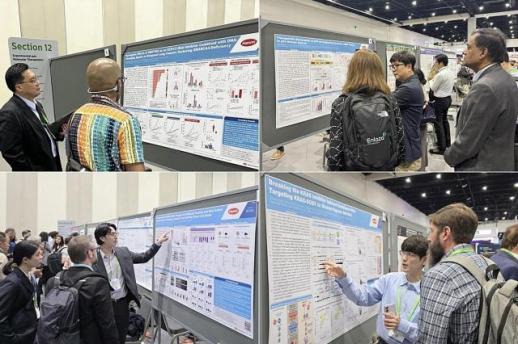 Hanmi Pharmaceutical Unveils Next-Generation Cancer Drug Pipeline at AACR 2026 Hanmi Pharmaceutical said it has unveiled a cancer drug pipeline built on a range of next-generation modalities, underscoring its growing body of oncology research. The company said on April 28 that it presented nine research findings covering eight new drug candidates at the American Association for Cancer Research meeting, AACR 2026, held April 17-22 (local time) in San Diego. Hanmi noted that recent technology-licensing deals by global drugmakers show antibody-drug conjugates and bispecific antibodies emerging as key investment targets. Hanmi said its AACR presentations were organized around three areas: targeted therapies that selectively modulate proteins highly expressed in cancer cells; targeted therapies based on next-generation modalities; and immuno-oncology candidates designed to activate immune cells and trigger antitumor responses. In targeted oncology, the company disclosed an EZH1/2 dual inhibitor (HM97662), a selective HER2 inhibitor (HM100714) and an inhibitor of SOS1-KRAS interaction (HM101207). Hanmi also highlighted an EP300 selective degrader developed using its targeted protein degradation platform. The company said the candidate showed lower toxicity and stronger anticancer efficacy than existing inhibitors, suggesting a potential new treatment approach. In immuno-oncology, Hanmi presented research on STING mRNA and p53 mRNA cancer drug candidates, as well as multispecific antibody-based programs led by Beijing Hanmi Pharmaceutical: a 4-1BB x PD-L1 bispecific antibody (BH3120) and a B7H3 x PD-L1 bispecific antibody-drug conjugate (BH4601). Hanmi said animal models showed tumor-growth suppression after intravenous and intramuscular administration. It also reported increased immune cells and anticancer activity in so-called “immune-cold” tumors that do not respond to existing immunotherapies. The company said it confirmed a dual mechanism that both activates immunity and suppresses cancer-cell proliferation while maintaining survival of normal cells. Hanmi said BH3120 uses its “Pentambody” bispecific antibody platform, enabling one antibody to bind two different targets and combine targeted anticancer treatment with immune-cell activation. The company said BH4601 is a bispecific antibody-drug conjugate that targets B7H3 and PD-L1 at the same time, and it presented a mechanism aimed at reducing resistance and activating immunity across a range of solid tumors. Choi In-young, head of Hanmi Pharmaceutical’s R&D Center, said the company’s next-generation modality-focused oncology pipeline demonstrated its research and development competitiveness. “We will continue to expand future growth engines through technology convergence and R&D,” Choi said.* This article has been translated by AI. 2026-04-28 17:46:44