

Journalist

Lim Byung-sik
-
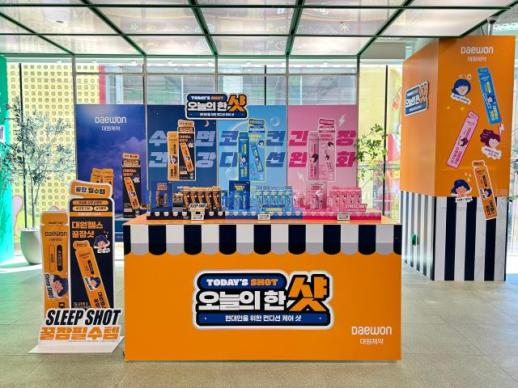 Daewon Pharmaceutical Strengthens 'Channel-Customized' Health Supplement Strategy Daewon Pharmaceutical is revamping its health supplement brand, Daewon Health, to accelerate its expansion in the consumer healthcare (CHC) sector. The company is targeting the market by varying its product offerings and marketing strategies based on consumer touchpoints such as home shopping, health and beauty stores, and online platforms. According to Daewon Pharmaceutical, the company is focusing on a 'channel-customized portfolio' for its health supplement business. This marks a shift from the previous approach of supplying generic products across multiple distribution channels to a more segmented strategy tailored to the characteristics and purchasing motivations of consumers in each channel. This strategic shift reflects changes in consumer patterns within the health supplement market. The Korea Health Supplement Association reports that over the past five years, the market has rapidly transitioned from family-oriented consumption to individual health concerns. As health supplements become a regular part of daily management, the consumer base and purchasing motivations are becoming more diverse. Competition in the market has intensified. According to the Ministry of Food and Drug Safety, the number of specialized health supplement distributors has surged from about 3,200 in 2019 to over 5,630 this year, a 73% increase. This indicates that differentiation through generic products alone has become increasingly challenging. In response to market changes, Daewon Pharmaceutical has refined its product strategies by channel. In the home shopping sector, the company is enhancing its lineup of traditional health supplements focused on high potency and large volumes, targeting middle-aged consumers who prioritize brand trust and functionality. Its flagship high-potency albumin product, 'Albumin King,' sold out during its first home shopping broadcast and has achieved 13 consecutive sellouts. Following this success, offline purchase inquiries have increased, leading to expanded sales channels in major department stores nationwide. Conversely, in health and beauty stores like Olive Young, the company is focusing on convenient products aimed at younger consumers. It is promoting easy-to-consume items such as 'Honey Sleep Shot,' 'Stress Shot,' and 'Nose Relief Shot' to broaden consumer engagement. Last month, it also operated a pop-up store centered around these products. For online channels, Daewon plans to expand its portfolio of small-packaged products and customized offerings focused on specific functionalities to meet segmented consumer demands. A company representative stated, "The direction Daewon Health is focusing on is diversifying product lineups tailored to the characteristics of each distribution channel. We are developing and operating channel-customized products by analyzing channel characteristics and consumer lifestyles." The representative added, "Our core strategy is to expand consumer touchpoints by dualizing the structures of home shopping, offline, and online commerce channels." The brand strategy has also been revamped. Since entering the health supplement market in 2017 with its probiotics brand 'Jang Daewon,' Daewon Pharmaceutical has expanded its product range and rebranded to 'Daewon Health' last year. This rebranding aims to enhance consumer recognition and provide a more intuitive brand identity. Based on this strategy, the company plans to rapidly grow its health supplement business. During a recent investor relations meeting, Daewon set ambitious revenue targets, aiming to increase Daewon Health's sales from 8.7 billion won last year to 40 billion won this year, 70 billion won by 2027, and 100 billion won by 2028. A Daewon representative remarked, "As health concerns become increasingly segmented, we are continuously expanding our product range to address these needs. We are focusing on providing products in optimized forms at the moments consumers need them, rather than simply increasing quantity."* This article has been translated by AI. 2026-06-05 14:09:00
 -
 KT to Simplify Pricing Plans, Launches 18 Unified Plans for 5G and LTE in July KT is set to unify its pricing structure for 5G and LTE services, introducing an option that allows customers to continue using data at reduced speeds even after their data allowance is exhausted. On June 5, KT announced that it will launch 18 new unified pricing plans on July 1, replacing the existing 105 plans for 5G and LTE. The new structure simplifies the selection process, allowing customers to choose plans based on the same criteria regardless of device type or network. Current subscribers can retain their existing plans. The new offerings will include a fully unlimited data option called 'Choice' and a tiered data option named 'Basic.' A key feature of this overhaul is the introduction of a 'Data Assurance Option' (QoS) across all plans. The Basic 110GB plan will offer speeds of up to 5 Mbps, while plans with more than 14GB will provide speeds of up to 1 Mbps. For lower-tier plans with less than 10GB, speeds will be capped at 400 Kbps after the data allowance is used. The Choice plan will provide unlimited data without speed restrictions. KT will also automatically apply age-specific benefits, known as 'Bonus Benefits,' without requiring separate applications. Customers will receive double data upon turning 13 through the 'School Bonus,' and those aged 18 and older will receive the 'Y Bonus.' Seniors will automatically receive the '65+ Bonus' at age 65 and the '75+ Bonus' at age 75. Benefits for vulnerable groups will also be expanded. Seniors aged 65 and older using low-cost LTE plans will receive basic voice and text services for over 20,000 won per month, while those paying over 10,000 won will receive 30 minutes of voice calls and 50 text messages. Military personnel will receive additional data during their service, and welfare recipients, including people with disabilities, will have access to video and additional calls for up to 600 minutes. Kim Young-gul, Senior Vice President of KT's Customer Business Division, stated, "This restructuring of our pricing plans was designed to alleviate the difficulties customers face in choosing options. We will continue to expand tailored benefits that reflect life cycles and usage patterns."* This article has been translated by AI. 2026-06-05 14:09:00
 -
 Daishin Balance No. 20 SPAC Soars 86% on First Day of KOSDAQ Listing Daishin Balance No. 20 SPAC is experiencing a significant surge on its first day of trading on the KOSDAQ, far exceeding its initial public offering price. As of 1:42 PM on June 5, the SPAC's shares were trading at 3,735 won, up 1,735 won (86.75%) from the IPO price of 2,000 won. The stock price even soared to 6,710 won early in the session. A SPAC, or Special Purpose Acquisition Company, is established to facilitate the listing of private companies. It must merge with a private company within three years, or it will be automatically delisted. Market analysts attribute the stock's rise to heightened investor interest in newly listed companies, along with expectations of future mergers with growth-oriented industries. Daishin Balance No. 20 SPAC plans to pursue mergers with companies in future growth sectors, including renewable energy, biopharmaceuticals and medical devices, secondary batteries, LED applications, green transportation systems, carbon reduction energy, advanced water treatment, digital content, gaming, entertainment, robotics, new materials, nanotechnology, high-value food industries, automotive parts manufacturing, and IT semiconductors. In related news, Daishin Balance No. 18 SPAC was listed on the KOSDAQ in January after merging with GF-I, a next-generation smart safety systems company.* This article has been translated by AI. 2026-06-05 14:03:00
 -
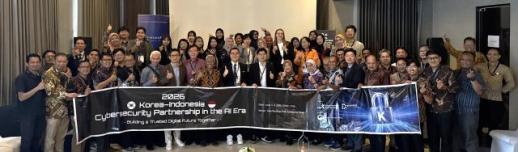 KISA Enhances Cybersecurity Cooperation with Indonesia Amid AI Era The Korea Internet & Security Agency (KISA) hosted a business cooperation event in Jakarta, Indonesia, to strengthen partnerships between cybersecurity companies and institutions from both countries, focusing on the local security market in the telecommunications and finance sectors. KISA announced on June 5 that it co-hosted the '2026 AI Era Korea-Indonesia Cybersecurity Partnership Day' with the Indonesian Telecommunications Association (APJII) on June 3-4 in Jakarta. The event, supported by the Ministry of Science and ICT, saw participation from 10 domestic cybersecurity companies and over 120 representatives from local institutions and businesses in Indonesia. Since establishing a local strategic base in Indonesia in 2016, KISA has been supporting the overseas expansion of domestic companies. In April, the two governments signed a memorandum of understanding to enhance cooperation in the ICT sector, including cybersecurity. The event was divided into two sectors: telecommunications and finance. Five companies from the telecommunications sector, including △Pylon Link △Raonsecure △NPKore △Winning Eye △LSWare, and five from the finance sector, including △Quadminer △MarkAny △Igloo Corporation △P&P Secure △Wiz Korea, participated. During the seminar, representatives from Indonesia's Financial Services Authority, Ministry of Communication and Informatics, and National Cyber and Crypto Agency presented the country's cybersecurity policy directions and key security issues. Domestic companies showcased security solutions tailored to local demand and explored specific market entry possibilities during subsequent one-on-one business meetings. KISA President Lee Sang-jung stated, "As we transition into the AI era, the importance of cybersecurity for critical infrastructure such as telecommunications and finance is increasing. We aim to assist cybersecurity companies in entering the global market and expand international cybersecurity cooperation through demand-based collaboration and public-private partnerships." * This article has been translated by AI. 2026-06-05 14:03:00
 -
 Meta Integrates Facial Recognition into Smart Glasses App Amid Consent Concerns Meta has reportedly embedded facial recognition features into its smart glasses app, although it is not yet available for general users. The app contains code that recognizes faces and cross-references them with the user's contacts. According to a report from the technology publication Wired on June 4, Meta has added facial recognition system code to its AI app, which connects with Ray-Ban and Oakley smart glasses, through several updates this year. The app, essential for utilizing the smart glasses' main features, has surpassed 50 million downloads. Wired identified the internal name of the feature as 'NameTag.' It works by recognizing a person's face captured by the smart glasses' camera and sending a notification to the wearer if the face matches a contact stored on their phone. The publication reported that three AI models for finding, cropping, and converting faces into biometric data have already been distributed from Meta's servers to users' phones. External security researchers have also replicated the app's analysis results. The main issue at stake is notification and consent. While Meta stated in April that it would approach the introduction of facial recognition features cautiously, Wired pointed out that key components have been included in the app since at least January. Meta maintains that the feature has not yet been released and that no final decision has been made. A spokesperson told Wired, "We are exploring facial recognition-related features, and if we do implement them, we will do so transparently." They also emphasized that they are not creating a centralized facial database. Privacy organizations are pushing back. Over 70 groups, including the American Civil Liberties Union (ACLU) and the Electronic Privacy Information Center (EPIC), have previously demanded that Meta abandon the facial recognition feature for smart glasses. They argue that allowing smart glasses users to identify others in public without consent could increase risks of stalking, harassment, and surveillance.* This article has been translated by AI. 2026-06-05 13:48:00
 -
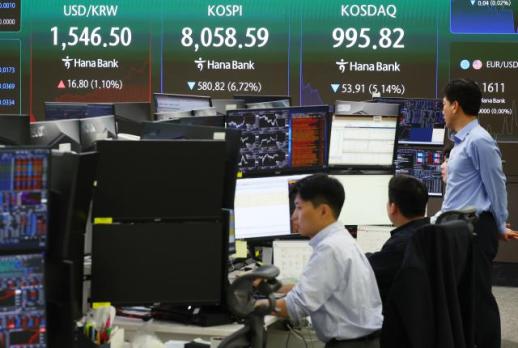 KOSDAQ Index Falls Below 1000 Amid Foreign Sell-Off, Recovers Later The South Korean stock market experienced a significant decline on June 5, driven by a correction in U.S. tech stocks and foreign selling pressure. The KOSDAQ index fell below 1000 during the session, marking a drop into the 900s for the first time in three months. However, it later recovered as bargain hunters entered the market. According to the Korea Exchange, as of 1:22 PM, the KOSDAQ index was down 43.53 points (-4.15%) at 1006.20. The index opened at 1035.22, down 14.51 points (-1.38%), and continued to decline. During the session, it dropped to 992.80, a decrease of 56.93 points (-5.42%), falling below the 1000 mark for the first time since March 4. Although it later regained the 1000 level, it still showed a decline of over 4%. Foreign selling has been a major factor pulling down the index, with foreign investors net selling 223.3 billion won. In contrast, individual and institutional investors bought a net 18 billion won and 206.5 billion won, respectively, indicating some bargain hunting. Most of the top market capitalization stocks also showed weakness. Notable declines included Alteogen (-3.32%), EcoProBM (-7.85%), EcoPro (-7.07%), Rainbow Robotics (-6.58%), JUSUNG Engineering (-13.57%), Kolon TissueGene (-8.49%), Rino Technology (-5.52%), Samchundang Pharmaceutical (-4.85%), and HLB (-4.00%). However, Wonik IPS saw a gain of 3.54%. The KOSPI also experienced a downturn, recording a drop of 452.19 points (-5.23%) to 8187.35 at the same time. A trading halt was triggered at 9:08:25 AM due to a sharp decline in the KOSPI 200 futures index. In the securities market, foreign and institutional investors net sold 2.8331 trillion won and 138.6 billion won, respectively, while individuals net bought 2.7849 trillion won. Among the top market capitalization stocks, Samsung Electronics (-5.26%), SK Hynix (-8.36%), SK Square (-7.64%), Hyundai Motor (-3.71%), LG Energy Solution (-2.37%), Samsung Life Insurance (-7.88%), and Samsung C&T (-15.51%) all declined. Conversely, Samsung Electro-Mechanics (3.03%) and HD Hyundai Heavy Industries (1.61%) saw gains. The sharp decline is attributed to the correction in U.S. tech stocks. Overnight, the New York Stock Exchange saw semiconductor-related stocks such as Broadcom (-12.59%), Micron Technology (-7.74%), SanDisk (-3.92%), and Western Digital (-3.13%) all decline significantly. Lee Kyung-min, a researcher at Daishin Securities, stated, "The sharp drop in the semiconductor sector in the U.S. negatively impacts investor sentiment for the domestic semiconductor sector. At the same time, the recent surge has led to increased short-term overheating concerns among major leading stocks, dampening investor sentiment."* This article has been translated by AI. 2026-06-05 13:42:00
 -
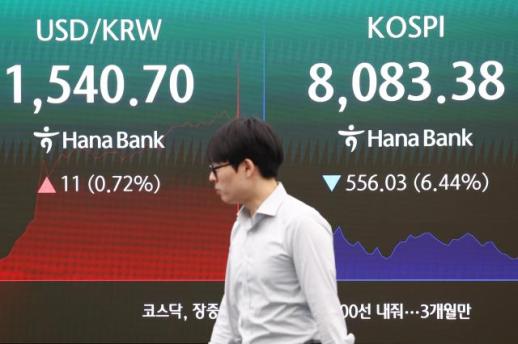 Won weakens further as KOSPI drops over 6% SEOUL, June 5 (AJP) - The South Korean won continued weakening on Friday, with the exchange rate climbing to 1,542 per dollar around noon, from the previous session's close of 1,529.70. The decline came less than a day after the exchange rate weakened past 1,540 won during extended trading, marking its highest intraday level since the global financial crisis. It appears to be largely due to a sharp sell-off in South Korean stocks. The country's benchmark KOSPI tumbled more than 6 percent at one point, briefly falling below 8,100, while a sell-side program trading curb, known as a sidecar, was triggered to slow the pace of the decline. The selloff followed overnight weakness in U.S. technology shares, with Broadcom falling sharply after its earnings release. The decline weighed on investor sentiment toward artificial intelligence (AI) and semiconductor-related stocks, which have been among the key drivers of the recent rally in Seoul. Foreign investors were net sellers of more than 2 trillion won worth of KOSPI shares during the morning session. The selling followed a wave of foreign outflows earlier this week. Foreign investors sold a net 16.5 trillion won worth of KOSPI shares from Monday to Thursday - over just three trading sessions in June. The dollar index and the dollar-yen exchange rate showed relatively limited movements during the same period, while the won's decline deepened alongside foreign selling in the local stock market. Bond yields also extended their rise, though the pace of increase was more limited than the previous session. During morning trading, the three-year government bond yield was up 2.1 basis points at 3.879 percent, while the 10-year yield rose 2.6 basis points to 4.255 percent. The move followed a sharp selloff in the bond market, when the three-year yield jumped 8.5 basis points to close at 3.858 percent and the 10-year yield climbed 9.4 basis points to 4.229 percent. 2026-06-05 13:38:07
 -
 Anthropic Calls for Slowing AI Development Amid Recursive Self-Improvement Concerns Anthropic has urged leading global artificial intelligence (AI) developers to consider slowing or pausing their AI model development. The company argues that as AI becomes increasingly involved in the development of subsequent AI systems, managing risks could become more challenging, necessitating mechanisms to control the pace of development. In a blog post published on June 4, Anthropic stated, "The world should have the option to slow down or pause frontier AI development." The company's primary concern centers on the concept of "recursive self-improvement," where AI takes on a significant role in developing future AI systems, leading to stronger AI being utilized in the creation of the next generation of AI. Anthropic believes that while this could accelerate development, it may also reduce the time available to identify and manage risks. Anthropic explained that AI is already increasing the speed of development in the field. According to the company, its engineers are currently incorporating eight times more code per quarter compared to the average from 2021 to 2025. As of May, over 80% of the code merged into Anthropic's codebase was generated by its AI model, Claude. The company noted that it would be ineffective for only certain companies to halt their development. If one organization slows down, less cautious companies or countries could gain an advantage, potentially lowering overall safety. Anthropic emphasized that for any meaningful slowdown or pause to occur, major AI research institutions and companies across multiple countries must act under the same conditions. There must also be a way to verify whether development has indeed slowed and to establish the conditions under which a pause would begin and end. The biggest challenge lies in verification. AI training tasks are easy to conceal, and the equipment and data used for training are highly versatile. This creates a strong incentive for someone to continue development secretly to gain a technological edge. Through its research organization, the Anthropic Institute, the company plans to conduct studies to support a slowdown and pause framework. It aims to discuss the risks of recursive self-improvement and international coordination methods with policymakers, researchers, civil society, and other AI companies.* This article has been translated by AI. 2026-06-05 13:36:00
 -
 Oman Rejects U.S. Demand to Distance from Iran, Continues Hormuz Discussions Reports indicate that Oman has rejected U.S. pressure to distance itself from Iran. Amid escalating tensions between the U.S. and Iran regarding navigation issues in the Hormuz Strait, Oman has expressed its intention to maintain communication channels with Iran. According to The Guardian on June 4, Oman is resisting U.S. demands to cease its discussions with Iran. The Wall Street Journal (WSJ) previously reported that the U.S. is urging Oman to sever ties with Iran and align more closely with American interests. Citing U.S. and Arab officials, the WSJ noted that Washington has begun to view Oman's neutral stance as contrary to U.S. interests. The core issue revolves around navigation in the Hormuz Strait. Iran has been advocating for a management and toll system for passage through the strait, which the U.S. perceives as a threat to the freedom of navigation in international waters. The U.S. is concerned that Oman may cooperate with Iran's proposal. Oman has clarified that it does not support Iran's toll proposal. It stated that discussions with Iran are aimed at addressing future management of the Hormuz Strait within the framework of international law and the United Nations' International Maritime Organization (IMO). Oman has also reaffirmed its commitment to upholding the principle of free navigation in the strait. While maintaining security cooperation with the U.S., Oman has kept diplomatic channels open with Iran. It has served as a point of contact for both sides, even when direct dialogue between the U.S. and Iran has been challenging. This conflict highlights the growing diplomatic tensions surrounding the Hormuz Strait. While the U.S. demands that Oman distance itself from Iran, Oman remains committed to facilitating discussions on strait management and acting as a mediator between the U.S. and Iran.* This article has been translated by AI. 2026-06-05 13:27:00
 -
 Will Elected Officials Keep Their Real Estate Promises? The real estate market is difficult to read, and securing a home is equally challenging. The government's policies are no exception. This is where the complexity of real estate begins. The June 3 local elections have concluded, with 16 metropolitan leaders elected. Changes in administration occurred in 13 regions, while only three—Seoul's Oh Se-hoon, Gyeongbuk's Lee Cheol-woo, and Gyeongnam's Park Wan-soo—will continue their current policies. Most elected officials will soon take office, but the transition teams are already at work. During their campaigns, promises were evaluated based on whether they were included in plans. Now that they are elected, the focus shifts to what they are doing to ensure those promises are incorporated. The real estate market operates on actions, not just promises. Unfulfilled Rail Promises; Efforts for Inclusion in Fifth Plan Have Begun The most urgent issue is rail development. Key projects proposed by elected officials are not included in the currently established Fourth National Rail Network Construction Plan. These include the new GTX-E, F, G, and H lines proposed by Gyeonggi's Choo Mi-ae, the BuTX and TRX connections to the new Gadeok Airport proposed by Busan's Jeon Jae-soo, and extensions of the CTX main line in the Chungcheong region, among others. Many of these projects are outside the Fourth Plan. For these lines to commence, they must be included in the forthcoming Fifth National Rail Network Construction Plan, which is expected to be outlined soon. The Ministry of Land, Infrastructure and Transport is currently assessing candidate routes through preliminary feasibility studies and demand forecasts, meaning the transition teams must act quickly. Without organizing feasibility studies and consulting with government departments, it will be difficult to get on the candidate list. The Fifth Plan will likely yield the fastest results in the first year of their terms. A prime example is the southeastern region. Elected officials Jeon Jae-soo from Busan and Kim Sang-wook from Ulsan are from the Democratic Party, while Park Wan-soo from Gyeongnam represents the People Power Party. Given the political divide, collaboration is not automatic. The Ulsan-Yangsan-Busan metropolitan railway, initiated under the previous administration, passed preliminary feasibility in July 2025, while the southeastern circular metropolitan railway (Jin-yeong to Ulsan Station) is currently undergoing feasibility studies. Jeon Jae-soo's BuTX and TRX proposals add to the mix. Conflicts may arise over routes, budgets, and priorities within the same southeastern region. Whether these three metropolitan areas cooperate or compete will determine the future of the southeastern mega-city rail network. 'No Tax Burden' Underground Development; Real Estate Projects Start Now The underground development follows a similar structure. Under the 'Integrated Development of Underground Railways Special Act' enacted in 2024, the first pilot projects in Busan, Daejeon, and Ansan were selected in February 2025. However, the comprehensive plan for underground development has yet to be announced. For additional segments promised by many elected officials in Seoul, Incheon, and Cheonan to move forward, they must first be included in the comprehensive plan. The changes citizens will feel in the next term are likely to be more about 'plan confirmation' rather than 'groundbreaking.' The goal for the first pilot project is set for 2030. The true nature of the SOC promises lies elsewhere. The structure of the underground rail projects promised by six elected officials is as follows: land contribution for railway sites → issuance of bonds by project implementers to finance construction costs → underground development and above-ground site preparation → high-density development above ground → repayment of bonds through development profits. This means costs will be covered not by taxes, but through sales and rental income from buildings and commercial spaces developed above ground. According to estimates from Seoul City, the project cost is 25.6 trillion won, while the above-ground development profit is projected at 31 trillion won. The development profit exceeds the project cost by 121%. If the development profit decreases by 20%, it will fall to 24.8 trillion won, which would be below the project cost. Estimating development profits is crucial for assessing project viability. The phrase 'no tax burden' implies a lower financial obligation, not the absence of costs. The real estate market must cover these costs. Elected officials will need to decide on changes to the floor area ratio and zoning for above-ground development, as well as the structure of contributions from project implementers. The essence of new airport projects is similar. Gyeongbuk Governor Lee Cheol-woo's TK New Airport, Daegu Mayor-elect Choo Kyung-ho's development of the former airport site, the relocation of Gwangju Airport, the Saemangeum Airport, and Busan's Gadeok New Airport all superficially appear to be transportation infrastructure projects. However, the core issue from a real estate perspective is the development of the former airport site and surrounding areas. How the relocated airport site will be utilized remains a key question. Supply Dwindles While Unsold Units Pile Up; Speed and Scale Will Determine Success The residential market facing elected officials is at the center of polarization. According to housing statistics from the Ministry of Land, Infrastructure and Transport for April 2026, housing permits in Seoul from January to April totaled 12,760, a 24% decrease from the previous year (16,787). Nationwide, completions dropped to 75,230, a 45.9% decline from the previous year (139,139). A decrease in permits now means fewer move-ins in two to three years. Completions have already halved. Meanwhile, of the 65,179 unsold units at the end of April, 47,881 (73%) were in provincial areas, and of the 29,504 completed but unsold units, 25,166 (85.3%) were also in provincial areas. A critical signal is that while unsold units in the metropolitan area decreased by 1,314 in April, they increased by 1,210 in provincial areas, indicating a deepening divide where new constructions are drying up in the metropolitan area while unsold homes accumulate in provincial regions. The first task for the new city and provincial administrations is clear. How will they prevent the cliff of permits and groundbreaking in the metropolitan area, and how will they address the growing unsold inventory in provincial areas? The solutions to these two issues are not the same. In the metropolitan area, accelerating the processing of permits for redevelopment projects, regulating sale prices, and revitalizing urban redevelopment projects are immediate strategies. Incheon Mayor-elect Park Chan-dae has promised urban projects like Camp Market mixed-use development and Dongincheon administrative center development, while Gyeonggi Governor-elect Choo Mi-ae's GTX and new town supply, along with Seoul Mayor Oh Se-hoon's push for faster redevelopment projects, should all respond to the permit cliff. Conversely, addressing unsold inventory is the priority in provincial areas. This requires activating rental programs for unsold units, adjusting sales timelines, urban renewal in provincial metropolitan areas, and reallocating supply to areas with confirmed demand. The first reality facing elected officials Jeon Jae-soo from Busan, Heo Tae-jung from Daejeon, and Kim Sang-wook from Ulsan is the unsold inventory that has already accumulated before their new promises. New housing models are one of the tools to address this issue. Oh Se-hoon's land lease apartments and support for non-apartment construction, Park Chan-dae's citizen REITs and Incheon-style social housing, Jeon Jae-soo's public SPC land lease, and Sejong Mayor-elect Cho Sang-ho's basic housing for youth are all part of the solution. However, if these models take 2-3 years to be implemented in a market already facing permit and unsold unit issues, they will not provide answers to the diagnosis. The restructuring of SH, LH, and urban corporation regulations, the establishment of funding, land acquisition, and the initiation of pilot projects must all begin concurrently from the transition team stage. The speed and scale of implementation will determine the market's fate. Models providing 1,000 to 2,000 units annually will fall short of addressing the declining move-in volume in Seoul.* This article has been translated by AI. 2026-06-05 13:24:00