

Journalist

Lim Byung-sik
-
 Data Breach at TVING Prompts Government Investigation A data breach at the domestic online video service TVING has prompted the government to initiate a joint investigation. According to Yonhap News on June 3, TVING reported that unauthorized external access led to the exposure of some users' personal information. The leaked data includes member IDs, names, birth dates, gender, phone numbers, and email addresses. However, it has been confirmed that sensitive information such as resident registration numbers and payment details were not compromised. The extent of the data breach is still being assessed, and details on victim compensation will be provided later. TVING officially reported the data breach to the Ministry of Science and ICT on June 1, after becoming aware of the incident. The Ministry and the Korea Internet & Security Agency (KISA) immediately requested that TVING preserve relevant data and began investigating the cause and scope of the breach. During a subsequent meeting of the Incident Investigation Review Committee, the incident was classified as serious, leading to the formation of a joint investigation team. This team includes officials from the Ministry and KISA, as well as private sector experts in forensics and cloud services. Additionally, the Ministry has issued a public security notice on the 'Protection Nation' website to prevent secondary damage, such as smishing, from the leaked personal information. In response to the incident, Choi Joo-hee, CEO of TVING, issued an official apology on June 3, acknowledging the breach. She stated, "We have confirmed the unauthorized access that led to the exposure of users' personal information. The responsibility for failing to protect the information entrusted to us lies entirely with TVING." Choi added, "We have implemented necessary response measures following the incident and are fully cooperating with the government's investigation and related agencies." She also mentioned that affected users are being individually notified and promised transparency in updates regarding the situation, stating, "We will take full responsibility for victim compensation and user protection."* This article has been translated by AI. 2026-06-03 20:30:00
 -
 Three-Way Race in Pyeongtaek By-Election Remains Uncertain The by-election for the National Assembly seat in Pyeongtaek, held alongside the local elections on June 3, is proving to be a closely contested race. Results from exit polls conducted by the three major broadcasters (KBS, MBC, SBS) and predictions from JTBC show conflicting outcomes, indicating that the final result may not be clear until the end of the vote counting process. According to the exit polls from the three broadcasters, Cho Kuk of the Justice Party leads with 31.1%, followed closely by Yoo Yi-dong of the People Power Party at 30.6% and Kim Yong-nam of the Democratic Party at 30.3%. The candidates are effectively within the margin of error, highlighting the tight nature of the race. In contrast, JTBC's predictive survey places Kim Yong-nam in the lead with around 34%, followed by Cho Kuk. This divergence in results has made Pyeongtaek one of the most unpredictable constituencies in the national by-elections. Political analysts have characterized this election as a 'three-way structure' rather than a simple contest between the ruling and opposition parties. Yoo Yi-dong, a local native and a three-term lawmaker, has built a strong regional base. Kim Yong-nam is leveraging the advantages of being from the ruling party and its organizational strength to close the gap. Cho Kuk is banking on his national recognition and the support of the Justice Party to make a significant impact. As the election nears its conclusion, no candidate can confidently claim an advantage. Public sentiment in Pyeongtaek appears to be influenced more by party affiliation, political symbolism, and local ties than by individual candidates. While the younger and progressive voter base has increased around the Godeok New Town area, traditional communities such as Paengseong-eup and Anjung-eup still show strong support for Yoo Yi-dong. The simultaneous competition between the Democratic Party and the Justice Party has also been identified as a major variable in this election, leading to a fragmentation of the progressive vote. The exit polls indicating all three candidates hovering around 30% reflect this phenomenon. The Pyeongtaek by-election carries significance beyond just a local contest. If Cho Kuk wins, the Justice Party will expand its presence in the National Assembly and gain momentum for future political agendas. Conversely, a victory for the Democratic Party would symbolize a strengthening of governmental authority early in its term. For the People Power Party, a win for Yoo Yi-dong would mean retaining a foothold in the metropolitan area. Political observers describe the current situation as a "de facto three-way tie," with no candidate able to guarantee victory. The differing results from the exit polls and the minimal gaps between candidates suggest that the final outcome will only become clear once a significant portion of the votes has been counted. Pyeongtaek is likely to be the final battleground in the June 3 by-elections. 2026-06-03 20:24:00
 -
 Trump Expresses Desire to Meet Iran's New Leader Mozhtaba Amid Peace Talks President Donald Trump expressed a desire to meet Iran's new Supreme Leader, Mozhtaba Khamenei, who he noted is deeply involved in negotiations between the two countries. In an interview with the New York Post podcast "Pod Force One" on June 3, Trump stated, "He is clearly involved in the negotiations, and the Iranian side holds him in high regard." Trump added, "I want to meet him, and I want to meet everyone. Depending on how things progress, I will probably meet him at some point." Mozhtaba ascended to the position of Supreme Leader following the death of his father, Ayatollah Ali Khamenei, in early March due to a U.S. and Israeli airstrike. He has not yet made any public appearances or delivered speeches, remaining in a hidden location while receiving updates on negotiations with the U.S. through a complex network of contacts, according to U.S. intelligence. In related remarks, U.S. Secretary of State Marco Rubio confirmed during a Senate Foreign Relations Committee hearing on June 2 that Mozhtaba is alive and gradually increasing his involvement in the Iranian regime's decision-making. Trump conveyed strong confidence regarding the ongoing peace negotiations with Iran, stating, "The negotiations are progressing rapidly. Iran will not possess nuclear weapons, and many other good things will happen in the future." He expressed regret that minor conflicts are somewhat hindering the peace talks but maintained an optimistic outlook, suggesting that an agreement could be reached "quite quickly." Additionally, Trump addressed rumors of discord with Israeli Prime Minister Benjamin Netanyahu, acknowledging that he was somewhat displeased with Netanyahu's ongoing conflicts with Lebanon, even admitting to using profanity during a phone call. However, he emphasized, "We have worked very well together. I like Bibi (Netanyahu) very much. I am a wartime president, and he is a wartime prime minister," reinforcing the strength of their relationship.* This article has been translated by AI. 2026-06-03 20:18:00
 -
 Election Commission Apologizes for Ballot Shortage During Voting On June 3, the National Election Commission (NEC) issued a public apology regarding a ballot shortage that occurred at several polling places in Seoul during the 9th nationwide local elections. Heo Cheol-hoon, the Secretary General of the NEC, announced the apology and held a briefing at the commission's headquarters in Gwacheon at 9 PM. The ballot shortage primarily affected polling places in the Songpa district. According to Yonhap News, starting around 1 PM, voters at some locations, including the No. 6 polling station in Jamsil 2-dong, faced delays due to a lack of ballots. In response, Shin Dong-wook, chairman of the People Power Party's Election Integrity Committee, visited the NEC to demand explanations regarding the extent and causes of the ballot shortage. During a meeting with Shin, Heo confirmed that as of 6:30 PM, ballot shortages had been identified at 12 polling places across four districts in Songpa, one polling place in Gangnam, and one in Gwangjin, totaling six districts and 12 polling stations. Heo expressed, "I sincerely apologize for the inconvenience and concern caused to the public due to the ballot shortage." The NEC reported that additional ballots were urgently dispatched to the affected polling places and ensured that voters who had not completed their ballots by the 6 PM deadline were still able to cast their votes. The commission plans to further investigate the circumstances and response measures related to the incident.* This article has been translated by AI. 2026-06-03 20:18:00
 -
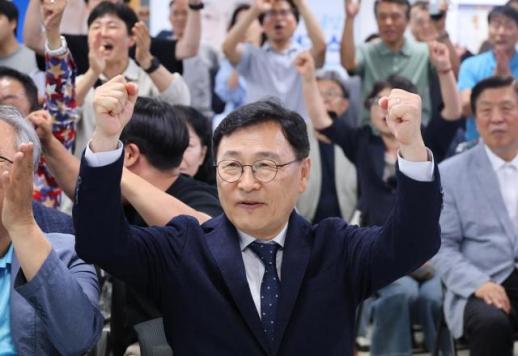 Progressive Candidates Lead in Education Superintendent Elections In the nationwide education superintendent elections held on June 3, progressive candidates are projected to have a strong advantage, according to exit polls conducted by three major broadcasters: KBS, MBC, and SBS. If the exit poll results hold true during the counting process, the progressive camp is expected to win in 9 out of 16 city and provincial education superintendent elections, while the conservative camp is projected to secure 3 positions. The remaining 4 races are anticipated to be closely contested within the margin of error. According to Yonhap News, the exit polls indicate that in Seoul, the current progressive education superintendent candidate Jeong Geun-sik is leading with 39.0%, significantly ahead of conservative candidate Jo Jeon-hyeok, who garnered 21.2%. If these results are confirmed in the official count, Jeong is likely to achieve re-election. In Gyeonggi Province, considered one of the key battlegrounds, progressive candidate Ahn Min-seok is projected to receive 58.2%, leading current conservative superintendent Lim Tae-hee by 16.4 percentage points. In Gangwon Province, progressive candidate Kang Sam-young is expected to secure 43.8%, surpassing current conservative superintendent Shin Gyeong-ho, who is at 35.2%. In Chungnam, progressive candidate Lee Byeong-do is also leading, while in Ulsan, progressive candidate Jo Yong-sik is ahead with 44.2%. The exit polls also show a progressive advantage in Daejeon and Busan, with candidate Seong Kwang-jin in Daejeon and current superintendent Kim Seok-jun in Busan projected to lead their conservative opponents. In the Honam region, competition among progressive candidates is evident. In Jeollanam-do, current superintendent Kim Dae-jung is leading with 40.4%, while in Jeollabuk-do, candidate Cheon Ho-seong is ahead with 56.2%. Conversely, conservative candidates are only leading in three regions: Daegu, Gyeongbuk, and Chungbuk. In Daegu, current superintendent Kang Eun-hee, seeking a third term, is projected to receive 51.5%, significantly ahead of progressive candidate Lim Seong-moo, who is at 29.5%. In Gyeongbuk, current superintendent Lim Jong-sik is leading, and in Chungbuk, current superintendent Yoon Geon-young is also ahead. Jeju, Gyeongnam, Sejong, and Incheon are classified as highly competitive regions. In Jeju, progressive candidate Ko Ui-suk is at 45.1%, closely followed by current conservative superintendent Kim Kwang-soo at 42.0%. In Gyeongnam, progressive candidate Song Yeong-ki is slightly ahead, while in Sejong, candidates Lim Jeon-su and Kang Mi-ae are in a tight race. In Incheon, current superintendent Do Seong-hun and candidate Lee Dae-hyung are also expected to have a close contest. The exit poll results highlight a notable strength of the progressive camp in this election. However, due to the high percentage of undecided voters and the significant impact of candidate recognition on the outcomes, the official results may vary in some regions.* This article has been translated by AI. 2026-06-03 20:12:00
 -
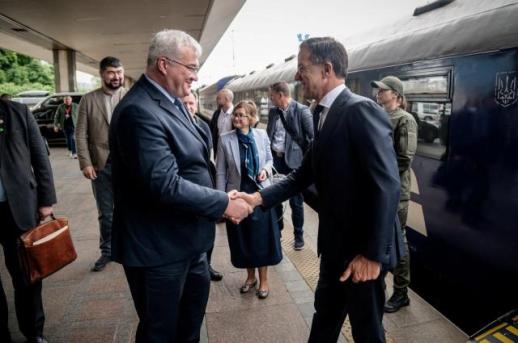 NATO Secretary General Makes Surprise Visit to Ukraine, Emphasizes Alliance Solidarity NATO Secretary General Mark Rutte made an unannounced visit to Ukraine on June 3, marking his first trip to the country in four months. According to Yonhap News Agency, the Ukrainian state railway company Ukrzaliznytsia shared a photo on social media showing Rutte arriving at Kyiv's central station, along with a welcoming message. Ukrzaliznytsia emphasized the significance of the visit, stating, "This visit is a gesture of solidarity and support from our allies and is very important, just like all previous visits," although the post was later deleted. NATO confirmed that Rutte was visiting Ukraine with ambassadors from member countries but did not disclose specific details of the itinerary for security reasons, as reported by DPA. AFP reported that Rutte is expected to meet with Ukrainian President Volodymyr Zelensky, who has been persistently requesting NATO member countries to enhance Ukraine's air defense systems, including the Patriot system. Rutte's visit comes as the fourth anniversary of the Russia-Ukraine war approaches, following his previous trip to Kyiv in early February. During that visit, he addressed the Ukrainian parliament, expressing NATO's commitment to deploying troops in Ukraine for post-war security guarantees. Meanwhile, U.S.-led peace negotiations have effectively stalled since February 28 due to the outbreak of war in the Middle East following attacks by Israel and the U.S. on Iran. Currently, Russia and Ukraine are engaged in intense military exchanges. On June 2, Russian missile and drone strikes on Kyiv and Dnipro resulted in 23 deaths in Ukraine. In retaliation, Ukraine launched airstrikes on local oil export terminals ahead of the opening of the St. Petersburg Economic Forum, often referred to as the "Russian Davos."* This article has been translated by AI. 2026-06-03 20:03:00
 -
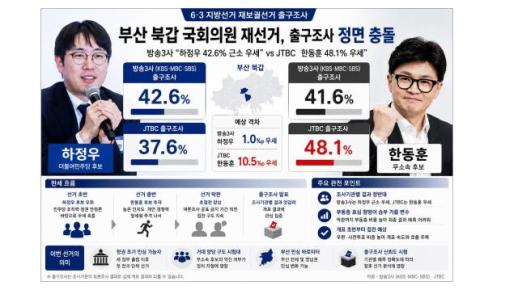 Conflicting Exit Polls in Busan North Gap By-Election: Ha Jung-woo vs. Han Dong-hoon The by-election for the Busan North Gap parliamentary seat, held alongside local elections, has emerged as a major point of intrigue. Conflicting results from exit polls conducted by three major broadcasters (KBS, MBC, SBS) and a prediction survey by JTBC have drawn significant attention to the vote counting in Busan North Gap. According to the joint exit poll from the three broadcasters, Democratic Party candidate Ha Jung-woo is projected to receive 42.6% of the vote, leading independent candidate Han Dong-hoon by 1 percentage point. This indicates a very close race. However, the JTBC prediction survey presented a starkly different outcome, showing Han with 48.1% and Ha at 37.6%, giving Han a 10.5 percentage point lead. The discrepancies between the two surveys are significant, with neither falling within the margin of error. This election has been characterized as the most divergent among the various constituencies in this local election cycle. The political focus on Busan North Gap stems from these conflicting predictions. In other races, such as for the mayor of Seoul and Busan, as well as the governor of Gyeonggi Province, while there were differences in polling results, the overall winner was consistently predicted. In contrast, the Busan North Gap race saw the broadcasters favoring Ha, while JTBC predicted Han's advantage. This effectively means two different electoral outcomes have been forecasted. The by-election was anticipated to be fiercely contested from the outset. The Democratic Party aimed to leverage the significance of this being the first nationwide election since the government took office, hoping for a shift in public sentiment in Busan. Ha has been working to solidify support based on the party's organizational strength and stability of the administration. Conversely, Han, despite running as an independent without party endorsement, has showcased his high recognition and personal competitiveness from the beginning of the campaign. The mobilization of conservative voters has been identified as a key variable. As the election progressed, the contest became increasingly uncertain. The Democratic Party emphasized the need for unity among its supporters, highlighting the early momentum of the administration, while Han focused on appealing to moderate and undecided voters by addressing fatigue with the two-party system and promoting local representation. Notably, even leading up to the blackout period before polling, results remained inconclusive, keeping Busan North Gap in the national spotlight. Following the release of the exit polls, interpretations within the political sphere have sharply diverged. The Democratic Party is leaning toward the results from the three broadcasters, suggesting that Ha's slight lead could translate into an advantage during the counting process. In contrast, Han's camp is focusing on the JTBC prediction, arguing that the significant margin indicates a stronger competitive position that will be reflected in the actual vote count. The outcome in Busan North Gap carries implications beyond just a local by-election. A victory for the Democratic Party could signal a shift in public sentiment in Busan since the government took office. Conversely, if Han wins, it would send a political message that candidates outside the major parties can remain competitive. Most importantly, this election will also test the predictive accuracy of the polling organizations. The results from either the three broadcasters or JTBC will likely influence future election analyses and evaluations of exit polls. The winner in Busan North Gap will likely only be confirmed once the ballots are counted. With such contrasting exit poll results, this election is expected to maintain national political interest until the final count is completed.* This article has been translated by AI. 2026-06-03 19:54:00
 -
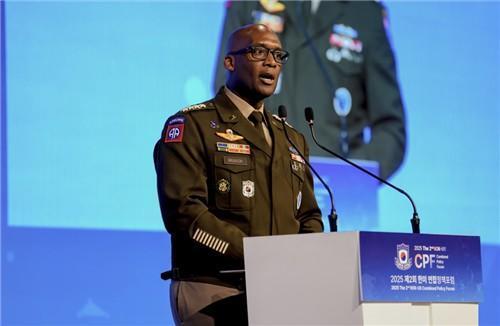 North Korea Criticizes U.S. General's 'Dagger' Remarks as Geopolitical Tool North Korea has strongly criticized U.S. Forces Korea Commander Javier Brunson's remarks about a "dagger," claiming that the U.S. is using South Korea as a geopolitical tool to contain China. According to Yonhap News on June 3, the Korean Central News Agency reported on an article by international affairs commentator Kim Myung-chul, titled "The Dagger Remarks in the Heart of Asia: A Manifestation of U.S. Hegemony and Cold War Mentality." Kim analyzed the implications of Brunson's comments and subsequent clarifications, stating, "This is not an impulsive personal claim but reflects the strategic perspective of past U.S. administrations that have sought to use South Korea as a key geopolitical tool in their regional strategy aimed at containing China." He noted that since the end of the Cold War, the U.S. has focused on establishing military dominance in the Asia-Pacific through its rebalancing strategy and Indo-Pacific strategy. He listed examples of U.S.-South Korea military cooperation, including the deployment of the THAAD missile defense system, joint exercises, the introduction of drones and fighter jets, and collaboration on nuclear submarines and the integration of nuclear and conventional forces. He argued that these actions ensure the "strategic flexibility" of U.S. forces in the region while directly linking South Korea's role to U.S. efforts to contain China. Furthermore, he condemned the U.S. as the "main culprit of peace destruction" that has turned the Korean Peninsula and surrounding areas into a battleground for factional confrontation and a new Cold War. He warned that the U.S.'s attempts to strengthen collective deterrence will inevitably provoke security concerns among neighboring powers, leading to increased cooperation to counterbalance these threats. Recently, Brunson stated in a podcast hosted by the U.S. Army War College that when China looks from its eastern coast, it sees South Korea, described as a dagger in the heart of Asia, and Japan, which acts as a defensive wall as China seeks to expand beyond the South China Sea. This has been interpreted as a demonstration of strategic flexibility aimed at using U.S. forces not only for deterring North Korea but also for countering China in the region. The Chinese Embassy in South Korea also reacted strongly, stating, "Your remarks clearly crossed the line." Meanwhile, North Korea's commentary was presented in the form of a personal opinion piece rather than an official statement, suggesting a measured response. The article was not published in the Rodong Sinmun, the newspaper read by North Korean citizens. Additionally, North Korea criticized the Japanese government for easing restrictions on the export of lethal weapons. International security analyst Kim Rye-won stated in a piece for the Central News Agency that Japan is expanding its military industry through vast arms sales and is determined to realize its ambitions for military power, abandoning even the facade of being a "peaceful nation." He called for thorough opposition to Japan's increasingly reckless militarization, which poses a serious threat to global peace and security.* This article has been translated by AI. 2026-06-03 19:45:00
 -
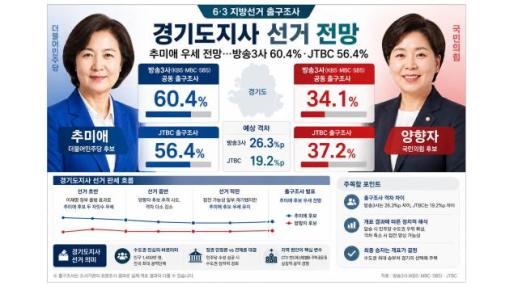 Choo Mi-ae Expected to Win in Gyeonggi Province Governor Election In one of the most competitive races of the local elections, Choo Mi-ae of the Democratic Party is projected to win the Gyeonggi Province governor election. Exit polls conducted by the three major broadcasting networks (KBS, MBC, and SBS) and predictions from JTBC indicate a strong likelihood of a Democratic victory in Gyeonggi Province. According to the joint exit poll from the three broadcasting networks, Choo Mi-ae received 60.4%, significantly leading Yang Hyang-ja of the People Power Party, who garnered 34.1%, a difference of 26.3 percentage points. JTBC's forecast also shows Choo Mi-ae at 56.4% and Yang Hyang-ja at 37.2%. Although the gap is narrower at 19.2 percentage points compared to the broadcasting networks' poll, Choo still maintains a double-digit lead. Both polls agree on the direction of the results, indicating a likely victory for Choo Mi-ae. However, they differ in the margin of victory, with the broadcasting networks predicting a near landslide for the Democratic Party, while JTBC suggests a reduced gap. Gyeonggi Province is the largest metropolitan local government in South Korea and is considered a barometer of public sentiment in the capital region. With a population exceeding 14 million, it has more voters than Seoul, making it a critical area for assessing the overall outcome of the local elections. This election has drawn national attention from the outset. The Democratic Party emphasized the symbolic importance of retaining Gyeonggi Province, which is the political base of President Lee Jae-myung. Meanwhile, the People Power Party has focused its efforts on reclaiming Gyeonggi Province to shift public sentiment in the capital region. Key issues during the campaign included transportation, housing, the expansion of the GTX transit system, the establishment of a semiconductor industry belt, and the creation of a northern special autonomous province. However, the national political landscape has also had a significant impact on the election dynamics. From the beginning of the election, various opinion polls indicated that Choo Mi-ae maintained a lead. Although Yang Hyang-ja attempted to close the gap by appealing to centrist voters and those from the science and technology sectors, many analysts believe it was challenging to overturn the prevailing trend. The exit poll results are interpreted as reflecting this ongoing trend. Political analysts suggest that if the actual vote counts align closely with the exit polls, it would reaffirm the Democratic Party's clear advantage in the capital region. Given that Democratic candidates are also leading in the Seoul and Incheon mayoral races, it could indicate a reconfiguration of the political landscape in the capital region. Conversely, the People Power Party is focusing on the relatively narrower gap reported by JTBC. If the actual vote percentages are lower than those predicted by the broadcasting networks, it may suggest that public sentiment in the capital region is not entirely leaning toward the Democratic Party. Ultimately, attention is centered on how large Choo Mi-ae's margin of victory will be. The Gyeonggi Province governor election has become significant not just for the outcome itself, but for the implications of the victory margin on future political interpretations. If the vote counts align with the exit polls, Choo Mi-ae would solidify the Democratic Party's governance in Gyeonggi Province while symbolically reaffirming the party's dominance in the capital region. The choice of Gyeonggi Province is expected to serve as a crucial benchmark for evaluating the overall results of this local election.* This article has been translated by AI. 2026-06-03 19:39:00
 -
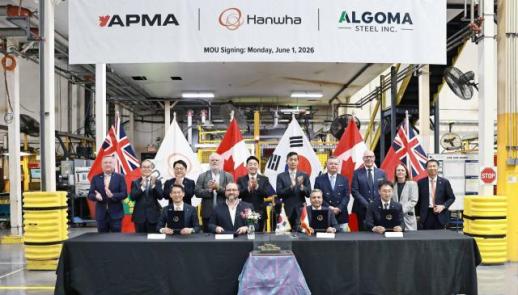 Kang Hoon-sik Pushes for Canadian Submarine Contract, Promises 430,000 Jobs by 2044 Kang Hoon-sik, the President's Chief of Staff, continued his efforts to secure a submarine contract in Canada on June 3, meeting with the Chief of Staff to the Prime Minister. In a Facebook post, Kang reported on the second day of his visit to Ottawa, stating that he met with various Canadian officials to seek support for the submarine bid. During his meeting with Mark-André Blanchard, Chief of Staff to the Canadian Prime Minister, Kang discussed expanding partnerships in energy and middle-power cooperation, urging for an objective and fair evaluation of the capabilities of South Korean submarines and the economic benefits of industrial collaboration. Kang noted that this was their third meeting, and both he and Blanchard agreed that the ongoing communication between the two countries' offices is a testament to the strengthening relationship. He also visited the Canadian Senate, where he met with Marty Deacon, Chair of the National Security, Defence, and Veterans Affairs Committee, and three other senators. Kang explained the economic benefits of linking energy resource cooperation with the submarine project and requested parliamentary support for the bid. Kang emphasized that 'Team Korea' could contribute to job creation and economic revitalization in Ontario, the heart of manufacturing. In a meeting with Minister of Industry Mélanie Joly, he highlighted that the agreement between Hanwha, APMA, and Algoma is equivalent to establishing a new automotive plant in Canada. He introduced the potential impact of submarine cooperation, which could generate CAD 96.3 billion in GDP and create 430,000 jobs by 2044, and shared Hyundai Motor's vision for hydrogen technology. Additionally, Kang met with Minister of Natural Resources Team Hodgeon to discuss expanding crude oil imports and energy cooperation on liquefied natural gas (LNG) and critical minerals. He also attended the 'Korea-Canada Energy Resource Supply Chain Forum.' Kang, who departed on May 31, is expected to conclude his visit to Canada and return home around June 4. Hanwha Ocean is competing with Germany's Thyssenkrupp Marine Systems (TKMS) for the Canadian next-generation submarine contract, valued at up to 60 trillion won. The final contractor announcement is anticipated by the end of June. 2026-06-03 19:39:00