
Journalist

MIN JAE YONG
-
 LH to Offer 4,500 Rental Units for Low-Income Households The Korea Land and Housing Corporation (LH) is recruiting first-priority tenants for rental housing aimed at low-income households without homes. A total of 4,500 units will be available nationwide, with applications accepted from June 8 to June 12 at local administrative welfare centers based on the applicant's registered address. The rental housing program allows eligible tenants to find homes within a specified support limit. LH will then sign a lease agreement with the property owner and rent the unit back to the tenant at a lower cost. LH explained that this approach protects tenants' deposits and provides a stable living environment. Eligible applicants include recipients of livelihood and medical benefits, single-parent families, and individuals with disabilities. The program will be available in the metropolitan area, major cities, and towns with populations exceeding 80,000. The distribution of units by region includes 1,326 in Seoul, 1,203 in Gyeonggi Province, 471 in Incheon, 358 in Busan and Ulsan, 302 in Daejeon and Chungnam, 242 in Daegu and Gyeongbuk, 241 in Gwangju and Jeonnam, 136 in Gyeongnam, 90 in Jeonbuk, 66 in Gangwon, 51 in Chungbuk, and 14 in Jeju. The maximum deposit support limit is 130 million won in the metropolitan area, 90 million won in major cities, and 70 million won in other regions. Tenants will be responsible for 2% or 5% of the rental deposit within the support limit. Monthly rent will be calculated based on the supported amount with an annual interest rate of 1.2% to 2.2%. The initial rental period is two years, with the option to renew for up to 14 additional two-year terms. However, if income and asset criteria are not met at the time of renewal, the rental deposit and rent may increase. If the tenant is over 65 years old, has a severe disability, or meets first-priority criteria at the time of renewal, there is no limit on the number of renewal terms. The application period runs from June 8 to June 12. Interested applicants should visit their local administrative welfare center to apply. LH plans to announce the results of the tenant selection process after verifying eligibility in September. Meanwhile, LH's rental housing program for low-income households was introduced in 2005 as a housing support initiative.* This article has been translated by AI. 2026-05-21 11:24:00
 -
 Paik Da Bang Launches Two Smoothies Inspired by Webtoon 'Nyanhan Namja' The coffee brand Paik Da Bang, under The Born Korea, has teamed up with the Naver Webtoon characters 'Chunbae and Friends' to introduce limited-time summer beverages and fan merchandise. On May 21, Paik Da Bang announced the launch of two new menu items inspired by the webtoon 'Nyanhan Namja-Chunbae and Friends.' The new offerings include smoothies that reflect the characters' essence. The 'Nyangnyang! Chunbae Punch Chocolate Smoothie' combines a milk smoothie with chocolate sauce and chocolate balls for a rich, sweet flavor and crunchy texture. The 'Nyangnyang! Chunbae Punch Strawberry Smoothie' features a milk smoothie with a strawberry base, highlighting a refreshing taste. Both products are topped with whipped cream and white chocolate shaped like cat paw prints to enhance the character concept. In addition to the collaboration beverages, Paik Da Bang will also sell character merchandise, including a random keycap keychain set and a temperature cup, totaling three items. Customers who purchase the collaboration beverages can buy the random keycap keychain for 200 won per drink. Starting June 1, the plush keychain set and temperature cup will also be available for purchase. From now until May 27, Paik Da Bang is offering discounts on the collaboration beverages for customers using the membership app pickup order. The two collaboration beverages will be discounted by 900 won, and customers purchasing a beverage and keychain set will receive an 1100 won discount. The collaboration menu and merchandise will be available at all Paik Da Bang locations nationwide, except for select stores and at Paik Da Bang Bread Research Institute. A representative from Paik Da Bang stated, "We have captured the lovable and friendly character essence of Chunbae and Friends in our summer beverages and merchandise. We hope customers can enjoy a unique experience in their daily lives." Recently, the food industry has seen a surge in collaboration marketing utilizing popular intellectual properties (IPs). Previously, Lotte Wellfood introduced seven snack items in collaboration with Nexon’s game 'MapleStory,' and Baskin-Robbins launched collaboration ice cream and merchandise to celebrate the 30th anniversary of 'Pokémon.'* This article has been translated by AI. 2026-05-21 11:21:24
 -
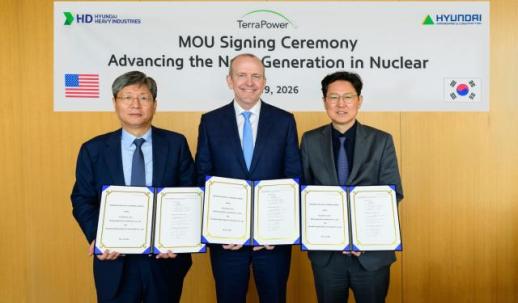 Hyundai Engineering Expands U.S. Nuclear Alliance to Next-Generation Reactors Hyundai Engineering is accelerating its entry into the global energy market by expanding its focus to advanced next-generation reactors. On May 19, Hyundai Engineering announced that it signed a memorandum of understanding (MOU) with TerraPower and HD Hyundai Heavy Industries for the commercial deployment of the next-generation reactor 'Natrium®' at Goldman Sachs headquarters in New York. The signing ceremony was attended by key executives, including Choi Young, Executive Vice President of Hyundai Engineering's New Energy Division; Chris Levesque, CEO of TerraPower; Kang Seok-joo, Executive Vice President of HD Hyundai; and Won Kwang-sik, Vice President of HD Hyundai Heavy Industries. TerraPower is a leading U.S. nuclear company known for its sodium-cooled fast reactor (SFR) technology, which utilizes liquid sodium as a coolant. HD Hyundai Group has been jointly involved in the development of sodium technology since its initial investment of $30 million in 2022, enhancing its collaboration with TerraPower by producing and supplying the reactor vessel for the first Kemerer unit and expanding its supply chain. Hyundai Engineering was selected as a strategic partner for this agreement due to its extensive experience in executing multiple nuclear EPC projects, including the Barakah nuclear power plant in the UAE, and its capabilities related to small modular reactors (SMRs). The company plans to continue discussions with TerraPower and HD Hyundai Heavy Industries to participate in the EPC execution of subsequent commercial sodium reactors. Meanwhile, Hyundai Engineering has identified securing contracts for small modular reactors (SMRs) in Palisades, Michigan, as a key strategy for the year. This project involves constructing two reactors at the Palisades nuclear site in Michigan, based on the SMR-300 model developed by U.S. nuclear firm Holtec International.* This article has been translated by AI. 2026-05-21 11:18:40
 -
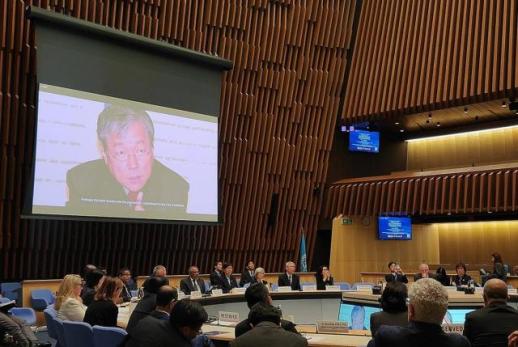 Memorial Service for Dr. Lee Jong-wook, 'Asia's Schweitzer,' Held at WHO Headquarters A memorial service commemorating the 20th anniversary of the passing of Dr. Lee Jong-wook, former Director-General of the World Health Organization (WHO), was held on May 20 at the WHO headquarters in Geneva, Switzerland. According to Yonhap News, the event was organized by South Korea's Ministry of Health and Welfare and the Korea Foundation for International Healthcare (KOFIH), with the participation of health ministries from six countries: South Korea, China, Ethiopia, Laos, Sri Lanka, and Tanzania. Attendees included WHO Director-General Tedros Adhanom Ghebreyesus, Minister Jeong Eun-kyeong, Dr. Lee's widow, Reiko Kaburaki, members of the National Assembly from both ruling and opposition parties, representatives from global health organizations, and colleagues of Dr. Lee. Prime Minister Kim Min-seok sent a video tribute. Dr. Lee began his association with WHO in 1983 as the head of the Hansen's disease eradication team in the South Pacific region. In 2003, he became the first South Korean to serve as the Director-General of WHO, holding the position until his sudden passing due to a brain hemorrhage caused by overwork in May 2006, just before the World Health Assembly. During his nearly 23 years at WHO, he worked tirelessly to combat Hansen's disease, tuberculosis, polio, and AIDS. Under Dr. Lee's leadership, the Framework Convention on Tobacco Control (FCTC), the first global health treaty, was adopted, and he played a key role in revising the International Health Regulations (IHR) in 2005, which are considered foundational for pandemic response. His dedication to global disease eradication earned him the title of 'Asia's Schweitzer.' In her tribute, Minister Jeong Eun-kyeong stated, "Many healthcare professionals are following the path that Dr. Lee paved, and the South Korean government will quietly support their efforts through various means, such as the Lee Jong-wook Public Health Award." Director-General Tedros remarked, "I may not have known Dr. Lee personally, but I feel his legacy at WHO. His time as Director-General was brief, yet his achievements continue to underpin global health efforts." Additionally, Reiko Kaburaki reflected on her time with Dr. Lee, expressing her commitment to continue his mission by supporting vulnerable populations as long as her health permits. Before the memorial service, a newly renovated strategic health operations center established by Dr. Lee was inaugurated as the 'Lee Jong-wook Strategic Situation Room,' supported by the Ministry of Health and Welfare. In an interview with Yonhap News following the event, Minister Jeong emphasized, "Dr. Lee left a significant legacy in public health and serves as a great example for future generations. I hope that healthcare professionals contributing to public health will continue to follow in his footsteps."* This article has been translated by AI. 2026-05-21 11:16:14
 -
 Lee Calls Bloomberg Correction on 'National Dividend' a Model for Domestic Media President Lee Jae-myung stated on May 21 that Bloomberg's correction regarding its reporting on the 'national dividend' should serve as a model for some domestic media outlets that engage in politically motivated manipulation and distortion while refusing to issue corrections. In a post on X (formerly Twitter), President Lee shared the article and remarked, "The claim made by Chief Policy Officer Kim Yong-beom was about distributing excess tax revenue, not excess profits, which was misreported. How admirable and commendable is this stance of a media outlet that values integrity and accuracy?" He further asserted, "Media that deliberately manipulate and distort information to favor certain groups or attack individuals cannot be considered credible." Earlier, Bloomberg had published an article on May 12 interpreting Kim Yong-beom's proposal for a 'national dividend' as a distribution of excess profits, stating that the KOSPI index fell following Kim's comments. In response, the Blue House requested an official apology and correction from Bloomberg, citing the outlet's "inaccurate framing" that led to significant confusion in the market and had a clear negative impact on investor sentiment.* This article has been translated by AI. 2026-05-21 11:13:53
 -
 Russia and Ukraine Exchange Strikes Amid Accusations of Foreign Involvement Russia and Ukraine are engaged in intense fighting following large-scale airstrikes targeting each other's capitals. Tensions have escalated as both nations accuse neighboring countries of supporting their adversaries. According to Reuters and AFP, the Dnipro region in southeastern Ukraine was hit by Russian drone and missile attacks overnight on May 20, resulting in two deaths and six injuries. In addition, 13 people, including three children, were injured in the northern Sumy region and southeastern Zaporizhzhia. The previous day, attacks on Ukrainian cities including Pryluky and Kharkiv left four civilians dead. Ukraine has also intensified its counterattacks targeting Russian territory. Industrial areas in Russia's southern Stavropol region were struck, and two drones were shot down over the northwestern region of St. Petersburg. These attacks appear aimed at oil facilities and export ports. Ukrainian drones were also detected near Moscow and in the Tula region. The clashes have intensified following a massive air assault on Kyiv and other locations on May 15, when Russia deployed over 1,500 drones, resulting in 27 fatalities. Two days later, Ukraine retaliated with strikes on Moscow, killing four and injuring dozens. Recently, Ukraine has been using long-range drones to target Moscow and Russian oil facilities in the rear. On April 29, Ukrainian forces struck an oil pumping station near Perm, located 1,500 kilometers from Ukraine, for two consecutive days. According to Reuters, sources indicated that these attacks have led to production halts or reductions at major oil facilities in central Russia. Ukrainian President Volodymyr Zelenskyy stated on social media that there have been favorable changes for Ukraine on the front lines this month and announced the approval of a long-range operational plan for June. Both sides are also exchanging accusations regarding the potential involvement of neighboring allies in the conflict. Ukraine claims that Russia is attempting to draw Belarus into the war. Belarus shares a border with Ukraine to the north and is located approximately 100 kilometers from Kyiv. Zelenskyy noted, "We have identified five scenarios in which Russia seeks to escalate the war through the northern region," adding that Ukraine will reinforce its troops in the north and increase diplomatic pressure on Belarus. Conversely, Russia alleges that Ukraine is planning to deploy drone units in Latvia to attack Russian territory. Russia reiterated this claim during a recent United Nations Security Council meeting in New York, warning of retaliation against Latvia. In response, Latvia's UN Ambassador Sanita Pavluta-Deslandes dismissed the allegations as "completely unfounded fabrications." As the clashes escalate, peace negotiations that were stalled due to the situation in the Middle East are losing ground. U.S. Secretary of State Marco Rubio stated during a visit to Rome on May 8 that while he is prepared to play a mediating role regarding the Russia-Ukraine war, he does not want to waste time if no progress is made.* This article has been translated by AI. 2026-05-21 11:12:00
 -
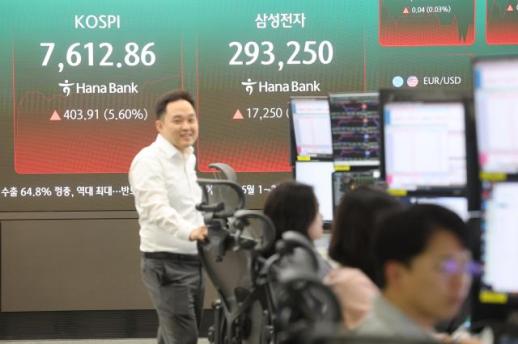 KOSPI recovers above 7,600 as Samsung averts strike SEOUL, May 21 (AJP) - South Korean stocks sharply rebounded on Thursday as investor sentiment improved on growing optimism over artificial intelligence and easing geopolitical tensions. Sentiment was also boosted after Samsung Electronics struck a tentative deal following marathon last-minute negotiations over wages and performance bonuses, easing concerns over a possible large-scale strike at the country's biggest chipmaker. The benchmark KOSPI surged 6.62 percent to 7,685.96 points as of around 10:30 a.m., while the junior KOSDAQ jumped 5.06 percent to 1,109.46. The sharp early gains triggered sidecar curbs on trading. Samsung Electronics' shares climbed 6.16 percent to 293,000 won, helping drive gains in the broader market. The South Korean won also strengthened as external uncertainties eased, trading at 1,499.5 won against the greenback, compared with the previous session’s close of 1,507.80 won. Investor sentiment improved after global oil prices and U.S. Treasury yields retreated overnight. WTI crude fell below the US$100-per-barrel mark to around $98, while the benchmark U.S. 10-year Treasury yield slipped back into the 4.5 percent range after U.S. President Donald Trump said negotiations with Iran were in the "final stages," raising hopes for a diplomatic breakthrough. The decline in oil prices and yields weakened demand for safe-haven assets and helped lift risk appetite across global markets from New York to Seoul. Chip stocks also surged, with SK hynix climbing 6.88 percent to 1,865,000 won and SK Square rising 7.48 percent to 1,106,000 won amid continued optimism over the AI-driven semiconductor boom. Automakers and industrial shares posted strong gains as well. Hyundai Motor advanced 7.43 percent to 636,000 won, Kia jumped 9.37 percent to 163,400 won and HD Hyundai Heavy Industries added 3.30 percent to 657,000 won. Battery and electronics-related shares moved higher across the board. LG Energy Solution rose 3.38 percent to 397,500 won, while Samsung SDI surged 11.12 percent to 1,179,000 won. Financial and biotech shares also joined the rally. Samsung Life Insurance soared 10.10 percent to 343,500 won, Samsung C&T climbed 7.96 percent to 400,000 won, Samsung Biologics gained 4.11 percent to 1,392,000 won and KB Financial rose 2.11 percent to 154,900 won. Defense shares were also firmer, with Hanwha Aerospace advancing 3.12 percent to 1,288,000 won. But much of the market's early gains were driven by Samsung after its management and labor union reached the deal the previous day through government-mediated talks, averting a planned strike and putting it to a union vote through May 27. The agreement eased concerns over labor unrest and addressed key union demands including bonuses and the removal of caps on incentive payments. Markets, however, would remain cautious ahead of the vote, with investors closely watching whether the deal will hold at the country's largest chipmaker, which makes up about one-fifth of the KOSPI by market capitalization. Meanwhile, across Asia, markets broadly moved higher, with Japan's Nikkei 225 surging 3.39 percent to 61,834.74, China's Shanghai Composite Index rising 0.84 percent to 4,196.94 and Hong Kong's Hang Seng Index adding 0.61 percent to 25,807.79 amid improving global risk sentiment. 2026-05-21 11:05:34
 -
 Samsung Electro-Mechanics flies on renewed AI frenzy after US silicon capacitor deal SEOUL, May 21 (AJP) - Samsung Electro-Mechanics stock on Wednesday drew a flurry of price upgrades after it signed a 1.56 trillion won ($993 million) contract to supply silicon capacitors to a U.S. big tech company developing AI chips, its first large-scale order in a business it designated a strategic priority in 2024. The components affiliate of Samsung Electronics disclosed the two-year contract on Tuesday, with deliveries running from January 1, 2027 through December 31, 2028. Shares surged as much as 10 percent to end Tuesday 9.42 percent up at 1,060,400 won to rejoin the "emperor stock" level — a Korean term for shares trading above 1 million won apiece. They roared on, jumping 10.93 percent to 1,177,000 won as of 11:00 a.m., with brokerages rushing to raise target prices up to 1.6 trillion won. The stock has risen more than tenfold from its 52-week low near 110,000 won last December, lifted by the AI component cycle. The buyer of the silicon capacitors was not identified, though analysts expect the components to go into next-generation neural processing units and advanced packaging at a top North American hyperscaler. The order is the clearest signal yet that Samsung Electro-Mechanics has broken into a supply chain long dominated by a few incumbents. The silicon capacitor market has been concentrated among suppliers including Japan's Murata Manufacturing and U.S.-based Empower Semiconductor, with the top five holding an estimated 63 percent of 2024 revenue, because of high technical barriers and lengthy customer certification cycles. The contract, while modest against the company's roughly 3 trillion won in quarterly revenue, marks its entry as a qualified supplier to the AI hardware market. KB Securities maintained a "buy" rating and raised its target price 14 percent to 1.6 million won from 1.4 million won, lifting its five-year operating profit compound annual growth rate estimate to 61 percent from 53 percent. DB Securities also moved its target to 1.6 million won and said the company's long-term market capitalization could reach 120 trillion won. Daol Investment & Securities raised its target to 1.5 million won from 1.05 million won, projecting 2027 revenue of 15.9 trillion won and operating profit of 3 trillion won. Silicon capacitors are next-generation passive components built on silicon wafers through thin-film processes. They can be made as thin as 50 micrometers, against 200 micrometers or more for the ultra-compact multilayer ceramic capacitors, or MLCCs, that have been Samsung Electro-Mechanics' mainstay, sharply reducing the area and thickness constraints inside a semiconductor package. Their equivalent series inductance — a property that impedes alternating current in high-frequency conditions — is roughly 100 times lower than conventional MLCCs, at 2 to 3 picohenries. That makes them the leading option for stabilizing voltage in AI processors, where clock speeds reach several gigahertz and power fluctuations occur faster than MLCCs can physically correct. As AI chips process surging volumes of data, their power draw has risen sharply, raising the risk that momentary voltage swings degrade performance or cause errors — the gap silicon capacitors are designed to fill. Samsung Electro-Mechanics runs the business on a fabless model, performing chip design and testing in-house while outsourcing wafer production to foundries in Taiwan and elsewhere. The structure allows margins in the 30 percent range without the burden of large capital expenditure on manufacturing facilities. DB Securities cited the silicon capacitor revenue alongside detected price increases for the company's mainstay MLCCs as the basis for its estimate upgrade. KB Securities analyst Lee Chang-min said embedded substrates — in which silicon capacitors are built directly into packaging boards — are a product unique to Samsung Electro-Mechanics and stand to benefit strongly from the AI super-cycle. Daol analyst Kim Yeon-mi described the company as the only global player holding both top-tier flip-chip ball grid array, or FC-BGA, substrate capability and ultra-fine capacitor technology, an advantage she said would persist as the company adds customers. FC-BGA substrates are high-end boards that connect advanced processors to circuit boards, a segment Samsung Electro-Mechanics also supplies for AI chips. The deal lands as Samsung Electro-Mechanics pivots its portfolio toward higher-margin AI components and away from legacy products, a shift brokerages expect to accelerate through the second half of the year as MLCC shortages and price increases coincide with the ramp-up of the new silicon capacitor business. 2026-05-21 11:03:14
 -
 Google's Transformation and the Rise of AI Natives In childhood, if you wanted to find a song but didn’t know its title, you had to hum and ask, “Do you know this song? Hmm hmm~~ hmm hmm hmm.” If no one could help or if you weren’t a good singer, you had to wait for the DJ on the radio to announce the title. With the advent of the internet, the world changed dramatically. Instead of humming, you could type a few lyrics into a search engine to find the song you were looking for. Now, you can simply open an AI app on your smartphone, play a snippet, or hum it, and it will remarkably identify the song, even confirming it through YouTube. Before the AI era, the keyboard was the primary interface connecting us to the internet, and text was the main medium. The generation that learned to combine search terms effectively to get the desired results is known as the 'internet natives.' However, we have now entered an era where we ask questions of AI instead of searching. Google has redesigned its single-line text search box into a query interface for AI, adding multimodal search capabilities that include images, voice, and video. This shift symbolizes the transition from the internet age to the 'AI native' era. In the past, obtaining desired knowledge required careful consideration and combination of relevant words. This was our method of 'searching' for information. Now, instead of typing text, we can use all types of data we encounter—photos, videos, sounds—to instantly retrieve the information we need. The format of answers has also changed. Previously, Google analyzed user keywords and prioritized the most relevant answers. Now, AI focuses on understanding context and user intent. Instead of sifting through a long list of search results, users can read a complete answer from AI and refine their requests if the information is not satisfactory. It is time to redefine the act of 'searching.' While traditional searching was a skill to find fragmented information on the internet, AI-powered 'multimodal search' acts more like an auxiliary memory for humans. Consider how we think: starting with abstract questions, we refine them to find the most suitable information. Interacting with AI is similar. Unlike the past, where we presented clear terms, we can now pose abstract questions and requests, and AI analyzes and visualizes them in real time. This process allows us to collaboratively build ideas. It transcends simple searching through a window and approaches the synchronization of AI with the human brain. AI can be seen as a guide to accessing the cloud filled with all the world's information. Even while we sleep, AI continues to search for and create new information in the cloud. Knowledge has shifted from being something we memorize to something we look up when needed, now fully established as an auxiliary memory in the cloud. Imagine being curious about a famous building you see for the first time at a tourist site. By simply pointing your smartphone camera or smart glasses, AI can instantly provide over an hour's worth of in-depth information. Even when users are unsure of what they want, AI observes the surrounding context and delivers the necessary information. AI serves a role beyond that of a simple information storage device. As technology aligns so closely with human intuition, the lives and thought processes of the AI native generation are fundamentally different from those of previous generations. At this point, AI has evolved from a mere search tool to a bridge that continuously connects humans with the cloud and acts as an extension of our brains.* This article has been translated by AI. 2026-05-21 11:00:23
 -
 Lotteria to Raise Menu Prices by Average 2.9% Starting May 28 Lotteria will increase prices for some menu items starting at the end of this month. Lotteria GRS announced on May 20 that it will raise prices by an average of 2.9% beginning May 28. The price adjustments will affect 22 types of individual burgers, with increases ranging from 100 to 300 won per item. The popular 'Ria Bulgogi' and 'Ria Shrimp' burgers will each see a 100 won increase, bringing their prices to 5,100 won. The company cited rising exchange rates due to domestic and international instability, global raw material supply issues, and increased logistics costs as reasons for the price hike. However, it noted that the increases are lower than the recent hikes in minimum wage and delivery fees to minimize the burden on consumers. A Lotteria GRS representative stated, "We decided to adjust prices after discussions with franchisee associations to protect franchise profitability. We also plan to implement discount promotions to alleviate the burden on consumers." Earlier this year, Burger King raised its burger prices by 200 won and side menu items by 100 won in February. McDonald's also increased prices for 35 menu items by an average of 2.4% during the same month, while Mom's Touch raised prices for 43 individual items by an average of 2.8% starting in March.* This article has been translated by AI. 2026-05-21 10:58:22