
Journalist

Park Heewon
-
 To Avoid Becoming a 'Feast for Yeouido,' South Korea Must Address Economic Inequality The 'trickle-down effect' has long been a term associated with conservative economic policies in South Korea. This concept, often referred to as the trickle-down effect, suggests that when large corporations grow and generate significant profits, the benefits will eventually flow down to suppliers, local communities, and consumers. The successful industrialization centered around large corporations has lent credence to this argument. In contrast, the 'fountain effect' represents a progressive viewpoint. It argues that a thriving economy relies on the purchasing power of the working class and middle class. The income-led growth strategy of the Moon Jae-in administration exemplifies this perspective. The trickle-down and fountain effects ultimately reflect the longstanding conflict between 'growth-first' and 'distribution-first' ideologies. The trickle-down effect has also been a narrative in the manufacturing sector. The success of major companies like Samsung, Hyundai, and LG has made this narrative familiar. However, as South Korea has moved beyond the industrialization era, the trickle-down effect has become increasingly negligible. Recently, however, the Korean economy has been stirred by a resurgence of the trickle-down effect, this time originating not from manufacturing but from the capital markets. The stock market is experiencing an unprecedented boom. The KOSPI index, which has been rising faster than any other in the world, is on track to reach the 8,000-point mark. Events that once caused anxiety among investors, such as the recent Middle Eastern conflicts, have become mere variables in the Korean stock market. Conversations about stock prices are ubiquitous, with people discussing their gains in restaurants and on the streets. Everyone, from the elderly to young adults, housewives to office workers, is captivated by the stock market. The saying, "When a housewife with a baby appears in the trading room, it's time to sell," has lost its relevance. Many are envious of memes circulating on social media claiming, "I made millions in an instant." The trickle-down effect from the stock market is also reflected in economic indicators. The surge in stock prices is beginning to warm the real economy. The Bank of Korea reported that the consumer sentiment index (CCSI) for May jumped to 106.1, a 6.9-point increase from the previous month, marking the largest rise since June of last year. The current economic assessment index rose by 15 points, the most significant increase in over five years. This optimism is attributed to strong semiconductor exports and the soaring KOSPI, indicating the so-called asset effect, where rising stock prices stimulate consumer spending. The semiconductor industry's robust performance has also boosted the real gross national income (GNI). In the first quarter of this year, real GNI increased by 7.5% compared to the previous quarter and surged by 12.3% year-on-year, a record-breaking figure. The semiconductor sector shows no signs of slowing down, and the stock market's rapid rise has bolstered the current government's confidence. With the index soaring past 2,000 points and approaching 8,000, there is ample reason for pride, reflected in President Yoon Suk Yeol's approval ratings, which remain above 60%. However, the benefits of this boom are not being felt equally. Many lament that it is still a 'feast for Yeouido,' as the surrounding economy remains sluggish. Small business owners continue to struggle, with the number of annual business closures expected to surpass 1 million in 2024 and the closure rate hovering around 9%. The delinquency rate for personal loans among the five major banks rose to 0.78% in the first quarter. In the real estate market, concerns over rental instability are growing. Not all stock investors are reaping rewards. Following the KOSPI's brief surge above 8,000 points, a market downturn led to forced sell-offs totaling 300 billion won over three days starting on May 20. While the exact number of retail investors affected remains unclear, many who chased the dream of striking it rich may be facing significant losses. The current stock market situation is not merely a fleeting boom; many analysts suggest it reflects structural changes. The long-overlooked South Korean stock market is being re-evaluated, which is undoubtedly a positive development. However, the benefits have yet to reach the broader society. Behind the dazzling figures of the semiconductor and capital markets, shadows of small business struggles, domestic consumption issues, debt, and high-interest rates loom large. This is where the government must focus its attention. It remains uncertain whether the trickle-down effect from the stock market will genuinely strengthen the South Korean economy or merely lead to further polarization and debt repercussions. On May 21, Financial Services Commission Chairman Lee Ok-keun proposed a 'shift to inclusive finance,' highlighting the importance of addressing these issues. The suggestion by Kim Yong-beom, head of the Presidential Policy Office, to consider utilizing excess tax revenues at the national level also holds merit. This could mark the beginning of serious discussions on how to sustain the trickle-down effect that started in the stock market. It is crucial to also examine the competitiveness of industries outside of semiconductors and real estate, particularly small businesses. There is no such thing as an endlessly flowing fountain. The stream of money pouring from the stock market could dry up at any moment. Now is the time to listen closely to the cries that are being drowned out by the celebratory sounds of popping champagne.* This article has been translated by AI. 2026-05-23 16:54:00
 -
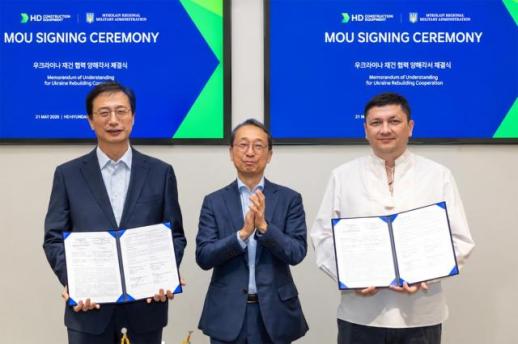 HD Construction Machinery Signs MOU for Ukraine Reconstruction Cooperation HD Hyundai is expanding its cooperation with the Mykolaiv regional government of Ukraine beyond equipment support to establish a long-term collaboration framework for overall reconstruction efforts. On May 22, HD Construction Machinery announced that it signed a memorandum of understanding (MOU) with the Mykolaiv regional government at the HD Hyundai Global R&D Center in Pangyo the previous day. The signing ceremony was attended by key officials, including Mykolaiv Governor Vitaliy Kim, HD Hyundai Vice Chairman Cho Young-cheol, and HD Construction Machinery President Moon Jae-young. This agreement builds on a previous collaboration established in 2023, which focused on the donation of construction equipment and training. Both parties agreed to continue their existing cooperation while expanding their partnership to include equipment supply, the establishment of local training centers, service and maintenance support, financial assistance, and energy infrastructure recovery, thereby creating a comprehensive support model for reconstruction efforts. HD Construction Machinery plans to establish a branch in Kyiv, Ukraine, in 2024 and has strengthened its local cooperation foundation through training programs for government officials, including those from the Ministry of Territorial Development, invited last year. HD Hyundai also aims to develop an integrated reconstruction cooperation model that links its capabilities in construction machinery and energy sectors. Cho Young-cheol, Vice Chairman of HD Hyundai, stated, "We will establish a cooperation system that can contribute practically to Ukraine's reconstruction beyond simple equipment supply, and we will actively support local infrastructure recovery and stabilization using our capabilities in construction machinery and energy sectors." Vitaliy Kim, a fourth-generation Korean and Ukrainian, remarked, "This agreement is an important milestone for the systematic reconstruction of Mykolaiv Oblast and will serve as a key driving force for rebuilding infrastructure, energy, and local communities. I sincerely thank HD Hyundai and South Korea for their ongoing support and the establishment of a long-term partnership." In September of last year, a delegation of Ukrainian government officials visited HD Hyundai's key facilities to secure the technical capabilities necessary for reconstruction and to strengthen cooperation. The delegation, which included officials from the Ministry of Territorial Development, toured the HD Construction Machinery campus in Ulsan, examining excavators and production lines while discussing reconstruction cooperation strategies.* This article has been translated by AI. 2026-05-23 16:51:28
 -
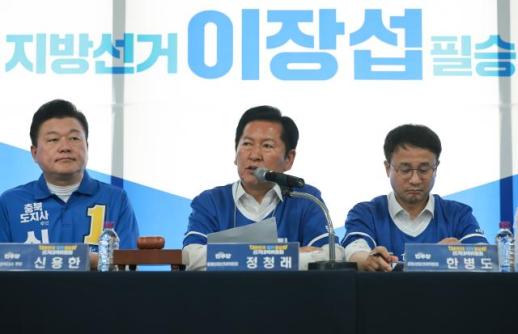 Jung Cheong-rae Calls for Apology from Shinsegae Chairman and Lawmaker Over Starbucks Controversy Jung Cheong-rae, the chairman of the Democratic Party, has called on Shinsegae Group Chairman Shin Yong-jin and People Power Party floor leader Song Eon-seok to "kneel and apologize" regarding the ongoing controversy surrounding Starbucks Korea's "Tank Day." He also announced plans to propose a strengthened version of the 5·18 special law. During a meeting of the election campaign committee in Cheongju on May 22, Jung stated, "There must never be a denial of history or an insult and mockery of human dignity, which is a universal value. Starbucks and Shin Yong-jin must once again kneel and sincerely apologize to the public. Apologize before the boycott of Starbucks spreads from Gwangju." Jung continued to express his discontent towards Song, who recently sparked controversy with comments suggesting he would not visit Gwangju because it was "dirty." In a recent press conference, Jung remarked, "No matter how I hear it, it sounds like 'I won't go because it's dirty.' Is he testing the hearing of the entire nation?" He criticized Song for threatening legal action after Jung posted about the comments on Facebook, saying, "He should either take legal action or apologize; he must do one or the other." Jung also pointed out that the People Power Party has yet to apologize for the state of emergency and is engaging in what he termed a "rebellious nomination" by calling for a return to the past. He warned that the public would deliver a stern judgment and urged them to apologize before it is too late. Regarding the 5·18 Gwangju Democratization Movement, Jung indicated that he would propose an amendment to the special law that would penalize not only the dissemination of false information but also mockery and insults related to the democratization movement. He stated, "President Lee Jae-myung is also strongly addressing Starbucks' belittlement of the 5·18 movement. Therefore, I am adding provisions to punish defamation due to the dissemination of false information and mockery and insults against the democratization movement. I will ensure that this amendment passes in the National Assembly immediately after the June 3 local elections."* This article has been translated by AI. 2026-05-23 16:48:58
 -
 Chinese State Media Calls President Lee Jae-myung a Formidable Leader Chinese state media has recently focused on President Lee Jae-myung's approach to China and his practical diplomatic efforts. They noted his public pushback against rising anti-China sentiment in South Korea and his emphasis on the necessity of trilateral cooperation among South Korea, China, and Japan during Korea-Japan diplomatic discussions, labeling him as "a formidable leader." The Newtanqin account, affiliated with the Chinese state-run Xinhua News Agency, highlighted President Lee's strong criticism of a recent fake news report claiming that "Chinese nationals purchased 944 apartments in Gangnam, Seoul," calling it a "false report that incites anti-China sentiment." The outlet remarked, "This is a rare scene in today's South Korean political landscape," pointing out that there are still factions in South Korea that view China through a biased lens and are dissatisfied with improving Korea-China relations, leading to various distortions and smear campaigns. They concluded that President Lee is relatively composed, having consistently drawn lines against anti-China rhetoric and calling for a stern response this time as well. The Chinese media particularly noted that President Lee has publicly acknowledged the need to manage relations with China while maintaining cooperation with the United States and Japan. Newtanqin reported that during a press conference following the Korea-Japan summit, Japanese Prime Minister Takaiichi Sanae emphasized strengthening Korea-Japan and Korea-U.S.-Japan strategic cooperation but did not mention China directly. In contrast, President Lee stated, "In addition to Korea-Japan and Korea-U.S.-Japan cooperation, mutual respect and collaboration among the three countries—Korea, China, and Japan—are also important," even proposing ways to enhance civilian-centered Korea-China-Japan cooperation. The media interpreted this as Takaiichi intentionally avoiding mention of China, while President Lee emphasized the importance of strengthening cooperation with China. Furthermore, the differences in social media activity following the Korea-Japan summit caught attention. During her visit to South Korea, Takaiichi posted multiple photos and messages expressing her gratitude for the hospitality she received from President Lee. However, there were no related posts on President Lee's social media accounts. Newtanqin also noted that President Lee typically shares his diplomatic activities on social media. For instance, he recently disclosed his conversations with U.S. President Donald Trump and Mexican President Claudia Sheinbaum, as well as a meeting with U.S. Treasury Secretary Scott Vessen, but there was no mention of Takaiichi. Chinese media have assessed that despite the recent trend of improving Korea-Japan relations, the Lee Jae-myung administration is making efforts to manage its relationship with China. The Chinese state-run Global Times analyzed on May 18 that despite the friendly atmosphere between the leaders of Korea and Japan, there remains a significant gap between the two countries. The Global Times stated that amid significant regional and global uncertainties, President Lee is attempting to improve relations with Japan through practical diplomacy while continuing the pro-Japan policies of the Yoon Suk-yeol administration regarding historical and territorial issues. At the same time, he is also striving to steadily restore relations with China, noting that President Lee is avoiding a one-sided approach amid deteriorating China-Japan relations.* This article has been translated by AI. 2026-05-23 16:46:33
 -
 Labor Minister: Emergency Mediation Authority Unthinkable Amid Samsung Electronics Struggles Kim Young-hwan, the Minister of Employment and Labor, stated on May 22, "The thought of using emergency mediation authority is something I could never imagine." He firmly disagreed with claims that the recent strike by the Samsung Electronics union could be attributed to the revised labor union law, known as the Yellow Envelope Law. In an appearance on MBC Radio's "Kim Jong-bae's Focus," Kim commented on the negotiations between Samsung Electronics and its labor union, saying, "Our society has experienced significant growing pains that we all need to address." He added that the discussions surrounding how to socially redistribute the profits generated by rapid productivity increases, particularly those driven by artificial intelligence, have been opened. Regarding the emergency mediation authority, which has been raised by some within the government and business circles, he remarked, "I said that the occurrence of a strike at Samsung Electronics is something I could never imagine. However, it is not entirely impossible for a strike to happen." He emphasized that from his perspective, the idea of employing emergency mediation authority is indeed unthinkable. Previously, Minister of Trade, Industry and Energy Kim Jeong-kwan had stated, "I cannot yet imagine a strike occurring." President Lee Jae-myung also made comments suggesting that basic rights could be limited for the sake of public welfare. In response to Kim Jeong-kwan's remarks, Kim Young-hwan noted, "The Minister of Trade, Industry and Energy has his responsibilities, and I have mine." He speculated that the urgency behind the Minister's comments might stem from a desire to protect the fragile growth momentum that could be jeopardized by a strike at Samsung Electronics. On the topic of limiting public welfare, he clarified, "This is not simply about hindering corporate profits. It is not a matter of whether a company has profits or not. If it exacerbates polarization, is that a risk to the development of the national economy?" He further explained that the President has emphasized the need to increase union organization rates and foster a labor-respecting society. However, he acknowledged concerns that declining public opinion toward unions could hinder economic benefits. In response to inquiries about whether the Yellow Envelope Law has intensified disputes, he countered, "It is quite the opposite. The criticism against the super-large union at Samsung Electronics overlooks subcontractors and appears self-serving. The Yellow Envelope Law is intended to facilitate negotiations between subcontractors and primary contractors to address these issues." He added, "The way to suppress self-serving behavior is through the activation of the Yellow Envelope Law. Ensuring compliance with the Yellow Envelope Law is essential to changing the structure that allows only primary contractors to benefit." He also addressed claims that the law provides immunity for illegal strikes, stating that the super-large union has engaged in lawful disputes.* This article has been translated by AI. 2026-05-23 16:44:05
 -
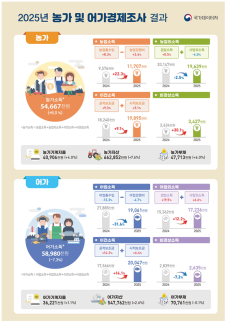 Farm Income Rebounds in 2025, While Fisheries Income Declines After a decline, farm income successfully rebounded last year, while fisheries income decreased, reflecting mixed trends. Despite a record high seafood export of $3.33 billion last year, it did not significantly impact fisheries income. The National Data Agency released the "2025 Farm and Fisheries Economic Survey Results" on May 22. The average annual income for farms was reported at 54.67 million won, an 8.0% increase from the previous year. While agricultural income, transfer income, and non-regular income saw increases, income from non-agricultural sources declined. Excluding agricultural management costs, the average agricultural income rose by 22.3% to 11.71 million won. Total agricultural income increased by 8.3% to 39.91 million won, driven by rises in crop income (1.1%) and livestock income (28.5%). Agricultural management costs also rose by 3.4% to 28.21 million won, attributed to increases in material costs (2.8%), labor costs (10.8%), and other expenses (2.6%). While income from side businesses increased by 0.5%, income from non-business activities fell by 4.0%, leading to an overall decline of 2.5% in total non-agricultural income, which stood at 19.64 million won. Transfer income rose by 9.1% to 19.89 million won, and non-regular income increased by 30.1% to 3.43 million won. Farmers reported average expenditures of 40.91 million won in 2025, with consumer spending rising by 3.3% to 32.14 million won and non-consumer spending increasing by 6.9% to 8.76 million won. As of the end of last year, the average assets of farms were valued at 662.85 million won, with fixed assets at 550.22 million won and current assets at 112.63 million won. Farmers carried an average debt of 47.71 million won, a 6.0% increase from the previous year. Additionally, larger farm sizes correlated with higher income, though debt levels also increased. Farmers under 50 years old, as well as those aged 50-59 and 60-69, reported incomes, expenditures, assets, and debts above the average, while those over 70 had figures below the average. In contrast, fisheries income, which reached a record high in 2024, shrank by 7.3%. The decline in aquaculture appears to have significantly impacted overall income. The average annual income for fisheries was reported at 58.98 million won, down 7.3% from the previous year. While income from non-fishing activities and transfer income increased, fishing income and non-regular income saw substantial declines, pulling down total income. In 2025, fishing income fell by 31.6% to 19.06 million won. Total fisheries income decreased by 13.3% to 76.11 million won, while fishing management costs decreased by 4.7% to 57.05 million won. Fisheries reported average expenditures of 36.22 million won last year, with consumer spending at 27.89 million won and non-consumer spending at 8.33 million won. The average assets of fisheries increased by 2.6% from 2024, reaching 547.76 million won, with fixed assets at 419.14 million won and current assets at 128.63 million won. As of the end of last year, the average debt for fisheries was 70.76 million won, a slight decrease of 0.1% from the previous year. Similar to farms, fisheries operated by managers under 50 years old, as well as those aged 50-59 and 60-69, reported higher income, expenditures, and assets than the average, while those over 70 fell below the average.* This article has been translated by AI. 2026-05-23 16:42:00
 -
 Household Loans Increase in Q1, Driven by Housing and Jeonse Loans for 30s and 40s In the first quarter of this year, household loans for individual borrowers increased, primarily driven by mortgage and jeonse loans. According to preliminary statistics on household debt by the Bank of Korea released on May 22, the average new household loan amount per borrower was 35.42 million won, an increase of 990,000 won from the previous quarter. This marks a reversal from a decrease of 4.09 million won in the prior quarter. The increase was particularly notable among borrowers in their 30s and 40s. New loan amounts for those in their 30s and 40s rose by 6.35 million won and 3.12 million won, respectively, while borrowers aged 60 and above saw a decrease of 1.8 million won, those in their 50s decreased by 1.14 million won, and those in their 20s decreased by 1.01 million won. As the government tightens lending regulations for banks, non-bank loans increased by 3.17 million won, while bank loans decreased by 2.34 million won. In terms of loan products, housing-related loans showed an upward trend. The new mortgage loan amount was 229.39 million won, an increase of 16.35 million won from the previous quarter. During the same period, jeonse loans and credit loans also rose by 10.48 million won and 1.2 million won, respectively. For mortgages, borrowers in their 30s took out new loans averaging 34.57 million won, while those in their 40s borrowed an average of 12.03 million won, indicating a concentration of growth among these age groups. Regionally, increases were observed in the Seoul metropolitan area (32.48 million won), Chungcheong region (10.19 million won), and Honam region (7.95 million won). In Seoul, the new loan amount reached 48.18 million won, an increase of 2.46 million won, marking the largest rise since the third quarter of last year. The southeastern region saw an increase of 760,000 won to 33.41 million won. However, the Gangwon and Jeju region (-5.19 million won), Daegu and Gyeongbuk region (-1.23 million won), Honam region (-590,000 won), and Chungcheong region (-260,000 won) experienced declines. By the end of the first quarter, the average household loan balance per borrower was 97.4 million won, a slight increase of 10,000 won from the previous quarter. Borrowers in their 30s saw an increase of 1.83 million won, while those in their 40s increased by 700,000 won. The overall household loan balance also rose, primarily driven by increases in mortgage loans (+1.79 million won) and jeonse loans (+990,000 won). Min Suk-hong, head of the Household Debt Microstatistics Team at the Bank of Korea, stated, "The increase in household loan amounts per borrower has turned around, mainly due to restrictions on mortgage limits in regulated areas and a decrease in jeonse listings, which have affected housing transactions. This has led to an increase in both mortgage and jeonse loans." He added, "The rise in new loan amounts from non-banks is primarily centered around mortgages, but the impact of previous transactions before the suspension of group loans and recruitment loans from mutual finance institutions should also be considered." Min also noted, "Given the strengthened management of household debt, future increases are expected to be limited, and the ongoing expansion of regulations suggests a low correlation with the expansion of non-bank loans."* This article has been translated by AI. 2026-05-23 16:39:28
 -
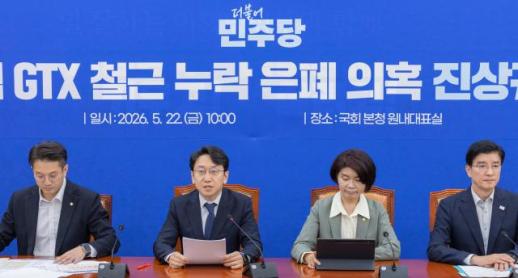 Democratic Party Forms Task Force to Investigate Allegations of Missing Rebar in GTX-A Project The Democratic Party has established a task force to thoroughly investigate recent allegations regarding missing rebar in the GTX-A line, holding its first meeting on May 22. The party has indicated that there are signs suggesting Oh Se-hoon, the candidate from the People Power Party, attempted to cover up the issue. Led by Cheon Jun-ho, the task force includes members such as Han Jeong-ae, Lee Joo-hee, Choi Gi-sang, Jeon Yong-gi, Lee Hae-sik, and Park Min-kyu. During a press conference at the National Assembly, they claimed that the Seoul city government was aware of the missing rebar but made organized efforts to conceal it. One lawmaker stated, "The recent inquiries by the Land, Infrastructure and Transport Committee have clearly revealed the responsibility of the Seoul city government, yet candidate Oh continues to remain evasive. This highlights the extreme irresponsibility of Oh and the People Power Party, who are indifferent to public safety. The Democratic Party will thoroughly investigate this matter to the end." Cheon also remarked, "An unbelievable incident has occurred in the heart of Gangnam, Seoul. Allegations are growing that the city government concealed information from the construction company for six months after receiving reports. We need to verify the circumstances surrounding this prolonged concealment and the continuation of construction without validated reinforcement measures." He emphasized that both Oh and the Seoul city government must provide clear explanations regarding the delays in reporting, the timing of Oh's awareness of the missing rebar, and the controversy over the delayed reports to the Ministry of Land, Infrastructure and Transport aimed at protecting Oh. Additionally, the Democratic Party outlined plans for regular task force meetings and inquiries in the National Assembly's standing committees moving forward. Cheon concluded, "We must clarify the facts and fully disclose the materials to discuss how to resolve this situation with experts. Additional meetings are planned around the upcoming full meeting of the Administrative Safety Committee on May 26. The task force is also continuing to request materials from the Seoul city government and related agencies."* This article has been translated by AI. 2026-05-23 16:36:55
 -
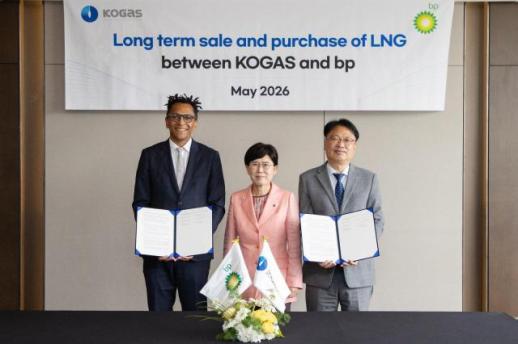 Korea Gas Corporation Signs Long-Term LNG Import Deal with BP Korea Gas Corporation (KOGAS) has signed a long-term agreement with global energy company BP to import an additional 700,000 tons of liquefied natural gas (LNG) annually for ten years starting in 2028. KOGAS announced on May 22 that the contract was finalized on May 21. This follows a previous agreement made in August of last year to import 3.3 million tons of U.S. LNG annually. The new contract is expected to enhance the stability of South Korea's natural gas supply. The agreement aims to diversify supply sources amid increasing instability in the energy market due to conflicts in the Middle East. It is anticipated to bolster supply chain resilience and energy import stability. BP's ability to source LNG from various regions, including the U.S., Australia, Indonesia, Angola, and Oman, will further contribute to supply diversification. This flexibility is expected to be beneficial in maintaining a stable supply. Additionally, as energy prices continue to rise, securing competitively priced LNG in advance may help stabilize domestic natural gas prices. Choi Yeon-hye, President of KOGAS, stated, "In light of the growing importance of energy security, this achievement is the result of our ongoing efforts to enhance the stability of domestic natural gas supply and improve price competitiveness."* This article has been translated by AI. 2026-05-23 16:34:14
 -
 Samsung TV Plus Expands FAST Territory with Free NCT Wish Concert Samsung Electronics' ad-supported free streaming service, Samsung TV Plus, is collaborating with SM Entertainment to launch a "Monthly SM Concert" series. According to Samsung Electronics on May 22, Samsung TV Plus will unveil new live performances by SM Entertainment artists each month. Last year, it attracted global K-pop fans with an exclusive live broadcast of "SMTOWN LIVE 2025 in L.A." The Monthly SM Concert will be exclusively available on Samsung TV's dedicated channel, STN, and the SMTOWN channel every Saturday at 7 PM. Viewers in five countries, including South Korea, Australia, New Zealand, Brazil, and Mexico, will have access to the performances. Any Samsung TV Plus user can enjoy the concert content for free. The inaugural performance will feature the idol group NCT Wish. Their first concert tour encore, "NCT WISH 1st CONCERT TOUR 'INTO THE WISH: Our WISH' ENCORE IN SEOUL," will be premiered on the 30th. FAST, or Free Ad-Supported Streaming Television, allows users to access live channels and video-on-demand (VOD) content for free, provided they watch ads. Unlike traditional IPTV and cable TV, which require a set-top box and monthly fees, FAST can be accessed immediately with just an internet connection and a smart TV. Samsung TV Plus also supports the "Eclipse Audio" feature, developed in collaboration with Google, enhancing audio immersion. This next-generation technology, based on the open 3D audio standard IAMF, delivers optimized multi-channel sound for an engaging audio experience. The Samsung SmartThings app on smartphones and Samsung TVs allows users to set viewing routines and automatically turn on the TV. By connecting smart devices in the home, users can adjust lighting and audio settings to create an immersive concert atmosphere. Choi Jun-hun, head of Samsung Electronics' TV Plus division, stated, "The Monthly SM Concert series lays the foundation for global fans to continuously enjoy K-pop performances. We will expand differentiated entertainment content based on Samsung TV Plus's unique technology and connectivity experience."* This article has been translated by AI. 2026-05-23 16:31:58