

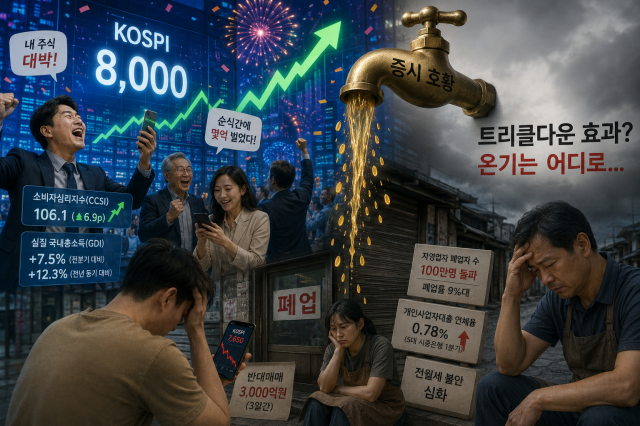
The 'trickle-down effect' has long been a term associated with conservative economic policies in South Korea. This concept, often referred to as the trickle-down effect, suggests that when large corporations grow and generate significant profits, the benefits will eventually flow down to suppliers, local communities, and consumers. The successful industrialization centered around large corporations has lent credence to this argument.
In contrast, the 'fountain effect' represents a progressive viewpoint. It argues that a thriving economy relies on the purchasing power of the working class and middle class. The income-led growth strategy of the Moon Jae-in administration exemplifies this perspective. The trickle-down and fountain effects ultimately reflect the longstanding conflict between 'growth-first' and 'distribution-first' ideologies.
The trickle-down effect has also been a narrative in the manufacturing sector. The success of major companies like Samsung, Hyundai, and LG has made this narrative familiar. However, as South Korea has moved beyond the industrialization era, the trickle-down effect has become increasingly negligible. Recently, however, the Korean economy has been stirred by a resurgence of the trickle-down effect, this time originating not from manufacturing but from the capital markets.
The stock market is experiencing an unprecedented boom. The KOSPI index, which has been rising faster than any other in the world, is on track to reach the 8,000-point mark. Events that once caused anxiety among investors, such as the recent Middle Eastern conflicts, have become mere variables in the Korean stock market. Conversations about stock prices are ubiquitous, with people discussing their gains in restaurants and on the streets. Everyone, from the elderly to young adults, housewives to office workers, is captivated by the stock market. The saying, "When a housewife with a baby appears in the trading room, it's time to sell," has lost its relevance. Many are envious of memes circulating on social media claiming, "I made millions in an instant."
The trickle-down effect from the stock market is also reflected in economic indicators. The surge in stock prices is beginning to warm the real economy. The Bank of Korea reported that the consumer sentiment index (CCSI) for May jumped to 106.1, a 6.9-point increase from the previous month, marking the largest rise since June of last year. The current economic assessment index rose by 15 points, the most significant increase in over five years. This optimism is attributed to strong semiconductor exports and the soaring KOSPI, indicating the so-called asset effect, where rising stock prices stimulate consumer spending.
The semiconductor industry's robust performance has also boosted the real gross national income (GNI). In the first quarter of this year, real GNI increased by 7.5% compared to the previous quarter and surged by 12.3% year-on-year, a record-breaking figure. The semiconductor sector shows no signs of slowing down, and the stock market's rapid rise has bolstered the current government's confidence. With the index soaring past 2,000 points and approaching 8,000, there is ample reason for pride, reflected in President Yoon Suk Yeol's approval ratings, which remain above 60%.
However, the benefits of this boom are not being felt equally. Many lament that it is still a 'feast for Yeouido,' as the surrounding economy remains sluggish. Small business owners continue to struggle, with the number of annual business closures expected to surpass 1 million in 2024 and the closure rate hovering around 9%. The delinquency rate for personal loans among the five major banks rose to 0.78% in the first quarter. In the real estate market, concerns over rental instability are growing.
Not all stock investors are reaping rewards. Following the KOSPI's brief surge above 8,000 points, a market downturn led to forced sell-offs totaling 300 billion won over three days starting on May 20. While the exact number of retail investors affected remains unclear, many who chased the dream of striking it rich may be facing significant losses.
The current stock market situation is not merely a fleeting boom; many analysts suggest it reflects structural changes. The long-overlooked South Korean stock market is being re-evaluated, which is undoubtedly a positive development. However, the benefits have yet to reach the broader society. Behind the dazzling figures of the semiconductor and capital markets, shadows of small business struggles, domestic consumption issues, debt, and high-interest rates loom large.
This is where the government must focus its attention. It remains uncertain whether the trickle-down effect from the stock market will genuinely strengthen the South Korean economy or merely lead to further polarization and debt repercussions.
On May 21, Financial Services Commission Chairman Lee Ok-keun proposed a 'shift to inclusive finance,' highlighting the importance of addressing these issues. The suggestion by Kim Yong-beom, head of the Presidential Policy Office, to consider utilizing excess tax revenues at the national level also holds merit. This could mark the beginning of serious discussions on how to sustain the trickle-down effect that started in the stock market. It is crucial to also examine the competitiveness of industries outside of semiconductors and real estate, particularly small businesses.
There is no such thing as an endlessly flowing fountain. The stream of money pouring from the stock market could dry up at any moment. Now is the time to listen closely to the cries that are being drowned out by the celebratory sounds of popping champagne.
* This article has been translated by AI.
Copyright ⓒ Aju Press All rights reserved.