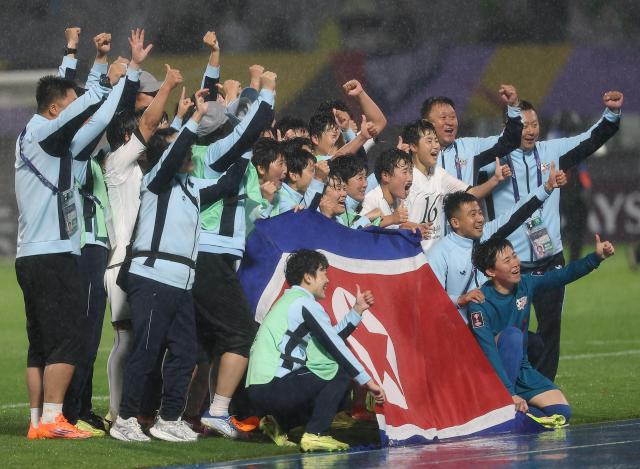
A recent report by the Institute for National Security Strategy said the visit should be viewed not as a signal of reconciliation but as “a limited form of contact between two states through an international sporting event,” according to researcher Kim Bo-mi.
Naegohyang FC arrived in South Korea on May 17 to participate in the Asian Football Confederation Women’s Champions League. The North Korean side defeated Suwon FC Women 2-1 in the semifinals on May 20 and is set to face Japan’s Tokyo Verdy in the final at 2 p.m. Saturday in Suwon.
The visit marked the first trip by a North Korean sports team to South Korea since 2018, drawing attention amid prolonged tensions between the two Koreas.
But Kim said the behavior of the North Korean delegation and Pyongyang’s state media coverage suggested the North was intentionally avoiding any narrative of inter-Korean reconciliation or ethnic unity.
“North Korea made clear that it views South Korea not as a partner for exchange and cooperation, but as a separate state encountered in an international competition,” Kim wrote.
During the tournament, North Korean players and officials also appeared cautious about attaching political meaning to the visit, repeatedly emphasizing that they were focused “only on football.”
Kim said it remains unlikely that the visit will trigger rapid improvements in inter-Korean ties or revive large-scale sports exchanges such as unified Korean teams, which were pursued during periods of relatively friendly relations in the past.
“For the time being, inter-Korean relations are likely to show a complex pattern in which military tensions and limited exchanges coexist,” she said.
Kim urged Seoul to recognize North Korea’s participation in limited exchanges under international norms and develop policies that reflect the changing nature of inter-Korean relations.

Copyright ⓒ Aju Press All rights reserved.