

Journalist

Park Sae-jin
-
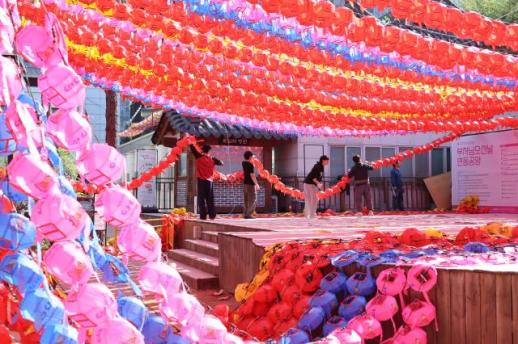 A ceiling of wishes: Jogyesa fills with lantern light ahead of Buddha's Birthday SEOUL, April 24 (AJP) -At Jogyesa Temple in downtown Seoul, the sky has begun to lower — not with clouds, but with color. A month ahead of Buddha's Birthday on May 24, preparations are in full swing. Lanterns gather overhead in long, patient rows, stretching across the temple grounds like a suspended tapestry. From a distance, they resemble a soft ceiling; up close, each one carries a name, a wish, a quiet intention. Near the entrance, a modest registration booth hums with steady activity. Believers and visitors stop to sponsor lanterns, their handwritten tags accumulating one by one — small slips of paper that will soon rise into the canopy above. The act is simple, almost routine, yet deliberate: a wish written, a string tied, a place secured among thousands. Elsewhere, the work continues in quiet coordination. Workers move methodically beneath the lines, lifting, fastening, adjusting. Long strings of lanterns are raised overhead, inch by inch, transforming open air into something more intimate. In some sections, the installation is complete — lanterns already catching sunlight, their reds, yellows and blues softly glowing against the spring sky. In others, hands remain busy, carefully attaching name tags to rows of white lanterns waiting to be filled with meaning. In the center of Seoul, amid traffic and routine, Jogyesa Temple becomes a place where tradition and faith briefly take visible form — not in grand gestures, but in repetition: lantern after lantern, wish after wish, rising together to fill the air. 2026-04-24 15:26:18
 -
 Kia Says Raw Material Costs Rose From March, Keeps 10.2 Trillion Won Operating Profit Target Kim Seung-jun, an executive vice president and head of Kia’s finance division, said on an earnings conference call for the company’s first-quarter results that rising raw material prices, including aluminum, began affecting costs in March. He said oil prices could stay around $100 this year even if the war ends, adding that the company faces a clear risk of higher costs. Kim said Kia ships about 260,000 vehicles a year to the Asia and Middle East region, but he believes the company has enough capacity to offset that volume in other markets such as South Korea, Europe and India. He said Kia expects to maintain its annual targets of 3.35 million vehicles sold and 10.2 trillion won in operating profit.* This article has been translated by AI. 2026-04-24 15:24:14
 -
 Coupang Denies Reports It Lobbied U.S. to Pressure South Korea Coupang on Thursday denied recent reports that it was pressuring the South Korean government through lobbying of the U.S. administration and Congress, calling the claims untrue. In a reference note, the company said assertions that there were discussions related to security were "clearly false." It said its lobbying has covered economic cooperation between the two countries, including expanding investment and trade involving South Korea, Taiwan and Japan, and broadening professional visa opportunities for South Koreans, and that it did not include any security-related issues. Coupang added that it is focused on communication with the United States and other countries to promote AI innovation, investment and job creation, and to expand cross-border commerce. Separately, a filing under the U.S. Lobbying Disclosure Act showed Coupang Inc. spent $1.09 million on lobbying in the first quarter (January to March) this year. Coupang said companies in the United States and major South Korean firms conduct legal lobbying, adding that major U.S. companies spend three to four times more than Coupang and that its spending is also lower than that of major South Korean conglomerates. * This article has been translated by AI. 2026-04-24 15:22:46
 -
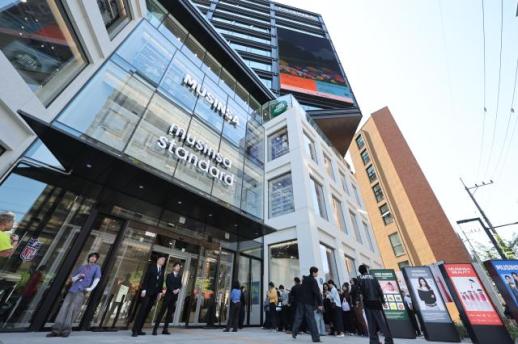 Forget SPA, enter experience: new K-fashion megastore lands in Seongsu SEOUL, April 24 (AJP) -For a shop lover, the ambience matters. This warehouse-like space hums with a hip energy that makes you feel instantly on trend. Musinsa's massive 66,000-square-foot offline store in Seongsu-dong that opened on Friday brings together about 1,000 brands across fashion, beauty and F&B under one roof to showcase the company’s retail essence. Musinsa Mega Store Seongsu, spanning one basement level and four above-ground floors, is the largest multi-brand shop in Korea housed within a single store. The space unfolds by theme rather than function. The basement floor houses Musinsa Young, work and formal wear, as well as casual and leather shoes. The first and second floors feature girls’ fashion, bags and caps club, eyewear and beauty. The third floor brings together Musinsa Standard Men, Women, Home and Beauty, while the fourth floor is dedicated to sports, running, next outdoor and a food garden. The beauty hall opens wide — a dense yet airy field of color and glass where shoppers test, compare, and consult. Products are grouped by function, not brand, encouraging discovery over familiarity. It feels less transactional, more exploratory. Ah, then there are the shoes. Neatly lined rows give way to bursts of color and texture — sneakers, loafers, leather classics — each pair waiting to be picked up, tried on, and walked out into the city. A “Girls” zone bursts in soft tones and textured fabrics, while just steps away, a “Sports” section shifts the mood with bold silhouettes and global labels. There is no single path. Visitors drift, double back, linger — browsing as if navigating an exhibition rather than a store. 2026-04-24 15:22:19
 -
 Smilegate to Launch “Maid of the Storm” Globally on Steam The maid cafe management tycoon game “Maid of the Storm” is set for an official global release on PC platform Steam on the 24th. Published by Smilegate and developed by Burgerduck Games, the dot-graphics management simulation puts players in charge of running a maid cafe and growing the business. Players manage distinctive maid characters, expand the shop and face competitive elements designed to increase immersion. A key feature is a strategic staffing system that goes beyond basic operations. Players must assign work while factoring in each maid’s condition and emotional state, aiming to maximize efficiency. The game also includes content modeled on real-world maid cafe culture, including performances tied to omelet rice and drink orders, a mini-game that involves drawing with ketchup, and interactive elements such as taking photo cards with customers. Players build the cafe through various episodes with the goal of winning the “Maid Championship,” combining management simulation with character and story elements. A demo previously released on Stove drew positive user feedback, helping validate the gameplay. Smilegate said it plans to use the global Steam launch to showcase the bright, upbeat appeal of maid cafes to players worldwide, including in Japan.* This article has been translated by AI. 2026-04-24 15:22:15
 -
 Seoul, Southern Gyeonggi Apartment Prices Rise as Gains Spread Beyond Gangnam South Korea’s apartment market continued a mild uptrend, with gains spreading in areas with strong access to Seoul’s Gangnam district — notably southern Gyeonggi Province — and into Seoul’s outer districts, highlighting widening gaps by location. KB Real Estate said in its weekly report released April 23 that nationwide apartment sale prices rose 0.07% in the third week of April, while jeonse (lump-sum deposit) lease prices increased 0.11%. In the Seoul metropolitan area, prices rose in Seoul (0.22%) and Gyeonggi (0.11%), while Incheon was flat. Within Seoul, Seongdong District (0.51%) and Seongbuk District (0.44%) posted gains, but Gangnam District (-0.08%) and Seocho District (-0.01%) fell, showing sharp differences by neighborhood. In Gyeonggi, the southern area led gains, supported by proximity to Gangnam and shorter commutes. Seongnam’s Sujeong District rose 0.64%, followed by Hanam (0.55%), Gwangmyeong (0.42%), Seongnam’s Jungwon District (0.38%) and Anyang’s Dongan District (0.37%). Some outlying areas declined, including Goyang’s Ilsandong District (-0.09%), Icheon (-0.07%) and Pyeongtaek (-0.06%). Regional markets were mixed: Ulsan (0.08%) and Daejeon (0.01%) rose, while Daegu (-0.01%), Busan (-0.02%) and Gwangju (-0.09%) fell. Busan turned down after 27 weeks of gains. Jeonse prices also edged higher nationwide. In the capital region, jeonse rose in Seoul (0.20%), Gyeonggi (0.19%) and Incheon (0.10%), with modest increases elsewhere as well. Seoul’s buyer-seller sentiment index climbed to 73.0, up 4.8 points from the previous week, rebounding after a one-week dip. The index has been volatile, suggesting both buyers and sellers remain cautious. A similar pattern appeared in data from the Korea Real Estate Board, which said April 23 that Seoul apartment sale prices rose 0.15% in the third week of April, accelerating from 0.10% a week earlier. In Seoul, gains were led by outer districts with many mid- to lower-priced apartments. Seongbuk (0.27%) rose mainly in Gireum and Hawolgok; Dongdaemun (0.25%) in Dapsimni and Hwigyeong; Gangbuk (0.24%) in large complexes in Mia and Beon; Gwangjin (0.22%) in Guui and Gwangjang; and Nowon (0.22%) near stations in Wolgye and Junggye. Gangseo (0.31%) rose mainly in Gayang and Yeomchang, and Gwanak (0.28%) in large complexes in Bongcheon and Sillim. Songpa gained 0.07%, ending an eight-week slide. Gangnam (-0.06%) and Seocho (-0.03%) continued to fall, underscoring diverging trends between core and outer areas. Across the capital region, Gyeonggi rose 0.07%. Gains were led by Hwaseong’s Dongtan area (0.41%), Gwangmyeong (0.34%), Suwon’s Yeongtong District (0.31%), Guri (0.29%) and Hanam (0.29%), aligning the uptrend in Seoul’s outskirts with southern Gyeonggi. Outside the capital region, weakness persisted. The five major metropolitan cities fell 0.01%, shifting from flat to negative, and Sejong (-0.07%) also turned down after rising. Nam Hyeok-woo of Woori Bank’s real estate research institute said sellers in Seoul’s mid-priced areas, which had shown strength in the first half of the year, moved to buy mainly distressed listings in Seongdong, Gwangjin, Dongjak and Mapo districts. He said many distressed listings in popular parts of Songpa were absorbed, pushing demand toward less popular, cheaper areas, with transactions extending into nearby Gangdong. Nam added that the relatively firm price trend in Seoul’s mid- to lower-tier areas is spreading in part to nearby outlying areas of Gyeonggi, and that the current “price catch-up” could gradually expand further into Gyeonggi’s outskirts. * This article has been translated by AI. 2026-04-24 15:21:20
 -
 Reliance’s Jio Financial, Allianz to Form 50-50 General Insurance Venture in India India’s Jio Financial Services (JFSL), the financial arm of Reliance Industries (RIL), said on the 22nd it will set up a general insurance company with Germany’s Allianz Group, with each side taking a 50% stake. JFSL said it signed an agreement with Allianz on the 22nd to establish a joint venture that will offer property and casualty insurance and health insurance. The two companies are also preparing to sign an agreement covering life insurance operations in India. RIL Chairman Mukesh Ambani said combining JFSL’s digital network with Allianz’s expertise would create “unique strengths.” He said the partners want to provide “easy-to-understand, affordable, world-class” insurance solutions across India and contribute to the Indian government’s vision of “insurance for all by 2047.” Allianz has long operated in India through two joint ventures with local insurer Bajaj Finserv. In March last year, Allianz said it would withdraw its investment from the two companies and end its partnership with Bajaj, and in July the same year it announced a tie-up with JFSL.* This article has been translated by AI. 2026-04-24 15:15:34
 -
 Banks Lift South Korea Growth Forecasts After Strong Q1, Fueling Rate-Hike Talk South Korea’s economy posted much stronger-than-expected growth in the first quarter, prompting major financial institutions at home and abroad to raise their full-year forecasts. Some global investment banks said the country’s fundamentals look firmer than expected, reviving speculation that the Bank of Korea could eventually shift toward rate increases. As of April 24, the financial industry said JPMorgan raised its 2026 annual gross domestic product growth forecast to 3.0% from 2.2%, a jump of 0.8 percentage points. The bank cited strong momentum in exports and facility investment as key drivers. Park Seok-gil, an economist at JPMorgan, said growth could slow in the second quarter due to base effects from the first quarter and the impact of the Middle East war. Still, he said upside risks are large compared with the bank’s earlier conservative view of 0% growth, and that it was raising its second-quarter outlook to reflect strong export and investment momentum. Over the medium to long term, he added, a technology cycle and improved corporate earnings could lift facility investment and increase the contribution from net exports. Citibank also raised its outlook. In a report, economist Kim Jin-wook said the bank was lifting its 2026 growth forecast to 2.9% from 2.2% to reflect the stronger-than-expected first-quarter GDP figure. Other firms made smaller upward revisions. Nomura raised its forecast to 2.4% from 2.3%, and Goldman Sachs increased its estimate to 2.5% from 1.9%. South Korean brokerages also moved higher, with Samsung Securities and KB Securities each at 2.7% and Daishin Securities at 2.5%, reinforcing expectations for mid-2% growth this year. Lee Jeong-hoon, a researcher at Daishin Securities, said the first-quarter surprise means that, arithmetically, the economy could still grow 2.4% even if it posts zero growth through year-end. He said export momentum may gradually cool in the second half, but domestic demand excluding construction investment could remain solid if the stock market avoids major swings. With growth proving stronger than expected, attention has turned to the Bank of Korea. Analysts said persistent inflation pressure, alongside resilient growth, is strengthening the case that policy rate increases could become a reality. Citing the GDP data, JPMorgan forecast the central bank would shift to a “gradual hiking cycle,” raising the base rate by 0.25 percentage points in the fourth quarter of this year and again in the fourth quarter of next year. Park said the risk of a more hawkish stance has increased due to cost pressures from higher oil prices. With inflation above target and growth above potential, he said, a gradual adjustment in the policy stance would be justified. Citi expects two rate hikes within the year. Kim said the risk of prolonged core inflation has increased, and that with accommodative financial conditions and an active role for fiscal policy, there is growing upside risk that the terminal rate could rise higher than expected to 3.25% to 3.50% by the second to third quarter of next year. Local brokerages also said the likelihood of rate hikes is rising. Kim Myeong-sil, a researcher at iM Securities, said expectations for rate cuts are retreating quickly as the combination of resilient growth and rising prices takes hold, bringing renewed focus on possible tightening. If inflation risks increase further, she said, the policy reaction function could effectively shift toward an asymmetric, hawkish stance.* This article has been translated by AI. 2026-04-24 15:11:55
 -
 NH NongHyup Financial Q1 Net Profit Rises 21.7% to 868.8 Billion Won on Strong Fee Income NH NongHyup Financial Group said Thursday it posted first-quarter net profit of 868.8 billion won, up 21.7% from a year earlier. The group attributed the gain to balanced growth in both interest and noninterest income. Interest income rose 7.3% to 2.1143 trillion won, helped by a larger core deposit base and a corporate-loan-focused portfolio that improved net interest margin. The combined bank and card NIM increased to 1.75% in March from 1.67% in December. Noninterest income climbed 51.3% to 903.6 billion won. The group cited higher brokerage revenue amid more active capital markets and a sharp rise in fee income as assets under management expanded. Return on assets and return on equity improved from the end of last year to 0.78% and 11.85%, respectively. The ratio of substandard or lower loans was 0.65%, and the loan-loss reserve coverage ratio stood at 156.54%. By major unit, NongHyup Bank earned 557.7 billion won, NH Investment & Securities posted 475.7 billion won, and NongHyup Life and Non-Life Insurance reported 67.1 billion won. NongHyup Bank’s profit rose slightly from a year earlier, up 3.3 billion won. Among capital-market affiliates, NH Investment & Securities and NH-Amundi Asset Management posted year-on-year profit increases of 128.5% and 117.5%, respectively, helping lift group results. 2026-04-24 15:10:48
 -
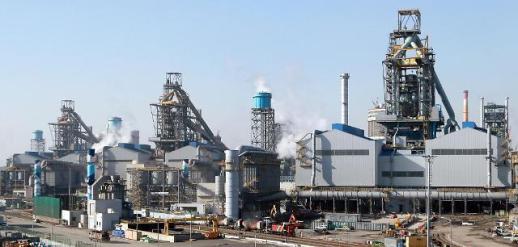 Hyundai Steel swings to Q1 operating profit on higher sales volume SEOUL, April 24 (AJP) - Hyundai Steel returned to the black in the first quarter of 2026, posting an operating profit of 15.7 billion won ($10.5 million) as rising sales volumes offset persistent cost pressures. The company reported consolidated revenue of 5.74 trillion won for the January to March period on Friday, up 3.2 percent from a year ago, buoyed by stronger product shipments. Operating profit, however, slid 63.7 percent quarter-on-quarter as exchange rate headwinds and elevated raw material costs weighed heavily on margins. Hyundai Steel said the surge in debt and its leverage ratio reflected capital injections into its U.S. steelworks and other growth-oriented expenditures, describing the increase as temporary. The company projected a gradual recovery in profitability from the second quarter onward, citing an expected easing in cheap import inflows and planned price increases for key products. "We will pre-empt new demand in the power infrastructure industry and actively respond to carbon-reduced steel demand through our combined electric arc and blast furnace process to achieve a recovery in profitability," said a Hyundai Steel Spokesperson. Shares of Hyundai steel traded at 42,100 won per stock on 3:00 p.m., 2.06 percent higher than a day ago. 2026-04-24 15:04:24