
Journalist

Park Yong-jun
-
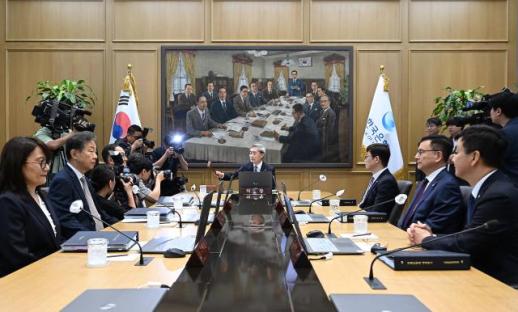 Bank of Korea Holds Interest Rate Steady Amid Inflation Concerns The Bank of Korea's Monetary Policy Committee has kept the base rate steady at 2.50% for the eighth consecutive time. Amid rising inflation expectations due to high oil prices and exchange rates stemming from the Middle East conflict, two committee members expressed dissenting opinions advocating for a rate hike, indicating a stronger hawkish stance within the bank. On May 28, the Monetary Policy Committee decided to maintain the base rate at 2.50%. While inflationary pressures are increasing and economic growth is more robust than anticipated, the committee deemed it prudent to keep rates unchanged due to ongoing uncertainties related to the Middle East situation. However, during this meeting, committee members Jang Yong-sung and Yoo Sang-dae voiced their opinions for a 0.25 percentage point increase in the base rate. The committee's statement on monetary policy direction noted, "Future monetary policy will be determined by assessing the extent of inflationary pressures, the trajectory of economic improvement, and financial stability conditions." The hawkish sentiment among committee members was also reflected in their six-month conditional rate forecasts. The most common projection was 3.00%, with ten members supporting it, while seven members forecasted 2.75%. Projections for 3.25% and 2.50% were each supported by two members, suggesting that at least three members expect two rate hikes by November of this year. In its revised economic outlook, the Bank of Korea raised its consumer price inflation forecast for the year from 2.2% to 2.7%, an increase of 0.5 percentage points. The core inflation rate is projected to be 2.4% this year and 2.3% next year. The bank cited rising international oil prices due to the Middle East conflict, persistent high exchange rates affecting import prices, and increased demand-side inflation pressures from rising incomes as contributing factors. The Bank of Korea anticipates that inflation rates could rise to around 3.0% in the second half of the year. Notably, in August, the impact of last year's telecommunications fee discounts is expected to result in both consumer and core inflation reaching their highest levels of the year. There remains significant uncertainty regarding the inflation trajectory due to developments in the Middle East. Should the situation stabilize quickly, inflation rates for this year and next could be 0.2 and 0.3 percentage points lower than the baseline forecast, respectively. Conversely, if the negotiation stalemate persists, inflation rates could rise by 0.3 and 0.5 percentage points, respectively. Lee Ji-ho, head of the Bank of Korea's Economic Research Division, stated at the economic outlook briefing, "The fundamental premise for consumer price inflation is the exchange rate and oil prices, and the ongoing high exchange rate is impacting inflation. Currently, the most significant factor driving prices is the impact of oil prices due to the Middle East situation." Next year, while supply-side shocks from rising international oil prices are expected to ease somewhat, demand-side inflation pressures are projected to expand, leading to both consumer and core inflation rates exceeding target levels. The forecast for the current account surplus has also been significantly revised upward. The Bank of Korea now expects a current account surplus of $250 billion this year and $190 billion next year, up from previous forecasts of $170 billion and $140 billion, respectively. The bank noted that while rising international oil prices will increase energy import costs, the growth in semiconductor exports is expected to offset this, leading to an expanded surplus primarily in the goods balance. * This article has been translated by AI. 2026-05-28 20:26:00
 -
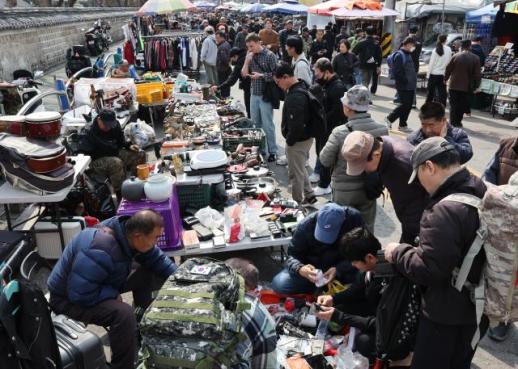 Wage Disparity Worsens in Q1; Low-Income Households Face Increased Deficit Spending Despite improvements in average wage indicators in the first quarter of this year, driven by performance bonuses in large export-oriented companies, the economic sentiment among ordinary citizens remains bleak. The growth in real wages has slowed, and low-income households are experiencing a faster increase in consumption than in income, leading to a deeper structure of deficit spending.According to the Ministry of Employment and Labor's "April 2026 Business Labor Survey Results" released on May 28, the average nominal wage for employees in businesses with one or more regular workers was 4.555 million won, a 3.4% increase (149,000 won) compared to the same period last year.However, when adjusted for inflation, the real wage was 3.847 million won, reflecting only a 1.3% increase (49,000 won). The ongoing rise in consumer prices has significantly offset the nominal wage gains.In March, when performance bonuses and special allowances were concentrated, the wage gap between businesses of different sizes became more pronounced. The average total monthly wage for employees in businesses with 300 or more workers was 6.512 million won, approximately 1.7 times that of businesses with fewer than 300 workers (3.743 million won). The absolute wage gap reached 2.769 million won.Special payments for regular employees increased by 4.4% year-on-year to 526,000 won, reflecting the impact of expanded performance bonuses in major export sectors such as semiconductors, automobiles, and shipbuilding.In contrast, small and medium-sized enterprises, struggling with sluggish domestic demand and high interest rates, have faced challenges in securing funds for performance bonuses, exacerbating the perception of wage polarization. For instance, the total wage in the accommodation and food service sector in March was 2.343 million won, significantly below the overall average.The increase in real wages has also been minimal. In March, real wages were 3.56 million won, showing only a 0.1% increase compared to the same month last year. With consumer price inflation remaining around 2%, the perceived improvement in wages has been limited.The wage gap and stagnation in real wages are also evident in household data. The National Data Agency's "First Quarter 2026 Household Trends Survey Results" revealed that the average monthly income per household was 5.481 million won, a 2.4% increase compared to the previous year. However, the real income growth rate, adjusted for inflation, was only 0.4%.Household consumption expenditure rose by 5.3% to 3.105 million won, significantly outpacing income growth. Consequently, the average household surplus decreased by 3.1% to 1.239 million won, while the average consumption propensity increased by 1.7 percentage points to 71.5%.Notably, the bottom 20% of earners, or the first income quintile, saw their average monthly income rise by 2.7% to 1.17 million won, but their consumption expenditure surged by 7.3%. Their average consumption propensity reached 155.3%, indicating that their spending exceeds their disposable income. This suggests that many households are relying on debt or depleting existing assets to cover living expenses.In contrast, the average monthly income for the top 20% of earners, or the fifth income quintile, increased by 4.2% to 12.378 million won, with disposable income rising by 5.1%. Their consumption expenditure also grew by 6.9%, but their average consumption propensity remained at 57.7%.The income gap continues to widen. The quintile ratio for equalized disposable income rose to 5.91 times, up from 5.82 times in the same period last year. Equalized disposable income is a measure that reflects differences in household size, indicating that a higher figure signifies an increase in income polarization.* This article has been translated by AI. 2026-05-28 20:24:00
 -
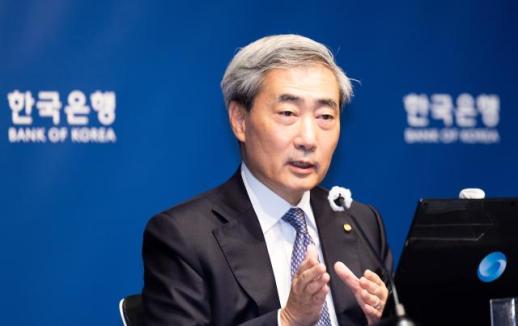 Bank of Korea Governor Shin Hyun-sung Signals Rate Hike Amid Inflation Concerns Bank of Korea Governor Shin Hyun-sung stated on May 28 that "inflation, growth, exchange rates, and real estate are all pointing in the same direction," indicating the need for a rate hike at an appropriate time. His remarks suggest a clear intention to tighten monetary policy in the second half of the year. After presiding over his first Monetary Policy Committee meeting, Shin noted that inflation is expected to remain above target for an extended period while growth continues to show solid improvement. He remarked, "Monetary policy can be challenging when multiple objectives conflict, but this time is an exception; the paths for inflation, growth, exchange rates, and real estate are clear." The recently released dot plot revealed a hawkish sentiment among committee members, with 19 out of 21 projections indicating a rate above the current level of 2.50%. Shin emphasized the importance of three factors: when to raise rates, how quickly, and to what extent, suggesting that the dot plot might provide insights into these questions. Market sentiment is leaning towards a July rate hike as a foregone conclusion. Based on Shin's comments, analysts suggest that consecutive increases in July and August are also feasible. Kim Sung-soo, a researcher at Hanwha Investment & Securities, stated, "The Bank of Korea is now in an environment where it can focus solely on price stability. The decision to hold rates steady this time was likely a move to provide guidance before a hike, making a July increase almost certain." Baek Yoon-min, a researcher at Kyobo Securities, noted, "While we expected inflation to peak in the second half of the year, the ongoing conflict in the Middle East could keep international oil prices elevated for an extended period, impacting inflation. It is reasonable to anticipate two rate hikes within this year as a basic scenario." Additionally, the Bank of Korea raised its economic growth forecast by 0.6 percentage points to 2.6%. Shin explained that while the Middle East conflict is expected to lower this year's growth rate by about 0.4 percentage points, stronger-than-expected semiconductor performance and increased IT exports could boost growth by 0.7 percentage points. He also noted that the government's supplementary budget and a booming stock market are expected to raise consumption and investment, contributing an additional 0.2 and 0.1 percentage points, respectively. In its optimistic scenario for the semiconductor market, the Bank of Korea anticipates that semiconductor export volumes could expand to the mid-20% range this year and maintain a high level in the mid-10% range next year, potentially increasing domestic growth rates by 0.5 percentage points this year and 0.3 percentage points next year, pushing economic growth above 3%. Conversely, in a pessimistic scenario where semiconductor export volume growth slows to the mid-10% range this year, the growth rate is expected to decrease by 0.3 percentage points this year and 0.2 percentage points next year.* This article has been translated by AI. 2026-05-28 20:24:00
 -
 National Pension Service Increases Domestic Stock Target Allocation to 20.8% The National Pension Service has decided to increase its target allocation for domestic stocks from 14.9% to 20.8% this year. This adjustment reflects the significant rise in the KOSPI index, which has pushed the actual share of domestic stocks held well above the initial target. According to Yonhap News Agency, the National Pension Fund Management Committee held its fifth meeting on May 28, where it reviewed and approved a proposal to adjust the target allocations for various asset classes and the medium-term asset allocation plan for 2027 to 2031. The medium-term asset allocation plan outlines the target allocations and management directions for stocks, bonds, and alternative investments over the next five years. It serves as a guideline to enhance the fund's profitability and stability. Initially, the target allocation for domestic stocks was set at 14.4% as per the fund management plan approved in May of last year. However, as the domestic stock market continued to rise, the committee raised the target allocation to 14.9% in January, with an upper limit of 19.9% including allowable ranges. As the KOSPI continued to surge, the actual allocation of domestic stocks reached 24.5% by the end of February. In light of this, the committee decided to raise the target allocation to 20.8%, considering market conditions, fund profitability and stability, and the impact on financial markets. The committee explained that this decision was made to enhance long-term profitability and stability while considering the potential structural changes in the domestic stock market and the need to mitigate market shocks from rebalancing. The adjusted target allocation will take effect at the end of next month, when the current rebalancing suspension ends. Other asset class target allocations will also be adjusted in line with the increased domestic stock allocation. By the end of this year, the target allocations for various asset classes will be 34.7% for overseas stocks, 23.1% for domestic bonds, 7.4% for overseas bonds, and 14.0% for alternative investments. To respond to the volatile domestic stock market, the committee has temporarily expanded the allowable range for strategic asset allocation (SAA) for domestic stocks. However, specific allowable ranges will not be disclosed to ensure market stability and fairness in fund management. Additionally, to minimize market impact, the committee has improved related rules, including reducing the maximum daily rebalancing size. The committee plans to reassess the SAA allowable range by the end of this year. The committee also confirmed the medium-term asset allocation plan for 2027 to 2031, which maintains the focus on expanding overseas and alternative investments. By the end of 2031, the target allocations for various asset classes are expected to be approximately 55% for stocks, 30% for bonds, and 15% for alternative investments. For next year, the target allocation for domestic stocks will remain at 20.8%. The allocations for overseas stocks, domestic bonds, overseas bonds, and alternative investments have been set at 35.6%, 21.8%, 7.4%, and 14.3%, respectively. Jeong Eun-kyung, Minister of Health and Welfare, stated, "This medium-term asset allocation is a decision made in response to recent market changes, aimed at enhancing the long-term profitability and stability of the fund while also considering its impact on financial markets. We will continue to closely monitor market conditions to ensure that fund management balances principles and flexibility."* This article has been translated by AI. 2026-05-28 20:06:00
 -
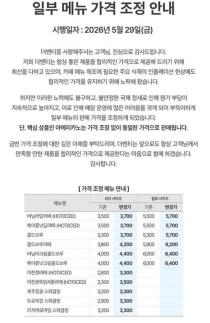 Dabangti Raises Prices of Coffee and Beverages by Up to 500 Won, Americano Prices Unchanged Dabangti will raise prices of its coffee and beverages by up to 500 won, excluding the Americano. According to a notice posted on Dabangti's website on May 28, prices for some beverages will increase by 100 to 500 won starting May 29. The price of a large Vanilla Deep Latte will rise from 3,500 won to 3,700 won, while the jumbo size will increase from 5,500 won to 5,700 won. Cold Brew prices will go up from 3,300 won to 3,700 won, and the jumbo size will increase from 5,300 won to 5,700 won. The price of the Icheon Rice Latte will increase from 2,800 won to 3,300 won, and the Jeju Cheonggyul Sparkling will rise from 3,200 won to 3,300 won. Other coffee menu items, including Hazelnut Vanilla Latte, Cold Brew Latte, Vanilla Cream Cold Brew, and Hazelnut Cream Cold Brew, as well as some beverages like Icheon Black Sesame Red Bean Latte, Tropical Sparkling, and Lychee Chamomile Sparkling, will also see price increases. Dabangti explained, "Due to ongoing cost pressures from unstable international conditions and difficulties in store operations, we have had to adjust the prices of some menu items."* This article has been translated by AI. 2026-05-28 20:02:00
 -
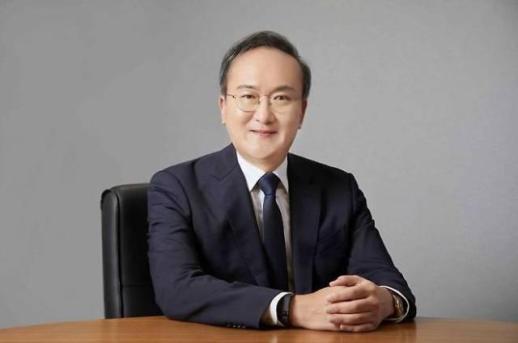 SK On CEO Lee Seok-hee Resigns, Yoon Wook Takes Over Sole Leadership Lee Seok-hee, CEO of SK On, is resigning due to health issues. On May 28, industry sources reported that Lee announced his decision in a letter to SK On employees, stating, "I wish to conclude my duties as CEO of SK On by the end of May," and added, "It has been a great honor to work alongside SK On members at the center of the secondary battery industry." He explained, "I have been deeply contemplating the significant responsibilities of the CEO role since the end of last year, but I delayed my resignation to ensure the successful completion of key management issues, including the conclusion of our U.S. joint venture." Appointed as president of SK On in December 2023, Lee previously held positions at Intel and served as a professor in the Department of Electrical and Electronic Engineering at KAIST. He also worked as the head of DRAM development at SK Hynix and as Chief Operating Officer. Lee is recognized as an expert in global manufacturing, having received the Intel Technology Award three times, and is seen as the ideal leader to transform SK On into a top-tier global battery company focused on advanced technology. He has played a crucial role in expanding SK On's presence in the North American market and establishing partnerships with automotive manufacturers. In October of last year, SK On appointed Yoon Wook, former CEO of SK Siltron, as president, creating a dual leadership structure alongside Lee. With Lee's resignation, SK On will transition from a dual leadership model to a sole leadership structure under Yoon Wook.* This article has been translated by AI. 2026-05-28 19:42:00
 -
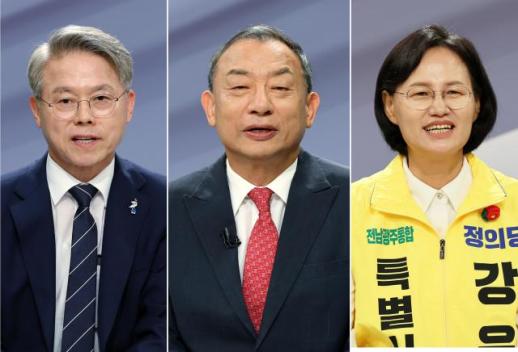 Candidates Present Visions for Integrated Gwangju-Jeonnam City in Debate In a televised debate ahead of the June 3 local elections, candidates for the Gwangju-Jeonnam integrated special city mayoralty presented their visions for integration and balanced development. However, their proposals for utilizing the allocated 20 trillion won in resources differed significantly. The candidates also addressed the need to check the dominance of the ruling party and the call for accountability from the opposition party. Min Hyung-bae of the Democratic Party, Lee Jung-hyun of the People Power Party, and Kang Eun-mi of the Justice Party participated in the candidate debate held on May 28 at the KBS Gwangju Broadcasting Center. As the first candidates for the newly established Gwangju-Jeonnam mayoralty, they outlined plans for integrated development. Min emphasized, "As I stated in my candidacy announcement, the first priority is growth, followed by balance. By fostering growth in each region, we can expand the economic pie, leading to improved living standards for ordinary citizens through balanced development." Kang also stressed the importance of tangible balanced development for successful integration, stating, "We must publicly address sensitive issues like the location of the government office and financial distribution through a citizens' deliberation committee to prevent power and resources from concentrating in any one area." Conversely, Lee criticized the rushed nature of the Gwangju-Jeonnam integration, saying, "Issues like the medical school and airport relocation have remained unresolved for 20 years, yet the integration was completed in just two months. We do not know what disasters or failures this may bring to our region. We will proceed slowly, centering on Gwangju." The candidates' plans for utilizing the 20 trillion won set aside for the integrated city varied. Min proposed using 80% of the funds to develop industries that will secure the future of Gwangju and Jeonnam, with 10% allocated for talent development and 10% for building community safety nets. He stated, "This 20 trillion won should not just be spent and disappear; it must be invested to yield returns for the citizens, serving as seed money for the next 100 years." Lee focused on job creation, asserting, "We need to concentrate on attracting ten major corporations to Gwangju and Jeonnam, bringing in partner companies and research institutes to create more jobs." Kang added, "We must invest for future generations, create sustainable foundations, and contribute to reducing regional disparities through balanced development." The debate also highlighted the longstanding narrative of the Democratic Party's dominance in Gwangju and Jeonnam, alongside calls for accountability from the People Power Party regarding the December 3 martial law. Kang diagnosed, "Monopolistic politics without competition has harmed Gwangju and Jeonnam." In response, Min acknowledged the negative aspects of a lack of competition but countered that the People Power Party has failed to fulfill its role as the main opposition party. Lee pointed out that while the Gwangyang steel mill produces 27 million tons, there are no manufacturing plants for shipbuilding or automobiles nearby, criticizing the monopolistic power for failing to create jobs. Min challenged Lee's approach, questioning whether he was running as a candidate for the integrated mayoralty or attempting to suppress his opponent through political rhetoric. The candidates continued their attacks on the People Power Party. Min noted, "The failure to include the May 18 Democratic Movement in the constitutional preamble was due to the People Power Party," while Kang criticized the party for politicizing the controversy surrounding Starbucks' trivialization of the May 18 movement. Lee stated he has always supported including the May 18 movement in the constitutional preamble and expressed regret over the party's actions regarding the Starbucks marketing controversy, saying, "As a member of the People Power Party, I feel disappointed and angry about these remarks and behaviors. I apologize for this."* This article has been translated by AI. 2026-05-28 19:24:00
 -
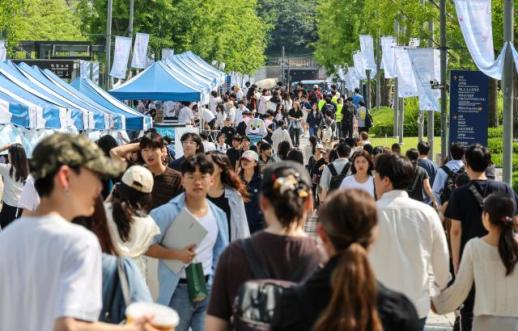 Campus dips into May festival mood SEOUL, May 28 (AJP) - Students and visitors filled the campus of Yonsei University in western Seoul on Wednesday as university festival season continued across South Korea. Club band performances and student-run booths took place throughout the Sinchon campus near central Seoul, while students wearing school uniforms and varsity jackets moved between food stalls and performance areas, enjoying the festive atmosphere. International students were also seen joining the celebrations and experiencing South Korea’s distinctive campus festival culture. Yonsei University is holding its four-day Muak Daedongje festival, titled “UNIT:Y,” to mark the school’s 141st anniversary. The festival began on May 26 with the “Blue Run” event organized with the student council’s athletics department. On May 27, the university’s international campus in Songdo, Incheon, hosted water slide attractions, performances and food events. Events at the Sinchon campus in Seoul continue through May 29, featuring student booths, live performances and celebrity appearances along Baekyang-ro. Crowds gathered across the campus as students waited for celebrity performances and enjoyed live music by campus bands, adding to the lively atmosphere of the annual university festival. 2026-05-28 18:59:39
 -
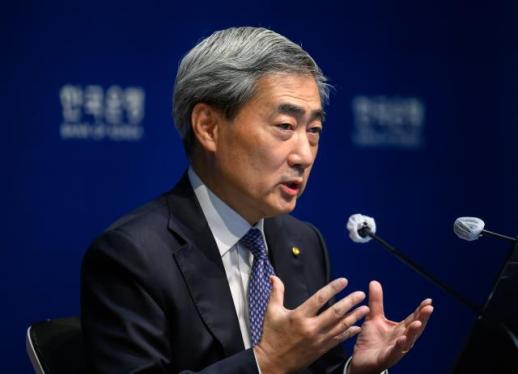 A siren song from the BOK: the leverage party is over SEOUL, May 28 (AJP) -For a full year, the Bank of Korea sat motionless on a 2.50 percent benchmark while the KOSPI staged the most spectacular rally on the planet — up more than 93 percent since year-end, briefly flirting with 8,450 before Wednesday's close. On Thursday, the central bank's new governor finally said out loud what the bond market had been bracing for: the only questions left are when, how fast, and how far rates rise. A plain-spoken siren to the leverage crowd. New governor Shin Hyun-song could hardly have been blunter in his first rate-setting meeting and media briefing. "All the signs — price pressure, the growth trajectory, the exchange rate and the real estate market — point in one clear direction," he said, calling the case "exceptionally clear." A new governor living up to a hawkish reputation on day one is, in itself, a market event. But the substance behind the posture is what should sober up a frenzied retail base. The freshly released six-month dot plot tells the story with unusual candor. Ten of the 21 projected policy-rate dots now cluster at 3.00 percent, seven at 2.75 percent, and two reach 3.25 percent — leaving only two laggards still betting on a hold at 2.50. The board's center of gravity has shifted to two more quarter-point hikes, with a credible tail toward a third. Rewind to February, when 16 of 21 dots saw no change and four saw a cut, and the reversal is nothing short of dramatic. The BOK simultaneously revised up both growth and inflation forecasts, citing stronger-than-expected chip demand, the prolonged Gulf crisis, and an extraordinary terms-of-trade windfall that lifted first-quarter gross domestic income 12.3 percent year on year. Here is the uncomfortable part Shin was unusually willing to name: the boom is feeding on itself. Earnings and stock gains are spilling into wages and bonuses, adding to price pressure — and the rally has been bankrolled, dangerously, on leverage. Margin trading balances stood at 36.7 trillion won, up a startling 34 percent since the start of the year. "The capital losses from highly leveraged, debt-fueled trading are ultimately borne by market participants who do not carry debt," Shin warned. "This behavior distorts the normal economic demand curve." Translated from central-bank diction: the party financed on credit will hand the bill to everyone, and the BOK would rather deflate the foam now than clean up after it bursts. And the data show that bill is already coming due for the most over-extended traders. According to a think tank affiliated with the Korea Financial Investment Association, the forced-liquidation ratio — the share of margin debt that ends up dumped onto the market when investors fail to meet collateral calls — breached its 2 percent warning line on 20 of the 122 trading days between Nov. 22 and May 22. In stable conditions that ratio hovers near 1 percent; that retail investors were force-sold on roughly one of every six sessions is a sign the leverage has turned from accelerant into liability. The damage clustered in March and May, with nine days above the threshold in March and seven in May. The ratio blew through the severe 4 percent level five times, peaking at 7.6 percent on May 20 — when 145.8 billion won of stock was liquidated against 1.64 trillion won in outstanding margin credit — followed by 6.5 percent on March 5, 6.0 percent on May 18, 5.4 percent on May 11 and 4.6 percent on May 19. The deterioration is stark against history. In the six months to November 2024 the ratio topped 2 percent just three times; in the half-year before that it never did, peaking at a mild 1.8 percent. Now the average daily ratio has nearly doubled to 1.45 percent, from a prior 0.6-to-0.8 percent range, while average daily forced liquidations have tripled to 17.33 billion won from 5-to-8 billion won. And those figures capture only brokerage margin credit — they exclude margin loans, stock loans and contracts for difference. Brokerage margin loan balances alone have nearly doubled to about 36 trillion won as of Wednesday from 18.5 trillion a year ago; stock-collateralized loans have climbed to 25.7 trillion won. The true exposure to a forced-selling cascade is almost certainly larger than the headline numbers suggest. The market got the message in real time. Bond prices collapsed — the three-year government yield jumped 5.5 basis points to 3.766 percent and the ten-year rose 4.5 to 4.147 percent, both at roughly 15-year highs not seen since the 2011 eurozone crisis. Equities convulsed: the KOSPI plunged more than 4 percent intraday, briefly breaching the psychologically critical 8,000 line, before clawing back to close at 8,185.29, down just 0.53 percent on bets that a "healthy" hike won't derail the chip story. The KOSDAQ, with thinner semiconductor cover, found no such floor, shedding 2.54 percent to 1,104.36 after diving more than 5.7 percent at its worst. The won slid 5.1 to 1,507.10 per dollar — and Shin made clear he "will not tolerate disorderly herd behavior" there either. That split-screen — bonds breaking, stocks half-recovering on chip faith — is precisely the imbalance worth worrying about. The rally has never been broad. On Wednesday, with the index near a record 8,330, decliners crushed gainers 826 to 75. A market this narrow, this concentrated in Samsung Electronics and SK hynix (whose combined weighting topped 50 percent intraday), is structurally fragile, and the leverage layered on top makes it brittle. And that leverage keeps finding new outlets. Just this week, sixteen single-stock leveraged and inverse ETFs tied to the two chip giants debuted to roughly 10.4 trillion won in first-day turnover, pushing Korea's total ETF market past 500 trillion won for the first time. Investors who watched the chip rally from the sidelines are now chasing it with amplified, FOMO-driven exposure — even as a record 258.65 trillion won sits parked in money market funds and the VKOSPI clings to panic-adjacent territory above 70. That is the psychology of a market simultaneously greedy and terrified: a textbook late-cycle signature. As one Korea Investment & Securities analyst warned, when leverage accumulates this far, "massive volumes of forced liquidations can hit the market with a time lag" — amplifying volatility precisely when investors can least afford it. None of this means the chip thesis is wrong. Samsung and SK hynix posted combined operating profits north of 90 trillion won, and Nomura and others have lifted KOSPI targets toward 10,000 and beyond. But valuation built on real earnings is one thing; a record index propped up by borrowed money and 5-to-6 percent daily swings is another. Shin's hawkish turn is, at bottom, an attempt to normalize asset prices before the foam hardens into a bubble — and bubbles, unlike rallies, do not get to choose how they end. The governor framed the dissent on his board as "strategic — about timing rather than direction." That is the whole point. Direction is no longer in doubt. The dots have moved, the bonds have repriced, and the man holding the gavel has shown his hand on his very first day. For the leveraged longs still dancing to the chip rally's tune, this was the clearest reality check yet: it is simply a matter of time. *The author is the managing editor of AJP. 2026-05-28 18:56:53
 -
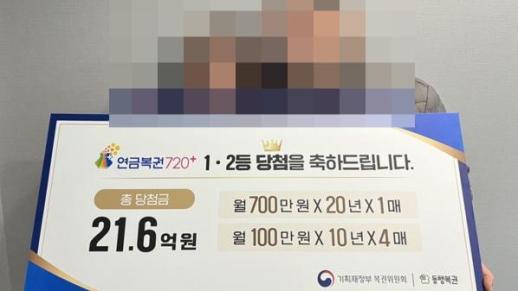 Dream of Falling into Dirty Water Leads to Simultaneous Lottery Wins "The day after dreaming of falling into dirty water, I bought the pension lottery as usual in that area." As interest mounts in the winning numbers for the 317th Pension Lottery 720+ on May 28, the story of the winner of the 292nd Pension Lottery 720+, who won 1st place (1 ticket) and 2nd place (4 tickets), has captured attention. In a recent post on the Donghaeng Lottery winners' bulletin board, the winner shared, "Due to the nature of my job, I often travel throughout Daejeon and Chungnam to buy lotto tickets, and I purchase the pension lottery in a specific area." The winner continued, "The day after I dreamed of falling into dirty water, I bought the pension lottery in that area as usual. On Sunday afternoon, while checking the lotto and pension lottery at home, I noticed an unusual number of zeros and realized I had won 2nd place." "In shock, I checked the remaining tickets and found that I had won both 1st and 2nd place simultaneously. When I told my family, they were even happier than I was and congratulated me. My parents passed away early, and I feel grateful that they seem to be helping me as I’ve worked hard in life," the winner reflected. The winner, who purchased the lottery ticket at a sales outlet in Asan, Chungnam, responded to a question about their usual lottery purchases by saying, "I mainly buy lotto tickets and occasionally purchase the pension lottery and Spitto." Regarding plans for the winnings, the winner stated, "I plan to pay off my loans and take a trip with my family." Meanwhile, the winning numbers for the 317th Pension Lottery 720+ will be available after 7:05 PM today (28th).* This article has been translated by AI. 2026-05-28 18:56:00