

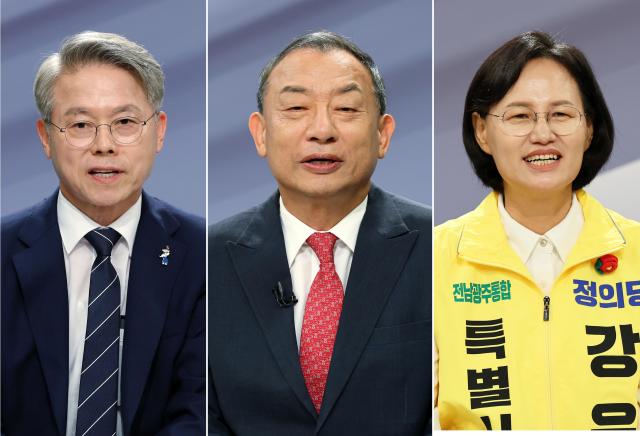
In a televised debate ahead of the June 3 local elections, candidates for the Gwangju-Jeonnam integrated special city mayoralty presented their visions for integration and balanced development. However, their proposals for utilizing the allocated 20 trillion won in resources differed significantly. The candidates also addressed the need to check the dominance of the ruling party and the call for accountability from the opposition party.
Min Hyung-bae of the Democratic Party, Lee Jung-hyun of the People Power Party, and Kang Eun-mi of the Justice Party participated in the candidate debate held on May 28 at the KBS Gwangju Broadcasting Center.
As the first candidates for the newly established Gwangju-Jeonnam mayoralty, they outlined plans for integrated development. Min emphasized, "As I stated in my candidacy announcement, the first priority is growth, followed by balance. By fostering growth in each region, we can expand the economic pie, leading to improved living standards for ordinary citizens through balanced development."
Kang also stressed the importance of tangible balanced development for successful integration, stating, "We must publicly address sensitive issues like the location of the government office and financial distribution through a citizens' deliberation committee to prevent power and resources from concentrating in any one area."
Conversely, Lee criticized the rushed nature of the Gwangju-Jeonnam integration, saying, "Issues like the medical school and airport relocation have remained unresolved for 20 years, yet the integration was completed in just two months. We do not know what disasters or failures this may bring to our region. We will proceed slowly, centering on Gwangju."
The candidates' plans for utilizing the 20 trillion won set aside for the integrated city varied. Min proposed using 80% of the funds to develop industries that will secure the future of Gwangju and Jeonnam, with 10% allocated for talent development and 10% for building community safety nets. He stated, "This 20 trillion won should not just be spent and disappear; it must be invested to yield returns for the citizens, serving as seed money for the next 100 years."
Lee focused on job creation, asserting, "We need to concentrate on attracting ten major corporations to Gwangju and Jeonnam, bringing in partner companies and research institutes to create more jobs." Kang added, "We must invest for future generations, create sustainable foundations, and contribute to reducing regional disparities through balanced development."
The debate also highlighted the longstanding narrative of the Democratic Party's dominance in Gwangju and Jeonnam, alongside calls for accountability from the People Power Party regarding the December 3 martial law. Kang diagnosed, "Monopolistic politics without competition has harmed Gwangju and Jeonnam." In response, Min acknowledged the negative aspects of a lack of competition but countered that the People Power Party has failed to fulfill its role as the main opposition party.
Lee pointed out that while the Gwangyang steel mill produces 27 million tons, there are no manufacturing plants for shipbuilding or automobiles nearby, criticizing the monopolistic power for failing to create jobs. Min challenged Lee's approach, questioning whether he was running as a candidate for the integrated mayoralty or attempting to suppress his opponent through political rhetoric.
The candidates continued their attacks on the People Power Party. Min noted, "The failure to include the May 18 Democratic Movement in the constitutional preamble was due to the People Power Party," while Kang criticized the party for politicizing the controversy surrounding Starbucks' trivialization of the May 18 movement. Lee stated he has always supported including the May 18 movement in the constitutional preamble and expressed regret over the party's actions regarding the Starbucks marketing controversy, saying, "As a member of the People Power Party, I feel disappointed and angry about these remarks and behaviors. I apologize for this."
* This article has been translated by AI.
Copyright ⓒ Aju Press All rights reserved.