
Journalist

Park Yong-jun
-
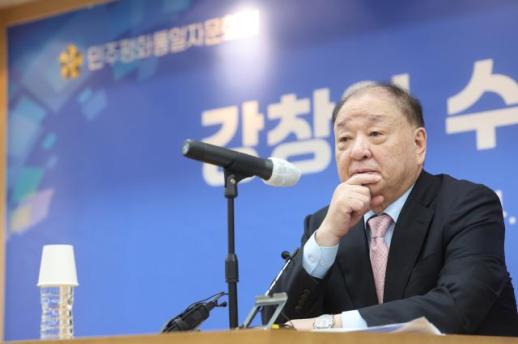 President Yoon Appoints Seven Officials, Including Kang Chang-il and Shin Hyun-sung Lee Jae-myung, the President of South Korea, awarded appointment letters to seven officials, including Kang Chang-il, Chief Vice Chair of the National Unification Advisory Council, and Shin Hyun-sung, Governor of the Bank of Korea, on May 28 at the Blue House.This information was conveyed through a written briefing by Kang Yu-jeong, the Chief Spokesperson of the Blue House.Kang was appointed on April 17, succeeding the late Lee Hae-chan. A historian by training, he has served four terms as a lawmaker from Jeju City and was the South Korean ambassador to Japan during the Moon Jae-in administration.In addition to Kang and Shin, the appointments included Yoon Kwang-il and Jeon Hyun-jeong as members of the National Election Commission, and Ko Kwang-heon as the chair of the Broadcasting and Communications Review Committee. Also appointed were Lee Chang-hoon as chair of the National Climate Crisis Response Committee and Kim Jin-oh as vice chair of the Low Birthrate and Aging Society Committee.* This article has been translated by AI. 2026-05-28 18:48:00
 -
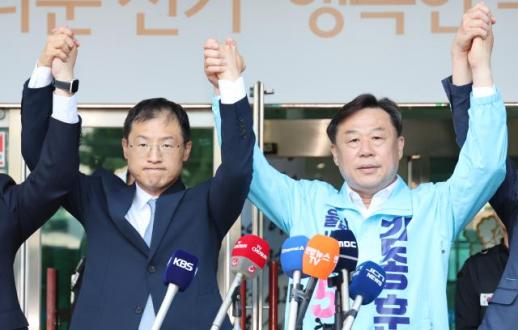 Democratic Party and Progressive Party Unite Behind Kim Sang-wook for Ulsan Mayor On May 28, one day before early voting for the Ulsan mayoral election, the Democratic Party and the Progressive Party unified their candidate selection, naming Kim Sang-wook as their joint candidate. At a joint press conference held around 5:50 p.m. in front of the Ulsan Election Commission, Kim Sang-wook and Kim Jong-hoon announced the results of a public opinion poll conducted to determine the unified candidate. Throughout the day, both candidates used polling firms of their choice to conduct surveys utilizing a secure phone number system, resulting in Kim Sang-wook being selected as the unified candidate for both parties. Kim Jong-hoon, who lost in the selection process, accepted the results and submitted his resignation as a candidate to the Ulsan Election Commission just before the announcement. Kim Sang-wook expressed his gratitude, stating, "I will carry the hopes and aspirations of our Progressive Party comrades in my heart and work to create a citizen-led Ulsan and true democracy. I extend my respect and thanks to Kim Jong-hoon for making a difficult choice and showing courage." The initial unification poll was conducted from May 23 to 24. However, on the morning of May 24, Kim Sang-wook's camp raised concerns about the omission of a clause to prevent reverse selection, leading to the suspension of the selection process. Subsequently, Kim Sang-wook's camp proposed a re-election contingent upon implementing safeguards against organized interference from specific factions, which Kim Jong-hoon accepted on May 27, allowing the re-election to proceed. Meanwhile, a survey commissioned by Gyeongsang Ilbo and Ulsan MBC, conducted by Hankyung Research from May 25 to 26 among 1,102 Ulsan voters, showed Kim Sang-wook with 35.8%, Kim Du-gyeom of the People Power Party with 35.5%, and Kim Jong-hoon with 19.0%. In a poll based on the premise of Kim Sang-wook's unification, he garnered 43.6%, while Kim Du-gyeom received 36.9%. The survey utilized random digit dialing (RDD) for 17.2% of responses and automated response systems (ARS) for 82.8%, with a response rate of 4.3% and a margin of error of ±3.0 percentage points at a 95% confidence level.* This article has been translated by AI. 2026-05-28 18:42:00
 -
 Government to Import 20 Million Eggs and 9 Million Chicken Breeding Eggs Amid Price Concerns As concerns over the supply of eggs and chicken continue due to the impact of highly pathogenic avian influenza (AI), the South Korean government plans to import an additional 20 million fresh eggs and 9 million chicken breeding eggs. This move aims to alleviate the financial burden on consumers.The Ministry of Agriculture, Food and Rural Affairs announced on May 28 that it will import 20 million fresh eggs from the United States and Thailand between June and July. Since January, the ministry has already imported 7.87 million fresh eggs from these countries through the Korea Agro-Fisheries & Food Trade Corporation (aT) and plans to bring in an additional 2.24 million eggs by next month. The government aims to counteract the expected decrease in egg supply during the summer months by importing these additional eggs.A ministry official stated, "The number of laying hens aged six months and older has decreased, raising concerns about a drop in egg production next month. The average daily egg production in June is projected to decline by 3.6% compared to last year, totaling 46.92 million eggs."Due to the supply shortage, egg prices have remained high. According to the Korea Agricultural Products Quality Evaluation Institute, the average retail price for a carton of eggs (30 eggs) nationwide is 7,547 won, a 7.58% increase from the same period last year.The government is also expanding discounts on eggs. Starting today until July 1, the discount support price will increase from 1,000 won to 1,500 won. The National Agricultural Cooperative Federation (Nonghyup) is implementing a program to lower the supply price of eggs delivered to Hanaro Mart by 2,000 won per carton, in collaboration with the Korea Poultry Association, Daejeon-Chungnam Poultry Association, and Pocheon Livestock Association.In addition to eggs, the government is taking steps to stabilize chicken prices by increasing supply. The average retail price for chicken nationwide is currently 6,504 won per kilogram, a 15% increase from last year.The ministry plans to import an additional 900,000 chicken breeding eggs by August, following the previous import of 800,000. The imported breeding eggs will be hatched and raised in domestic broiler farms for 33 days before being supplied to the market, aiming to restore chicken production levels to last year's figures.The government will also implement a tariff quota on 30,000 tons of chicken starting at the end of this month. Additionally, it will provide discount support for chicken until July 1 and plans to supply chicken to markets at prices reduced by more than 1,000 won per bird through self-help funds during the summer.A ministry official expressed optimism, stating, "We expect these measures to contribute to market supply stability and alleviate consumer price burdens. We will continue to monitor the supply and demand situation for livestock products and respond actively to maintain stable supply conditions and reduce consumer burdens."* This article has been translated by AI. 2026-05-28 18:40:00
 -
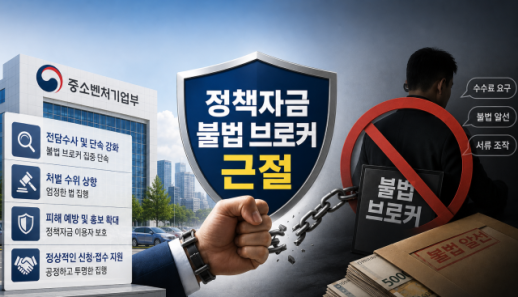 Policy Fund Scams Evolve: Legal Reforms Needed to Combat Fraud A small business owner, referred to as A, signed a contract with a management consulting firm that promised to secure policy funding. The firm demanded an upfront fee of 2 million won, claiming it was for administrative costs in exchange for assistance with a loan within six months. However, after the six-month period passed without government loan approval, A requested a refund, but the firm did not respond. Ultimately, A had to report the case to the Ministry of SMEs and Startups' illegal broker reporting center. According to the Ministry of SMEs and Startups on the 28th, illegal brokers exploiting the policy fund market have become increasingly sophisticated and organized, often disguising themselves as management consulting firms. These firms frequently misuse the logos and advertisements of agencies under the Ministry. This leads to fraudulent practices such as falsifying documents, charging success-based fees, and bundling insurance products. For small business owners, the average loan amount is typically between 30 million and 40 million won, with brokers reportedly taking around 20% in fees under the guise of consulting. As demand for low-interest financial support rises, the tactics of illegal brokers are diversifying. A Ministry official stated, "Some brokers impersonate public institutions or use the names of former employees to offer consultations on policy funds. As reporting of illegal brokers increases, more victims are coming forward to file complaints." To combat illegal brokers, the Ministry is implementing measures such as surveys to identify undue third-party involvement, a reporting reward system that pays up to 2 million won, and an amnesty program for self-reporting individuals. Additionally, the Ministry plans to track the IP addresses of applicants in real time to prevent undue third-party involvement. They are also introducing a system to check for similarities and duplications in business plans to catch brokers who draft plans on behalf of multiple firms. The Ministry aims to ensure that all policy fund loan applications are submitted directly by the businesses themselves. To address legal loopholes, the Ministry is preparing legislative measures to prevent undue third-party involvement. Earlier this year, the Ministry announced plans to revise the Small and Medium Enterprises Promotion Act to include management guidelines and prohibited activities, but the legislative process has been slow. The current illegal broker reporting center can only request investigations from relevant agencies based on received complaints, limiting its ability to take proactive measures. Critics argue that merely operating the reporting center is insufficient to eradicate illegal brokers. For complaints to lead to legal action, there is a need for a clear definition of "undue third-party involvement and proxy actions in the policy fund application process" to be included in the Small and Medium Enterprises Promotion Act, along with a legal prohibition against such actions. The Ministry official added, "There are various cases of reports related to job advertisements aimed at recruiting illegal brokers, but it is often challenging to find evidence during investigations, leading to many cases being treated with caution. It is difficult to gather evidence unless financial damage is evident. We will focus on post-action measures to eliminate illegal broker activities through legal reforms."* This article has been translated by AI. 2026-05-28 18:36:00
 -
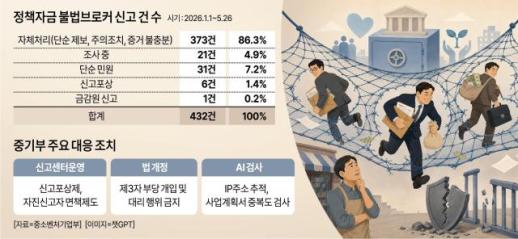 Surge in Reports of Illegal Policy Fund Brokers Amid Limited Investigations Reports of illegal brokers exploiting government policy fund support have surged, but most cases are either treated as simple complaints or lack sufficient evidence for further action. The Ministry of SMEs and Startups has initiated a reward system for whistleblowers, yet it faces a paradox: it lacks the authority to confirm the outcomes of investigations, leaving it unaware of any resulting penalties. According to the Ministry of SMEs and Startups, from January to May 26 of this year, the "Illegal Policy Fund Broker Reporting Center" received a total of 432 reports. This figure is more than six times the 70 reports filed in the entire previous year when the center was not operational. Of the reports processed, 373 (86.3%) were handled as "self-processing" (simple tips, warnings, or insufficient evidence), 21 (4.9%) were under investigation, 31 (7.2%) were classified as simple complaints, and 1 (0.2%) was referred to the Financial Supervisory Service. Only 6 cases, or 1.4% of the total, resulted in investigations that led to rewards. Among these, 4 involved small business victims and 2 involved cases from larger enterprises. The cases that received rewards involved demands for upfront fees and deposits under the pretense of guaranteeing or confirming policy fund loans, as well as instances of impersonating government agencies to send forged documents. However, the low number of cases referred for investigation compared to the total reports suggests that many submissions lack concrete evidence and are merely complaints. Additionally, the Ministry's authority is limited to referrals, making direct enforcement challenging. In response, the Ministry is considering measures to directly address third-party misconduct related to illegal brokers under the Small and Medium Enterprises Promotion Act and other relevant laws. A Ministry official stated, "Previously, when we referred cases to the police, we did not receive updates on the outcomes. However, with the upcoming legal amendments, the Ministry will be able to participate in the entire investigation process, from the inquiry stage to the final results, granting us more direct enforcement powers." Earlier this year, the Ministry implemented a reward system offering up to 2 million won for whistleblowers and a self-reporting amnesty program to combat illegal brokers. Additionally, it is enhancing guidance in collaboration with private platforms like 'Soomgo' and 'Kreamong' to prepare for illegal proposals during policy fund applications. The total scale of policy funds for this year amounts to 7.7933 trillion won, including 4.4313 trillion won for small and medium enterprise policy funds and 3.3620 trillion won for small business policy funds.* This article has been translated by AI. 2026-05-28 18:36:00
 -
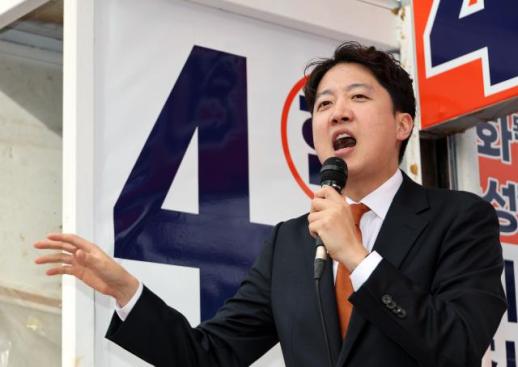 Lee Jun-seok Endorses Yoo Yi-dong in Pyeongtaek Election, Emphasizes Semiconductor Industry Lee Jun-seok, leader of the Reform Party, urged voters on May 28 to support Yoo Yi-dong, the People Power Party candidate running in the Pyeongtaek by-election, one day before early voting for the local elections and by-elections begins.In a Facebook post, Lee stated, "As the leader of the Reform Party, I ask you not just as a party leader but as a member of the National Assembly who must protect the semiconductor industry in southern Gyeonggi and the rights of engineers and researchers."He continued, "Yoo, who has shared the same concerns for over a decade with the development of the Godeok International New Town and Dongtan, deserves another opportunity to work in the National Assembly. He is someone I have trusted for a long time and whom I personally recruited as the chair of the policy committee. He has consistently spoken the truth without bearing any responsibility for the military regime or the failures of the Yoon Suk-yeol administration."Lee also targeted Kim Yong-nam, the Democratic Party candidate, and Cho Guk, the Justice Party candidate, saying, "There are individuals with allegations of operating illegal loan businesses and controversies surrounding their children attending foreign language high schools while being listed as authors on engineering papers. I hope those with such controversies are eliminated from consideration, as they tarnish the pride built on the hard work and research ethics of the engineering community in both cities."He emphasized the importance of the semiconductor belt in southern Gyeonggi, stating, "Geographically, with Dongtan at the center, the semiconductor belt includes Samsung Electronics' Hwaseong campus, Pyeongtaek campus, SK Hynix's Icheon and Cheongju campuses, and the soon-to-be-operational Yongin Nam-sa and Won-sam cluster. This semiconductor belt is the heart and future of South Korea's industry. Ensuring these massive production bases operate smoothly is essential for maintaining and enhancing Dongtan's value."Lee noted, "Recently, when meeting with Dongtan residents, I often hear their concerns. Some members of the Democratic Party have suggested relocating the semiconductor belt to Saemangeum or Jeollanam-do. However, the reality is that there are not enough colleagues in the National Assembly to counter such attempts in southern Gyeonggi."He concluded, "I hope that at least the National Assembly members representing Dongtan, which houses the Samsung Electronics Hwaseong campus, and Pyeongtaek, which houses the Pyeongtaek campus, can work together to protect this issue. If the residents of Dongtan persuade their colleagues in Pyeongtaek, and vice versa, we will have two National Assembly members who can solve the issues facing both Dongtan and Pyeongtaek together."* This article has been translated by AI. 2026-05-28 18:28:00
 -
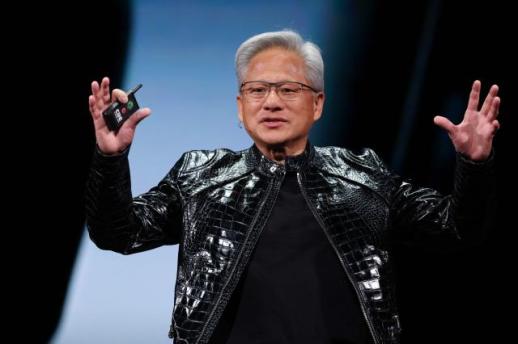 NVIDIA's Jensen Huang to Visit South Korea Next Week for Semiconductor and AI Collaboration NVIDIA founder and CEO Jensen Huang is expected to visit South Korea next week. This will be his first visit since attending the Asia-Pacific Economic Cooperation (APEC) CEO Summit in Gyeongju last October.According to industry sources on May 28, Huang will travel to South Korea after wrapping up his schedule at NVIDIA's annual AI conference, GTC Taipei 2026, and the Computex 2026 IT exhibition, both taking place in Taipei next week.GTC Taipei is scheduled for June 1-4, where Huang will deliver a keynote address on the company's next-generation AI semiconductors and infrastructure strategies.Industry insiders anticipate that Huang's visit will facilitate discussions on high-bandwidth memory (HBM), next-generation AI accelerators, and foundry collaborations with major South Korean semiconductor companies such as Samsung Electronics and SK Hynix.Additionally, discussions on AI collaboration across various sectors, including cloud computing with LG and Naver, are also expected during his visit.Previously, Huang visited South Korea in late October during the APEC summit, where he held a meeting with Samsung Electronics Chairman Lee Jae-Yong and Hyundai Motor Group Chairman Chung Eui-sun, referred to as a 'gangbu meeting.'* This article has been translated by AI. 2026-05-28 18:28:00
 -
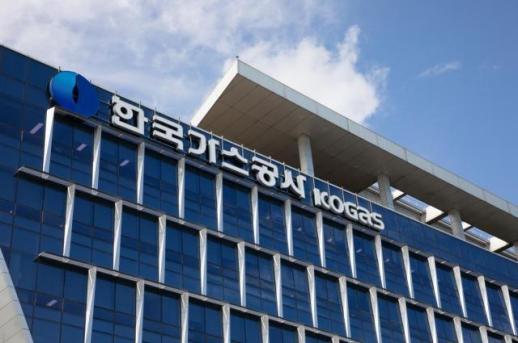 Korea Gas Corporation to Disclose Environmental Impact of Natural Gas As the importance of ESG (Environmental, Social, and Governance) management grows, there is an increasing demand for the disclosure of environmental product declarations related to energy sources like liquefied natural gas (LNG). The environmental impact from carbon emissions and the entire production-to-consumption process is directly linked to a company's ESG performance, prompting energy public enterprises to consider releasing environmental data at the product level. According to industry sources on May 27, an environmental product declaration quantifies and publicly discloses the environmental impacts occurring throughout the entire process of a product, from raw material extraction to production, transportation, distribution, usage, and disposal. There is a growing demand for energy companies, which inevitably produce carbon emissions, to disclose such environmental product declarations. In response, Korea Gas Corporation is pursuing certification for natural gas products, becoming the first in the country to do so. While the company has previously released environmental information at the corporate level through global evaluation agencies, it recognized the limitations in providing specific environmental data at the product level. Korea Gas Corporation has initially targeted certification for LNG truck supply products, as the boundaries of the process are clearer compared to pipeline supply, making data collection easier. However, due to the complex process from natural gas import to supply, a large-scale collaborative project involving 10 internal departments and 33 domestic and international suppliers has been launched. During this process, the company collected and standardized 16,752 data points across all stages, including raw material extraction, maritime transport, storage and distribution, and truck dispatch. As a result, it quantitatively assessed environmental impacts across seven categories, including carbon footprint, water footprint, and ozone layer impact. This effort has established a foundation for systematically managing environmental data across the entire supply chain, beyond just a simple certification process. Particularly, a comprehensive assessment of the production and transportation processes of LNG is deemed essential. Industry experts view Korea Gas Corporation's objective data acquisition as a means to not only sell energy but also provide carbon information and environmental data simultaneously. Given the need to manage carbon emissions during the production process, the provision of environmental data by energy suppliers is likely to become a significant purchasing criterion. Starting with this initiative, Korea Gas Corporation plans to gradually expand the scope of certification to include pipeline-supplied natural gas and hydrogen. This is because it can objectively demonstrate that LNG has lower carbon emissions compared to fossil fuels. The collected data will be provided to 119 truck supply demand points. Additionally, the general public will be able to intuitively perceive the eco-friendliness of natural gas through the environmental product declaration certification mark attached to truck vehicles they encounter in their daily lives. A representative from Korea Gas Corporation stated, "This certification initiative is the first step toward providing consumer-centered environmental information. Through transparent information disclosure and ongoing environmental improvement efforts, we aim to establish ourselves as a trusted eco-friendly energy company among the public."* This article has been translated by AI. 2026-05-28 18:28:00
 -
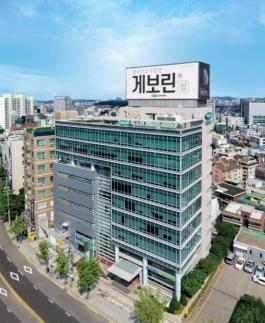 Samjin Pharmaceutical Expands CNS Business to Capture Aging Market Samjin Pharmaceutical is accelerating its expansion into the central nervous system (CNS) market, focusing on treatments for dementia and epilepsy. The company aims to develop this sector as a key growth area in response to the rapidly increasing demand driven by an aging population, building on its existing cardiovascular treatment business. According to market research firm IQVIA, the global CNS market is projected to grow from $154 billion in 2024 to $185 billion by 2029. The rise in the elderly population and the increasing number of patients with dementia and degenerative brain diseases are contributing to the rapid growth of related treatment markets. Samjin Pharmaceutical's business structure is heavily weighted towards prescription-based specialty drugs, with 77.2% of its total revenue of 309.1 billion won coming from this segment in the first quarter of this year. The core of its operations lies in the cardiovascular treatment sector. The company's flagship antithrombotic drug, Plavix, accounted for approximately 28% of total sales last year. Plavix is the first generic version of Sanofi's original cardiovascular drug, maintaining the top market share in the generic and improved drug categories. Leveraging its competitive edge in the cardiovascular market, Samjin Pharmaceutical is now focusing on expanding its CNS portfolio. While the cardiovascular market is based on chronic disease patients, dementia and epilepsy treatments tend to have a high rate of long-term use and strong prescription continuity. Establishing a stable supply chain and prescription reliability could lead to significant long-term revenue potential. The company's epilepsy treatment, Epilatam, consistently generates annual sales of around 4 to 5 billion won. Samjin has also successfully localized the active pharmaceutical ingredient (API) levetiracetam, which it previously imported entirely. A company representative stated, "The primary goal of localizing the raw materials is to ensure 'high quality' and to build a 'stable supply chain.' It is significant in establishing a foundation to supply pharmaceuticals without disruption from external factors through strict quality control and a reliable supply system." In February, the company launched the third-generation epilepsy treatment Brivaracetam, further expanding its CNS lineup. Brivaracetam is an improved formulation of Epilatam, and details regarding the localization of its raw materials are still being finalized as it is in the early stages of release. Samjin Pharmaceutical is also intensifying its efforts to penetrate the Alzheimer's market. The company recently introduced Nutoin Duo, a combination drug for Alzheimer's disease that combines donepezil and memantine. This product simplifies the treatment regimen for severe Alzheimer's patients, reducing the burden of taking two separate medications and enhancing adherence for long-term users. The company is also developing next-generation Alzheimer's treatments. In 2022, Samjin entered into a research and development agreement with biopharmaceutical company Aribio to collaborate on treatments for intractable and degenerative brain diseases. Samjin currently holds a 5.9% stake in Aribio, making it the second-largest shareholder. Aribio's oral Alzheimer's treatment, AR1001, targets multiple mechanisms, including inhibiting neuronal cell death, improving cerebral blood flow, and removing toxic proteins. It is currently in the final stages of global Phase 3 clinical trials, and Samjin has secured exclusive production and sales rights in South Korea. Aribio has also attracted attention by signing an exclusive licensing agreement with China's Puxing Pharmaceutical for a global development, approval, production, and commercialization deal worth approximately 7 trillion won. A Samjin representative noted, "The top-line results of the Phase 3 trial for AR1001 are expected to be announced around September to October. Since we have secured production and domestic sales rights, we plan to successfully launch in the domestic market through close cooperation with Aribio." The representative added, "We will work to strengthen our position in the market for treatments for degenerative brain diseases and dementia."* This article has been translated by AI. 2026-05-28 18:24:00
 -
 ABL Bio Begins Phase 1 Clinical Trials for Dual Antibody ADC in the U.S. ABL Bio announced on May 28 that Neok Bio has completed the first patient dosing in its Phase 1 clinical trials for the dual antibody drug conjugate (ADC) candidates ABL206 (NEOK001) and ABL209 (NEOK002) in the United States. Neok Bio is a U.S.-based biotechnology company established by ABL Bio, responsible for the global development and commercialization of these candidates. The dual antibody ADC technology targets two antigens simultaneously, delivering a chemical payload to cancer cells while minimizing damage to normal cells, thus enhancing therapeutic efficacy. ABL206 is a first-in-class dual antibody ADC that targets both B7-H3 and ROR1, utilizing a topoisomerase I inhibitor payload. It has demonstrated improved efficacy and safety compared to single antibody ADCs in preclinical studies, and favorable tolerability was confirmed in GLP toxicity tests on non-human primates. ABL209 targets both EGFR and MUC1 and is being developed with the same topoisomerase I inhibitor payload as ABL206. It is expected to reduce skin toxicity associated with EGFR-targeted therapies and address limitations related to MUC1. Neok Bio aims to evaluate the safety, tolerability, and efficacy of both candidates through this Phase 1 trial, with initial clinical data anticipated by 2027. According to global market research firm Grand View Research, the global ADC market is projected to grow from approximately $12 billion in 2024 to over $32 billion by 2033, with an annual growth rate exceeding 10%. In South Korea, the development of dual antibody ADC clinical data is just beginning. Lee Sang-hoon, CEO of ABL Bio, stated, "While the single antibody ADC market is becoming increasingly competitive, the dual antibody ADC field is still in its early stages and holds significant growth potential. Neok Bio will leverage its identity as a U.S. company and its rapid development pace to secure competitiveness."* This article has been translated by AI. 2026-05-28 18:24:00