
Journalist

Park Yong-jun
-
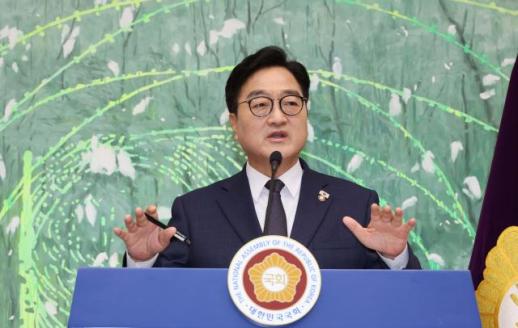 Outgoing National Assembly Speaker Reflects on Tenure, Calls for Constitutional Reform Woo Won-sik, the Speaker of the National Assembly, reflected on his two-year tenure during a press conference on May 28, stating, "It was a good decision to lead the effort to lift the illegal martial law." However, he expressed disappointment over the failure of the constitutional reform proposal due to opposition from the People Power Party. During the press conference held at the National Assembly, Woo remarked, "I feel like I was in the midst of upheaval and turmoil." He was elected as the Speaker of the 22nd National Assembly in 2024 and is set to conclude his term on May 29. Recalling the martial law period, Woo criticized former President Yoon Suk Yeol, saying, "He ignored the National Assembly," and added, "It was unrealistic, but I thought, 'This is what he intended to do' when the martial law was declared." He also confessed, "At that time, I was worried that we needed to resolve this before dawn, fearing that if the sun rose, the people might resist, leading to bloodshed." During his term, Woo led efforts to pass the proposal to lift the December 3 martial law, the impeachment motion against former President Yoon, and the establishment of the Serious Crimes Investigation Agency as part of judicial reform. Recently, he had also pushed for the processing of the constitutional reform proposal. Woo expressed regret over the failure of the constitutional reform initiative, stating, "I am disappointed that it did not come to fruition," but noted, "We resolved procedural obstacles, and public consensus on gradual constitutional reform has increased." He added, "I regret that we did not build barriers against the illegal martial law that I thought would never happen again, which occurred until recently." He highlighted the passage of urgent legislation, including the Special Law on Rental Fraud, the Yellow Envelope Law, the Franchise Business Act, and the Basic Law on Life Safety, as well as laws aimed at enhancing the nation's future competitiveness, such as the Commercial Act and the Semiconductor Special Act. Woo reflected, "There were times when the process of passing legislation was quite painful, but I prioritized bipartisan agreement and chose to mediate directly rather than waiting indefinitely, and when that failed, I made decisive choices." Addressing concerns about the neutrality of the Speaker, Woo stated, "If I had only taken the easy path amid the normalization of conflict between the parties, there would have been no progress at all. While bipartisan agreement is important, I believe the Speaker's role in the current National Assembly is to read the direction of public sentiment and find solutions." Woo also offered advice to his successor, saying, "I pondered a lot about how to conduct myself as Speaker. I faced complaints from People Power Party members about being one-sided and received strong criticism from Democratic Party supporters. However, in those moments, one must consider whether the choices benefit the people and democracy, rather than making partisan decisions." Following Woo's retirement, the National Assembly will temporarily operate under an acting Speaker. According to National Assembly law, the longest-serving member will assume this role. The longest-serving members in the 22nd National Assembly are Jo Jung-sik of the Democratic Party and Joo Ho-young and Jo Kyung-tae of the People Power Party. Given that Joo, born in 1960, is the oldest, he is likely to take on the acting Speaker role. Democratic Party spokesperson Lee Joo-hee also stated on May 21, "It seems that Joo will preside over the meeting for the election of the Speaker." The parties plan to hold a vote on June 5 to establish the leadership for the second half of the National Assembly. Meanwhile, the Democratic Party has nominated Jo Jung-sik for Speaker and Nam In-soon (fourth term) for Deputy Speaker. The People Power Party has nominated Park Deok-heum (fourth term) for Deputy Speaker. Both the Speaker and Deputy Speaker nominations require a majority vote from the members present. 2026-05-28 11:30:00
 -
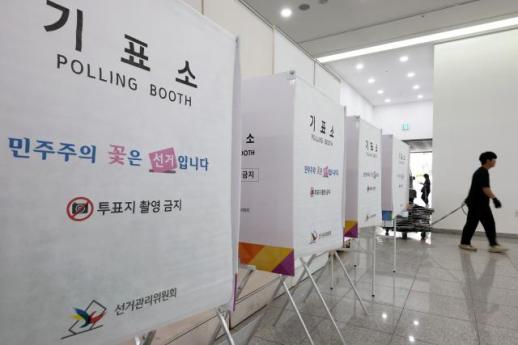 Ruling Party Expected to Win Local Elections with 57.1% Support A recent poll indicates that the ruling Democratic Party is expected to win the upcoming local elections. On May 28, the Korea Social Opinion Institute (KSOI) released results from a survey conducted from May 26 to 27, which showed that 57.1% of respondents anticipate a victory for the ruling party. In contrast, only 22.1% expect the opposition party to win, marking a 35 percentage point gap between the two. By age group, 66.7% of respondents in their 50s and 66% in their 60s predicted a win for the ruling party. However, among those in their 20s, 32.3% forecasted a victory for the opposition, the highest among all age groups. Regionally, the ruling party's expected victory was dominant across all areas. The highest support was in Gwangju and Jeolla, where 69.5% predicted a win, followed by Gangwon and Jeju at 64.3%, Gyeonggi and Incheon at 60.8%, and Daejeon, Sejong, and Chungcheong at 60.1%. In Seoul, the gap between expectations for the ruling and opposition parties was narrower. The ruling party's expected victory dropped by 6.5 percentage points from the previous survey to 48.8%, while the opposition's forecast rose to 30.7%. Looking at party support, 84.9% of Democratic Party supporters expect a win for their party, while support for the opposition party among People Power Party supporters fell by 8.3 percentage points to 47.6%. Among undecided voters, 36.2% expect a ruling party victory compared to 11.3% for the opposition, resulting in a 24.9 percentage point gap. In terms of political ideology, 83.7% of progressives and 67.1% of centrists anticipate a win for the ruling party. The survey was conducted using automated response methods with wireless virtual numbers provided by three telecommunications companies. The margin of error is ±3.1 percentage points at a 95% confidence level, with a response rate of 7.4%. For more details, please refer to the Central Election Polling Review Committee's website.* This article has been translated by AI. 2026-05-28 11:27:00
 -
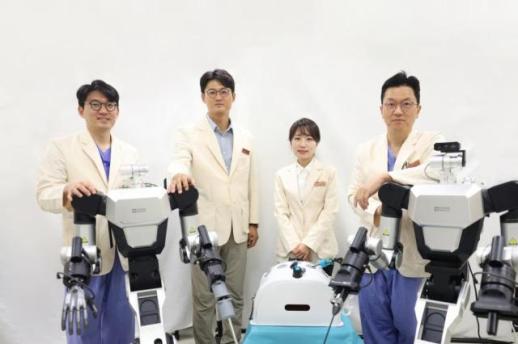 Samsung Medical Center to Build AI Surgical Robot Platform Samsung Medical Center is set to establish a platform to support the development and commercialization of AI-based surgical robots. As the medical AI robot market expands, the hospital aims to accelerate the establishment of a hub that supports everything from clinical validation to product commercialization. Industry observers are keen to see if the combination of the hospital's clinical capabilities and advanced technology can propel the domestic medical robot industry forward.On May 28, Samsung Medical Center announced that it has been selected as the lead organization for the Ministry of Health and Welfare's "AI-Based Surgical Robot Innovation Lab Construction and Utilization Project," which will receive approximately 10 billion won in government funding over the next five years.The hospital plans to establish the "AI-Based Surgical Robot Innovation Lab" and the "AURORA Lab (AI-Unified Robotics & Operative Research Accelerator Lab)," which will identify unmet needs in surgical settings and enable rapid validation and feedback in real clinical environments.Additionally, dedicated research facilities and testing environments for surgical robots will be created, and a specialized team will support the entire product development process, including performance verification, safety assessments, and usability evaluations.The project will involve collaboration with robotics companies such as Rainbow Robotics, E-Rob, and Roen Surgical, as well as institutions like Samsung Convergence Medical Center, Daegu Gyeongbuk Institute of Science and Technology, Tomorrow Robotics, and Ha Hae-ho. The project will be led by Professor Jeong Yong-ki from the Department of Otorhinolaryngology at Samsung Medical Center.During the first phase of the project, which runs until 2028, the focus will be on establishing specialized research facilities for surgical robots, enhancing AI technology, developing prototypes, and securing patents. In the second phase, from 2029 to 2030, the goal is to elevate the technology readiness level (TRL) to 8. Following this, the plan includes obtaining regulatory approvals from domestic and international agencies and facilitating the introduction of innovative medical technologies into actual healthcare settings.The medical AI robot market is also in a phase of expansion. According to the U.S. market research firm Grand View Research (GVR), the global medical robot market is estimated to reach $25.56 billion in 2023, with an expected annual growth rate of 16.55% until 2030.* This article has been translated by AI. 2026-05-28 11:24:00
 -
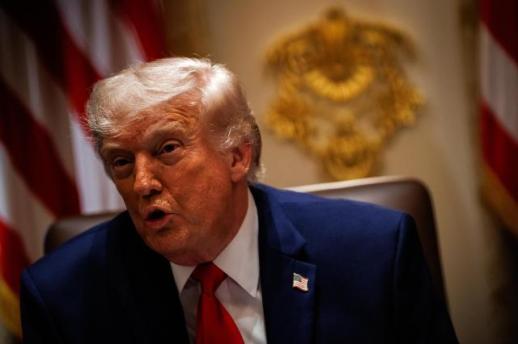 Trump Warns Oman Over Iran's Proposed Hormuz Toll Donald Trump, the President of the United States, issued a strong warning regarding Oman’s discussions with Iran about imposing a toll on ships passing through the Strait of Hormuz, even mentioning the possibility of military action. On May 27, during a Cabinet meeting at the White House, Trump stated, "Oman must act like other countries. Otherwise, we may have to blow them away." He added, "They understand that point. It will be fine." Earlier, Mohammad Aminnejad, Iran's ambassador to France, revealed in an interview with Bloomberg that Iran and Oman were discussing the establishment of a permanent toll system for vessels transiting the Strait of Hormuz. Politico reported that Trump rejected this proposal and threatened that Oman, a U.S. ally, could face severe consequences. The reopening of the Strait of Hormuz has emerged as a key issue in negotiations aimed at ending the conflict between the U.S. and Iran. The strait, located between Iran and Oman, could be completely blocked if the two nations reach an agreement. Therefore, Oman’s discussions with Iran regarding tolls could be seen as a thorn in the side of the U.S., which is currently pursuing the reopening of the strait through peace negotiations with Iran. Trump reiterated his stance that the Strait of Hormuz should not be under the control of any nation. He stated, "The strait must be open to everyone. It is international waters. No one will control it. We will monitor it, but no one can control it." Oman has played a crucial mediating role in the Iran nuclear negotiations and U.S.-Iran backchannel communications. While maintaining a friendly relationship with the U.S., Oman has not participated in Trump’s Abraham Accords. CNN noted that Trump’s remarks add Oman to the list of countries he has threatened or mentioned as potential targets during his presidency. Since taking office, Trump has conducted military actions in Iran, Iraq, Nigeria, Somalia, Syria, Venezuela, and Yemen, and has also mentioned the possibility of attacks on Canada, Colombia, Cuba, Greenland, Mexico, Panama, and Oman. However, CNN pointed out that not all of these threats and actions are of the same nature, with some being limited attacks aimed at specific terrorist groups. Analysts suggest that Trump employs a so-called "madman theory" in his foreign policy, using unpredictable rhetoric to pressure adversaries.* This article has been translated by AI. 2026-05-28 11:24:00
 -
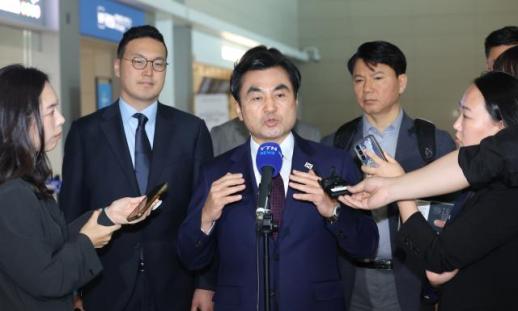 An Kyoo-baek to Attend Shangri-La Dialogue, Hold Bilateral Talks with Japan and Australia Defense Minister An Kyoo-baek will participate in the 23rd Shangri-La Dialogue, scheduled to take place in Singapore from May 29 to 31. According to the Ministry of National Defense on May 28, Minister An will deliver a speech on May 30 addressing "Regional Security Challenges and South Korea's Strategic Response," outlining South Korea's defense policies in response to the rapidly changing security environment. During the event, Minister An is expected to hold discussions with delegations from the United States Congress, as well as defense ministers from Japan, Australia, Norway, the Philippines, and Thailand, focusing on expanding defense and military cooperation. This will mark the first face-to-face meeting between Minister An and Japan's Defense Minister Shinjiro Koizumi since their bilateral talks in Yokosuka, Kanagawa Prefecture, during An's visit to Japan in January. U.S. Secretary of Defense Pete Hegseth will also attend this year's Shangri-La Dialogue. However, a bilateral meeting between the U.S. and South Korean defense ministers has already taken place on May 11 during Minister An's visit to the U.S., making another meeting during the Shangri-La Dialogue unlikely. Attention will be on whether the defense ministers of South Korea, the U.S., and Japan will have the opportunity to meet together. The Shangri-La Dialogue is an annual multilateral security conference organized by the International Institute for Strategic Studies (IISS) since 2002, bringing together defense ministers, senior military officials, and security experts from major countries in the Asia-Pacific and Europe, including South Korea, the United States, Japan, ASEAN, and the EU. The event has been held annually at the Shangri-La Hotel in Singapore since its inception, hence the name "Shangri-La Dialogue."* This article has been translated by AI. 2026-05-28 11:24:00
 -
 Hyundai Mobis joins Eclipse Foundation's open-source SDV project SEOUL, May 28 (AJP) - Hyundai Mobis announced it has joined the Eclipse Foundation's Software-Defined Vehicle working group and will contribute to the S-Core project, a global open-source initiative to standardize the software platforms that underpin next-generation connected vehicles. The S-Core project, launched in late 2024 by a consortium of European firms, aims to build a common middleware layer for SDV systems certified to functional safety standard ASIL-B — the first of its kind built on an open-source foundation. Thirteen companies are currently involved in the effort, pooling resources to reduce duplicated investment and accelerate development of the shared technical base that applications such as autonomous driving depend on. Hyundai Mobis said Thursday it marks the first time the company has opened its proprietary code to outside developers. The company will contribute its container solution technology, which isolates individual software processes running on Linux to prevent interference between them. Through the project, Hyundai Mobis said it expects to collaborate with a broad range of automakers, parts suppliers, and software specialists, while positioning its technologies as candidates for global industry standards. The company added that open-sourcing its code is itself a public demonstration of confidence in its software capabilities. 2026-05-28 11:21:20
 -
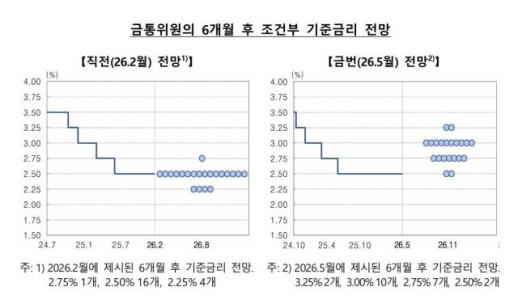 Bank of Korea Signals Potential Rate Hikes Amid Economic Pressure The Bank of Korea is expected to shift towards a hawkish stance in its six-month outlook for the benchmark interest rate, indicating the possibility of two rate hikes within the year. According to the dot plot released on May 28, 19 out of 21 projections are set above the current rate until November. This suggests that most members of the Monetary Policy Committee anticipate a rate increase within the next six months. The dot plot includes projections from seven committee members, including Governor Shin Hyun-song, each providing three estimates. The most common projection is 3.00%, with 10 members indicating this rate, while seven members projected 2.75%. Two members suggested rates of 3.25% and 2.50%, respectively. If these projections hold true, the likelihood of a rate increase has risen, with at least three members forecasting two hikes by November. The committee has maintained the current rate during its last six meetings, including those held in July, August, October, and November of last year, as well as January, February, and April of this year. However, given the robust economy and rising inflation pressures due to the conflict in the Middle East, the committee hinted at a tightening monetary policy. In its decision statement, the committee noted, "Future monetary policy will be determined by assessing the extent of inflationary pressures, the trajectory of economic improvement, and financial stability conditions." During the rate decision process, five committee members voted to maintain the current rate, while members Jang Yong-seong and Yoo Sang-dae expressed a minority opinion favoring an increase to 2.75%. Looking ahead, there are four scheduled monetary policy meetings before November, including those in July, August, October, and November. The dot plot, introduced in February, will be released quarterly in conjunction with economic forecasts in February, May, August, and November. Each committee member may project all three estimates at the same rate or distribute them across different levels. In the previous dot plot released in February, 16 out of 21 projections clustered around the current benchmark rate of 2.50%, indicating expectations for a rate freeze. At that time, four projections were at 2.25%, and only one was at 2.75%. The significant shift in this latest dot plot is interpreted as a response to the Middle Eastern conflict and strong semiconductor exports.* This article has been translated by AI. 2026-05-28 11:12:00
 -
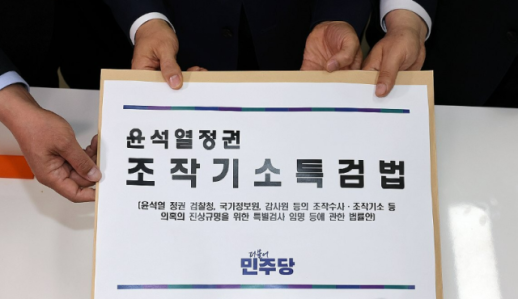 Concerns Raised Over Special Prosecutor Bill's Authority to Dismiss Charges The Corruption Investigation Office has expressed concerns regarding a clause in the special prosecutor bill, known as the "manipulated prosecution special prosecutor law," which would allow the special prosecutor to decide whether to maintain charges. The office submitted its opinion to the National Assembly, stating that this provision could violate the principle of separation of powers. On May 28, legal sources reported that the Corruption Investigation Office conveyed its concerns in a written response to Representative Koo Ja-geun of the People Power Party. The office noted that the clause allowing the special prosecutor to take over cases and decide on charge maintenance raises potential issues with the principle of separation of powers, warranting careful consideration. However, the office clarified that the decision on whether a special prosecutor is needed for specific cases should be determined by the National Assembly, which holds legislative authority. This decision should take into account the necessity for an independent special prosecutor, public interest, and various circumstances surrounding the cases. The clause in question is Article 8, Section 7 of the bill, which states that "the special prosecutor shall perform the duties related to the maintenance of charges for the cases received." Previously, the Democratic Party introduced the bill on April 30, aimed at appointing a special prosecutor to investigate allegations of manipulated investigations and prosecutions by the Yoon Suk-yeol administration, the National Intelligence Service, and the Board of Audit and Inspection. The bill includes a total of 12 cases for investigation, such as the Daejang-dong development corruption scandal, the Ssangbangwool North Korea remittance case, and the shooting of a civil servant in the West Sea. Legal experts have pointed out that this clause could effectively grant the special prosecutor the authority to dismiss charges. The Supreme Prosecutors' Office also expressed concerns on April 30, stating that it could unduly influence the independence of the judiciary. The Economic Justice Action has also called for the removal of the clause granting charge dismissal authority. Political disputes continue over the advancement of the bill. The People Power Party has labeled the bill as a "charge dismissal special prosecutor" and has opposed it. In contrast, the Democratic Party has stated that it will gather opinions on the timing and procedures for processing the bill after the local elections.* This article has been translated by AI. 2026-05-28 11:09:00
 -
 Park Ji-hyun Reveals Father's Battle with Stomach Cancer Actor Park Ji-hyun has revealed that her father, a doctor, is battling stomach cancer. On May 27, Park appeared as a guest on the tvN variety show "You Quiz on the Block." During the episode, she discussed her role in the Netflix series "Eun-jung and Sang-yeon," stating, "Since my father is a doctor, I sought a lot of medical advice during the preparation for the project," and added, "He was diagnosed with cancer around the time 'The Youngest Son of a Conglomerate' was released." She explained the situation, saying, "At the time when the ratings for 'The Youngest Son of a Conglomerate' were rising, I received a call from my brother. They found pus in his stomach due to food poisoning, and while he was hospitalized at a university hospital, they conducted further tests and discovered cancer." Park continued, "From that point on, his condition worsened, and I felt like something was being taken away from me while I was given something in return." She expressed that her father's illness weighed heavily on her heart. She also mentioned that she asked her father many questions during filming. "While shooting 'Eun-jung and Sang-yeon,' I thought of my father a lot. When I received the script, he was in a much better condition, so I asked him many questions. I asked him what kind of pain he was experiencing, and he said, 'If it weren't for my family, I would have wanted to die.' Hearing that made me understand Sang-yeon's feelings," she said. Despite his battle with cancer, Park's father expressed joy over his daughter's achievements. Park reflected, "I think my father felt proud that I was able to show some success in my acting while he was sick. I saw him liking all the posts fans shared, and I thought that showing a good image through my active work was the best I could do for him."* This article has been translated by AI. 2026-05-28 11:09:00
 -
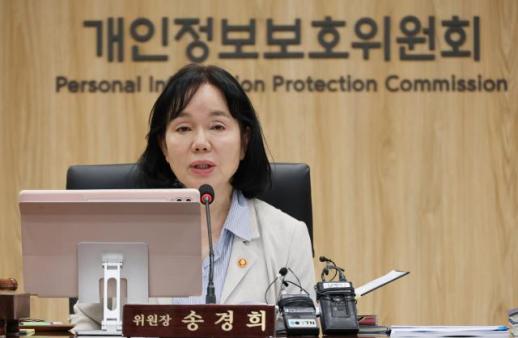 Privacy Commission Recommends Improvements to Face Recognition System for Mobile Phone Registration The Personal Information Protection Commission has recommended improvements to the face recognition system implemented during mobile phone registration, citing inadequate privacy protections. On May 28, the commission announced that it had approved a set of recommendations regarding the operation of the face recognition system during mobile phone registration at its plenary meeting the previous day. The Ministry of Science and ICT has been piloting the face recognition system since December as part of a government initiative to combat voice phishing. This system compares a photo of the user's ID with their live face in real time. The commission's investigation found that the ministry had not sufficiently considered the sensitivity of biometric data from a privacy protection perspective. Under the Personal Information Protection Act, facial data is classified as sensitive information and can only be processed with the consent of the individual or a clear legal basis. Concerns were raised about the lack of clarity in existing telecommunications laws regarding the use of facial data as a means of identity verification during mobile phone registration. Additionally, the commission noted that users effectively have no choice but to accept face recognition, which undermines their ability to opt out. It also suggested that the scope of data processed by the contractor's system should be minimized. The commission urged the ministry to thoroughly review the necessity, applicability, effectiveness, appropriateness, and proportionality of processing biometric data before formal implementation. It emphasized the need to operate the system according to the principle of privacy by design (PbD) and to clarify legal grounds and protections for individuals' rights. The commission plans to monitor the implementation of these recommendations and support efforts to ensure that government-wide measures against voice phishing are carried out within a framework that protects personal information.* This article has been translated by AI. 2026-05-28 11:06:00