

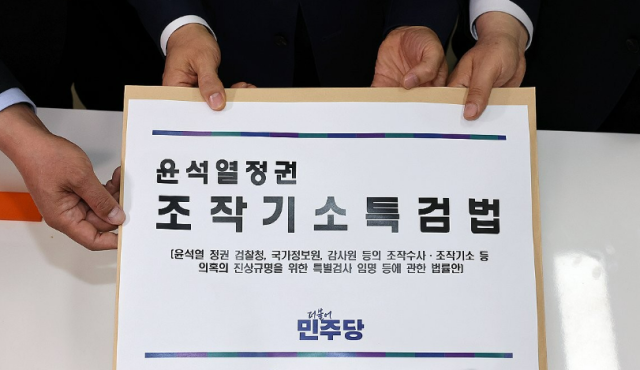
The Corruption Investigation Office has expressed concerns regarding a clause in the special prosecutor bill, known as the "manipulated prosecution special prosecutor law," which would allow the special prosecutor to decide whether to maintain charges. The office submitted its opinion to the National Assembly, stating that this provision could violate the principle of separation of powers.
On May 28, legal sources reported that the Corruption Investigation Office conveyed its concerns in a written response to Representative Koo Ja-geun of the People Power Party. The office noted that the clause allowing the special prosecutor to take over cases and decide on charge maintenance raises potential issues with the principle of separation of powers, warranting careful consideration.
However, the office clarified that the decision on whether a special prosecutor is needed for specific cases should be determined by the National Assembly, which holds legislative authority. This decision should take into account the necessity for an independent special prosecutor, public interest, and various circumstances surrounding the cases.
The clause in question is Article 8, Section 7 of the bill, which states that "the special prosecutor shall perform the duties related to the maintenance of charges for the cases received."
Previously, the Democratic Party introduced the bill on April 30, aimed at appointing a special prosecutor to investigate allegations of manipulated investigations and prosecutions by the Yoon Suk-yeol administration, the National Intelligence Service, and the Board of Audit and Inspection.
The bill includes a total of 12 cases for investigation, such as the Daejang-dong development corruption scandal, the Ssangbangwool North Korea remittance case, and the shooting of a civil servant in the West Sea.
Legal experts have pointed out that this clause could effectively grant the special prosecutor the authority to dismiss charges. The Supreme Prosecutors' Office also expressed concerns on April 30, stating that it could unduly influence the independence of the judiciary.
The Economic Justice Action has also called for the removal of the clause granting charge dismissal authority.
Political disputes continue over the advancement of the bill. The People Power Party has labeled the bill as a "charge dismissal special prosecutor" and has opposed it. In contrast, the Democratic Party has stated that it will gather opinions on the timing and procedures for processing the bill after the local elections.
* This article has been translated by AI.
Copyright ⓒ Aju Press All rights reserved.