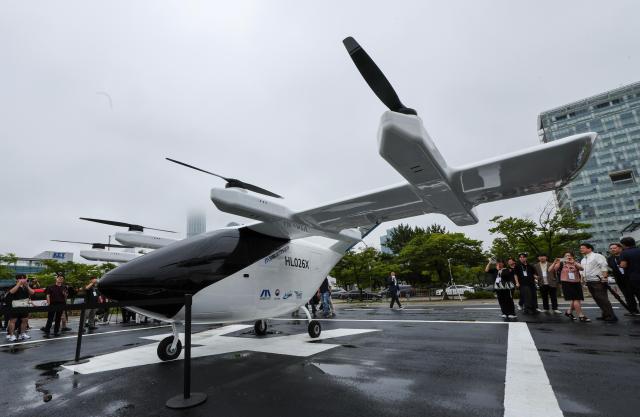
The unmanned aircraft remained firmly on the ground despite three attempts to take off during the K-UAM Flight Showcase at Incheon National University's INU Innovation Center.
Organizers eventually called off the demonstration, citing rain and suspected radio interference.
The showcase was intended to demonstrate South Korea's progress toward urban air mobility ahead of the 2026 Korea Drone & UAM Expo.
Instead, it inadvertently revealed the formidable technological, regulatory and operational challenges that remain before air taxis can safely fly over crowded cities.
The event had been scheduled about a week in advance, according to an official. But by 9 a.m., wind swept across the outdoor venue while a light drizzle began to fall, raising concerns over whether the aircraft would be able to fly at all.
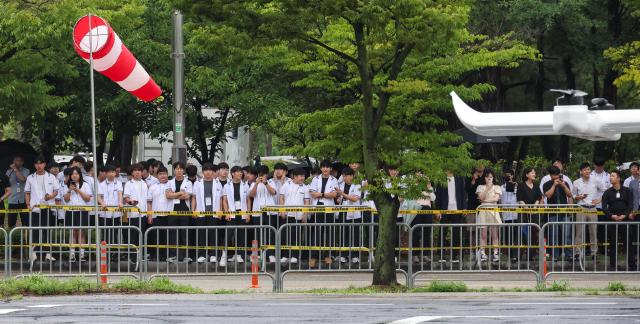
Organizers had been hoping for a brief 30-minute break in the weather around 10 a.m. As forecast, the rain eased shortly before the demonstration, allowing hundreds of visitors, government officials and students from Incheon National University and Inha University to gather around the fenced-off flight area.
Then came the countdown.
"Three, two, one."
Nothing happened, and an awkward silence fell over the crowd including VIPs from the air force.
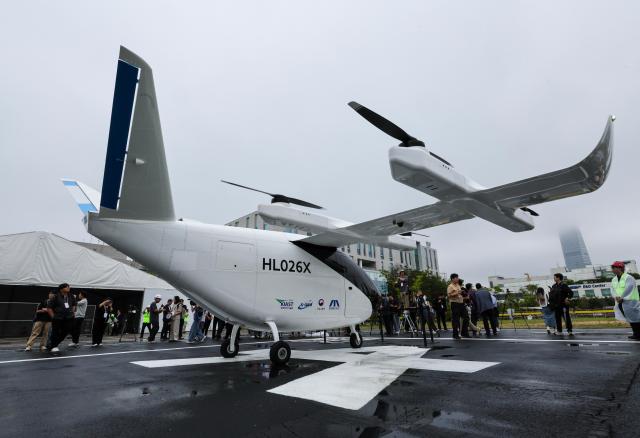
An event official said an unauthorized drone appeared to have entered nearby airspace shortly before the demonstration and may have disrupted radio communications. The official added that the interference did not appear to have originated from mobile phone signals.
A Sambo Motors official said Wednesday's event effectively marked the company's first attempt to fly the aircraft in an urban environment.
Previous test flights had been conducted in relatively isolated areas such as Taean, where radio conditions are far less congested than in metropolitan areas.
The company said it still needs to analyze flight logs before determining the exact cause of the failure. But the official acknowledged that the current prototype relies on communication systems similar to those used by drones rather than fully aviation-grade flight-control networks.
That admission highlighted one of the least visible but perhaps most fundamental obstacles facing the urban air mobility industry.
While public attention often focuses on electric propulsion, batteries and aircraft design, reliable communications, navigation and flight-control systems will ultimately determine whether future air taxis can safely operate above densely populated cities filled with high-rise buildings, competing wireless signals and increasing numbers of drones.
If a nearly one-ton unmanned prototype can be grounded by unexpected radio interference during a controlled public demonstration, commercial aircraft carrying passengers will require multiple layers of redundancy and significantly more robust aviation-grade systems before regulators allow routine operations.
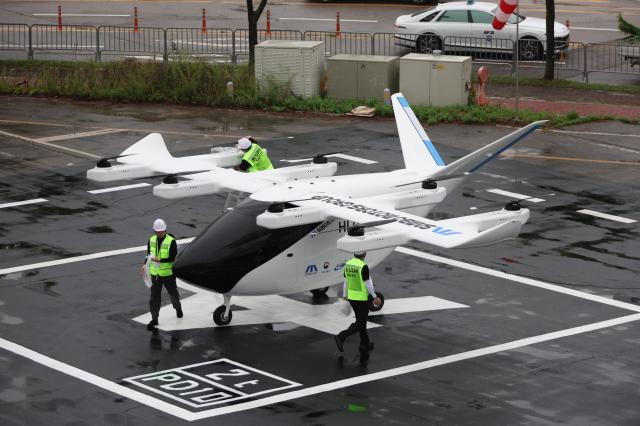
"This aircraft is a test vehicle," Joo said. "It is designed as a two-seat aircraft, but we are currently flying it without a pilot to verify key systems."
He added that radio interference would have posed a different issue had a pilot been on board.
"If a pilot had been onboard, radio interference would not have been the same kind of problem," he said.
The B-32-R2 measures about 10 meters wide, 6.2 meters long and 3.2 meters high, with a maximum takeoff weight of 950 kilograms. Powered by eight electric motors, the aircraft is being used to validate flight-control technologies before Sambo Motors develops a larger commercial model.
According to Joo, the company is already working on a three-seat aircraft weighing roughly 1.7 tons that is intended for eventual passenger operations.
The company's development timeline also underscored a widening gap between government ambitions and industry expectations.
The Ministry of Land, Infrastructure and Transport aims to launch South Korea's first urban air mobility services in 2028. Sambo Motors officials, however, acknowledged that their own commercial passenger aircraft is unlikely to be ready before 2030.
That suggests the government's target is likely to consist of tightly controlled pilot operations rather than widespread commercial air taxi services.
Indeed, the ministry's own roadmap envisions a much more limited initial rollout than the futuristic image often associated with flying taxis.
Early operations will focus on sightseeing flights, regional connections and airport-linked routes within designated trial zones. Flights will operate only during daylight hours and favorable weather conditions. Only one aircraft will be permitted within each flight corridor at a time, with daily operations limited to no more than ten one-way flights. Aircraft will fly within designated corridors at altitudes between 300 and 600 meters, while individual routes will generally be limited to about 50 kilometers.
In other words, the 2028 milestone represents the beginning of a carefully managed aviation trial rather than the arrival of flying taxis as a routine form of urban transportation comparable to buses, subways or conventional taxis.
Sambo Motors is already identifying potential routes for those early operations.
One possibility under consideration would connect Jamsil in southeastern Seoul with Incheon International Airport, covering approximately 65 kilometers. The company is also studying services in Busan, including routes linking Busan Port with Haeundae or Gimhae International Airport, where aircraft could fly largely over coastal areas with fewer obstacles than central Seoul.
Company officials said vertiports would function much like railway stations for future air taxis. Although fares have yet to be finalized, the company expects prices to be comparable with—or slightly above—premium black taxi services.
Executives also openly acknowledged that South Korea still trails leading urban air mobility developers in the United States, Europe and China.
"Korea is not yet at the same level as global frontrunners," one company official said. "But we believe we can catch up as a fast follower by leveraging our strengths in batteries and manufacturing."
Despite the failed demonstration, the aircraft continued attracting curious visitors throughout the day.
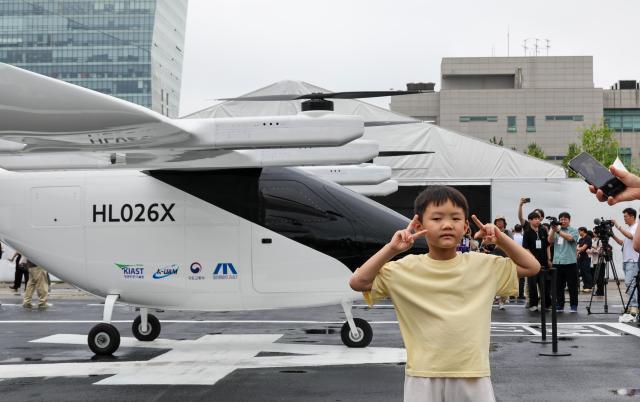
"I've always liked drones," Yoo said. "I don't know exactly why, but they're cool."
Although the aircraft never left the ground, he said he was not disappointed.
"Even though it didn't take off, I still felt good," he said.
Asked whether he would ride a flying taxi if one became available someday, Yoo answered without hesitation.
"If there is really a flying taxi someday, I definitely want to ride it once," he said. "I want to experience it."
His excitement captured the paradox facing South Korea's urban air mobility industry.
Public imagination has already embraced the vision of flying taxis, but Wednesday's grounded demonstration showed that turning that vision into a safe, reliable commercial transport system will require far more than simply getting an aircraft off the ground once.

Copyright ⓒ Aju Press All rights reserved.