
Journalist

Ra Mason
-
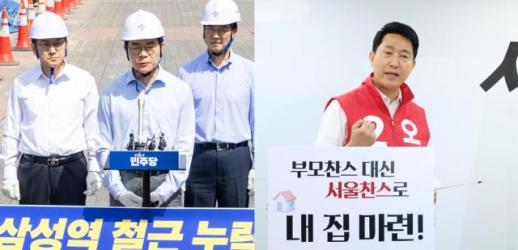 Negative Campaigning Intensifies in Seoul Mayor Race Ahead of Local Elections As the nationwide local elections approach on May 31, the race for Seoul mayor is heating up. Negative campaigning surrounding alleged mistakes and controversies has intensified, increasing tension among candidates. Jung Won-oh, the Democratic Party's candidate, targeted Oh Se-hoon, the People Power Party candidate, over a construction issue involving missing rebar in the GTX-A line at Samseong Station, which occurred during Oh's tenure as mayor. During a visit to the construction site, Jung criticized the situation as a reflection of the city’s irresponsible safety oversight. He questioned when Oh first learned of the construction deficiencies and what actions he took, raising suspicions of a cover-up due to the delay in reporting the issue to the Ministry of Land, Infrastructure and Transport. Jung's campaign labeled the incident as a "reporting omission of the GTX construction failure" and asserted that the city bears responsibility for the problems arising from the construction. Lee In-young, the head of Jung's campaign committee, held a press conference at the National Assembly, demanding that Oh explain whether he concealed the issue during his time as mayor and warned that legal accountability may be pursued if necessary. In response, Oh denied the allegations of covering up the construction failures and escalated his counterattacks by announcing a pledge to eradicate alcohol-related violence. After unveiling his housing promises for young people at his campaign office, Oh stated, "Upon investigation, it turns out that Hyundai Engineering & Construction acknowledged the mistake and reported it themselves; I only learned about it yesterday." He dismissed the cover-up allegations, suggesting that Jung's campaign appears to be on the defensive. Later in the day, Oh announced the "Zero Alcohol Violence Project," which aims to implement a zero-tolerance policy for alcohol-related misconduct among city officials, targeting a past incident involving Jung from 1995 when he was an aide to the mayor of Yangcheon District. The People Power Party also joined the fray, filing a counter-complaint against Democratic Party lawmakers for alleged violations of the Public Official Election Act. Earlier, Democratic Party lawmaker Seo Young-kyo and others accused Jung of assaulting a female employee who refused to stay overnight. Joo Jin-woo, a lawmaker from the People Power Party, announced on his Facebook that Seo's initial complaint reignited the controversy over Jung's alleged coercion, emphasizing the need to thoroughly investigate the claims. The ruling party has vowed not to back down. Lee In-young condemned the "shameless black propaganda" against Jung and stated that three complaints have already been filed, assuring that there will be no cover-up after the elections.* This article has been translated by AI. 2026-05-17 16:40:20
 -
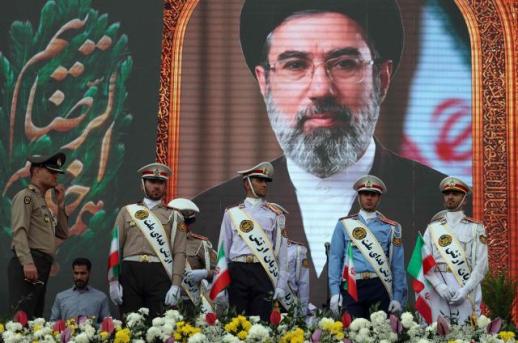 Iran-Backed Militants Expand Attack Plans to Include U.S. Soil Concerns are growing that Iran-backed militant groups may expand their activities beyond the Middle East, including potential attacks on U.S. soil, following revelations of their plans to target Western nations. The New York Times reported on May 16, citing an indictment released in a Manhattan federal court, that Mohammad al-Sadi, a senior official of the Iraqi militia Kata'ib Hezbollah, has been charged with plotting at least 20 attacks against Western countries, including the United States, since the onset of the war in late February. Al-Sadi is accused of planning a firebomb attack at a synagogue in Belgium and a terrorist act against a Bank of America building in Paris. Investigations in the U.S. revealed he also attempted to attack a synagogue in New York City. Iraqi media outlet Saberin News, linked to the militia, reported that al-Sadi was arrested by Turkish security forces while traveling to Moscow via Turkey. While Kata'ib Hezbollah has not commented on al-Sadi's arrest or the charges against him, his lawyer claims he is a "political prisoner and a war captive." This incident raises alarms about the potential for Iran's proxy forces, previously focused on the Middle East, to extend their operations into the U.S. and Europe. Aaron Zelin, a scholar at the Washington Institute for Near East Policy, told the Times, "They (Kata'ib Hezbollah) are now expanding their operational scope beyond war zones to Western countries, suggesting that Iran-supported 'Axis of Resistance' is becoming involved in more attacks against the West." Experts believe that groups like Kata'ib Hezbollah are likely conducting overseas operations with the approval of Iran's Islamic Revolutionary Guard Corps (IRGC). Given the potential backlash against Iran, which is already engaged in conflict with the U.S., it would be difficult for these proxies to operate independently without IRGC consent. Since the late 1980s, Iran has built a network of proxy militias known as the 'Axis of Resistance' throughout the Middle East. These groups have grown into significant armed forces in Iraq and have reportedly participated in attacks targeting the U.S. Embassy in Iraq and oil facilities in Gulf nations following the recent war. The U.S. has repeatedly highlighted the threat posed by Iran-backed militant groups. According to The New Region, U.S. Central Command (CENTCOM) Commander Brad Cooper stated during a Senate Armed Services Committee hearing on May 14 that "in just 30 months before the start of Operation Epic Fury, Iran-backed terrorist groups attacked U.S. troops and diplomats over 350 times. This equates to more than one attack every three days, resulting in the deaths of four U.S. service members and nearly 200 injuries." In response, the U.S. government has increased pressure on Iran-backed militias in Iraq, offering rewards of up to $10 million (approximately 15 billion won) and imposing related sanctions. A State Department spokesperson explained that the reward program for Abu Ala al-Walai, the leader of Kata'ib Sayyid al-Shuhada (KSS), is part of efforts to dismantle Iran-backed militias in Iraq and advance U.S.-Iraq relations.* This article has been translated by AI. 2026-05-17 16:34:19
 -
 Samsung Electronics Strike Looms as Government Considers Emergency Mediation The impending strike by Samsung Electronics' labor union has deepened concerns for labor authorities. The government, which has maintained a principle of 'self-resolution' between labor and management, has officially mentioned the possibility of invoking emergency mediation for the first time, reflecting the tension between pro-labor policies and economic risks.In a public address on May 17, Prime Minister Kim Min-seok stated, "If a situation arises where the strike could cause significant damage to the national economy, we cannot rule out any possible response measures, including emergency mediation."He emphasized that the negotiations on May 18 represent the "de facto last chance" to prevent a strike, urging both labor and management not to take the gravity of the situation lightly.The presence of Minister of Employment and Labor Kim Young-hoon at the address underscores the government's serious recognition of the issue. Emergency mediation is a measure that can be activated by the Minister of Employment and Labor when a labor dispute poses a significant risk to the national economy.The government's public mention of such a 'last resort' is unusual. Until recently, officials maintained that "emergency mediation is not under consideration," prioritizing resolution through voluntary negotiations and mediation by the Central Labor Relations Commission.However, as the potential for disruptions in semiconductor production becomes more tangible, a shift in sentiment is evident. Minister Kim Young-hoon met with both the union and management on May 15 and 16 to hear their positions and facilitate last-minute adjustments.In light of these developments, both sides have agreed to resume negotiations under the Central Labor Relations Commission's post-adjustment procedures on May 18. With only three days remaining until the strike, this adjustment is likely to be the final negotiation. The union has announced plans for a total strike from May 21 to June 7, with over 46,000 members expressing their intention to participate.If emergency mediation is invoked, strike actions could be suspended for up to 30 days while the Central Labor Relations Commission initiates its own mediation. This measure has not been used since it was activated during a strike in the airline industry under the Roh Moo-hyun administration in 2005.The government's consideration of this option is rooted in the semiconductor industry's critical role in the domestic economy. Semiconductors account for about 35% of South Korea's total exports, and the Korea Development Institute (KDI) has analyzed that a 10% drop in semiconductor exports could reduce the country's GDP by 0.78%. Given the nature of semiconductor production, once a production line halts, it takes considerable time to restart, making the burden of a prolonged strike significant.Industry experts are concerned that if the strike materializes, it could lead to decreased exports, supply chain instability, and shocks to the stock market, given that Samsung Electronics accounts for more than a quarter of the domestic stock market's total capitalization.However, the government's public mention of the possibility of invoking emergency mediation could escalate tensions between labor and the government. The Korean Confederation of Trade Unions criticized the emergency mediation as a "last resort that should only be considered in exceptional circumstances," while the Korean Trade Union Confederation expressed concerns that it could set a precedent for restricting the strike rights of workers in large corporations.* This article has been translated by AI. 2026-05-17 16:28:46
 -
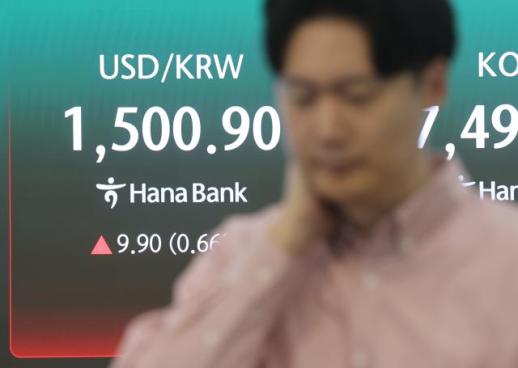 Korean Won Surges Past 1500 Against Dollar Amid Foreign Capital Outflow The won-dollar exchange rate has experienced significant fluctuations, rising nearly 70 won in just over a week to surpass the 1500 mark. This volatility is attributed to ongoing foreign capital outflows, compounded by geopolitical risks in the Middle East and strong dollar pressures. According to the Seoul foreign exchange market on May 17, the won closed at 1500.8 won per dollar on May 15, up 9.8 won from the previous trading day. On that day, the exchange rate opened at 1494.2 won, rising to the low 1500s by mid-afternoon. This marks the first time the rate has exceeded 1500 since April 7. Recent fluctuations in the exchange rate have been pronounced. The rate dropped to 1439.6 won on May 6, only to soar to 1507.7 won on May 15, creating a nearly 70 won gap between the low and high points within a week. Foreign capital outflows are a key factor driving the exchange rate increase. Foreign investors have consistently sold off domestic stocks over the past week, with net sales reaching 31 trillion won over seven consecutive trading days. Moon Da-woon, a researcher at Korea Investment & Securities, noted that foreign investors have been in a selling phase since the fourth quarter of last year, and the recent surge in domestic stock returns has led to additional selling pressure due to profit-taking and rebalancing. Deputy Prime Minister and Minister of Economy and Finance Koo Yun-cheol expressed concern, stating, "The excessive volatility in our economy is being driven by foreign investors selling stocks and speculative trading outside the country." Investor sentiment across the domestic financial market remains subdued. Uncertainties surrounding labor negotiations at Samsung Electronics and concerns over fiscal expansion have led to a sharp rise in bond yields. On May 15, the yield on three-year government bonds closed at 3.766%, up 11.2 basis points from the previous day. This marks the first time the three-year yield has reached the 3.7% range since November 16, 2023. Internationally, political instability in the UK has weakened the pound, further strengthening the dollar and increasing downward pressure on the won. The potential challenge to Prime Minister Keir Starmer from Manchester Mayor Andy Burnham, following his securing of parliamentary candidacy, has raised concerns over fiscal sustainability due to increased spending. As a result, the pound fell to its lowest level in over a month as of May 15. Geopolitical risks from the Middle East are also contributing to upward pressure on the exchange rate. Stalled peace negotiations between the U.S. and Iran, along with inconclusive results from the U.S.-China summit, have led to ongoing uncertainties regarding potential conflicts. Analysts warn that if high oil prices persist, risk appetite may diminish, potentially solidifying the won-dollar exchange rate in the 1500 range. However, some analysts suggest that further upward movement may be limited. Moon noted, "The current range between 1500 and the post-war peak of 1536 is a zone where government intervention is likely, and the burden of levels is quite high. This week, with domestic and external pressures on the exchange rate overlapping temporarily, we expect more short-term increases rather than a sustained rebound." * This article has been translated by AI. 2026-05-17 16:24:37
 -
 Semiconductor Society Warns Samsung Strike Could Harm Industry Workforce Development The Semiconductor Society, representing the domestic semiconductor academic community, expressed concern over the total strike at Samsung Electronics. On May 17, the society's president, Choi Ki-young, Professor Emeritus at Seoul National University, stated, "The total strike at Samsung Electronics will have a devastating impact on the entire ecosystem of the domestic semiconductor industry," urging both labor and management to avoid the strike. He further noted, "If negotiations are prolonged or production disruptions accumulate, the repercussions will extend beyond the parties involved to affect suppliers, the research community, and the training of future personnel." Professor Choi emphasized, "The semiconductor industry has accounted for over 20% of national exports and is now nearing 40%, serving as a pillar of the South Korean economy. Samsung's semiconductor division is a crucial part of that pillar. Suppliers of materials, components, and equipment, as well as professors and students in the society, have all grown through research and communication within the Samsung semiconductor ecosystem." He added, "Currently, the world is making the largest-scale semiconductor investments in history to keep pace with the AI revolution. It is time for South Korea to unite to secure advanced semiconductor technology for the AI era." Finally, he earnestly appealed, "At this critically important time for the nation, both labor and management should deeply consider the potentially devastating effects on the national economy and the entire semiconductor industry and strive to conclude negotiations amicably."* This article has been translated by AI. 2026-05-17 16:22:29
 -
 First 'India Day' transforms Seoul riverfront into 'Mini India' SEOUL, May 17 (AJP) - On Saturday, May 16, the weekend breeze off the Han River carried the heavy scents of cumin, masala, and roasting curries. Under a cloudless early-summer sky, Mulbit Square at Yeouido Hangang Park was temporarily remade into a "Mini India." More than 1,500 people navigated the sprawling outdoor festival, where visitors in bright saris mingled alongside families setting up pop-up tents and picnic mats under the trees. Hosted by the Embassy of India and the Swami Vivekananda Cultural Centre, the inaugural "India Day" was pitched as a cultural showcase, but its roots are diplomatic. The event was launched to support an agreement expanding bilateral exchanges, brokered last month during South Korean President Lee Jae Myung's state visit to India to strengthen the nations' Special Strategic Partnership. Organized around a "Unity in Diversity" theme, booths highlighted regional specialties from India's 28 states and eight union territories. The displays ranged from Rajasthan marble crafts to a live handloom demonstration by a Pashmina weaver from Jammu and Kashmir. For food, the Coffee Board of India poured five varieties of GI-tagged Arabica, while the Marine Products Export Development Authority served traditional Kerala seafood curries. Nearby, long lines snaked away from food trucks hawking regional street snacks. For many locals, the draw was simply a new weekend experience. Park Nam-seok, a 40-year-old resident of Gangseo-gu, came after his son was invited by an Indian friend, Swapran. "I didn't expect much since it's the first year, but the festival turned out to be much bigger and better organized than I imagined. It's a great event to come to with children," Park said. "It was my first time trying Indian food, and it was honestly really delicious." The festival also served as a gathering point for expats eager to share their heritage. Naina, a 38-year-old from Bengaluru currently living in South Korea, brought a group of American friends along. "I actually invited my American friends to come with me today. I wanted them to really feel Indian culture by eating the food and watching the dances in person," she said. "This event really lets us show how rich India is, both culturally and in terms of cuisine. I see so many foreigners here, and they all look like they're having a good time. For a first-time event, I would say it's definitely a success." The afternoon's formal programming bridged the cultural and the official. Indian Ambassador to South Korea Gaurangalal Das addressed the crowd, drawing a parallel between the Han River and his home country's most famous waterway. "The Han River has witnessed Korea's remarkable journey of resilience and transformation. Just as Ganga in India has witnessed thousands of years of civilization, culture, and human connection," the ambassador said. Using the Korean phrase "ma-eum-i tong-han-da (hearts are connected)" to describe hearts connecting, he added that "festivals like this remind us that culture has the power to bring people together in ways that rich politics, high politics cannot." AJU News Corporation Chairman Kwak Young-gil followed, outlining the economic ties binding the two nations. "India is one of the world's oldest civilizations, yet also one of the youngest and most dynamic nations leading the age of AI and advanced technology," Kwak said. "Today, our two countries are entering a new era together — an era of cooperation in AI, semiconductors, culture, content, and youth exchange." That focus on youth and tech was front and center during the Korea-India Culture & Innovation Contest awards. Ambassador Das handed the AI Video category's Grand Prize and a Korea Creative Content Agency award to Kim Dong-hee for "Flying Higher Together." AJU News Corporation President Lim Kwu-jin presented the Essay category's Grand Prize for "One Frame, Two Worlds" to Sonali Ray. With Ray currently in India, Deputy Chief of Mission Nishi Kant Singh accepted the plaque on her behalf. As the afternoon wore on, the crowd watched traditional Odissi dancers, the RAAS Dance Company, and K-pop group Blackswan. When the sun dipped below the horizon, ending the formal schedule, DJ Paresh Mundade took over the stage. Roughly a hundred attendees immediately abandoned their picnic mats and rushed the front, closing out the festival with a spontaneous dance party. 2026-05-17 16:20:32
 -
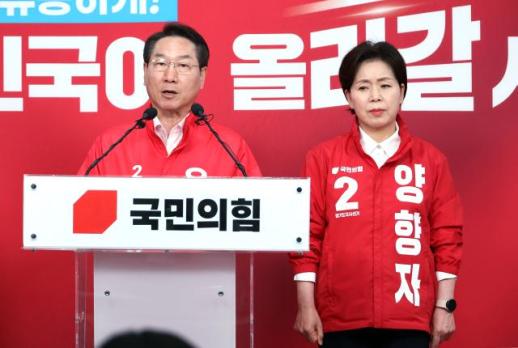 Yoo Jeong-bok and Yang Hyang-ja Criticize Democratic Party's Support for Daejang-dong Yoo Jeong-bok, the People Power Party candidate for Incheon Mayor, and Yang Hyang-ja, the candidate for Gyeonggi Governor, condemned the Democratic Party candidates' remarks supporting the Daejang-dong project during a press conference on May 17 at the People Power Party headquarters in Yeongdeungpo, Seoul. The candidates criticized the Democratic Party's candidates for the metropolitan area, stating, "We are astonished to think that they have come out to align with the president's interests rather than considering the thoughts of local voters." Yoo specifically addressed comments made by Park Chan-dae, the Democratic Party's candidate for Incheon Mayor, who suggested applying the Daejang-dong project to Incheon development. Yoo stated, "The Daejang-dong project has been clearly ruled as guilty by the judiciary and is known as the largest corruption case since the founding of the nation. Are they trying to turn a crime into an achievement just to please the president?" In response to claims from Park's camp that they were using the Daejang-dong issue for negative campaigning, Yoo dismissed the accusation, saying, "Pointing out clear facts as negative campaigning is a tactic to hide their own mistakes. If they think it’s negative, they can come out and debate it." Yang also remarked, "Candidates like Choo Mi-ae from the Democratic Party and Park are competing to show loyalty to the president by defending the Daejang-dong incident, which is a notorious crime. They seem to think they can win this election by riding on the president's coattails." She urged Choo to focus on the Gyeonggi elections, saying, "What do you think Gyeonggi residents will think when they see Choo, who does not participate in debates and ignores local issues while only discussing national political topics?" Meanwhile, the two candidates, along with Oh Se-hoon, the candidate for Seoul Mayor, are expected to strengthen their alliance following this joint press conference. They plan to cooperate on common issues affecting the metropolitan area and announce their findings.* This article has been translated by AI. 2026-05-17 16:20:13
 -
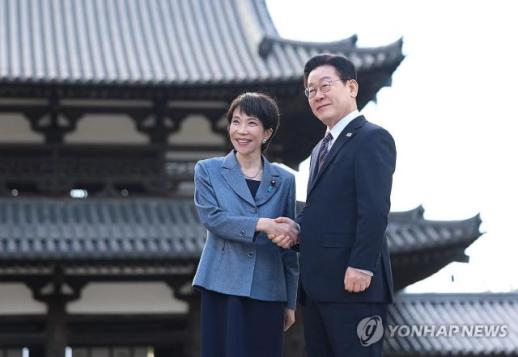 Japanese Prime Minister Visits Andong as Korea-Japan Relations Shift to 'Hometown Diplomacy' Diplomacy often carries a stronger message when tied to a specific location. The venue of a summit is not merely a matter of protocol; it symbolizes the direction and atmosphere of the relationship. In this context, the Korea-Japan summit scheduled for May 19 in Andong, North Gyeongsang Province, may encapsulate the recent changes in Korea-Japan relations. Japanese Prime Minister Sanae Takaiichi will visit Andong, the hometown of President Lee Jae-myung. This visit serves as a reciprocal gesture following President Lee's trip to Nara, Japan, in January, which is Takaiichi's political base and hometown. The Blue House described this as the "first realization of mutual hometown visits between the leaders." This marks a shift from traditional shuttle diplomacy between Seoul and Tokyo to a new phase of 'hometown diplomacy,' where leaders visit each other's political and cultural roots directly. The upcoming summit in Andong is also seen as highly symbolic within Japan. Officials from the Japanese Foreign Ministry suggest that Takaiichi's background as a politician from the Kansai region may influence this diplomatic style. The Kansai area has historically engaged in active exchanges with the Korean Peninsula, and a significant Korean community has developed around Osaka, Kyoto, and Nara. Many in Japanese diplomacy view Takaiichi as a politician with relatively less distance from Korean culture and sentiments. In fact, Nara, Takaiichi's political base, has deep historical connections with the Korean Peninsula. It is known for retaining strong influences from Baekje and Silla cultures during the formation of ancient Japanese culture. This context adds significance to President Lee's visit to Nara in January, which was interpreted as more than just a local visit. The Andong summit also connects to the historical flow of Korea-Japan diplomatic relations. A notable example is the 2004 summit between President Roh Moo-hyun and Prime Minister Junichiro Koizumi in Jeju. At that time, tensions were high due to the Dokdo issue and historical conflicts, yet the leaders chose Jeju as the meeting location. This decision aimed to reduce diplomatic tension and foster trust in a more human atmosphere. However, the upcoming Andong summit represents a step further than the Jeju meeting. While Jeju was characterized as 'neutral space diplomacy,' Andong embodies a more direct form of 'hometown diplomacy.' It involves sharing the life spaces and cultural roots of the leaders, aiming to build trust as a diplomatic asset rather than merely a social event. The symbolism of Andong is significant. It is a center of Korean Confucian culture and traditional spirit, home to Hahoe Folk Village, Dosan Seowon, and the lineage culture. The visit of a Japanese prime minister to such a space carries implications beyond a simple local itinerary. The image of a Japanese leader visiting the heart of Korean traditional culture sends a diplomatic message in itself. This summit is particularly noteworthy amid changing international dynamics. The North Korean situation remains unstable, and the U.S.-China strategic competition is intensifying. Coupled with unrest in the Middle East, risks related to energy and maritime security are also rising. The Japanese government has publicly emphasized that "the importance of Korea-Japan relations and Korea-U.S.-Japan cooperation is growing," reflecting this backdrop. Ultimately, both Korea and Japan find themselves in urgent need of stabilizing their relationship. Japan's security strategy, centered on the U.S., faces challenges without cooperation from Korea, while Korea also recognizes the necessity of collaboration with Japan in terms of supply chains, advanced industries, and economic security. Of course, historical issues remain a challenge. However, diplomacy ultimately hinges on how well future needs can manage past conflicts. The Andong summit indicates that Korea-Japan relations are moving beyond mere practical diplomacy to a stage where they are adjusting the 'temperature of the relationship.' Just as the Jeju summit between Roh Moo-hyun and Koizumi remains a symbolic moment in that era of Korea-Japan relations, the upcoming Andong summit between Lee Jae-myung and Takaiichi is likely to be frequently referenced in discussions about the future of Korea-Japan relations. This time, it is neither Seoul nor Tokyo, but each leader's hometown. This shift itself speaks to a new direction in Korea-Japan relations. 2026-05-17 16:13:09
 -
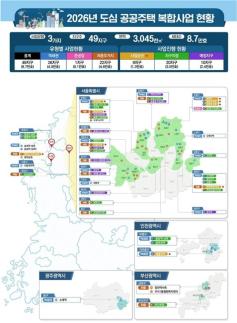 Gangnam Among 44 Areas Applying for Urban Public Housing Project, Expecting 60,000 Units Seoul's urban public housing complex project, aimed at redeveloping aging residential areas through public-led high-density development, has attracted participation from 44 locations, including the three districts of Gangnam, with expectations of supplying approximately 60,000 new housing units. According to the Ministry of Land, Infrastructure and Transport on May 17, proposals from residents were submitted from 44 locations across 16 districts in Seoul by the application deadline on May 8. The urban public housing complex project is designed to facilitate development in aging urban areas where private redevelopment and reconstruction efforts are challenging. It is characterized by the ability to expedite the process by omitting steps such as establishing associations or management plans. This application process allowed residents to propose projects directly. After review by the districts, recommended sites will be evaluated by a selection committee involving the Ministry and the Seoul city government, with final candidate sites expected to be announced in July. Notably, projects with a participation rate exceeding 30% will receive maximum evaluation points, and approximately 61% of the proposals, or 27 locations, met this criterion. By type, there are 16 residential-commercial high-density zones centered around transit stations (covering 674,000 square meters), 25 housing supply activation zones in low-rise residential areas (covering 1,983,000 square meters), and 3 residential-industrial convergence zones in semi-industrial areas (covering 159,000 square meters). The government plans to temporarily relax the floor area ratio for transit-oriented and low-rise residential types to a maximum of 1.4 times the legal limit until April 2029. This is intended to enhance project viability and encourage increased supply in urban areas. Currently, among 49 urban public housing complex sites nationwide, 29 (approximately 48,000 units) have already been designated as complex zones, with 9 (about 13,000 units) having received project approval. The Ministry anticipates that the urban public housing complex project in the northern area of Jemulpo Station in Incheon’s Michuhol District will begin construction five years after its selection as a candidate site. This project, which will feature up to 49 floors and approximately 3,500 units, is noted as the first successful case of public-led development utilizing a REITs (Real Estate Investment Trust) model. Additionally, significant construction projects in Seoul are expected to commence next year, with notable sites including Eunpyeong District's Jeungsan 4 District and Yeonsinnae Station, as well as Shin-gil 2 District in Yeongdeungpo and Banghak Station and Ssangmun Station in Dobong District. Lee Jae-pyeong, Director of Housing Supply Policy at the Ministry, stated, "The high interest and participation from residents in this application process reflect the community's expectations for the urban public housing project. We will actively support the swift and smooth advancement of projects following the selection of candidate sites based on improved systems."* This article has been translated by AI. 2026-05-17 16:03:57
 -
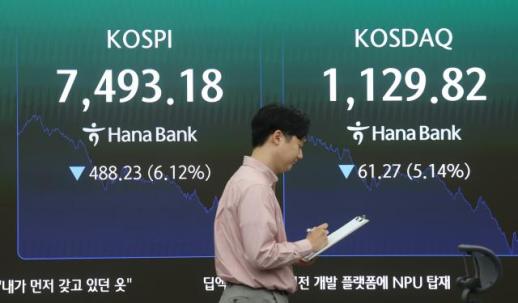 Record Borrowing Fuels Major Korean Brokerages' Q1 Interest Income Surpassing 600 Billion Won As the domestic stock market continues to thrive, the scale of borrowing for investment, known as "debt investment," has reached an all-time high. Consequently, major Korean brokerages reported interest income of 600 billion won in the first quarter of this year. According to reports from the top ten domestic brokerages (Mirae Asset Securities, Korea Investment & Securities, Samsung Securities, KB Securities, NH Investment & Securities, Shinhan Investment Corp., Meritz Securities, Kiwoom Securities, Hana Securities, and Daishin Securities) released on May 17, the total interest income from margin trading for these firms in Q1 amounted to 600 billion won. This figure represents a 55.9% increase compared to 384.6 billion won during the same period last year. It also marks a 14% rise from the previous quarter (Q4 2025), which saw interest income of 526.2 billion won, despite a market contraction due to provisions for real estate project financing. The surge in interest income is attributed to a significant influx of retail investors seeking leverage as the KOSPI index, which hovered around 4,200 at the end of last year, surpassed 6,000 during the first quarter. In fact, the average daily balance of margin trading in Q1 reached 31.1 trillion won, crossing the 30 trillion won mark for the first time. This figure is a 79.3% increase from the average of 17.3 trillion won in Q1 of last year and a 19.2% rise from the previous quarter's average of 26 trillion won. Given that brokerages are applying high interest rates ranging from 5% to nearly 10% for loans depending on the duration, investors are estimated to be bearing an average interest rate of around 8-9% for their debt investments. The reliance on interest income from debt investments varies significantly among brokerages. Some firms derive over 25% of their quarterly net profit from margin trading interest, while others see this income account for less than 10% of their total net profit. However, as the overall performance of brokerages has improved, the contribution of margin trading interest to net profit has actually decreased compared to last year. In Q1, the total net profit of the top ten brokerages was 4.33 trillion won, with margin trading interest accounting for 13.8% of this total, down from 18.7% in Q1 of last year and a sharp decline from 26.1% in the previous quarter.* This article has been translated by AI. 2026-05-17 16:00:35