

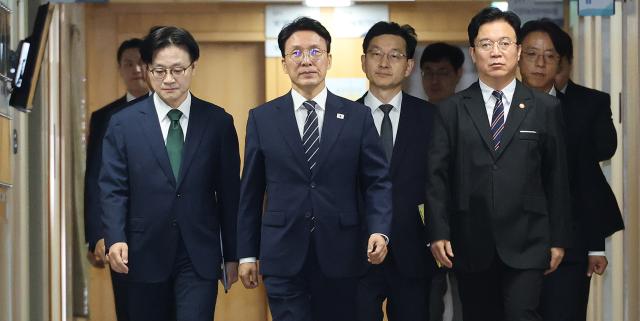
The impending strike by Samsung Electronics' labor union has deepened concerns for labor authorities. The government, which has maintained a principle of 'self-resolution' between labor and management, has officially mentioned the possibility of invoking emergency mediation for the first time, reflecting the tension between pro-labor policies and economic risks.
In a public address on May 17, Prime Minister Kim Min-seok stated, "If a situation arises where the strike could cause significant damage to the national economy, we cannot rule out any possible response measures, including emergency mediation."
He emphasized that the negotiations on May 18 represent the "de facto last chance" to prevent a strike, urging both labor and management not to take the gravity of the situation lightly.
The presence of Minister of Employment and Labor Kim Young-hoon at the address underscores the government's serious recognition of the issue. Emergency mediation is a measure that can be activated by the Minister of Employment and Labor when a labor dispute poses a significant risk to the national economy.
The government's public mention of such a 'last resort' is unusual. Until recently, officials maintained that "emergency mediation is not under consideration," prioritizing resolution through voluntary negotiations and mediation by the Central Labor Relations Commission.
However, as the potential for disruptions in semiconductor production becomes more tangible, a shift in sentiment is evident. Minister Kim Young-hoon met with both the union and management on May 15 and 16 to hear their positions and facilitate last-minute adjustments.
In light of these developments, both sides have agreed to resume negotiations under the Central Labor Relations Commission's post-adjustment procedures on May 18. With only three days remaining until the strike, this adjustment is likely to be the final negotiation. The union has announced plans for a total strike from May 21 to June 7, with over 46,000 members expressing their intention to participate.
If emergency mediation is invoked, strike actions could be suspended for up to 30 days while the Central Labor Relations Commission initiates its own mediation. This measure has not been used since it was activated during a strike in the airline industry under the Roh Moo-hyun administration in 2005.
The government's consideration of this option is rooted in the semiconductor industry's critical role in the domestic economy. Semiconductors account for about 35% of South Korea's total exports, and the Korea Development Institute (KDI) has analyzed that a 10% drop in semiconductor exports could reduce the country's GDP by 0.78%. Given the nature of semiconductor production, once a production line halts, it takes considerable time to restart, making the burden of a prolonged strike significant.
Industry experts are concerned that if the strike materializes, it could lead to decreased exports, supply chain instability, and shocks to the stock market, given that Samsung Electronics accounts for more than a quarter of the domestic stock market's total capitalization.
However, the government's public mention of the possibility of invoking emergency mediation could escalate tensions between labor and the government. The Korean Confederation of Trade Unions criticized the emergency mediation as a "last resort that should only be considered in exceptional circumstances," while the Korean Trade Union Confederation expressed concerns that it could set a precedent for restricting the strike rights of workers in large corporations.
* This article has been translated by AI.
Copyright ⓒ Aju Press All rights reserved.