
Journalist

Seo Hye Seung
-
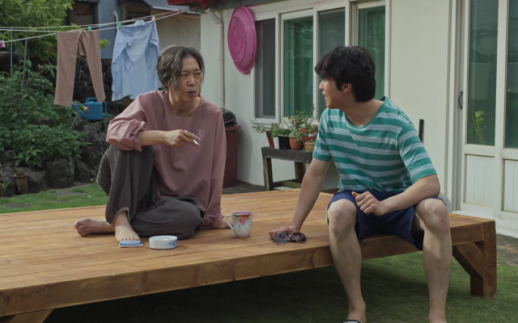 South Korean film 'My Name' wins Audience Award at Italian festival SEOUL, May 04 (AJP) - South Korean film "My Name," directed by Chung Ji-young and centering on the 1948 Jeju 4.3 massacre, won the Audience Award at the Udine Far East Film Festival in Italy on Monday, the film's distributor Let's Films said. The victory at Europe's largest festival dedicated to Asian cinema suggests that South Korean historical narratives are gaining universal resonance through popular vote. The Audience Award is determined by direct ballots from attendees at the Nuovo Giovanni Theater. This marks a significant moment for a film dealing with specific domestic trauma to receive direct validation from an international audience. Production company Let's Films said the movie tells the story of 18-year-old Shin Woo-bin and his mother, Yeom Hye-ran, as they navigate the legacy of the incident. Since its April 15 release, the film has attracted 191,000 viewers in South Korea while maintaining grassroots momentum through organized relay screenings. The Jeju 4.3 Incident refers to a series of uprisings and subsequent brutal suppressions on Jeju Island, currently one of South Korea's favorite getaway destinations, between 1948 and 1954. According to the Jeju 4.3 Peace Foundation, the military and police campaign resulted in the death of an estimated 30,000 people, representing roughly 10 percent of the island's population at the time. Historical records from the National Institute of Korean History show that the Northwest Youth League, a right-wing paramilitary group, carried out many of the most severe atrocities against civilians. The group was primarily composed of Christian refugees who had fled the northern region of the peninsula to escape communist persecution. Driven by extreme anti-communist sentiment and a sense of displacement, members of the Northwest Youth League engaged in widespread extrajudicial killings, rape, and torture. Their presence on the island was often characterized by a lack of oversight, leading to indiscriminate violence against those suspected of leftist sympathies. Let's Films stated that the international recognition in Udine highlights the potential for South Korean cinema to facilitate global understanding of human rights issues. The film continues to play in South Korean theaters as civic groups host additional screenings to maintain public awareness. 2026-05-04 17:06:20
 -
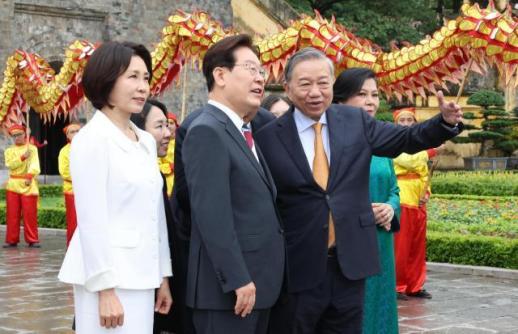 Lee Jae-myung to Host Children’s Day Event at Cheong Wa Dae President Lee Jae-myung will host a Children’s Day event May 5 at the Cheong Wa Dae main building and Nokjiwon lawn, the presidential office said. It will be the first Children’s Day invitation event since the presidential office returned to Cheong Wa Dae. Children invited include those from areas facing population decline, multicultural families and neighborhoods near Cheong Wa Dae. About 200 children and guardians are expected, including children Lee and first lady Kim Hye-kyung have met through visits to disability welfare centers and child care facilities, as well as children and families connected through meetings with patients with rare diseases. Presidential Chief of Staff Kang Hoon-sik and Senior Secretary for Social Affairs Moon Jin-young will attend, along with Health and Welfare Minister Jeong Eun-kyeong, the office said. Children will tour the main building and hear an explanation of Cheong Wa Dae’s history. They will also visit the Sejong Room and Chungmu Room with the presidential couple, rooms familiar to the public through live broadcasts of Cabinet meetings. The group will then move to Nokjiwon, near Sangchunjae, for free play time. For the day, the lawn will be set up as a pop-up playground with swings and a small airplane ride, and will offer activities including cupcake-making for healthy eating and hand-washing lessons. Cheong Wa Dae said it planned the event so that “our children can dream together of a hopeful and bright future” as Children’s Day is celebrated again at the complex.* This article has been translated by AI. 2026-05-04 17:05:44
 -
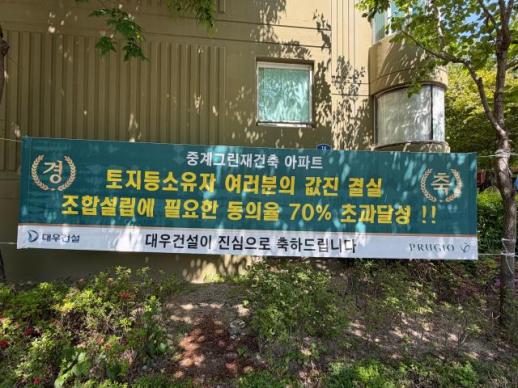 Seoul’s Nowon District Heats Up on Redevelopment Hopes as Rules Ease Seoul’s redevelopment market in the northern districts is heating up, led by Nowon-gu. The so-called “Nodogang” area — Nowon, Dobong and Gangbuk — has been posting a string of record-high apartment prices, driven by the Seoul city government’s push to allow higher-density development and by demand concentrating in large complexes. We visited two key redevelopment sites in Nowon: Junggye Green and Hagye Jangmi apartments. According to the Korea Real Estate Board on the 4th, apartment sale prices in Nowon-gu have risen 3.38% so far this year, outpacing Seoul’s overall increase of 2.65%. In the last week of April, Nowon-gu’s weekly gain was 0.18%, higher than Gangbuk-gu (0.14%) and Dobong-gu (0.13%). Weekly increases in March and April held in the 0.18% to 0.32% range, ranking among the highest in Seoul. That contrasts with a sharp slowdown in the southern districts, including Gangnam-gu (-0.02%) and Seocho-gu (0.01%). The shift is attributed to buyers priced out of Gangnam amid lending curbs and peak-price concerns, along with reduced jeonse supply pushing more renters to buy. At Junggye Green and Hagye Jangmi, redevelopment expectations were visible throughout the complexes. Construction company banners congratulated residents on reaching the consent threshold to form a promotion committee. Both complexes sit about a 30-second walk from Line 7 stations — Junggye Station and Hagye Station — and are also favored by end-users because an elementary school is reachable by crossing a single street. Junggye Green is a large complex of 25 buildings and 3,481 households, and transactions continued as moves took place. The real estate platform Asil reported three sales and seven jeonse deals last month. A 59-square-meter unit sold in March for 720 million won, a record high, up about 140 million won from 577 million won in July last year. Hagye Jangmi, a 15-building complex with 1,880 households, also showed a clear price rise. A 59-square-meter unit traded last month for 780 million won, the highest price on record. That was about 175 million won higher than 605 million won in July last year. Policy changes by the Seoul city government also appear to be supporting Nowon-gu’s rise. Seoul is pursuing a plan that introduces a mixed-use redevelopment model around transit hubs and allows high-density projects of up to 60 stories. Under the plan, Hagye Jangmi is expected to pursue redevelopment up to 59 stories, while Junggye Green is expected to pursue a plan up to 49 stories and 4,360 households. Expectations have also been lifted by the use of a public support system to shorten administrative procedures and speed up projects. A Seoul city official said the city applied a “high-density, mixed-use development centered on transit hubs” concept while revising district unit plans for parts of Sanggye, Junggye and Hagye neighborhoods in Nowon-gu. The official said some transit-area complexes can now apply a floor area ratio of up to about 400% through measures such as zoning upgrades. The official added that while Junggye Green is near a station, it differs from complexes that qualify for the high-density mixed-use standard because there are no nearby semi-residential or commercial zones. Seo Jin-hyeong, a professor in the Department of Real Estate and Law at Kwangwoon University, said Nowon-gu had lagged in redevelopment because existing floor area ratios were already high, limiting additional capacity and weakening project feasibility. He said the latest easing of floor area ratio rules could become a catalyst for revitalizing redevelopment. 2026-05-04 17:04:35
 -
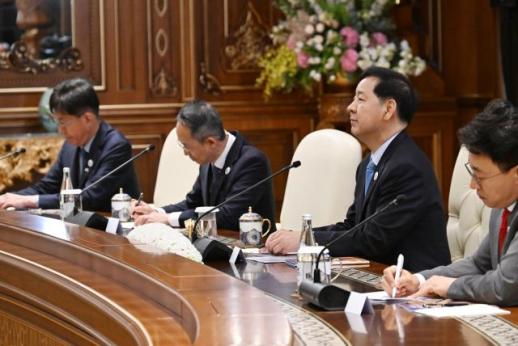 Koo Yun-cheol Signs MOU With ADB to Set Up AI Innovation Center in South Korea Deputy Prime Minister and Minister of Economy and Finance Koo Yun-cheol signed a memorandum of understanding with the Asian Development Bank to establish an artificial intelligence innovation and development center in South Korea and agreed to expand cooperation on critical-mineral supply chains. The Ministry of Economy and Finance said Monday that Koo, visiting Samarkand, Uzbekistan, on the sidelines of the ADB annual meeting, met with ADB President Masato Kanda and signed the MOU to set up the center. The AI Innovation and Development Center, known as CAID, is to be established in South Korea as a cooperation hub to apply AI to ADB programs supporting developing countries and to help strengthen AI capabilities in those countries. During the meeting, Koo said, “Through cooperation in the AI field, we will pursue mutually beneficial development cooperation that helps all countries,” and presented South Korea’s vision of a “global AI hub” that would bring together AI-related organizations under multilateral development banks and the United Nations. The two sides also agreed to broaden cooperation on critical-mineral supply chains. Koo voiced support for ADB’s policy to diversify critical-mineral supply chains in the region and stressed the importance of building stable supply chains through cooperation among member countries. Koo also met the same day with Indranee Thurai Rajah, Singapore’s second minister for finance, to discuss cooperation as co-chairs of the next ASEAN+3 finance ministers and central bank governors meeting. They agreed to sustain cooperation momentum based on the outcome of the South Korea-Singapore summit and to continue consultations to identify agenda items that provide practical help to ASEAN+3 countries. Koo introduced his “global AI hub” initiative to Rajah and proposed that Singapore join South Korea’s efforts to share the benefits of AI with the global community.* This article has been translated by AI. 2026-05-04 17:03:19
 -
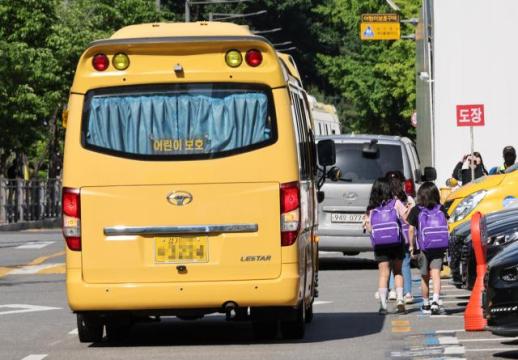 Playgrounds stay empty as Korean children simply have no time to play SEOUL, May 04 (AJP) - As South Korea observes the 104th anniversary of Children’s Day this Tuesday, the festive banners and gift-wrapped toys mask a sobering reality. The holiday, envisioned by pioneer Bang Jeong-hwan as a day to prioritize the "happiness and well-being" of the nation’s youth, has become a poignant reminder of a childhood increasingly spent in the shadows of high-stakes testing and digital screens. Data suggests that for the average South Korean child, the "right to play" is less a lived reality and more a luxury they simply cannot afford. The most striking finding from the National Center for the Rights of the Child’s “2025 Key Statistics for Children” isn't just that children are busy—it’s the profound disconnect between their aspirations and their daily lives. Four out of 10 desired to spend time and play with friends after school, but only two were able to do so as most were carried off to after-school academies and private tutoring. More than half of surveyed students identified after-school academies (hagwons) and tutoring as the main barriers to free play. The pressure begins early in South Korea’s highly competitive education system, where preparation for elite university admissions increasingly starts in elementary school. A 2024 survey by ChildFund Korea found that older elementary students aged 9 to 12 spent an average of 2 hours and 47 minutes a day studying outside school, while younger children aged 6 to 9 studied an additional 2 hours and 17 minutes daily. Although school hours in South Korea are shorter than the OECD average, total study time including private education reaches nearly six hours a day, exceeding the OECD average of five hours. The consequences are increasingly visible. In its report “Child Well-Being in an Unpredictable World,” the Organization for Economic Co-operation and Development ranked South Korea 28th out of 40 countries in children’s physical health and 34th out of 36 countries in mental health. Despite significantly longer study hours than Japan, South Korean students also posted lower scores in reading, mathematics and science in the 2022 PISA assessment. “When private education hours become excessively long, marginal utility inevitably decreases,” said Kim Hyun-chul, a professor at Seoul National University. “It is crucial to maintain proper balance in everything.” Where physical play and social interaction vanish, digital dependence fills the void. In a world where safe play spaces are scarce and time is tighter than ever, smartphones have become the default "playground." A recent survey by the Korean Teachers and Education Workers Union reveals that 70% of upper elementary students are already engaging with generative AI like ChatGPT and Gemini and half of them spending more than two hours on smartphones after school. While technological literacy is vital, researchers warn that this shift is often a survival mechanism. When children are too tired or too busy for the park, they turn to the screen for a quick, low-effort dopamine hit. Globally, however, attitudes toward play are shifting in the opposite direction. The United Nations Children's Fund and the LEGO Group last year established June 11 as the International Day of Play, emphasizing play as essential to healthy child development. The World Health Organization has also stressed that regular physical activity and active play are critical for children’s physical and mental well-being. “Allow them to sleep and exercise sufficiently,” Korean children’s rights pioneer Bang Jeong-hwan wrote in the original Children’s Day proclamation more than a century ago. “Let them go on walks or picnics occasionally.” The words now sound less like celebration and more like a reminder of what many Korean children increasingly lack. 2026-05-04 16:53:07
 -
 Kia April Global Sales Rise 1% to 277,188 Despite Uncertainty Kia said Sunday that its global vehicle sales in April rose 1% from a year earlier to 277,188 units. Sales in South Korea climbed 7.9% to 55,045, while overseas sales slipped 0.7% to 221,692. Special-purpose vehicle sales totaled 451. The Sportage was Kia’s top-selling model worldwide in April, with 51,458 sold. It was followed by the Seltos with 28,377 and the Sorento with 22,843. In South Korea, the Sorento led sales with 12,078 units. Passenger-car sales totaled 13,441, led by the Ray with 4,877, the K5 with 2,366 and the K8 with 1,461. Recreational vehicle sales totaled 35,877, including the Sorento, the Carnival with 4,995, the Sportage with 4,972 and the EV3 with 3,898. Commercial vehicle sales totaled 5,727, including the PV5 with 2,262 and the Bongo III with 3,335. Overseas, the Sportage was the best-selling model with 46,486 units, followed by the Seltos with 24,797 and the K4 with 18,654. Kia sold 451 special-purpose vehicles, including 63 in South Korea and 388 overseas. A Kia official said sales in Arab and Middle Eastern markets fell somewhat due to geopolitical risks in the region, but strong demand in South Korea and overseas markets outside the Middle East supported overall growth. The official said Kia will seek to sustain momentum with eco-friendly vehicles, including electric vehicles and hybrid SUVs.* This article has been translated by AI. 2026-05-04 16:45:18
 -
 Where to Go in May: 10 Family-Friendly Festivals Across South Korea May, widely marked in South Korea as Family Month, brings a packed calendar of festivals aimed at family visitors nationwide. Options range from nature and hands-on events during the Children’s Day holiday to culture, food, and flower festivals later in the month. In Hampyeong, South Jeolla Province, the 28th Hampyeong Butterfly Festival runs through the 5th at Hampyeong Expo Park. Under the theme “Dreaming Butterfly, the Journey Begins,” it features flower-and-butterfly exhibits, activities and performances, including butterfly releases indoors and outdoors, feeding programs, parades and shows. Admission is paid: 7,000 won for adults, 5,000 won for youths and soldiers, and 3,000 won for kindergarteners, children and seniors, based on on-site sales. In Boseong, South Jeolla Province, the Boseong Green Tea Festival continues through the 5th. Now in its 49th year, it highlights local tea culture with programs such as tea-leaf picking, tea making, tea tasting and green-tea therapy. Admission is free. In Damyang, South Jeolla Province, the Damyang Bamboo Festival runs through the 5th at Juknokwon Bamboo Garden and the nearby Dambit Music Hall area. With the slogan “Shine, Shine, Bamboo!” it offers bamboo-themed activities, performances and nighttime lighting programs. Admission is free, while Juknokwon charges 3,000 won and returns the full amount as a payback coupon. The Yeoncheon Paleolithic Festival runs through the 5th at the Jeongok-ri archaeological site in Yeoncheon. The family-oriented history festival centers on Paleolithic-era experiences. General admission is 7,000 won and youth and children’s tickets are 3,000 won. General visitors receive a 5,000 won Yeoncheon Love gift certificate, while youths and children receive a 3,000 won certificate. In Miryang, South Gyeongsang Province, the Miryang Arirang Festival is scheduled for the 7th through the 10th around Yeongnamnu Pavilion and the Miryang River. Admission is free. The festival aims to preserve and develop Miryang Arirang, which is listed by UNESCO as an Intangible Cultural Heritage of Humanity, and includes a Miryang Arirang contest, traditional culture activities and the multimedia outdoor show “Miryang River Odyssey.” The Seoul World Cities Culture Festival will be held from the 9th to the 10th at Dongdaemun Design Plaza, or DDP, from noon to 9 p.m. Participation is free. Organizers plan cultural performances, traditional costume and game experiences, and global food and dessert zones. The 2026 Busan Wheat Festival is set for the 9th to the 10th at Hwamyeong Ecological Park in Busan’s Buk District. Hosted by Busan Metropolitan City and organized by the Busan Festival Organizing Committee, it will feature wheat-themed food programs, a flea market, hands-on activities and performances. A food lounge under a large shade canopy and spaces for participatory programs will be set up on site. From the 15th to the 18th, the 2026 Haeundae Sand Festival will take place at Haeundae Beach and Haeundae Square in Busan. This year’s theme is “A Time-Travel Journey Through Busan in Sand.” The program includes an international sand sculpture exhibition, activities and performances. The sand works will remain on display through June 14. The Gokseong World Rose Festival runs from the 22nd to the 31st at Seomjingang Train Village. The site includes a rose garden covering about 75,000 square meters, with 1,004 varieties of rare European roses and other flowers. Admission is paid, but Gokseong residents, people of national merit and people with disabilities are admitted free. In Chuncheon, Gangwon Province, the Chuncheon Mime Festival is scheduled for the 24th through the 31st across the city under the theme “Body Landscape.” Events include the opening street program “Ah! Water-rang,” theater performances, “Mime You See While Walking,” “Art Madang X,” and overnight programs including “Goblin Madang.” Most events are free, but theater performances and some programs charge admission. Organizers warn that festivals can be especially crowded during the Children’s Day holiday and on weekends. Some hands-on programs require advance reservations or operate on a first-come, first-served basis, and some events charge admission or separate activity fees. Visitors are advised to check official websites for hours, ticket prices, parking and whether shuttle buses are running before traveling.* This article has been translated by AI. 2026-05-04 16:42:25
 -
 Iran Military Warns It Will Attack U.S. Forces if They Approach Strait of Hormuz Iran’s unified military command warned that U.S. forces would be attacked if they approach or enter the Strait of Hormuz, after President Donald Trump said the United States would help ships stuck in the waterway. Ali Abdollahi, head of Iran’s unified military command, said in a statement on the 4th that security in the Strait of Hormuz is handled by Iran’s armed forces and that safe passage for vessels must be coordinated with the military. He added that Iran would strike “foreign armed forces, especially the aggressive U.S. military,” if they try to approach or enter the strait. The statement appeared aimed at Trump’s announcement a day earlier. Trump said ships trapped in the Hormuz channel were facing shortages of food and supplies and that the United States would help them move safely. The specific operational plan has not been made public. Iran also urged merchant ships and oil tankers to refrain from moving without coordination with Iran’s military, reiterating that it views transit through the strait as under its military control rather than a matter of maritime safety alone. Reuters reported that U.S. Central Command plans to support the initiative with 15,000 troops and more than 100 land- and sea-based aircraft, warships and drones. Iran said such moves could further complicate the situation and could instead threaten the safety of ships passing through the strait.* This article has been translated by AI. 2026-05-04 16:39:55
 -
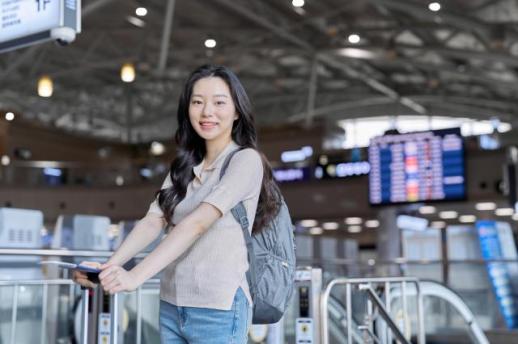 South Korea online shopping hits record as travel demand defies fuel surcharges SEOUL, May 04 (AJP) - South Korea's online shopping transactions hit an all-time monthly high in March as travelers booked spring holidays despite soaring fuel costs driven by the Middle East conflict. Data from Statistics Korea showed monthly transactions reached 25.6 trillion won, marking the first time the figure has surpassed 25 trillion won since tracking began in 2017. Total volume grew 13.3 percent compared to the same period last year. Travel and transport services served as the primary engine for growth, surging 21.7 percent to 3.3 trillion won. Surge comes as South Koreans prepare for the peak travel window in May, which includes major public holidays for Children's Day and Buddha's Birthday. Demand for air travel has remained price-inelastic despite a sharp rise in jet fuel surcharges. Costs spiked following geopolitical volatility involving Iran, which heightened concerns over oil supply stability in the Persian Gulf. South Korean carriers adjust international fuel surcharges monthly based on the Mean of Platts Singapore (MOPS) benchmark. Recent regional instability pushed these surcharges higher, but travelers have opted to secure tickets early to hedge against further price increases. Total online transactions for the first quarter of the year reached 72.2 trillion won, up 9.2 percent from 2023. Beyond travel, the sector saw significant gains in automotive supplies and telecommunications equipment. Overseas direct sales also expanded 24.4 percent to 1.1 trillion won in the first quarter. Cosmetics and K-pop-related merchandise, including albums and video content, drove the bulk of international demand. China remained the largest partner for cross-border e-commerce. Online purchases by South Koreans from Chinese platforms totaled 1.2 trillion won during first three months of year. 2026-05-04 16:39:09
 -
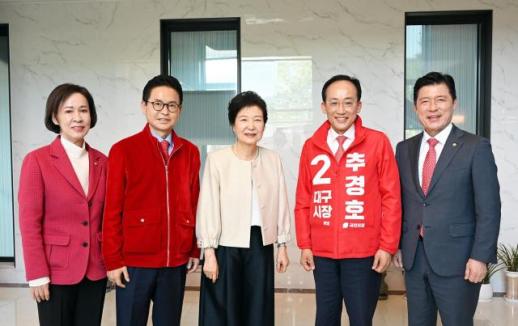 PPP’s Choo Kyung-ho and Lee Cheol-woo visit Park Geun-hye, urge conservatives to hold Daegu People Power Party Daegu mayoral candidate Choo Kyung-ho and North Gyeongsang Gov. Lee Cheol-woo, also a candidate in the June 3 local elections, visited Park Geun-hye on May 4, in what appeared to be an effort to rally conservative voters with help from former presidents. The two candidates visited Park’s home in Dalseong County, Daegu, on Monday afternoon. They were accompanied by Lee In-sun, head of the party’s Daegu chapter; Koo Ja-geun, head of the party’s North Gyeongsang chapter; and lawmaker Yoo Young-ha. After the meeting, Choo told reporters Park is “a former president from our party and the most senior figure in conservative politics,” and said he visited to pay his respects, check on her well-being and talk with her. Choo said Park recalled praising him during her administration, saying he had strong drive “true to his name,” which he said helped put him at ease. He said Park also voiced concern that recent domestic and international conditions were unsettled and said that in such times it is important to defend liberal democracy and that Daegu should play its role as a center of conservative politics. Choo said Park encouraged them to work hard and win, adding that she said each voter’s choice would determine the nation’s fate and that the public would choose wisely. Choo said he took her remarks seriously and pledged to revive Daegu’s economy and “protect the conservative heart.”* This article has been translated by AI. 2026-05-04 16:37:02