
Journalist

Seo Hye Seung
-
 Big 5 Banks’ Mortgage Loans Post Biggest Gain in 8 Months as Household Debt Rises Mortgage loan balances at South Korea’s major commercial banks rose by the most in eight months, driven largely by policy-backed lending such as jeonse deposit loans and Didimdol loans, the financial sector said Monday. As of the end of April, outstanding mortgage loans at the five largest banks — KB Kookmin, Shinhan, Hana, Woori and NH NongHyup — totaled 612.2443 trillion won, up 1.9104 trillion won from the end of March, according to financial industry data released Monday. It was the biggest monthly increase since August last year, when the balance rose 3.7012 trillion won. Overall household lending also increased. The five banks’ household loan balance stood at 767.2960 trillion won at the end of April, up 1.5670 trillion won from a month earlier — the largest rise since October last year, when it increased 2.5270 trillion won. Industry officials said the mortgage loan increase appears to reflect growth in policy-backed loans rather than a broad recovery in housing transactions. “This month, the increase was led by jeonse-related loans and policy-backed products such as Didimdol loans,” a financial industry official said. “It’s hard to say real estate transactions are high overall, but deals have continued, mainly for apartments on the outskirts of Seoul, and that has pushed up policy-backed lending.” Mortgage loan balances have fluctuated this year, falling 1.4836 trillion won in January, rising 596.7 billion won in February, then slipping 387.2 billion won in March before the increase widened in April. Group loans to individuals rose 220.1 billion won, turning higher for the first time since September 2024. Unsecured personal credit loans, however, swung to a 318.2 billion won decline in April after rising 347.5 billion won in March. Loans to individual business owners increased 362.2 billion won, extending gains for a third straight month. Deposit balances were mixed by product. Time deposits totaled 937.1834 trillion won at the end of April, down 273.1 billion won from a month earlier. Installment savings deposits rose 409.5 billion won to 46.5673 trillion won. Demand deposits, often treated as standby funds, fell 3.3557 trillion won to 696.5524 trillion won, turning lower for the first time in three months.* This article has been translated by AI. 2026-05-04 16:18:23
 -
 Renault Korea April Sales Drop 40.5% as Exports Slump on Global Uncertainty Renault Korea said Sunday that its total April sales fell 40.5% from a year earlier to 6,199 vehicles, as exports slumped amid worsening international conditions. Domestic sales dropped 23.4% to 4,025 units, while exports plunged 58% to 2,174, the company said. Cumulative sales for January through April totaled 22,820 vehicles, down 20.2% from the same period a year earlier. Hybrids accounted for 3,527 units of April domestic sales, or 87.6% of the total. The FILANTE HEV and Grand Koleos HEV sold 2,139 and 1,337 units, respectively, representing 100% and 86.3% of their model sales. Arkana HEV sales totaled 1,337 units, or 15.2% of overall domestic sales. A Renault Korea official said April results weakened as economic uncertainty persisted, citing higher oil prices linked to the recent war in the Middle East. The official said the company will expand customer promotions starting in May, pointing to the proven competitiveness of its HEV E-Tech models. In April exports, the Grand Koleos posted 894 units, the Arkana 260 and the Polestar 4 1,020, the company said. Another company official said external uncertainty remains but Renault Korea will work to avoid disruptions in export volumes by optimizing production and shipping schedules.* This article has been translated by AI. 2026-05-04 16:15:00
 -
 KOSPI Hits Record Above 6,900 as Analysts Debate Whether Rally Can Last in May After surging more than 30% in April, South Korea’s benchmark KOSPI kept running in May, setting another record on the first trading day of the month. The move has undercut the market adage “Sell in May,” but investors are watching whether the rally can hold after such outsized gains, which have often been followed by sharp pullbacks. According to the Korea Exchange, the KOSPI on May 4 jumped 338.12 points, or 5.12%, to close at 6,936.99, a record high by closing price. The index rose 30.61% last month, and the latest gain was driven by strong buying from foreign and institutional investors from the start of May trading. In the main board market, foreigners were net buyers of 3.9623 trillion won and institutions bought a net 2.5569 trillion won, lifting the index. Retail investors, meanwhile, sold a net 6.3364 trillion won as they took profits. By stock, chipmakers led: SK hynix rose to a record 1.45 million won, while Samsung Electronics touched 230,000 won and climbed as high as 232,500 won. Even amid the record run, some investors are again discussing a “Sell in May” approach. Historically, May has tended to see returns cool after strong gains from November through April, as institutions rebalance portfolios and lock in profits. Recent market patterns highlight that risk. Last year, the KOSPI posted a historic 165.96% surge in April, but the gain slowed sharply to 5.52% in May. In 2024, a 1.99% drop in April was followed by another decline of 2.06% in May, as concerns about elevated levels weighed on prices. With seasonal volatility often rising as investors digest earnings and the market shows fatigue after sharp moves, some analysts say April’s 30.6% return could again be followed by a pause in early May. Brokerage forecasts are mixed. Choi Bo-won, a researcher at Korea Investment & Securities, said earnings releases by top market-cap companies have largely wrapped up and tariff uncertainty could re-emerge, making a temporary pullback possible. Still, Choi said expectations for medium- to long-term earnings improvement could provide further upside, adding that even if there is a brief early-May correction, investors may consider re-entering large-cap IT and infrastructure shares. Han Ji-young, a researcher at Kiwoom Securities, said investors should focus on macro indicators and fundamentals. Han said weak April employment data could be neutral or better for stocks because it may help cool the rise in the 10-year yield, which recently climbed into the 4.4% range, making the jobs data particularly important for growth-stock investors. Han also pointed to improving earnings expectations, saying the 2026 KOSPI operating profit consensus rose 32% in a month to 850 trillion won. Han added that April export data delivered an earnings surprise led by semiconductors and solid-state drives, and said that with upside factors such as potential further upgrades to profit forecasts, it is appropriate to set a base-case outlook that the KOSPI continues to push to higher highs this week.* This article has been translated by AI. 2026-05-04 16:04:54
 -
 Middle East War Ripples Through Asian Manufacturing as Costs Surge Despite Stockpiling The fallout from the war in the Middle East is spreading across Asian manufacturing. Companies have boosted output for now by building inventories ahead of possible supply disruptions. But a sharp rise in energy and raw material prices is quickly increasing cost pressures. S&P Global said on the 4th that last month’s purchasing managers’ index, a gauge of business conditions, showed manufacturing output generally expanded in major Asian economies. PMI readings for Taiwan, Japan and South Korea all rose in April, reflecting front-loaded purchasing as firms prepared for delivery delays and further price increases. S&P Global cited AI-related demand in Japan and Taiwan, and new product launches in South Korea, as factors supporting production and sales. Still, the pickup is difficult to read as a broad recovery. The data also reflect inventory building by companies and their customers as worries grow over logistics disruptions and higher prices if the war drags on. The Middle East is a key supplier of crude oil, gas and fertilizer for Asia. Since fighting began in late February, prices for energy and other raw materials have climbed, raising costs for Asian manufacturers and weighing on sentiment. Uncertainty is also rising over how long the conflict will last. “This war has brought the biggest supply-chain disruption since the COVID pandemic,” said Annabel Fiddes of S&P Global Market Intelligence. Cost pressures were reported across the region. South Korean manufacturers said both input costs and selling prices jumped to record levels. In Japan, Indonesia and Vietnam, higher raw material prices pushed input costs to their highest levels in years. The hit has been more direct in some emerging markets. Output fell in Indonesia and Vietnam even as costs surged. Vietnam’s new orders declined in April for the first time in eight months. “If prices and supply conditions do not improve quickly, production is also likely to slow,” said Andrew Harker of S&P Global Market Intelligence. India was not immune. Its manufacturing sector continued to improve modestly, but the pace was the second-slowest in about four years, indicating that rising costs are constraining the recovery. Analysts said output is being supported by stockpiling demand, but other countries could face renewed slowing once that effect fades. Usamah Bhatti, an economist at S&P Global Market Intelligence, said how sales and production move after inventory building weakens will be a key variable for manufacturing conditions in the coming months.* This article has been translated by AI. 2026-05-04 16:03:18
 -
 GM Korea April Sales Rise 14.7% to 47,760 Vehicles on Strong Exports GM Korea said Sunday it sold 47,760 vehicles in April, up 14.7% from a year earlier. Domestic sales totaled 811 vehicles, while exports reached 46,949. The company said April marked the third time this year it posted monthly sales above 40,000 vehicles, following January and March. Exports of the Chevrolet Trax Crossover, including derivative models, rose 12.7% from a year earlier to 31,239 units. Exports of the Chevrolet Trailblazer, including derivative models, increased 24.7% to 15,710 units. GM Korea said cumulative sales of the two models have topped 2 million since launch, helping position the operation as a global hub for small SUVs under the Chevrolet brand. The company said it handles the full process for the models — planning, design, engineering and production. Last year, the two models sold a combined 422,792 units in the U.S., accounting for about 43% of the small-SUV segment, it said. Gustavo Colossi, vice president of sales, service and marketing at GM Korea, said the Trax Crossover and Trailblazer are “continuing meaningful results in global markets,” citing their competitiveness and the 2 million cumulative-sales milestone. He said the company will keep working to provide a satisfactory service experience as customers at home and abroad show trust in GM’s products and brand. GM Korea said it will offer various financing programs and provide cash and fuel-cost support in May for customers who buy the Trax Crossover, Trailblazer or the American premium pickup truck Sierra. Chevrolet also said it will run a “Chevrolet Homecoming Festival” for Family Month. Customers who own older Chevrolet models — Spark, Matiz, Damas or Labo — and buy a Trax Crossover or Trailblazer will receive 1 million won in cash support. The company will also provide 300,000 won in cash to customers with a minor or a family member age 65 or older, to small-car owners, and to customers who have owned an aging diesel vehicle for at least five years.* This article has been translated by AI. 2026-05-04 16:00:20
 -
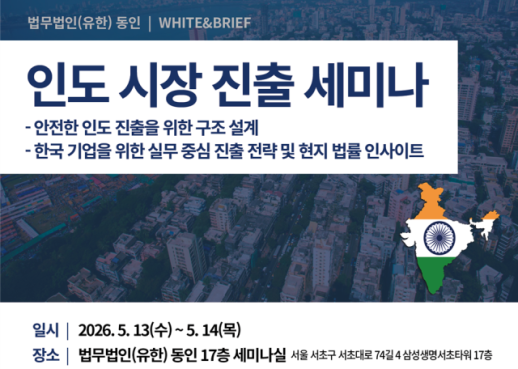 Dongin Law Firm to Hold India Market Entry Strategy Seminar in Seoul Dongin Law Firm said it will hold a practical seminar to support South Korean companies seeking to enter the Indian market, as interest increasingly moves from preliminary reviews to actual investment. The firm said the program will focus on contract structures and partner design. Dongin said May 4 it will host the “India Business Practical Guide” seminar May 13 and 14 at its main conference room in Seocho-dong, Seoul. The program was planned by attorney Moon Hae-jin (Judicial Research and Training Institute class 39). Moon said companies’ India strategies are increasingly leading to investment and the establishment of joint ventures. “We are seeing more moves, especially among manufacturers (autos and batteries), consumer goods companies represented by K-beauty, and tech firms, to pursue supply-chain diversification and talent recruitment at the same time,” Moon said. Moon said early-stage contract design is a key variable in India. “In JVs or partnerships, gaps between contractual rights and actual operating control often block decision-making or make it difficult to exit,” Moon said. He added that because administrative enforcement and on-the-ground practices can matter more than written law, companies may face unexpected delays and costs in permitting, labor and compliance. The seminar is designed to offer practical responses rather than a general market overview, Moon said. “We will cover investment approaches, JV structures and key contract clauses at a level participants can apply immediately,” he said, adding that the program will present a model in which a Korean law firm leads and manages cooperation with local counsel. Dongin said it will invite a partner attorney from the Indian law firm White & Brief to explain the local regulatory environment and partnership structures, while Korean attorneys review risks from the perspective of Korean companies. The seminar is aimed at companies considering entry into India, as well as legal and strategy staff at manufacturers and consumer goods companies preparing to expand trade or build local supply chains. Each session will be limited to 20 participants. “India is a market where opportunity and risk exist at the same time,” Moon said. “The goal of this seminar is to create a link that mid-sized companies, which lack the local infrastructure of large conglomerates, can rely on when entering the market.” Dongin said registration and detailed schedules are available on its website, and inquiries can be made by email or phone.* This article has been translated by AI. 2026-05-04 15:53:19
 -
 Lotte Chilsung Beverage Q1 Operating Profit Jumps 91% on Milkis, Saero Growth Lotte Chilsung Beverage said its first-quarter operating profit surged 91% from a year earlier, as beverage exports and overseas subsidiaries expanded despite weak domestic demand and pressure from a strong exchange rate. Growth in soju and ready-to-drink products also supported results in its liquor business. The company said Monday that first-quarter operating profit on a consolidated basis totaled 47.8 billion won, up 91% from the same period a year earlier. Revenue rose 4.6% to 952.5 billion won. In beverages, revenue increased 1.5% to 414.2 billion won, while operating profit climbed 62% to 21.1 billion won. The company cited a tougher external environment and higher business costs, but said sales rose across most major categories, including carbonated drinks, juice, coffee, energy drinks, sparkling water and sports drinks. Energy drink sales rose 8.7% from a year earlier, and sports drink sales increased 11.5%. Beverage exports also grew. Sales of products including Milkis, Let’s Be and aloe juice increased in more than 50 countries, including the United States, Russia, Europe and Southeast Asia, lifting export performance 13.4% from a year earlier. In the liquor business, revenue rose 0.7% to 194.2 billion won and operating profit increased 9.6% to 15.6 billion won. The company said consumer sentiment weakened amid Middle East-driven geopolitical risks, high inflation and shifting drinking trends, but soju, cheongju and RTD products supported performance. Soju sales rose 2.6%, led by Saero, which underwent its first renewal since launch. Cheongju sales increased 2.7% as demand for smaller-size alcoholic beverages grew, with Subok One Cup driving gains. RTD sales jumped 74.4% on rising interest in fruit-flavored sparkling alcoholic drinks and an expanded lineup. Growth was also strong in the global segment, which includes overseas subsidiaries in the Philippines, Pakistan and Myanmar. First-quarter revenue in the segment rose 11.1% to 378.3 billion won, and operating profit increased by 13.7 billion won to 14.3 billion won. The global segment’s share of total revenue expanded to about 46%. Lotte Chilsung Beverage said it will continue focusing this year on improving profitability at its overseas subsidiaries. It also plans to expand production capacity to strengthen competitiveness in fast-growing emerging markets and meet rising global demand for products including Milkis, Let’s Be, Saero and Soonhari. A company official said it will keep prioritizing profitability to raise corporate value and build a foundation for sustainable growth. Separately, Chief Executive Officer Park Yoon-ki said at the company’s 59th annual shareholders meeting in March that it would pursue management efficiency, restructure its domestic business portfolio and strengthen overseas operations to meet its business plan, while moving ahead with mid- to long-term strategies for future growth.* This article has been translated by AI. 2026-05-04 15:52:10
 -
 KGM April Sales Rise 6.5% on Strong Exports, Led by Musso KG Mobility, or KGM, said Monday its April sales totaled 9,512 vehicles, up 6.5% from a year earlier, as exports climbed. Domestic sales fell 4.6% to 3,382 vehicles, while exports rose 13.8% to 6,130. KGM said Musso export sales increased, pushing monthly exports above 6,000 for the first time in four months since December, when exports reached 7,000 vehicles. Cumulative sales through April rose 4.7% from the same period a year earlier. By model, the Musso, which began its global market launch last month, sold 1,336 vehicles, and the Torres EVX sold 1,830, helping drive the increase. KGM said it is stepping up efforts to expand volumes by building on export momentum and strengthening its response in the domestic market. On April 28 and 29, KGM invited overseas dealers and reporters from 31 countries to Turkiye, its largest export market, for the Musso global launch and test-drive events. In Germany, it held a launch and test-drive event for the Actyon Hybrid in early April. In March, KGM Chairman Kwak Jae-sun met with its Vietnam KD partner, Kim Long Motors, to inspect production sites and discuss detailed cooperation plans. In South Korea, KGM said it is conducting marketing activities to strengthen brand communication and expand customer engagement, including hosting “KGM Tuning Festival Season 2” and serving as an official sponsor of the “2026 UCI MTB World Series.” A KGM official said exports are recovering and that April sales rose 6.5% from a year earlier, with cumulative sales up 4.7%. The official said the Musso has been well received in South Korea and at last month’s global launch events, and KGM plans to expand rollouts by country and deepen cooperation with local dealers to further increase sales.* This article has been translated by AI. 2026-05-04 15:51:17
 -
 KOSPI Jumps 5.1% to Record Close Near 7,000 on Foreign, Institutional Buying The KOSPI surged Monday on heavy buying by foreign investors and institutions, climbing to just shy of the 7,000 mark and posting a record closing high. The benchmark jumped more than 5% to finish above 6,900. According to the Korea Exchange, the KOSPI closed up 338.12 points, or 5.12%, at 6,936.99. It opened at 6,782.93, up 184.06 points, or 2.79%, and extended gains as foreign and institutional demand strengthened. The index also reset an intraday record. It moved above 6,800 at about 10:16 a.m. and later broke through 6,900 at about 12:57 p.m. as buying accelerated. Lee Kyung-min, an analyst at Daishin Securities, said the KOSPI has continued to rally as stronger earnings momentum and what he called attractive undervaluation have come into focus. He added that local stocks reflected gains in U.S. markets during the May 1 holiday, while foreign net buying expanded ahead of the May 5 holiday, adding to the market’s upward momentum. In the main board market, foreigners were net buyers of 3.9623 trillion won and institutions bought a net 2.5569 trillion won. Retail investors sold a net 6.3364 trillion won. Among top market-cap stocks, Samsung Electronics rose 5.44%, SK hynix gained 12.52%, SK Square jumped 17.84%, LG Energy Solution added 2.50%, Hyundai Motor rose 1.51%, Doosan Enerbility gained 0.08% and Hanwha Aerospace climbed 3.39%. HD Hyundai Heavy Industries fell 0.73%. SK hynix traded as high as 1.45 million won during the session, setting a record. Samsung Electronics, which had slipped on profit-taking after touching 230,000 won on April 30, rebounded in a single session to as high as 232,500 won. The KOSDAQ closed up 21.39 points, or 1.79%, at 1,213.74 after opening at 1,212.28, up 19.93 points, or 1.67%. In the KOSDAQ market, foreigners bought a net 613.9 billion won. Retail investors and institutions sold a net 520.5 billion won and 76.1 billion won, respectively. Among KOSDAQ heavyweights, EcoPro rose 1.90%, EcoPro BM gained 4.61%, Alteogen added 1.22%, Rainbow Robotics rose 3.16%, Lino Industrial gained 1.26%, Kolon TissueGene climbed 2.75% and HLB added 0.16%. Samchundang Pharm fell 1.44% and ABL Bio slipped 1.71%.* This article has been translated by AI. 2026-05-04 15:48:19
 -
 South Korea legalizes credit card issuance for minors SEOUL, May 04 (AJP) - South Korea officially authorized the issuance of credit cards to minors aged 12 and older on Monday, institutionalizing a digital payment system that reflects the country’s rapid transition toward a cashless economy. The measure, which took effect May 4, replaces a temporary pilot program with a permanent legal framework under the Specialized Credit Financial Business Act. The regulatory shift aims to eliminate the widespread but technically prohibited practice of children using their parents’ credit cards, so-called "Um-ka (mother's card)" for daily purchases. Financial authorities expect the formalization of youth spending to improve transaction safety, simplify loss-reporting procedures, and foster early financial literacy under parental oversight. Financial Services Commission (FSC) Chairman Lee Eok-weon oversaw the implementation of amendments designed to increase the predictability of financial administration. The commission stated that the change provides a legal basis for "family cards" while expanding the business scope for credit finance companies. Under the new rules, monthly credit limits for minors are set at a default of 100,000 won ($68). Parents may increase this threshold to 500,000 won if they provide explicit consent during the application process. Usage is restricted to essential sectors including convenience stores, stationery shops, cram schools, and hospitals. The cards are strictly blocked at nightlife venues and gambling establishments to ensure funds are used for daily necessities and educational purposes. The update also lowered the age floor for debit card issuance to 7 years old, down from 12. While debit cards were not previously restricted by law, South Korean banks had synchronized issuance with the minimum age for deferred-payment transportation features. To address rising public transit costs, the monthly limit for these deferred transportation payments was doubled to 100,000 won. This allows elementary school students to pay for commutes digitally as cash usage continues to decline across South Korea. "Institutionalizing these services provides higher predictability for administrative actions and expands the business scope for credit finance companies," The FSC head said. The commission also modernized merchant registration by allowing non-face-to-face verification through mobile applications. This replaces the previous requirement for recruiters to visit business sites in person to confirm that a merchant is actively operating. South Korea’s move mirrors international trends such as the "Credit Piggybank" concept in the United States, where some banks allow minors to use cards to build independent credit histories. Unlike the American model, which focuses on building individual scores, the South Korean system bills expenditures directly to the parents’ account and credit records. The FSC intends to continue identifying regulatory tasks that reflect on-site demand to improve convenience for both small business owners and financial consumers. 2026-05-04 15:46:28