
Journalist

Seo Hye Seung
-
 South Korea Expects Up to 200,000 Chinese and Japanese Visitors for May Holidays Higher airfares are pushing travelers toward short-haul trips, and South Korea expects a surge of visitors from China and Japan during the Labor Day and Golden Week holiday period. The government says it will deploy targeted marketing to extend the strong momentum seen in the first quarter. The Ministry of Culture, Sports and Tourism and the Korea Tourism Organization forecast on the 28th that a combined 180,000 to 200,000 tourists will visit around May 1, including 80,000 to 90,000 from Japan and 100,000 to 110,000 from China. In the first quarter, arrivals from Japan reached 940,000, up 20% from a year earlier, while visitors from China totaled 1.45 million, up 29%, already near record highs. ◆ Japan targets families; Kyushu travelers steered to Busan For Japan’s Golden Week (4. 29~5. 6), the ministry is focusing on families and proximity. Working with Jin Air and Air Busan, it will offer families traveling with children airfare discounts of 1,000 to 2,000 yen and an extra 5 kilograms of checked baggage allowance. It will also provide discount coupons for Shinsegae duty-free shops and department stores and recommend tailored attractions such as Jeju’s Snoopy Garden to encourage spending during visits. For residents of Japan’s nearby Kyushu region, the ministry is launching a “Now is the time for Busan” campaign with special discounts on ferries and flights to Busan. Programs including cruise-ship fireworks will be discounted 40% to 50% to ease perceived costs. A “K-tourism roadshow” in Fukuoka on the 30th will feature Hwang Min-hyun, and a May 1 special broadcast on Japan’s Mainichi Broadcasting System (MBS) is aimed at boosting demand for weekend one-night, two-day trips. Welcome events for charter-flight passengers will also be held May 2 and 3 at Cheongju Airport. ◆ “Shortest-distance appeal stands out” as four China cruises call During China’s Labor Day holiday (5. 1~5), the ministry expects South Korea’s appeal as a nearby destination to be especially strong. Four cruise ships are scheduled to call at South Korean ports during the period. According to travel agencies in Shandong, bookings on the shortest routes between South Korea and China rose to 30% to 60% above last year’s level. To welcome travelers arriving on direct flights from Shanghai to Gimhae, the ministry will set up a reception booth in the Gimhae Airport arrivals hall and promote repeat visits to regional destinations. Through a roulette event, it will offer experience vouchers for a Haeundae “K-beauty all-in-one course” and a Gwangalli “ocean activity course,” along with souvenirs from four southeastern cities — Busan, Ulsan, Pohang and Changwon. In a joint promotion with Hong Kong Express, it will also offer airfare discounts on Hong Kong-to-regional airport routes (Gimhae, Daegu and Jeju), aiming to draw demand from Guangzhou into regional tourism. Culture Minister Choi Hwi-young said the ministry has operated a weekly tourism situation “war room” since February to respond early to changing conditions. “Even amid concerns about a slowdown in international tourism demand, we will make the most of Golden Week and Labor Day to firmly maintain the growth trend in inbound tourism,” he said. 2026-04-28 08:59:02
 -
 Hyundai Motor Securities Raises LG Innotek Target Price 82% on Substrates, Optics Outlook Hyundai Motor Securities on 28 raised its target price for LG Innotek to 710,000 won from 390,000 won, an 82% increase, citing expectations for growth in its package-substrate business and improving conditions for its optical solutions unit. It maintained a “buy” rating. Analyst Kim Jong-bae said the stock’s recent surge reflected rising optimism about the package-substrate market, LG Innotek’s fast execution and near-term results. He added that a recovery in optical solutions “is a key basis” supporting earnings growth, and said growth potential should be higher than in 2021-2022, when the company’s expansion was centered on optics. LG Innotek reported first-quarter consolidated revenue of 5.5348 trillion won and operating profit of 295.3 billion won, well above market expectations. Revenue rose 11% from a year earlier and operating profit jumped 136%. The firm attributed the performance to favorable exchange rates, stable camera-module pricing and premium-led demand for North American smartphones. Hyundai Motor Securities expects strength to continue in the second quarter, estimating revenue of 4.9034 trillion won and operating profit of 137.9 billion won, up 25% and 1,063% year over year, respectively. It cited strong North American smartphone sales, a sustained weak won and improved conditions for camera pricing negotiations. The package-substrate business was highlighted as a key growth engine. The brokerage expects market-share gains in RF-SiP on the back of technical capabilities, and said a shift toward 6G and higher specifications could support a high-margin structure. Entry into FC-CSP for memory and FC-BGA for servers was also cited as a medium- to long-term growth driver. Despite the sharp rise in the share price, Kim said the stock still looks reasonable, trading at a 2026 price-to-earnings ratio of 12.4 and a price-to-book ratio of 1.9. He said the company has entered an upcycle in which both earnings and momentum are strengthening. * This article has been translated by AI. 2026-04-28 08:58:17
 -
 Hyundai Rotem Signs Deal to Build Poland-Specific K2 Tanks in Poland Hyundai Rotem said Monday it held a signing ceremony in Warsaw on April 27 (local time) with BUMAR-ŁABĘDY, a defense company under Poland’s state-owned PGZ group, to cooperate on local production and maintenance of the Poland-specific K2PL main battle tank and an armored recovery vehicle. The ceremony, attended by Hyundai Rotem CEO Lee Yong-bae and BUMAR-ŁABĘDY CEO Monika Kruczek, was aimed at finalizing details for local production and maintenance that form a key part of the second implementation contract for Poland’s K2 tank program signed in August last year. Local production of other variants, including an engineering vehicle and a bridge-laying vehicle, will be discussed later, the company said. Hyundai Rotem described the K2PL as a customized version developed to meet Polish requirements. It said the K2 platform will also be applied to related variants to be produced in Poland in the future. A central element of the agreement is cooperation on local assembly of the K2PL. The deal also includes a localization approach dubbed the “Polish Solution,” under which some onboard systems will be sourced from Poland. Hyundai Rotem cited front and rear cameras that allow crews to monitor surroundings from inside the tank, and an inertial navigation system that measures position and attitude to support precise movement and firing. The agreement also includes an on-site training plan in which BUMAR personnel will take part in Hyundai Rotem’s maintenance work for K2 tanks operated by the Polish military. Hyundai Rotem said the goal is to help build maintenance capabilities and project experience before local production begins. Hyundai Rotem said it plans to strengthen long-term cooperation with BUMAR and other Polish defense firms, accelerate development of the local production system and complete the second implementation contract without disruption. The company said it previously demonstrated its execution capability by delivering tanks under the first implementation contract months ahead of schedule or on time. If Poland develops into a K2 production hub, Hyundai Rotem said it could create long-term growth opportunities for South Korea’s defense industry ecosystem by enabling partner companies to participate in exports and use the project as a foothold for overseas expansion, including in Europe. Hyundai Rotem said it last month announced a cooperation strategy with suppliers, including financial support measures such as a performance-sharing program and an expanded co-growth fund, as well as 200 billion won in supplier R&D investment over two years and a new organization dedicated to cooperation. “Through this agreement, we strengthened cooperation with BUMAR, established a practical local production plan to support the first overseas production of the K2 tank, and laid the groundwork to expand the K2 program in Poland,” a Hyundai Rotem official said. “Together with our partners, we will focus on stabilizing quality and providing timely logistics support to contribute to Poland’s national security and industrial competitiveness, while also working to build a sustainable defense industry ecosystem in Korea.” * This article has been translated by AI. 2026-04-28 08:57:11
 -
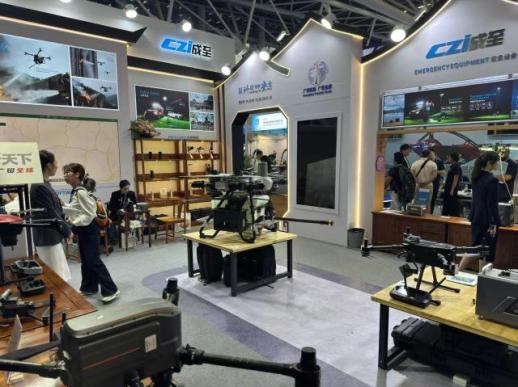 U.S.-Japan Drone Partnership Raises Stakes for South Korea’s Defense Industry The United States and Japan have agreed to jointly develop and produce advanced weapons, including attack drones, a move that is rapidly reshaping the global defense industry. The partnership pairs U.S. technology with Japan’s manufacturing capacity, giving it the character of an industrial alliance as well as a military one. While it is framed as a supply-chain shift aimed at China, it could also affect South Korea’s defense exports. The immediate goal is clear: to check China, which dominates the global drone market, and to adapt to changing battlefield conditions. In recent wars, drones have become core combat power rather than a supporting tool. Because they can be produced cheaply and deployed in large numbers, manufacturing capacity itself can translate into military strength. A division of labor in which the U.S. provides technology and Japan handles production is well suited to that shift. The larger issue is that the partnership may go beyond replacing Chinese supply. By combining technology and production, the two countries aim to secure price competitiveness, quality and stable supply at the same time. If that is reinforced by alliance-based political trust, global defense procurement could be reorganized. For South Korea’s defense industry, which has already posted results in Southeast Asia and the Middle East, the risk of market erosion cannot be ruled out. South Korea’s drone industry remains at an early stage. Exports are growing, but its global market share is still low. Its direct competitor is China, but over the medium to long term it is likely to face competition from an alliance-based supply chain led by the U.S. and Japan. South Korea’s defense sector, which has grown around finished weapons, could also come under pressure in “package export” competition. Once drones and other unmanned systems are integrated with existing weapons, the competitive field widens. Still, the shift does not have to be viewed only as a threat. It can be a chance to reset strategy. Defense production is moving beyond hardware toward a systems industry that combines artificial intelligence, data and communications. Competition is expanding from airframes to software and platforms. If South Korea misses that transition, its current strengths may not last. A response strategy needs to be clear. First, South Korea should separate short-term and medium- to long-term approaches. In the near term, it should protect export competitiveness by building on existing strengths and expanding real-world deployment of drones and unmanned systems. At the same time, it should focus on securing AI-based autonomous systems and data-integration capabilities. Speed and structural improvement must proceed in parallel. Second, it should strengthen links to a U.S.-centered defense ecosystem. A stronger U.S.-Japan alliance does not necessarily mean South Korea will be excluded. With fast production capacity and maintenance experience, South Korea could find a complementary role. The key is not participation alone but securing differentiated areas, particularly in communications, security and software. Third, it should push practical integration of civilian technology and defense production, which will require institutional change. Security rules should be maintained, but pathways should be created for private companies to participate. Opportunities for testing in constrained environments should be expanded, and technology development using defense data should be supported. The government should also make active use of advance purchases and test-bed programs to help early-stage technology firms enter the market. The need is for execution, not declarations. Ultimately, the U.S.-Japan cooperation is a signal that defense competition is shifting from company-to-company rivalry to competition among national industrial alliances. The sector is being reorganized into a complex industry combining technology, production and diplomacy. If South Korea fails to keep pace, its current gains may not endure. What is needed now is not simply a sense of crisis, but strategy and follow-through. South Korea’s defense industry has already shown its potential. The question raised by a U.S.-Japan drone partnership is straightforward: What position will South Korea hold in this new order? The answer will depend on prepared strategy and rapid execution.* This article has been translated by AI. 2026-04-28 08:54:24
 -
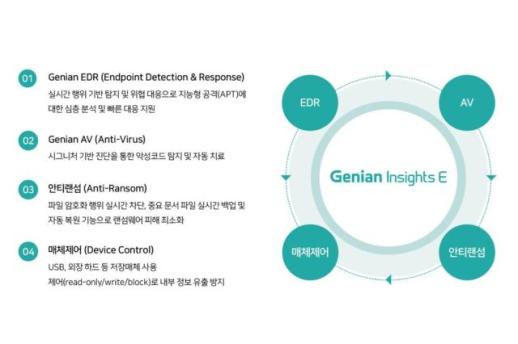 Genians Leads South Korea’s Public EDR Procurement Market for Seventh Straight Year South Korean cybersecurity company Genians said it ranked No. 1 in the public procurement market for endpoint detection and response, or EDR, for the seventh consecutive year. The company said Monday that it held a 46% share in 2025 based on the Public Procurement Service’s Nara Marketplace data. Genians said it has expanded its foothold in the public sector by building on technical competitiveness from the early days of South Korea’s EDR market in 2019 through today’s AI-driven security environment. EDR is a security technology that analyzes activity on endpoints such as PCs and servers in real time to detect and respond to threats. Its importance has grown as sophisticated cyberattacks have intensified alongside the spread of generative AI. Genians said it was the first in South Korea to develop EDR and has helped public institutions improve security visibility and respond to advanced threats. The company said it obtained a security function verification certificate from the National Intelligence Service, meeting stringent public-sector requirements, and has contributed to protecting government administrative networks and key infrastructure. Genians said its EDR has been deployed on more than 750,000 agents across central government agencies, local governments, financial institutions and large manufacturers, and that it has secured more than 200 references at home and abroad. The company said it is strengthening a single-console integrated security platform strategy by combining EDR with next-generation antivirus, anti-ransomware and device control to build an integrated endpoint response system. It also highlighted linking a machine-learning engine with AI-based cyber threat intelligence to detect previously unknown malware. The company said its system can identify threats from the hacking attempt stage and trace and analyze activity after an incident. Lee Dong-beom, Genians’ CEO, said defenses must be rebuilt on the assumption that threats can be constant in an era when AI can autonomously design attack scenarios. He said the company will combine its EDR technology with AI-based automated response to provide an endpoint security platform that blocks sophisticated attacks in real time.* This article has been translated by AI. 2026-04-28 08:48:20
 -
 Samsung Unveils Glasses-Free 32-Inch 3D Spatial Signage Display Samsung Electronics said on the 28th it will launch a new 32-inch glasses-free 3D display called “Spatial Signage.” The next-generation display uses Samsung’s proprietary “3D Plate” technology to create a three-dimensional effect without dedicated 3D glasses, making images appear to have depth as if there were space inside the screen. Samsung expanded the lineup after introducing an 85-inch model earlier this year, adding the 32-inch version to boost visibility for smaller products on display. The existing 85-inch model offers 4K UHD resolution and a screen about 190 centimeters tall, designed to deliver an immersive experience, such as viewing a runway show at a glance. The 32-inch model uses FHD resolution and a 9:16 aspect ratio, enabling realistic 360-degree rotating video that shows products such as shoes and jewelry from the front, sides and back. Despite a slim 49.4-millimeter profile, it delivers a sense of depth and can provide a lifelike viewing experience without physically displaying the product, the company said. Weighing 8.5 kilograms, it is lighter than box-shaped hologram-style 3D displays and is designed for easier installation in tight spaces, including on store shelves, Samsung said. Samsung’s commercial-display software, Samsung VXT, supports remote device management, real-time monitoring, and simpler content creation and operations. The company said it has added a range of new features to VXT to improve usability and operating efficiency across Samsung signage products, including Spatial Signage. A newly added “AI Studio” app allows users to create video content for signage using a single photo, Samsung said. Kim Hyeong-jae, a vice president in Samsung Electronics’ Visual Display Business, said the 32-inch Spatial Signage is designed to deliver an immersive 3D experience in places where large signage is difficult to install. “By building an integrated digital signage ecosystem that combines innovative display products and solutions, we will provide customers with optimal commercial displays,” Kim said.* This article has been translated by AI. 2026-04-28 08:46:38
 -
 Trump Skeptical of Iran Proposal to Open Strait of Hormuz, Pause Nuclear Talks U.S.-Iran talks aimed at ending the war have stalled, and President Donald Trump has been skeptical of a new Iranian proposal described as a “three-step peace plan,” according to a report. The Wall Street Journal reported April 27, citing U.S. officials, that Trump and his national security team view Iran’s offer with doubt. The proposal would include opening the Strait of Hormuz and deferring discussions of Iran’s nuclear program, the officials said. Trump discussed the offer with advisers that morning, the report said. He did not reject it outright, but questioned whether Iran is negotiating in good faith. He also expressed skepticism that Iran would accept key U.S. demands to stop uranium enrichment and abandon nuclear weapons development, according to the officials. Officials said Iran’s plan has three stages. In the first, the United States and Israel would halt military action against Iran and provide assurances it would not resume. In the second stage, mediating countries would work to resolve the issue of a Strait of Hormuz blockade and help reach an agreement on how the strategic waterway would be managed. Iran is said to be seeking to retain control over the strait during that process. In the third stage, Iran would enter talks on other disputes — including its nuclear program and support for regional proxy forces — only after those conditions are met, the officials said. The United States plans to keep negotiating, and the White House is likely to present an official position and a counterproposal within days, the report said. Trump has warned he could resume airstrikes on Iran if talks to end the war fail, but officials said sentiment within the administration to avoid renewed military conflict has been growing. White House spokeswoman Anna Kelly said, “The United States does not negotiate through the media, and anything not officially announced by President Trump or the White House should be considered speculation.”* This article has been translated by AI. 2026-04-28 08:45:50
 -
 Lee Praises NTS Chief Lim for Tracking Overseas Hidden Assets of Tax Delinquents President Lee Jae-myung applauded the National Tax Service on the 28th for tracking overseas hidden assets held by tax delinquents, calling tax fairness “a very important value.” In a post on X, formerly Twitter, Lee thanked NTS Commissioner Lim Gwang-hyeon for “working hard,” noting that Lim took the job after leaving his seat as a lawmaker. The NTS said the previous day it had recovered 33.9 billion won in overseas assets from delinquent taxpayers since Lee’s government launched in July last year. Lim wrote on X the previous day that the agency has recovered a total of 37.2 billion won in delinquent taxes from overseas since 2015, including 33.9 billion won during the nine months since Lee’s government took office. He added that recovery procedures are still underway in locations around the world. * This article has been translated by AI. 2026-04-28 08:45:16
 -
 Heungkuk Securities Raises Hyundai Steel Target on Improving Steel Market Outlook Heungkuk Securities maintained its “buy” rating on Hyundai Steel and raised its target price to 55,000 won. The brokerage cited expectations for improving steel market conditions and the impact of planned price increases, saying a near-term earnings rebound is becoming more visible. Jinsoo Jung, an analyst at Heungkuk Securities, said Hyundai Steel’s first-quarter results missed market expectations, with revenue of 5.7397 trillion won and operating profit of 15.7 billion won. He attributed the shortfall to a lagging effect that reflected lower prices for flat steel products and higher costs, which narrowed rolling margins. Still, sales volume rose to 4.26 million tons, which he said confirmed a demand recovery led by flat products. Jung said improved steel scrap prices and contributions from standalone subsidiaries helped cushion results. He added that consolidated profitability improved on one-off gains such as a tariff refund at Hyundai Steel Pipe and expanded operations at the Pune SSC in India. Looking ahead, Jung took a more upbeat view of the industry. He said global supply and demand are improving as Chinese hot-rolled coil prices rise and exports decline, and that anti-dumping effects are also creating conditions for domestic steelmakers to regain market share. He said domestic steelmakers are pursuing price hikes to reflect higher raw material costs, with the impact expected to show gradually in results starting in the second quarter. He added that a faster normalization is expected, particularly in the long steel segment. Jung said he raised his EBITDA estimate by 16% and increased the target price by applying a target EV/EBITDA multiple of 6.3. He forecast that improving market conditions would continue into the second half, alongside the effect of price increases for high value-added steel sheets used in automobiles.* This article has been translated by AI. 2026-04-28 08:42:06
 -
 Comedian Choi Yang-rak Says He Moved to Australia After Being Told He Was Too Old Comedian Choi Yang-rak has explained why he once moved to Australia. Choi appeared as a guest on the tvN STORY program “Namgyeoseo Mwohage,” which aired on the 27th. On the show, Lee Young-ja said it felt abrupt when he announced he was moving to Australia and asked why he stopped appearing on TV at the height of his career. Choi said it happened in 1998, when he was hosting “Good Friends” with Nam Hee-seok. “I was told the bureau chief wanted to see me, so I went, and I was notified I was being fired,” Choi said. “I was 38, and they said I was too old. So I left for Australia in anger.” Choi said only one person in his family of four had a job at the time. “Only my daughter had the ‘job’ of being a student, and the rest of us were unemployed,” he said, adding that taking his daughter to and from school was his only daily routine. He said he went with the money he had saved but was in no position to earn a living there. “I didn’t speak English, and I had no skills,” he said. “I’ve had a lot of ups and downs in my life.” Choi said he kept writing comedy after emigrating, and that his wife urged him to return to South Korea. He said she told him, “Let’s go back to Korea. You can do it,” and helped him prepare for a comeback, including getting him double-eyelid surgery and a short haircut. He said he returned with the new look and performed “alkkagi,” expressing gratitude to his wife, Paeng Hyun-sook, for helping him revive his career. 2026-04-28 08:39:24