
Journalist

Seo Hye Seung
-
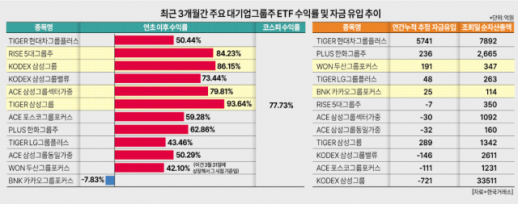 Samsung Leads ETF Market with 93% Returns, LG and Hyundai Lag Behind In the ongoing rally toward the "dream 7000-point" mark, Samsung Group has solidified its dominance in the domestic exchange-traded fund (ETF) market, achieving over 93% returns since the beginning of the year. In contrast, major companies like Hyundai and LG have underperformed, contributing to a growing disparity in returns. According to the Korea Exchange, as of May 7, ETFs tracking major conglomerates (excluding bonds) have shown that Samsung-related products dominate the top returns. The standout performer is the 'TIGER Samsung Group' ETF, which has achieved a remarkable 93.64% return. Following closely are 'KODEX Samsung Group' at 86.15% and 'RISE 5 Major Groups' at 84.23%, which has a high concentration of semiconductor stocks like Samsung Electronics and SK Hynix. The 'ACE Samsung Group Sector Weighted' ETF also recorded a solid 79.81% return. This surge in ETF performance is largely attributed to Samsung Electronics' significant rise, driven by the AI semiconductor supercycle. The KOSPI index has increased by 77.73% during the same period, but Samsung-related ETFs have outperformed by 10-15 percentage points, with Samsung Electronics soaring by 126.44%. In contrast, the returns for the other five major groups have lagged behind the KOSPI. The 'TIGER LG Group Plus' ETF showed the weakest performance at 43.46%, followed by 'TIGER Hyundai Group Plus' at 50.44% and 'ACE POSCO Group Focus' at 59.28%. Even the 'PLUS Hanwha Group' ETF, which benefited from strong shipbuilding and defense sectors, could only manage 62.86%, falling short of the KOSPI's gains. Among other large corporate groups, the disparity in returns is even more pronounced. The 'WON Doosan Group Focus,' launched on March 31, has achieved a 42.10% return, exceeding the KOSPI's 41.93%. However, the 'BNK Kakao Group Focus' has reported a -7.83% return, the only major group ETF in negative territory. This divergence in returns has led to polarized capital flows. Notably, the 'TIGER Hyundai Group Plus,' which underperformed, attracted a substantial inflow of 574.1 billion won, likely due to investor optimism regarding Hyundai's value-up program and new business ventures in robotics. Conversely, the high-performing 'KODEX Samsung Group' saw an outflow of 72.1 billion won as investors took profits, believing the index had peaked. Kim Seong-no, a researcher at BNK Investment & Securities, noted, "While the expansion of the ETF market has created favorable supply conditions, ongoing macroeconomic uncertainties could amplify stock market volatility. Given the concerns over slowing growth amid the index's rise, investors should be prepared for potential technical corrections due to overheating."* This article has been translated by AI. 2026-05-07 23:20:19
 -
 Indian Ambassador Calls South Korea a Key Partner for India's 2047 Vision Indian Ambassador Goranglal Das described President Lee Jae-myung's recent state visit to India as a pivotal moment for the two nations, reflecting the deep interest both leaders have in strengthening bilateral relations. During a press briefing on May 7 at the Indian Embassy in Yongsan, Das stated, "This visit is the result of the special attention that Prime Minister Narendra Modi and President Lee have given to our relationship." He emphasized Modi's longstanding respect for South Korea, recalling that during his first press conference as Chief Minister of Gujarat 25 years ago, Modi expressed a desire to model Gujarat after South Korea. "This shows how much attention Modi has paid to India-South Korea relations," Das noted. Das also highlighted Lee's commitment to India, mentioning that before becoming president, Lee served as the head of the Korea-India Friendship Association in the National Assembly, underscoring the importance he places on India. The ambassador pointed out that while the two leaders had previously met at the G7 and G20 summits, this state visit allowed for a more in-depth discussion about the future direction of their partnership. "From India's perspective, South Korea is a like-minded democratic nation and a special strategic partner," Das said, emphasizing the importance of collaboration amid geopolitical tensions, supply chain disruptions, energy uncertainties, and the rise of AI. He also noted South Korea's role as a key partner in India's 'Make in India' initiative, citing the successes of Samsung and Hyundai in India as examples of significant technological contributions across various sectors, including defense. Das revealed that India aims to become a developed nation by 2047, the centenary of its independence, and sees South Korea as a crucial partner in achieving this 'Viksit Bharat' vision. Comprehensive Industrial Cooperation from Shipbuilding to AI Das identified key areas for cooperation, including shipbuilding, semiconductors, AI, energy, steel, critical minerals, creative industries, and startups. He explained that India is prioritizing South Korea as it advances its maritime industry under the 'Maritime Amrit Kaal' vision. In semiconductors and AI, he highlighted the potential synergy between India's workforce and data and South Korea's semiconductor leadership. In the energy sector, India aims to achieve 100 gigawatts of nuclear power by 2047 and sees significant collaboration opportunities in green ammonia and green hydrogen supply. Das mentioned that India targets a steel production capacity of 500 million tons by 2047, and South Korea's advanced steel manufacturing technology could aid in India's self-sufficiency. During the state visit, the two leaders reportedly met for over five hours. They also commemorated their ancient ties with a tree planting ceremony, referencing a legend about an Indian princess from Ayodhya who married King Suro of Korea around 2,000 years ago. The planted tree will eventually be moved to a memorial park for the princess in Ayodhya. In the economic sphere, President Lee attended a business summit with around 800 participants, while Modi expanded a planned casual lunch into a working lunch with South Korean business leaders. Achievements in corporate collaboration included the establishment of a steel joint venture between POSCO and India's JSW, as well as Hyundai's cooperation in setting up a greenfield shipyard in India. Additional events included a financial cooperation forum, Bengaluru Space Day, and a venture, startup, employment, and entrepreneurship fair held alongside the summit. Das noted that four political documents were adopted during the visit, covering overall strategic vision as well as agreements in maritime, sustainability, and energy sectors. He quoted Modi, stating that the scope of cooperation has expanded "from chips to ships, talent to technology, and environment to energy." In response to questions, Das discussed expanding opportunities for South Korean companies in India, noting that fewer than 700 South Korean firms currently operate there. He mentioned President Lee's ambition to increase this number tenfold and highlighted discussions about creating a dedicated industrial zone for South Korean SMEs. Regarding energy cooperation, Das explained that both countries rely heavily on hydrocarbons from West Asia, making them vulnerable to supply chain disruptions. He expressed India's goal of becoming a more stable supplier of naphtha to South Korea, emphasizing the need for long-term contracts to enhance predictability. However, he clarified that sourcing and resale issues should be determined by companies, not governments. Das also mentioned interest in attracting significant Korean investments to the Indian stock market, citing examples of major Korean companies listing in India.* This article has been translated by AI. 2026-05-07 23:17:56
 -
 Increase in Noncompliance Cases Among KOSPI Companies Amid Market Boom As the stock market continues to thrive, cases of noncompliance among listed companies have risen this year. While the total number of designations remains similar to last year, the number of KOSPI companies identified has surged by 30%. This increase is attributed to a series of corporate events leading to disclosure reversals and failures during the market's rapid ascent. According to the Korea Exchange, as of June 6, there have been 110 cases of companies designated or warned for noncompliance in both the KOSDAQ and KOSPI markets. This figure is comparable to the 111 cases reported during the same period last year. However, the trends differ by market. The number of KOSPI companies rose from 30 last year to 39 this year, a 30% increase. In contrast, KOSDAQ companies saw a decrease from 81 to 71, a drop of 12.3%. Noncompliance is designated when companies fail to meet disclosure obligations. Common issues include failure to disclose, disclosure reversals, and changes in disclosures. The Korea Exchange first issues a warning before deciding on final designations after a review. Final designations lead to penalties. If a company accumulates 10 or more penalty points, trading is suspended for a day. If points exceed 15 within a year, the company may be designated as a management issue. This is crucial for maintaining market trust and protecting investors. This year, 19 companies were ultimately designated as noncompliant in the KOSPI market. Of these, 15 cases were due to failure to disclose, while there were two each for disclosure reversals and changes. Analysts suggest that the recent market rally has prompted companies to aggressively pursue investments and funding, leading to changes in plans and delays that resulted in disclosure violations. One notable case involved J.R. Global REITs, which was designated for reversing its capital increase plan. Additionally, Daewon Electric Wire faced issues for disclosing its capital increase decision in December, nearly a year after it was made, leading to a designation for failure to disclose in January.* This article has been translated by AI. 2026-05-07 23:16:01
 -
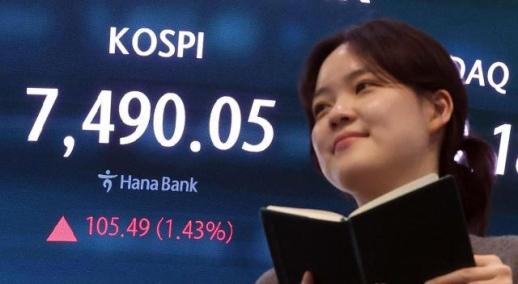 South Korea's Stock Market Surpasses Canada, Ranks Seventh Globally South Korea's stock market has risen to the seventh largest in the world by market capitalization, surpassing Canada. Just ten days after overtaking the UK for eighth place, the KOSPI index has climbed significantly, driven by gains from semiconductor giants Samsung Electronics and SK Hynix. According to Bloomberg, as of June 6, South Korea's market capitalization reached approximately $4.59 trillion, edging past Canada's $4.5 trillion. On April 27, the market capitalization was recorded at $4.04 trillion, allowing South Korea to surpass the UK. Only six countries now have larger market capitalizations than South Korea: the United States ($77.08 trillion), China ($15.27 trillion), Japan ($8.33 trillion), Hong Kong ($7.47 trillion), India ($5.1 trillion), and Taiwan ($4.67 trillion). The KOSPI index has surged 77.7% this year, exceeding last year's impressive growth of 75.5%. This marks the first time since the 1980s that the KOSPI has seen back-to-back years of over 70% growth. The surge in the KOSPI is largely attributed to the semiconductor sector. Since mid-April, Samsung Electronics and SK Hynix have consistently reached record highs, boosting the overall market capitalization. Expectations for further ranking improvements are rising. The KOSPI jumped 5.12% on May 4 and 6.45% on June 6, closing at a new high of 7,490.05. Samsung Electronics rose 2.07% to 271,500 won, while SK Hynix increased by 3.31% to 1,654,000 won. Together, these companies account for 45% of the KOSPI's total market capitalization, valued at 1,587 trillion won and 1,179 trillion won, respectively. Han Ji-young, a researcher at Kiwoom Securities, noted, "The pace of profit improvement is significantly outpacing stock price increases. The consensus for KOSPI's operating profit in 2026 is projected at 124.2%, exceeding the expected stock price growth during the same period." She added that with foreign investors recording net purchases of 6 trillion won since May, the momentum for further gains in the KOSPI, particularly in leading sectors like semiconductors, remains strong.* This article has been translated by AI. 2026-05-07 23:14:11
 -
 Commission Resumes Investigation of Pro-Japanese Assets After 16 Years The Pro-Japanese Asset Investigation Committee has been reestablished to review and decide on matters related to pro-Japanese assets. The new law provides a legal basis for recovering proceeds from the sale of these assets and for rewarding whistleblowers who report pro-Japanese properties.On May 7, the Justice Ministry announced that the Pro-Japanese Asset Confiscation Law passed the National Assembly. This law will take effect six months after its promulgation.The committee will resume its activities after 16 years. The first committee, active from July 2006 to July 2010, successfully recovered approximately 237.3 billion won in pro-Japanese assets before concluding its work.The new law not only reinstates the committee but also clarifies the legal framework for recovering proceeds from sold pro-Japanese assets and introduces reward provisions to encourage reporting.Once the committee resumes its work, recovered assets will primarily support funds for independence activists and their families, contributing to their financial stability and commemorative projects.In related developments, the Justice Ministry confirmed that descendants of pro-Japanese collaborator Im Seon-jun sold eight plots of land in Cheonsong-dong, Yeoju, between 1993 and 2000. On January 14, the ministry filed a lawsuit seeking the return of approximately 53 million won from the descendants.On April 22, the Seoul Western District Court ruled in favor of the state, marking the first successful case following a Supreme Court ruling that deemed claims of expiration by descendants of pro-Japanese collaborators as an abuse of rights.The Justice Ministry has also filed lawsuits for the return of properties belonging to descendants of other collaborators, including 31 plots in Ho-won-dong valued at about 7.8 billion won, 12 plots in Ilsan-dong valued at approximately 2.5 billion won, and two plots in Inchang-dong valued at around 3 billion won. These cases are currently in the first trial stage.Justice Minister Jeong Seong-ho stated, "The enactment of this law represents a national commitment to fully address pro-Japanese collaboration, aiming to recover unjustly accumulated assets and restore historical justice."* This article has been translated by AI. 2026-05-07 23:12:15
 -
 Samsung Faces Internal Strife Amid HBM Competitiveness Concerns Concerns are growing that internal conflicts at Samsung Electronics could undermine its competitiveness in high-bandwidth memory (HBM). The Device Solutions (DS) division is threatening a total strike over demands for increased bonuses, while the Device Experience (DX) division expresses feelings of deprivation amid declining profitability and the withdrawal from the Chinese TV and home appliance market.According to industry sources, the Samsung Electronics union's joint action committee plans to initiate a total strike starting May 21 if wage negotiations with management fail. A key issue is the demand for performance-based bonuses linked to operating profits, spurred by improved results in the DS division due to rising AI semiconductor demand.The mood within the DX division is tense. Samsung recently confirmed its withdrawal from the Chinese TV and home appliance market, a decision attributed to aggressive pricing from local competitors and weak demand. Many in the DX division perceive this as a retreat from a core business.Given that TVs and home appliances have long been vital to Samsung's global brand value, the anxiety among DX employees is palpable. While attention focuses on the DS division's impressive performance and the expanding AI semiconductor market, DX employees feel their contributions, especially amid risks like U.S. tariffs, are being overlooked.The recent departure of the Donghaeng Union, which has many members in the DX division, from the joint action committee highlights dissatisfaction over the prioritization of DS bonus discussions at the expense of DX issues. The Donghaeng Union has called for fair representation and compliance with obligations regarding information sharing and non-discrimination.A DX representative noted, "With nearly half of the company's workforce in the DX division, it will be difficult for management to fully accept the demands centered on the DS division. I believe the DS employees should make concessions before more extreme conflicts arise."Industry analysts warn that Samsung's internal strife could negatively impact its competitiveness in HBM and other memory semiconductors. The DS division struggled in HBM competition until late last year but has since begun to regain its footing, though it has yet to establish fundamental competitiveness.Experts emphasize that major tech clients like NVIDIA prioritize quality, yield, and delivery stability when selecting suppliers. If a strike occurs, the damage to customer trust could be more severe than short-term production disruptions.Concerns are mounting that repeated halts in production due to strikes could lead to lower yields and compromised quality. HBM, which involves stacking multiple DRAM chips and advanced packaging, requires stringent process stability and quality control. Inconsistent yields could result in losing key clients.An anonymous Samsung executive stated, "The union argues that a strike could result in losses of tens of trillions of won, while external estimates suggest that halting semiconductor production could cost 1 trillion won daily. HBM ultimately hinges on yield, and if production lines are repeatedly halted, we risk losing our status as a reliable supplier to key clients like NVIDIA, which is the most serious risk." 2026-05-07 23:03:39
 -
 Samsung Faces Internal Strife Amid Semiconductor Boom Once a source of self-deprecating humor, the term "Samsung after" referred to non-electronics subsidiaries, highlighting the allure of Samsung Electronics' performance and treatment. Recently, however, a new hierarchy has emerged within Samsung Electronics, deepening divisions among its business units.Concerns are growing that the discontent among employees in other divisions toward the Device Solutions (DS) sector's demands for average bonuses in the millions of won could harm organizational cohesion.According to industry sources, labor disputes over excessive compensation demands from the DS sector's union are escalating, raising the possibility of a general strike. Meanwhile, employees in the Device Experience (DX) sector, feeling sidelined, are increasingly fatigued. While the DS sector thrives on rising demand for AI semiconductors, the DX sector, responsible for mobile, TV, home appliances, and telecommunications, struggles amid global consumer slowdowns and cost pressures.In the first quarter, Samsung Electronics reported an operating profit of 57.2 trillion won, with the DS sector contributing 53.7 trillion won. The DX sector, excluding mobile, has seen stagnant or declining performance, with the home appliance division recording losses.This performance gap is shaking organizational morale, as the semiconductor division has a stronger justification for demanding bonuses, while the DX sector is focused on cost-cutting and defending profitability. An industry insider noted, "The economic conditions for DS and DX within Samsung Electronics are completely different," warning that the bonus dispute could lead to feelings of relative deprivation between the divisions.The rift is also manifesting as labor conflicts. The super-large union, dominated by DS members, is leading joint protests, while the DX-based union has withdrawn from the joint action committee. While this appears to be a difference in strategy, many in the industry interpret it as a buildup of dissatisfaction among DX members who feel excluded from DS-centric bonus negotiations.Management has expressed concern as well. With fierce competition from rivals like SK Hynix and Micron, there is a growing fear that a strike could disrupt production and damage customer trust, especially as the company seeks to regain its competitive edge in high-bandwidth memory (HBM). On the same day, Vice Chairman Jeon Young-hyun and CEO Roh Tae-moon emphasized the need to ensure future competitiveness during wage negotiations.Analysts suggest that Samsung Electronics faces a dual challenge: leveraging the semiconductor boom to strengthen overall competitiveness while also resolving internal conflicts.A Samsung employee, who requested anonymity, remarked, "The push for a general strike is primarily driven by DS, leading to increased dissatisfaction among DX employees. Nowadays, it feels like DS and DX are different organizations with conflicting interests rather than parts of the same company." 2026-05-07 23:02:40
 -
 Samsung Electronics Faces Challenges in Home Appliances and Mobile Business Samsung Electronics' Device Experience (DX) division is seeking ways to overcome poor performance in its non-semiconductor businesses. While focusing on strengthening its mobile sector, the company is also beginning to streamline underperforming areas like home appliances.On May 7, industry sources reported that Samsung has decided to halt sales of TVs, monitors, washing machines, vacuum cleaners, and refrigerators in China. The company officially notified employees at a meeting the previous afternoon and has informed local distribution channels and partners of this decision. Alongside the sales halt, adjustments to local staffing and organizational restructuring are expected.Changes are also occurring within the domestic TV business. Lee Won-jin, the head of global marketing, has been appointed as the new head of the Video Display (VD) division. Lee is known for successfully launching platform businesses like Samsung TV Plus, an ad-supported streaming service. The strategy aims to diversify revenue beyond hardware to focus on software-based platforms. A Samsung representative stated, "The focus is on enhancing platform capabilities rather than drastic organizational changes," adding that the shift towards a service-oriented business model will accelerate.The mobile sector is also facing difficulties. Samsung's combined operating profit for its Mobile Experience (MX) and Network (NW) divisions in the first quarter of this year was 2.8 trillion won, a 34.88% drop from 4.3 trillion won in the same period last year. The primary cause of this decline is the surge in memory semiconductor prices, which are expected to continue rising, making profitability management crucial.Despite these challenges, Samsung plans to enhance its mobile competitiveness by continuing to innovate its Galaxy S series and foldable products, as well as strengthening AI features. The company is preparing to launch smart glasses in the second half of the year and aims to increase the premium product share by enhancing features in wireless earbuds and Galaxy Watches.While halting appliance sales in China, Samsung will continue its mobile operations there. The company plans to release locally tailored smartphones, such as the Galaxy W series, and promote Galaxy AI features. However, it remains uncertain whether this will help regain market share against local competitors like Huawei and Xiaomi.The struggling Network division is undergoing personnel changes and increasing technology investments. In 2024, about 700 employees from the Network division were reassigned to other divisions to improve organizational efficiency. Concurrently, the company is focusing on securing next-generation technologies for the AI era. Since establishing the Next-Generation Communication Research Center under Samsung Research in 2019, it has been researching 6G technologies. Recently, it achieved transmission speeds nearly twice as fast as 5G in the 7 GHz frequency band, a key candidate for 6G.An industry insider noted, "The DX division is looking to improve performance by expanding its B2B revenue model beyond traditional B2C. With increasing low-cost competition from Chinese firms, relying solely on hardware sales shows clear growth limitations, necessitating a shift towards platforms, services, and AI."* This article has been translated by AI. 2026-05-07 23:02:10
 -
 KOSPI Soars Thanks to Semiconductors: Is 'Samsung-Hynix' Dependence a Risk or Benefit? Taiwan is home to TSMC, the world's largest foundry, which dominates the economy, accounting for 46% of the total market capitalization of the Taiwanese stock market. A similar concentration is raising concerns in South Korea, where the KOSPI index's reliance on 'Samsung-Hynix' (Samsung Electronics and SK Hynix) is causing fears of market polarization. Critics argue that the semiconductor sector is creating a misleading perception of overall market strength. However, supporters contend that the strong performance of these two companies justifies their stock price increases, and that sector concentration is not unique to South Korea. ◆ 'Samsung-Hynix' Approaches 50% of KOSPI Market Cap On May 7, the KOSPI closed at 7,490.05, up 105.49 points (1.43%). The surge was driven by semiconductors, with Samsung Electronics reaching a record high of 277,000 won and SK Hynix hitting 1,665,000 won. Although both stocks later retraced some gains, their market influence remains significant. Samsung Electronics and SK Hynix have market capitalizations of 1,587 trillion won and 1,179 trillion won, respectively, totaling 2,766 trillion won, or about 45.06% of the KOSPI. This is a slight decrease from 47% the previous day, but the KOSPI's direction is still heavily influenced by these two stocks. Their combined market cap has nearly doubled from about 462 trillion won (21.9% of KOSPI) a year ago, increasing to 1,184 trillion won (34.0%) by the end of last year, and maintaining 1,824 trillion won (38.2%) after the outbreak of conflict between the U.S., Israel, and Iran in early March. Despite the market boom, concerns about the concentration of 'Samsung-Hynix' persist. While the semiconductor sector is driving the rally, a slowdown could lead to increased volatility across the market. Eugene Investment & Securities noted that excluding semiconductors, the KOSPI index would be around 4,100, indicating that most sectors are lagging behind the index's rise. Only one-third of the market is reaching new highs this year. ◆ "Sector Concentration is Not Unique to South Korea" While the concentration in semiconductors is deepening, some analysts argue there is no cause for alarm. They point out that the stock prices of Samsung Electronics and SK Hynix are closely tied to their performance and are still considered undervalued. Domestic brokerages believe the memory sector's reevaluation is in its early stages, suggesting there is room for further growth. SK Securities raised its price targets for Samsung Electronics and SK Hynix to 500,000 won and 3 million won, respectively, while Mirae Asset Securities increased SK Hynix's target from 2 million won to 2.7 million won, a 35% hike. The phenomenon of large tech stocks leading the market is not exclusive to South Korea. In the U.S., the so-called 'Magnificent Seven' (M7) tech giants are driving market gains. According to StockAnalysis, the total market cap of companies in the Nasdaq 100 is approximately $38.38 trillion, with the M7—NVIDIA, Alphabet, Apple, Microsoft, Amazon, Meta, and Tesla—accounting for $23.19 trillion, or 60.4% of the total.* This article has been translated by AI. 2026-05-07 23:00:00
 -
 Government Seeks Farmer Input on Agricultural Cooperative Reforms The government, which is pushing for reforms in agricultural cooperatives, gathered feedback from farmers on May 7. Officials expressed intentions to address concerns about election fervor and rising costs.According to the Ministry of Agriculture, Food and Rural Affairs, Vice Minister Kim Jong-gu held a meeting with agricultural organization leaders at the aT Center in Seoul. He discussed the reform plans announced during government discussions on March 11 and April 1.Attendees included over 30 representatives from various agricultural organizations, such as Lee Seung-ho, president of the Korean Federation of Agricultural and Livestock Organizations, and Noh Man-ho, permanent representative of the Korean Comprehensive Agricultural Organizations Council.During the meeting, the ministry outlined key reform proposals, including the introduction of direct elections for members and the establishment of an Agricultural Cooperative Audit Committee. They also shared feedback gathered from previous meetings with cooperative leaders and regional briefings.Last month, the government held regional briefings in Daegu, Cheongju, and Suwon to collect opinions from cooperative leaders, members, agricultural organizations, and experts. Concerns raised included the potential for election fervor and politicization with direct elections, as well as worries about organizational expansion and financial burdens from the new audit committee.In response, Vice Minister Kim stated that they are considering alternatives such as strengthening the eligibility for candidates and introducing public elections, as well as simultaneous elections for the president and cooperative leaders. He also assured that they would explore cost-saving measures through organizational efficiency to address concerns about increased expenses from the independent audit committee.Kim emphasized, "This reform aims to improve the abnormal operational structure of agricultural cooperatives revealed in special audits and ultimately restore these organizations to serve their members and farmers. We will address the concerns raised in today's meeting during the legislative process."* This article has been translated by AI. 2026-05-07 22:14:45