
Journalist

Seo Hye Seung
-
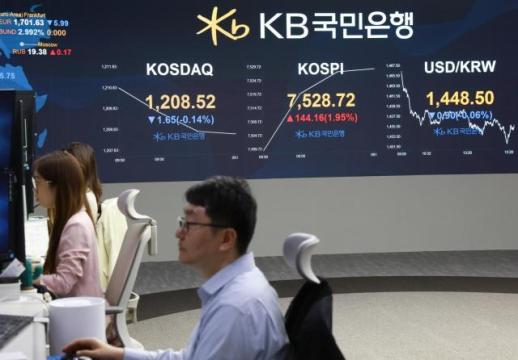 SK Hynix Doubles in Four Months, But Bank Stocks Lag in KOSPI Rally The KOSPI index surged past 7500, driven by a spike in semiconductor stocks, but bank shares remain sidelined in the market rally. Analysts attribute the limited upward momentum to concerns over financial stability and policy uncertainties despite record earnings. On May 7, Samsung Electronics closed at 271,500 won, up 5,500 won (2.07%) from the previous day, marking a 111.2% increase since the start of the year. Similarly, SK Hynix rose from 677,000 won to 1,654,000 won, a 144.3% jump. The semiconductor sector is leading the KOSPI's overall rise, fueled by expectations of increased demand for artificial intelligence and foreign investment. In contrast, bank stocks have lagged behind. While the KOSPI has risen 73.7% this year, the KRX Bank Index has only increased by 25.1%. Major financial groups saw limited gains, with KB Financial rising 30.7% from 123,300 won to 161,200 won, and Shinhan Financial increasing 29.1% from 76,600 won to 98,900 won, falling short of the KOSPI's growth. Despite the recent strong performance of the four major financial groups (KB, Shinhan, Hana, and Woori), which reported a combined net profit of 5.33 trillion won in the first quarter—an 8.1% increase year-on-year—analysts note that the growth in stock prices has been muted. This is partly due to the market already pricing in the banks' shareholder return strategies, including stock buybacks and increased dividends, as investor interest shifts toward high-growth sectors like AI and semiconductors. Concerns over rising delinquency rates and increased loan loss provisions have also heightened worries about financial stability, while the management of household loans poses additional challenges to bank profitability. Recent comments from President Yoon Suk Yeol and Kim Yong-beom, head of the Presidential Policy Office, criticizing the current credit rating system and interest rate structure have further dampened investor sentiment. However, analysts maintain that the fundamentals of bank stocks remain solid. Given the trends in market interest rates and lending regulations, there is a strong likelihood of continued improvement in net interest margins (NIM) in the second quarter. While short-term underperformance may persist, a reduction in market concentration could highlight the undervalued appeal of bank stocks. Hana Securities analyst Choi Jeong-wook stated, "If concerns about interest rates grow, the defensive appeal of bank stocks may resurface, and we expect them to outperform the market this month."* This article has been translated by AI. 2026-05-07 16:20:19
 -
 Financial Sector Supports Yeocheon NCC with Increased $300 Million Naphta Import Credit The financial sector is stepping in to support Yeocheon NCC amid increased supply challenges for naphta due to the prolonged conflict in the Middle East. On May 7, the Financial Services Commission announced that it would hold a meeting of the "Self-Regulatory Council of Bond Financial Institutions" to discuss a financial support plan that includes raising the naphta import letter of credit (L/C) limit to $300 million. A letter of credit is a payment method where banks guarantee payment to sellers on behalf of importers. This support plan is set to be approved by the Self-Regulatory Council on May 15 and implemented on May 18. Previously, Yeocheon NCC had requested an expansion of the L/C limit from its main creditor, Industrial Bank of Korea. In response, the bank expedited the usual six-week process for increasing the L/C limit to about two weeks, in line with a joint support system for naphta imports amid the Middle East situation. The Korea Trade Insurance Corporation also plans to provide $50 million in import insurance to bolster financial support. The Financial Services Commission stated, "This financial support will enable Yeocheon NCC to import naphta smoothly even in emergencies like price surges," adding that the financial sector will continue to provide prompt support to ensure no disruptions in naphta imports for the petrochemical industry. Meanwhile, Yeocheon NCC's operating rate had dropped to 55% due to supply disruptions from the blockade of the Strait of Hormuz, but it has recently adjusted the rate to 65% considering government support policies.* This article has been translated by AI. 2026-05-07 16:18:45
 -
 Tight Race for Daegu Mayor: Kim Boo-kyum vs. Choo Kyung-ho "Daegu needs to change now" "But the Democratic Party can't win" Public sentiment in Daegu, traditionally a conservative stronghold, is shifting. A visit by Aju Economy on May 7 revealed a tight race between Kim Boo-kyum of the Democratic Party and Choo Kyung-ho of the People Power Party for the mayoral position. Voices calling for change clashed with those insisting on preserving conservative values. Kim, the first Democratic lawmaker elected from Daegu, is leveraging his connection to the Lee Jae-myung administration to garner support, emphasizing the need for government budget allocations for the city. An 80-year-old man in Dongseongro, a former People Power supporter, remarked, "Isn't it time for Kim Boo-kyum to have a chance?" He argued that despite Choo's experience as a former economy minister, he questioned what could be achieved in the current political climate. A 20-something woman from Suseong District, where Kim has lived his entire life, noted, "It seems like more young people support the Democratic Party compared to older generations." A taxi driver traveling from East Daegu to West Daegu observed, "There seems to be a mood for change in Daegu, especially among the youth who are struggling to find jobs." The impact of the recent emergency measures is also influencing local sentiment, benefiting Kim. A 30-something professional expressed support for Kim, citing lingering loyalty to former President Yoon Suk-yeol as a drawback for Choo. Another professional woman in her 30s echoed this sentiment, expressing discomfort with Yoon. Choo, a three-term lawmaker from Dalseong-gun, is also receiving significant support. Residents believe he should be elected as mayor, having previously garnered 75.31% of the vote in the last general election. At the Hyunpoong Baeknyeondokgaebi Market, a 70-year-old man expressed his desire to see Choo as mayor, while another 73-year-old firmly stated, "We are definitely for Choo Kyung-ho." They also mentioned their support for former KCC chairman Lee Jin-sook, who is running for a parliamentary seat after being cut off from the mayoral race. An 80-year-old criticized President Lee's support policies, stating, "Offering 600,000 won will just burden the young people," and declared, "No matter what, I won't vote for the Democratic Party." Supporters in their 20s and 30s also expressed discontent with Lee's universal welfare policies. Many criticisms were directed more at the president than at Kim. While Choo's support is strong in Dalseong-gun, opinions suggest younger voters may differ. A taxi driver noted that Dalseong-gun has the youngest average age in the country at 44, indicating that the preferences of newcomers could be a significant factor. Some citizens expressed cynicism about the election, stating, "Neither candidate appeals to me," or "It doesn't matter who wins." Some even admitted they were unaware of the election. Recent polls indicate a close race, with Kim at 45.9% and Choo at 42.4%, a margin of just 3.5%. The survey, conducted by Daegu MBC and Ace Research from May 2-3, included 1,004 respondents aged 18 and older, with a margin of error of ±3.1 percentage points. More details can be found on the Central Election Survey Deliberation Commission's website. 2026-05-07 16:00:13
 -
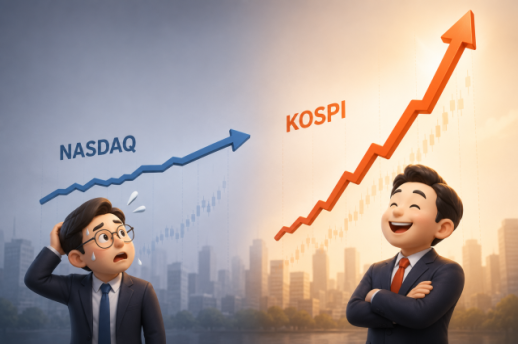 KB Asset Management Reclaims No. 3 ETF Market Share as Korea Stocks Surge South Korea’s stock market has climbed at an unusual pace, reshaping the exchange-traded fund landscape. Asset managers with heavier exposure to domestic equity ETFs have seen net assets rise quickly, while firms that emphasized U.S. big tech and other overseas-stock products have lagged. As of May 7, KB Asset Management’s ETF net assets totaled 32.4668 trillion won, according to the Korea Financial Investment Association. Korea Investment Management posted 32.4552 trillion won. Both had a 7.18% market share, but KB edged ahead on assets to retake third place. The two firms have traded the No. 3 spot for years. At the end of 2024, Korea Investment Management surpassed 13 trillion won in ETF net assets and closed in on KB, and the rankings continued to flip. By the end of last year, the gap widened: KB stood at 21.0866 trillion won with a 7.10% share, while Korea Investment Management rose to 25.3505 trillion won and an 8.53% share. The picture shifted this year as South Korean stocks surged. The Kospi has risen 191.49% over the past year, far outpacing the S&P 500’s 30.79% and the Nasdaq’s 45.67%. Since the start of the year, the Kospi is up 74.21%, compared with 7.39% for the S&P 500 and 11.20% for the Nasdaq. With money flowing into domestic stocks, related ETF assets expanded rapidly, helped by gains in the value of existing holdings. Analysts say managers with a larger share of domestic equity ETFs benefited most. Korea Investment Management has aggressively expanded a U.S. big tech-focused lineup. Among its flagship ETFs with more than 1 trillion won in net assets are ACE U.S. S&P 500 (3.6310 trillion won), ACE U.S. 30-Year Treasury Active (H) (1.8130 trillion won), ACE Global Semiconductor TOP4 Plus (1.3710 trillion won) and ACE Tesla Value Chain Active (1.2180 trillion won), all with significant exposure to U.S. stocks and technology shares. KB Asset Management, by contrast, has built a more balanced mix of domestic index and bond ETFs. Its flagship RISE 200 has 4.2780 trillion won in net assets. Other major products include RISE Korea Value Up (1.0010 trillion won), RISE Money Market Active (2.7240 trillion won), RISE Total Bond (A- or higher) Active (2.1070 trillion won) and RISE Samsung Electronics-SK Hynix Bond Mixed 50 (1.6110 trillion won), underscoring its domestic-asset tilt. The domestic rally is also affecting the battle for the top two spots. At the end of 2024, Samsung Asset Management and Mirae Asset Management held ETF market shares of 38.17% and 36.09%, a gap of 2.08 percentage points. By the end of last year, the gap widened to 5.39 points, and as of May 7 Samsung’s share had climbed to 40.08%, extending the lead over Mirae Asset to 8.64 points. Mirae Asset, which has also pursued an overseas-investment strategy, is seen as facing a relatively tougher environment during the domestic surge. An official in the financial investment industry said launching ETF products requires time and staffing, meaning an asset manager’s market outlook is reflected in its lineup. That lineup difference, the official said, becomes part of each firm’s brand identity and shapes investor choice. * This article has been translated by AI. 2026-05-07 15:56:26
 -
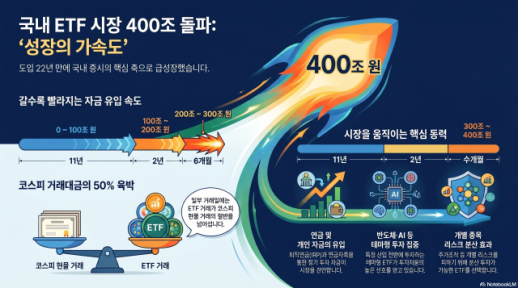 South Korea ETF Assets Top 400 Trillion Won as KOSPI Rally Fuels Shift From Stock Picking "We used to look for which stock would rise. Now we watch which ETF the money is flowing into." That line is increasingly common in Seoul’s Yeouido financial district as South Korean stocks extend a rally and the exchange-traded fund market expands quickly. Rather than picking individual names, more money is moving into ETFs that track indexes or broad sectors, shifting the market’s center of gravity. Industry officials say the domestic ETF market is accelerating even as external uncertainty, including war in the Middle East, persists. As of May 7, Korea Exchange data and other sources show domestic ETF net assets topped 400 trillion won last month. After ETFs were introduced in South Korea in 2002, it took 11 years for net assets to exceed 100 trillion won. It then took two years to reach 200 trillion won and six months to reach 300 trillion won. Net assets have now surpassed 400 trillion won within a few months, underscoring the faster pace of growth. ETF trading jumps with KOSPI rally Demand has risen as the KOSPI has repeatedly set record highs. Investors are increasingly favoring ETFs that provide exposure to the broader market and industries, rather than trying to manage volatility in individual stocks. A brokerage official said inflows are rising sharply as investors use ETFs to bet on the overall market trend in a rising market. Trading has also surged. On some sessions, ETF turnover has grown to more than half the value traded in the KOSPI cash market. Inflows have continued into semiconductor, artificial intelligence and secondary-battery ETFs, and trading has been active in leveraged ETFs that bet on bigger gains. Pensions and retail inflows reshape the market Retail investors and pension money are key drivers. ETF investing has expanded rapidly in individual retirement pension (IRP) and pension savings accounts, bringing steady long-term funds into the market. Analysts also point to financial regulators’ moves to strengthen responses to stock manipulation. As caution grows about risks tied to single-stock investing, some investors are leaning more toward ETFs for their diversification benefits. Competition among asset managers is intensifying. Major firms are rolling out a range of thematic ETFs, including semiconductors, AI, high-dividend and covered-call products, to capture demand. An industry official said ETFs have shifted from a supplementary tool to a core product for retail investors. "ETFs influence market direction" — and raise overheating concerns Some market participants say ETF inflows are now helping support the broader stock-market rise. A brokerage official said that when money enters ETFs, liquidity providers and authorized participants buy the underlying shares, improving supply-and-demand conditions in the cash market. Still, some warn about crowding into certain thematic ETFs. A sharp rise in leveraged and inverse ETF trading could increase market volatility. Even so, industry officials expect the ETF market’s growth to continue for the time being alongside the stock-market uptrend.* This article has been translated by AI. 2026-05-07 15:52:34
 -
 Tving Posts 19.2 Billion Won Q1 Operating Loss, Narrowing Deficit by 6.5 Billion Won Online video service Tving posted an operating loss of 19.2 billion won in the first quarter, narrowing its deficit and raising expectations for improved profitability after extending its content amortization period. CJ ENM said on May 7 during its 2026 first-quarter earnings conference call that Tving recorded a 19.2 billion won operating loss for the quarter. That compared with a 25.7 billion won operating loss a year earlier, reducing the loss by 6.5 billion won. A CJ ENM official said the company changed Tving’s amortization method for content rights from two years to four years. The official said the previous system was designed around broadcast-centered distribution cycles, but the shift to an OTT-driven market led the company to adjust content useful lives to better reflect reality. The official added that the change was made to align with amortization practices used by global OTT operators. CJ ENM said it will expand content investment this year centered on Studio Dragon while also improving cost efficiency by managing production costs per episode. A company official said domestic new-content investment had been somewhat stagnant, but investment will increase this year led by Studio Dragon. The official said CJ ENM plans to systematically manage per-episode production costs to limit the overall pace of cost increases. On a supply gap involving Fifth Season, CJ ENM said it was temporary. The company said it is discussing series supply with multiple platforms, and that Fifth Season posted first-quarter revenue of 233.6 billion won and an operating loss of 2.9 billion won, with the loss improving by 14.5 billion won from a year earlier. CJ ENM also reported on a consolidated basis first-quarter 2026 revenue of 1.3297 trillion won and operating profit of 1.5 billion won. That was up 16.8% and 107.2%, respectively, from a year earlier. Revenue in the entertainment division rose 22.6% to 951.1 billion won. The division remained in the red with an operating loss of 19.0 billion won, though the loss narrowed by 7.2 billion won from a year earlier. The commerce division extended revenue growth but saw weaker profitability. First-quarter revenue rose 4.5% to 378.5 billion won, while operating profit fell 7.6% to 23.9 billion won.* This article has been translated by AI. 2026-05-07 15:51:20
 -
 President Lee Jae-myung says price stability is top priority, urges steady supply of key goods President Lee Jae-myung said May 7 that stabilizing prices must be the government’s top priority, calling for full use of available measures to secure supplies of crude oil and other key raw materials and to keep supply and demand steady for major goods. Chairing a meeting with senior aides at Cheong Wa Dae, Lee warned that prolonged inflation would deepen the hit to livelihoods, weaken consumer sentiment and weigh on the economic recovery. He said price pressures were rising as global oil prices remained volatile, noting that fuel prices climbed more than 20% amid uncertainty over ceasefire negotiations and that the consumer price increase in April widened from March. Lee said active government management had kept Korea’s inflation increase relatively smaller than in other major countries, but added that was no reason for complacency. While it is unclear how long the war will last, Lee said, how the country overcomes the crisis will shape the future of the economy. He urged the public, businesses and the government to pull together, saying the crisis could ultimately strengthen the economy. Applications for the first round of “high oil price damage support payments” for vulnerable groups — including basic livelihood recipients, near-poor households and single-parent families — are open through May 8. Lee said the central and local governments’ detailed preparations helped keep confusion and inconvenience low during the first round. He called for thorough checks and publicity so the second round, set to begin May 18, proceeds without disruption. Lee also spoke about a 600 billion won citizen-participation National Growth Fund set to launch May 22, saying the world is engaged in a “war without gunfire” for leadership in future industries. He said active public investment to foster advanced industries could inject new and dynamic energy into Korean industry. Growth that does not share results with the public is not sustainable, Lee said. He said the fund could help expand productive finance and serve as a solid catalyst for developing future advanced industries and helping people build stable assets. He urged officials to step up outreach and closely review any institutional shortcomings so more people can join and share in the gains.* This article has been translated by AI. 2026-05-07 15:48:17
 -
 South Korea Appoints 134 New Prosecutors, Doubling Lateral Hires The Justice Ministry has appointed 134 new prosecutors, including 86 who passed the 15th bar exam and 48 experienced legal professionals. The ministry said the appointments were confirmed at a ceremony held May 7 at its headquarters in Gwacheon, south of Seoul. It said it moved up the selection process and expanded hiring compared with previous years to address a shortage of prosecutors. Of the 86 bar-exam hires, the ministry said it has run a strict, multi-step screening process since last year for law school students, including document reviews, practical-record evaluations, personality tests, and assessments of job and organizational competencies. The group included 41 men and 45 women. The share of lateral hires rose sharply. The ministry appointed 48 experienced legal professionals this year, double last year’s 24 and far above the three selected in each of 2022 and 2023. The ministry said it recruited candidates with at least two years of experience across fields including government agencies, courts, law firms, the Financial Supervisory Service, police, and companies, aiming to strengthen expertise and ease staffing strains. To speed up handling of a growing criminal caseload and add momentum to the organization, the ministry said it began the lateral-hire selection process about three months earlier than usual, reflecting calls from front-line offices for more prosecutors. It said the candidates completed a transparency review that included a recent two-week public disclosure of the roster. The lateral hires include 31 men and 17 women. At the ceremony, Justice Minister Jeong Seong-ho urged the new prosecutors to uphold fairness in law enforcement and protect human rights, and to use their varied experience to help the prosecution service earn public trust. The new prosecutors will enter the Justice Ministry’s training institute immediately for practical instruction. Training will vary by background: bar-exam hires will complete about five months of intensive training, including on-the-job practice at prosecutors’ offices, while experienced legal professionals will take about two months of focused training before being assigned to duties. A ministry official said bringing in people from diverse backgrounds would enable more well-rounded investigations and decision-making, adding that the ministry will continue to secure strong legal talent in a timely way to provide high-quality criminal justice services. 2026-05-07 15:36:34
 -
 Trump Aides Worry Jet Fuel Spike From Middle East War Could Hurt GOP in Midterms President Donald Trump’s aides have begun voicing concern about a sharp rise in jet fuel prices tied to the Middle East war, The Wall Street Journal reported Tuesday, citing sources. The spike could become a political liability for Republicans ahead of the midterm elections in early November, the report said. Chris Sununu, a Republican who leads Airlines for America, has warned Trump administration officials in recent weeks — including White House National Economic Council Director Kevin Hassett — about the economic fallout from elevated jet fuel costs, the sources said. Trump’s advisers also fear the price surge could damage Republicans politically and want the war to end quickly, the sources said. With global oil and jet fuel prices climbing because of the war, consumers heading into the summer travel season face higher costs, potentially fueling negative views of Trump and the GOP, the report said. In an NPR/PBS/Marist poll conducted April 27-30 among 1,322 U.S. adults (margin of error plus or minus 3.1 percentage points), 63% said the Trump administration bears significant responsibility for rising oil prices. Eight in 10 respondents said higher oil prices are increasing their financial burden. Reuters reported jet fuel prices rose from about $85 to $90 before the war to roughly $150 to $200 recently. The U.S. Department of Transportation said U.S. scheduled airlines spent $5.06 billion on jet fuel in March, up 56.4% from the prior month and 30.4% from a year earlier. Spirit Airlines, a major U.S. low-cost carrier, announced on May 2 that it would shut down, citing rising costs and other pressures. Higher fuel costs are also pushing up ticket prices. The U.S. Airline Survey Association said the average U.S. round-trip airfare in March was $570, up 21% from a year earlier. The Journal said Trump, who had initially dismissed the oil-price rise as “a very small cost” to eliminate Iran’s nuclear weapons, is now moving quickly to end the war. Sununu said administration officials are starting to recognize the economic consequences of the conflict. “Because of this, they’re trying to end the war as quickly as possible,” he said. Sununu cautioned it could take months for oil prices to return to prewar levels, and said even if the war ends immediately, airfares are likely to remain high through the fall. Trump said in an interview with PBS that a deal to end the war with Iran could be reached before his planned trip to China on the 14th and 15th, signaling the possibility of a swift agreement.* This article has been translated by AI. 2026-05-07 15:34:35
 -
 LH Signs Deal to Seek Second Special Redevelopment Zone for Gunpo Sanbon Rebuild Korea Land and Housing Corp., known as LH, said Wednesday it signed a business agreement with residents’ representatives from Zones 12 and 13 in Gunpo’s Sanbon area to pursue designation as a “second special redevelopment zone.” The aging planned-city redevelopment program targets sites developed more than 20 years ago, including the first-generation new town of Gunpo Sanbon. It aims to improve living conditions through integrated upgrades that include infrastructure such as parks and schools. Projects in these areas will use an improved resident-proposal process under the government’s Sept. 7 housing supply measures. Residents can speed the process by securing consent from a majority of landowners and proposing zone designation to the local government. The Ministry of Land, Infrastructure and Transport has said prepared projects could cut timelines by at least six months because there is no separate preparation period for a public contest. LH said the agreement was intended to strengthen cooperation with residents so Zones 12 and 13 can move forward as a follow-up integrated reconstruction project and be designated as a second special redevelopment zone. Under the agreement, the residents’ group will handle key decisions and collect consent forms. LH will support the overall project, including drafting the special redevelopment plan, assisting with permits and approvals, and providing initial project funding. LH said it will begin by seeking preliminary advice on an application to propose designation of the special redevelopment plan in the second half of the year, aiming to secure zone designation by year’s end. Based on the current draft redevelopment plan, the project is expected to supply about 5,000 housing units in the area. “With the earlier leading districts, we will help drive redevelopment momentum across Sanbon and present a high-quality model based on our public redevelopment know-how,” said Park Hyeon-geun, head of LH’s Seoul metropolitan area redevelopment projects headquarters. In its Sept. 7 housing supply measures last year, the land ministry projected that redevelopment of aging planned cities in first-generation new towns, including Gunpo Sanbon, could enable the supply of 63,000 housing units through improvements to selection methods and project procedures. * This article has been translated by AI. 2026-05-07 15:33:20