
Journalist

Seo Hye Seung
-
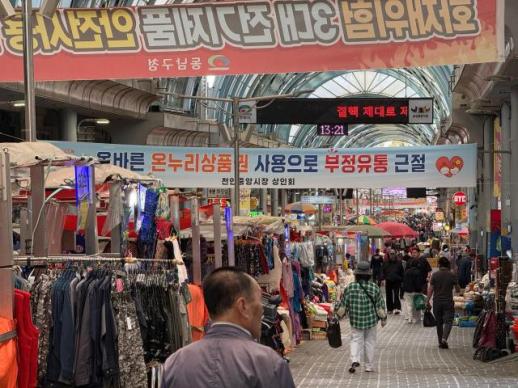 South Chungcheong Governor’s Race Tightens as Voters Split Between Kim Tae-heum and Park Soo-hyun "They’re both about the same, but we should still pick Kim Tae-heum for what he’s done for the province." "Park Soo-hyun is different from other lawmakers. I’m voting for him no matter what." In the Chungcheong region, long seen as a swing area in national elections, voters in South Chungcheong Province were split when Aju News spoke with residents on May 6 in places including Gongju and Cheonan. In Cheonan, more residents interviewed said they planned to vote for Gov. Kim Tae-heum, who is seeking re-election in the June 3 local elections. A 69-year-old taxi operator surnamed Choi praised Kim’s performance over the past four years but said he worried the Democratic Party could become too dominant nationwide. "Gov. Kim did a good job," he said. "I think I’m leaning toward him again." He added, "It feels like the whole country is turning blue. I hope the Democratic Party won’t conduct legislative activities too unilaterally." At Cheonan Central Market, Choi Seung-il, 87, said the two candidates were similar but gave Kim a slight edge. "Kim is ahead by one point," he said, adding he would back Kim again as he did in the previous election. Another market shopper, Kim Dong-wook, 73, said he opposed fiscal support policies such as livelihood support payments and fuel-linked subsidies being pursued by the Democratic Party government. "The Democratic Party has handed out too much money this time," he said. "If this continues, young people will have a hard time living." He said that led him to decide to vote for Kim. In Gongju, which was also Park Soo-hyun’s constituency, support among those interviewed leaned heavily toward Park, the Democratic Party’s candidate for governor. A worker in his 50s, surnamed Ko, said he planned to support Park and described it as a punitive vote against the People Power Party, which he accused of "insurrection" and wrongdoing. A voter in his 30s, surnamed Jang, said he would vote for Park because he supports the Democratic Party. In Gongju, some residents cited calls to punish the People Power Party over former President Yoon Suk Yeol’s martial law declaration, along with strong support for the Lee Jae-myung government. Ko said he voted for the People Power Party in the last local elections but would back the Democratic Party this time. "If the People Power Party, which shows no reflection over acts of insurrection, loses overwhelmingly, they’ll learn the people can be frightening," he said. He also praised the Lee government, citing what he called bold diplomacy with the United States, practical diplomacy including North Korea policy, and a third round of commercial law revisions that he said helped normalize the stock market. Jang also criticized what he called acts of insurrection that caused national turmoil. He said he liked the government’s "practical diplomacy" toward the United States and North Korea and said he expected reforms, including strong punishment for elites such as politicians and the media. Some residents also voiced doubts about Park’s prospects because of anti-Democratic Party sentiment. A 69-year-old taxi driver, Park Jong-young, said Gongju’s mood favored Park but added, "There’s a lot of backlash against the Democratic Party itself, so we don’t know what will happen." Still, he said, "Park is different from other lawmakers. I’m voting for him no matter what." Others said they would not support either candidate and might skip voting. A woman in her 60s who works at Cheonan’s Yeokjeon Market, surnamed Kim, said she had supported the People Power Party but was put off by what she called the recent conduct of party leader Jang Dong-hyeok. "This year I won’t vote," she said. She added that merchants want redevelopment and said she hoped any candidate would pledge it as a campaign promise. Across the province, residents commonly called for stronger industrial infrastructure, better jobs and expanded transportation networks. Ko said he hoped South Chungcheong would become more prosperous by attracting industries that fit local characteristics and by improving construction and transportation infrastructure. Jang said he wanted industrial investment and quality jobs for residents. Park said that, as someone in the transportation business, he hoped for expanded transport infrastructure. Park campaigned in person at Gongju Sanseong Market starting in the morning. Accompanied by Democratic Party candidates for mayor, provincial council and city council, he greeted merchants and shoppers one by one, shaking hands and saying, "I will definitely come back as governor." Some merchants and visitors responded, "Of course we’ll elect Park Soo-hyun as governor. Go, Park Soo-hyun!" Park said he visited the market because he plans to tour all cities in South Chungcheong as he begins full-scale campaigning, and he wanted his first stop to be Gongju because of his close ties to the city. He said he would work to address hardships raised by residents and merchants. * This article has been translated by AI. 2026-05-06 16:21:22
 -
 Korea’s ELS-Linked Issuance Rebounds to 95 Trillion Won as Markets Stabilize A market slump in derivative-linked products has begun to ease on the back of a rebound in global stocks and steadier interest rates, with issuance rising sharply in principal-protected derivative-linked bonds. Still, regulators said investor caution tied to past losses has not fully faded, underscoring the need to understand product structures before investing. According to the Financial Supervisory Service on Tuesday, issuance of derivative-linked securities and bonds in 2025 totaled 94.9 trillion won, up 21.3 trillion won from a year earlier. Redemptions over the same period came to 81.2 trillion won, down 5.1 trillion won. With issuance exceeding redemptions, the outstanding balance at year-end was tallied at 95.1 trillion won, recovering to the level seen at the end of 2023. The balance had fallen to 81.6 trillion won in 2024, the lowest since 2014 (84.1 trillion won), as demand slumped amid concerns over ELS losses following a sharp drop in Hong Kong’s H index and sales suspensions by major banks. By product, both derivative-linked securities and derivative-linked bonds posted growth of about 30%. Issuance of derivative-linked securities rose 5.7 trillion won, or 28.6%, to 25.8 trillion won, led by index-linked ELS. Derivative-linked bond issuance increased 15.6 trillion won, or 29.2%, to 69.1 trillion won, largely reflecting stronger demand for principal-protected products in the retirement pension market. The FSS data also showed shifts in product structure. Among derivative-linked securities, no-knock-in products still accounted for the majority at 60.0%, but that was down 7.3 percentage points from 67.3% a year earlier. For knock-in products, low knock-in structures made up 95.8%. All derivative-linked bonds were issued with no-knock-in structures. Returns improved overall. In 2025, the annualized return on products redeemed early or at maturity was 6.4% for derivative-linked securities and 3.7% for derivative-linked bonds. A year earlier, the figures were -4.7% and 4.0%, respectively. By type, annualized returns were 7.8% for ELS, 2.1% for DLS, 4.0% for ELB and 3.3% for DLB, with equity-based products performing relatively better. “Risk can increase as the number of underlying assets rises or as the offered yield gets higher, so investors should decide only after fully understanding the product structure,” an FSS official said. The official said the agency will closely monitor risk factors, including issuance trends, and guide financial firms to ensure investors receive adequate risk disclosures. * This article has been translated by AI. 2026-05-06 16:18:00
 -
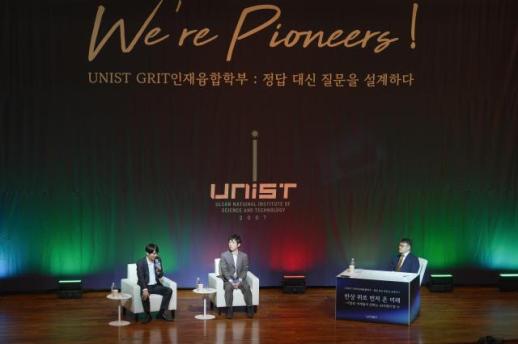 UNIST to Launch GRIT Interdisciplinary Program in 2027 to Train Question-Driven Talent Ulsan National Institute of Science and Technology, or UNIST, said it will launch a new undergraduate division, the GRIT Interdisciplinary Program, in 2027, aiming to help students design their own majors and academic paths. The school said the program is meant to move beyond department-centered education in an era when artificial intelligence can quickly produce answers, and instead strengthen students’ ability to form questions and map out lines of inquiry. UNIST said on May 6 it will separately admit about 10 freshmen a year starting in 2027 through a dedicated GRIT admissions track. The program will be built around project-based inquiry education. Students will combine foundational and research-oriented courses to create individualized curricula, then complete both personal projects and team-based interdisciplinary projects. Each student will be assigned a dedicated faculty mentor for one-on-one guidance throughout their studies and research. Kim Cheol-min, head of the GRIT Interdisciplinary Program, said the school is preparing an approach in which “one persistent question a student asks can become a major explored over four years, and a record of failure and trying again becomes a personal portfolio.” In the AI era, he said, it is important not only to find answers quickly but also to endure uncertainty and “design questions” in areas without clear answers. UNIST said it will also differentiate evaluation. The program will use a P/NR (Pass/No Record) system to reduce the burden of failure and encourage ambitious inquiry. Graduates will receive either a bachelor’s degree in interdisciplinary science or interdisciplinary engineering. The major title designed by the student will be officially listed on the academic transcript. UNIST introduced the GRIT program’s education philosophy to students and residents during “UNIST Open Stage 1,” held May 6 at the main auditorium of its administration building. Lee Sedol, a UNIST special professor, referred to his experience teaching a board game design course and interacting with students. “If you make rules, set criteria for choices, and think about why you make those judgments, your experience with baduk naturally connects to other fields,” he said. Lee Chang-ho, described as a baduk titleholder, echoed the program’s emphasis on student-driven inquiry, saying that a student’s persistent question can become a four-year field of study and that a record of failure and renewed attempts can become a personal portfolio. He also said that in the AI era, the attitude of designing questions matters. UNIST President Park Jong-rae said universities should be places that build students’ capacity to create their own questions, endure failure and find solutions on their own. He said the event, using baduk as a symbolic medium, showed that uniquely human perseverance, creativity and judgment are key conditions for future talent. UNIST said it plans to continue introducing the GRIT Interdisciplinary Program to residents and students through a range of events. Later this month, it said, a screening and artist talk are scheduled with media artist Kim A-young, a UNIST special professor. * This article has been translated by AI. 2026-05-06 16:07:27
 -
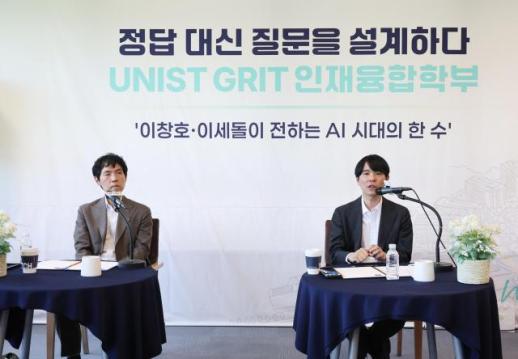 Lee Sedol, Lee Chang-ho warn against overreliance on AI: Humans must make answers their own "AI can show you a good move, but turning that answer into your own is ultimately a human task." As artificial intelligence rapidly expands into areas once considered uniquely human, two of South Korea’s best-known Go players said the skills that will matter most are the ability to ask the right questions and to make independent judgments. Lee Sedol, a distinguished professor at Ulsan National Institute of Science and Technology, and Lee Chang-ho, a top Go titleholder known for his calm style, spoke May 6 at UNIST in Ulsan during a talk concert titled “UNIST Open Stage 1” and at a briefing beforehand. They said AI should not be treated as a simple “answer machine.” Lee Sedol pointed to AlphaGo Zero and said that in an era when AI can evolve beyond human data, cooperation matters as much as use. He said watching AI play moves once taught as taboo made him realize how much people can be trapped by education and convention, adding that those who grasp AI’s message will move ahead. Lee Chang-ho said he initially struggled to accept AI’s unconventional moves, but later saw many as strong ideas that break fixed thinking. Still, he warned against blind trust, saying people should think deeply on their own and ask for help only when they truly need it. He said real synergy comes when a person has established a personal style and then uses AI support. Lee Sedol also described the personal strain AI brought to professional Go. He said studying with AI was so difficult it contributed to his decision to retire earlier, and that thinking about what younger players face weighs on him. Looking back on his 2016 match against AlphaGo, he said he would accept the challenge again but would prepare more thoroughly, adding that he regretted brushing aside expert advice at the time. He also said he was careless after winning Game 4 when he told Demis Hassabis that AI did not seem able to beat humans. Lee said it was a shameful answer to a question that could bring enormous change. On broader social impact, Lee Sedol said the loss of existing jobs during the transition is unavoidable, but that distinctly human value will rise. He said society should guard against a dystopia in which people lose control of their thinking or AI technology is monopolized by a small group in power. Lee Chang-ho said the AI era could make fundamentals even more important. He said a strong base — including humanities literacy and reading — would help people protect themselves from AI-related risks. In the talk that followed, both men framed AI not as a simple matter of winning and losing but as a matter of interpretation. They said that as AI produces more correct answers, what matters is not the answer itself but the ability to understand it and connect it to one’s own judgment. Lee Sedol said what matters more than AI’s strength is what new questions people can ask after seeing its answers, adding that judgment is needed to make choices in unfamiliar situations. Lee Chang-ho said seeing the right answer and understanding the path to it are different, and that even if AI suggests a good move, making it one’s own remains a human responsibility. * This article has been translated by AI. 2026-05-06 16:06:23
 -
 Why AI Is Moving Back Under Government Control, Jensen Huang’s Comments Highlight Nvidia CEO Jensen Huang’s words were brief but widely noted: “I believe the government will use technology correctly.” He made the remark at the Milken Global Conference in Los Angeles, in what amounted to more than a routine CEO opinion. It underscored how the global order around artificial intelligence is shifting. Huang called AI company Anthropic “a great company,” but said he disagreed with efforts to limit AI use for national security purposes. He added that “a CEO is not an elected official,” signaling that companies should not stand in the way if a government seeks to use technology to protect the public. The attention reflects a deeper split inside the U.S. AI industry. One camp views AI as a core strategic asset for national security. The other warns that militarizing AI could create uncontrollable risks. Huang has publicly aligned closer to the first view. For years, Silicon Valley often tried to keep its distance from state power, shaped by a strong libertarian culture and skepticism of regulation and military involvement. A prominent example was employee backlash at Google over the Pentagon’s drone-analysis effort known as Project Maven, when many argued AI should not be used as a tool of war. That mood has shifted sharply. One driver has been China. The United States has grown more alarmed as it watches China treat AI not merely as an industrial technology but as a national strategic capability. China is already pursuing a civil-military fusion strategy, effectively erasing the boundary between civilian and military technology. Across drones, facial recognition, surveillance systems, intelligence analysis and cyberwarfare, AI is moving quickly into military structures. The war in Ukraine has also been a jolt, showing how AI and data can reshape modern battlefields. Satellite-image analysis, drone strikes, real-time information processing and the speed of electronic-warfare responses have changed dramatically. Warfare has become less about raw firepower and more about who can process data and make decisions faster. The U.S. security establishment is absorbing that lesson. OpenAI, Google, Microsoft, Amazon Web Services and Nvidia have expanded cooperation with the U.S. Defense Department for the same reason. During the Cold War, U.S. security relied heavily on traditional defense contractors such as Lockheed Martin. Now the structure is changing. Warships and fighter jets alone are no longer enough to sustain dominance. National security is increasingly tied to semiconductors, cloud computing, AI models and data centers — a new “digital security complex” layered on top of the traditional military-industrial base. Huang’s comments fit within that broader shift. His stance is closer to realism than idealism: if rivals are arming, the argument goes, the United States cannot tie its own hands. The U.S. government has also begun treating AI as strategic infrastructure. U.S. controls on semiconductor exports to China are not simply a trade issue, the column argues, but part of an AI power competition. Concerns about militarizing AI, however, have not disappeared — and may be intensifying. AI differs from nuclear weapons. Nuclear arms are confined to specific facilities, but AI permeates daily life, from search and finance to health care, media, education, transportation and social media. The line between military and civilian AI is also blurring, with the same models used for intelligence analysis and consumer services. As a result, the debate is not only about weapons. It is increasingly about how to govern entire social systems. That is also why Anthropic has clashed with the U.S. Defense Department. The company has not rejected military use outright, but has sought limits on mass surveillance of Americans and on fully autonomous weapons. The problem, the column says, is that the U.S. government has grown increasingly uncomfortable with such constraints. One reason is speed: the pace of the battlefield is beginning to exceed human decision-making. Modern combat is accelerating. In environments shaped by hypersonic missiles, drone swarms and real-time cyberattacks, relying only on human reaction can be difficult. When thousands of drones move at once, people cannot press an approval button for each action. Militaries, the column argues, will push for more AI automation. That creates a major ethical collision. How far should AI be allowed to go in making judgments and deciding to strike? Keeping strict human control can reduce military efficiency. Allowing full automation can collapse accountability. Who is responsible — the developer, the soldier, the state, or the algorithm? The world does not yet have an answer. International debate is shifting from whether militarization can be stopped to how far it should be permitted. The issue is not simply idealism versus realism, the column argues, but a clash between national survival and democratic values. National security is inherently secretive, while democracy demands oversight. If governments and big tech expand AI military projects in secrecy, public control can weaken. If everything is disclosed, security functions can be undermined. The AI era is forcing democracies to confront a familiar question: where to draw the line between security and civil liberties. That dilemma existed in the Cold War, when the United States and the Soviet Union competed to build nuclear weapons while also pursuing arms-control agreements — not out of trust, but because the risks became too great. AI may follow a similar path, but with key differences. Nuclear weapons were largely monopolized by states; AI is driven by private companies, and models can spread globally through internet connections far faster than nuclear technology. That is one reason setting AI rules may be harder than nuclear arms control. Still, the column argues, some boundaries are necessary. That is why discussions are emerging about limiting at least the most dangerous areas, such as fully autonomous nuclear launch systems or mass civilian surveillance. In practice, it says, limited norms focused on what to prohibit may come before any broad AI disarmament. Silicon Valley is changing along with the debate. AI companies are moving deeper into national security systems as investment needs soar and data centers and semiconductor supply chains become tied to national strategy. They are no longer just startups, but increasingly part of strategic industries. That is why Huang’s remark matters, the column concludes. It was not simply a pro-government statement, but a sign of where power is shifting in the AI era — and of technology companies beginning to align again with the state. South Korea, the column adds, is not immune. AI is linked not only to platforms but also to semiconductors, defense, finance, health care, media, education and information systems. Seoul is likely to treat AI not only as industrial policy but also as a security strategy. The key, it argues, is direction, not speed. As competition intensifies, governments may seek stronger control. If security logic overwhelms everything, democratic freedoms can shrink quickly. If ethics and regulation dominate, anxiety about falling behind in technology will grow. What matters next is not a simple yes-or-no debate, the column says, but building social standards around how far to allow AI, what risks to accept and who bears final responsibility. Huang described the reality. Anthropic warned of the risks. The world, the column concludes, is beginning to search for a new balance between the two.* This article has been translated by AI. 2026-05-06 16:02:04
 -
 Samsung Electronics Joins $1 Trillion Market Cap Club Samsung Electronics has finally entered the coveted $1 trillion market cap club. The company's market capitalization surpassed 1,500 trillion won during trading, exceeding $1 trillion in dollar terms, making it the second Asian company to achieve this milestone after Taiwan's TSMC. This is not merely a rise in stock prices; it marks a historic moment for a South Korean company to stand proudly on the global capital market's highest stage. With its inclusion among tech giants like Nvidia, Apple, Microsoft, Amazon, Alphabet, Broadcom, TSMC, Aramco, Meta, and Tesla, Samsung's position signifies that South Korean industry is no longer just a follower. The integrated industrial platform encompassing semiconductors, mobile, home appliances, displays, and artificial intelligence supply chains is beginning to be reassessed in the global market.This achievement is rooted in a history of corporate patriotism spanning three generations. Lee Byung-chul, the founder, planted the seeds of industry, establishing the foundations of the South Korean economy through trade, manufacturing, finance, and talent development. His son, Lee Kun-hee, led a qualitative transformation with the declaration, "Change everything except your wife and children," marking the beginning of a cultural overhaul. The semiconductor super-gap strategy and quality revolution propelled Samsung to become a world-class company. Now, under Lee Jae-yong's leadership, the company faces another test. Samsung must carve out its path in future industries intertwined with AI semiconductors, high-bandwidth memory, foundry services, biotechnology, robotics, and next-generation communications.However, the glory of reaching $1 trillion is not the end but the beginning of a battle. The current global semiconductor landscape is rapidly reshaping. Nvidia has taken the lead in AI accelerators, while TSMC dominates the foundry market with a robust customer ecosystem. Broadcom is expanding AI infrastructure with customized semiconductors, and Apple is merging chip design with service ecosystems to dominate the consumer market. While Samsung holds a strong position in memory, it will not be enough in the AI era. Without integrated competitiveness in high-bandwidth memory, advanced packaging, foundry yield, design capabilities, and software ecosystems, maintaining its $1 trillion status will be challenging.Simultaneously, internal debates over performance bonuses are intensifying. The labor union demands fair distribution of profits, while the company emphasizes long-term investment and competitiveness. This conflict transcends mere wage issues, leading to fundamental questions about the essence of a corporation: Is it an organization that shares short-term results, or a community focused on long-term survival? The answers to these questions are currently being tested within Samsung Electronics.One cannot ignore the fundamental principle of capitalism regarding residual claims. Workers receive wages, suppliers are paid for deliveries, creditors receive interest, and the government collects taxes. Ultimately, shareholders take home the remaining surplus. Shareholders earn this right not as a privilege but as a responsibility, as they are the last to bear losses. This is not a moral issue but a contractual one; those who take risks are entitled to rewards.However, it is also true that this principle is often difficult to accept in reality. Workers on the front lines of the semiconductor industry justifiably demand to "share the results." The issue lies in the method. Short-term cash-based distributions cannot secure the company's future. A system that allows labor and capital to share the fruits of growth through long-term stock compensation, employee stock ownership plans, and restricted stock units is necessary. This alignment of incentives is a key reason why major U.S. tech companies are strong; when the company grows, employees grow alongside it.The role of government and political circles must also be clear. Viewing Samsung Electronics as a target for political distribution turns the company into a battleground. The government should provide support rather than interference, ensuring that companies do not fall behind in global competition through tax policies, energy, water resources, talent, research and development, regulatory relief, and diplomatic support. The business and academic sectors should propose solutions based on structure rather than emotion, and labor must consider responsibilities alongside rights. The public should not see Samsung Electronics solely as a target for criticism but recognize it as a pillar of national competitiveness.History warns us. Yahoo was once the gateway to the internet but lost its direction. Nokia was the king of mobile phones but failed to transition to smartphones. Cisco, a symbol of the dot-com bubble, faced a long recession after the bubble burst. The pinnacle of tech companies is fraught with risks rather than glory. Yesterday's success does not guarantee tomorrow's survival. Samsung Electronics is no exception. The current $1 trillion valuation is merely an assessment of past achievements, not a guarantee for the future.Thus, the path forward for Samsung Electronics is clear. It must lead in technology, maintain market trust, ensure organizational agility, and evolve labor-management relations into a shared destiny. Balancing short-term performance with long-term investment, labor with capital, and efficiency with stability is crucial. Leaning too far in one direction will destabilize the company. If balance is lost, competitiveness will erode.Ultimately, Samsung Electronics' entry into the $1 trillion club raises a fundamental question: What kind of capitalism will we choose? Will it be a structure that shares rewards without sharing risks, or one where risks and rewards are designed together? The answer is clear. Capitalism is a system of promises, and growth is only possible when those promises are kept.Now, Samsung Electronics stands at a crossroads. Will it invest more significantly or share current successes? Will it strive for greater achievements or settle for the present? The path of corporate patriotism remains valid, but it has become much more challenging than in the past.Global experts clearly highlight this point. Reuters noted, "Samsung's $1 trillion milestone reflects expectations for AI semiconductors, but future competitiveness will hinge on foundry and HBM capabilities." The Financial Times remarked, "Samsung is a memory powerhouse, but the winners in the AI era will be those who dominate ecosystems," emphasizing the need for structural transformation. Additionally, global investment bank Goldman Sachs analyzed, "Samsung's future value depends not just on immediate performance but on long-term technological leadership and sustained investment."In the end, the answer is singular: Invest, innovate, share fairly, and endure. This is the destiny of a $1 trillion market cap company and the next stage of corporate patriotism. 2026-05-06 16:00:23
 -
 Gallery Yujeong to Open Kwon Doo-hyeon’s ‘Length’ Painting Exhibition “Selling out during a downturn was no accident.” Gallery Yujeong will present “Length,” the second solo exhibition by painter Kwon Doo-hyeon, whose previous show drew attention after all works sold despite a sluggish art market. The exhibition is also the second series in his project, “Width, Length, Height and Depth.” It runs from May 9 to June 19. Following the earlier “Width” show, “Length” interprets the fundamentals of painting through the idea of distance, focusing on bringing unseen wind and the passage of time onto the canvas. The gallery said the earlier exhibition recorded steady sales across sizes, from large No. 80 works to small pieces under No. 10, even as the broader market weakened. It added that figures in the arts, including classical music critic Jang Il-beom, visited and acquired works, which it said supported Kwon’s stable market value. In “Length,” Kwon shifts from spatial reflection to an expanded gaze and a sense of distance. His canvases are filled with blue skies, green fields and a horizon that appears to stretch on. Viewers’ eyes move from nearby blades of grass toward a distant, fading point, allowing them to experience “length” directly. The works depict invisible wind through swaying grass and the artist’s dense, textured brushwork. The gallery also emphasized the connection between the works and the venue. The exhibition spaces, “Space Ellie” and “Space Elliot,” are arranged to use contrasts of light and visitor flow so audiences can study texture and color. The open view of Seoul from the 12th floor of the Duam Building is presented as a natural extension of the horizon theme. Kwon, who worked at the studio of the Leipzig contemporary art platform halle 14 in Germany, has focused on expressing an East Asian sensibility through Western painting techniques. His method of building density through repeated brushstrokes and leaving traces of time has been described as similar to Gerhard Richter’s approach to painterly exploration. A Gallery Yujeong official said the exhibition is meant to go beyond a simple opening event and to reinforce the gallery’s artistic standards. The official said the series will continue with “Height” and “Depth” to present the artist’s world in greater dimension. The exhibition is open Tuesdays through Saturdays from noon to 5 p.m.* This article has been translated by AI. 2026-05-06 15:58:51
 -
 Coupang Posts 12.46 Trillion Won in Q1 Revenue but Swings to Operating Loss Coupang posted 12 trillion won in first-quarter revenue but swung to an operating loss of about 350 billion won, weighed down by costs tied to a personal data breach and inefficiencies in its logistics network. Coupang Inc. Chairman Kim Beom-seok said Wow, the company’s paid membership service, is rebounding after last year’s breach but will take time to fully normalize. Coupang Inc. said on the 6th (Korea time) that first-quarter revenue rose 8% from a year earlier to 12.4597 trillion won, from 11.4876 trillion won. It reported an operating loss of 354.5 billion won, its largest in 4 years and 3 months. Net loss totaled 389.7 billion won. On a conference call, Kim said product commerce revenue growth hit its low point in January, then improved each month year over year, with the pace of improvement accelerating in February and March. He said most existing customers and Wow members did not leave after the breach and continued to increase spending. As of the end of last month, he said, rejoining by former members and growth in new sign-ups restored about 80% of the Wow membership decline after the incident. A key driver of the loss was the purchase credits issued to customers affected by the data breach. In January, Coupang provided 50,000 won in purchase credits to each of 33.7 million affected customers, for a total cost of 1.685 trillion won. Kim said the credits were a one-time item, with most of the impact limited to the first quarter, though some effects were expected to continue into early in the second quarter. Kim also cited logistics-network inefficiencies. Coupang has expanded facilities and adjusted supply-chain planning to match predictable demand patterns, but the external shock from the breach left actual demand below planned levels, creating idle capacity and inventory costs, he said. Kim said efforts continue beyond recovery to strengthen the business. He said the company is introducing automation and artificial intelligence across logistics and delivery networks to raise service levels while cutting costs, which he said should help improve customer experience and expand margins over time. Among overseas operations, Kim pointed to Taiwan as a key growth engine. He said Coupang’s in-house last-mile network that guarantees next-day delivery now covers most volume in Taiwan and continues to expand. He said providing the full Rocket Delivery service lineup in Taiwan remains at an early stage, but customer response has been strong, and the company will focus this year on building a top-tier customer experience and a foundation for long-term growth there. The conference call also addressed the issue of Korea’s designation of Coupang’s “same person,” a label used to identify a controlling owner. CFO Gaurav Anand said the company is aware of the designation in Korea and is reviewing it closely, adding that Coupang is committed to complying with regulatory requirements in every market where it operates. The Korea Fair Trade Commission recently changed Coupang’s designated controlling owner from the corporation to Kim personally. The change increases scrutiny of governance-related rules and subjects the company to regulations on unfair private benefits. Coupang has said Kim meets conditions for an exception and plans to contest the designation through an objection and an administrative lawsuit. 2026-05-06 15:57:28
 -
 Chinese Workers Demand Bonus Increases from Samsung and SK Hynix Samsung Electronics and SK Hynix are facing demands for bonus increases from their local employees in China, prompting reactions from South Korean netizens. On May 6, New Daily reported that employees at Samsung's semiconductor plant in Xi'an and SK Hynix's facility in Wuxi are advocating for higher bonuses. An industry insider noted, "Local hires at overseas subsidiaries are aware of how much headquarters employees earn, which is why they are clamoring for more bonuses. News about Samsung and SK Hynix's performance and bonuses is circulating on Chinese portals like Baidu." The report also mentioned that an SK Hynix representative stated, "We operate our bonus system according to the characteristics of each country." According to New Daily, SK Hynix is aware of the demands for bonus increases from its local hires in China. The Wuxi plant is a critical site, responsible for about half of the company's DRAM production, and it is estimated that at least 4,000 employees work there. In response to the news, South Korean netizens expressed negative opinions. Comments included, "It's chaos everywhere," "The yellow envelope law is causing a mess in no time," and "Those who think subcontractors should receive bonuses probably believe the same should apply to China." Other reactions included, "People are making a fuss both inside and outside the country," and "Did they return their salaries when the market was bad? Investors understand the risks they took, but it's frustrating," along with remarks about a global trend of seeking bonuses. 2026-05-06 15:56:40
 -
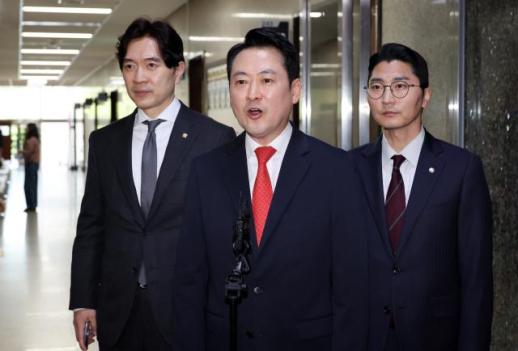 National Assembly Speaker Woo asks People Power Party leader Jang to back constitutional amendment vote National Assembly Speaker Woo Won-shik on May 6 again asked People Power Party leader Jang Dong-hyeok to cooperate on a floor vote on a constitutional amendment bill, a day before it is to be brought to the plenary session. Jang reaffirmed his opposition, saying it is not appropriate to discuss constitutional revision while the ruling party is pursuing what he called an unconstitutional special counsel probe. Woo visited the People Power Party leader’s office at the National Assembly and met with Jang. After the meeting, Woo told reporters he had asked for cooperation ahead of the May 7 vote on the amendment. Jang was reported to have reiterated that his party’s position is to oppose the amendment bill. He also cited the Democratic Party’s April 30 introduction of a special counsel bill titled the “special counsel bill to uncover the truth behind allegations of manipulated investigations and indictments by the Yoon Suk Yeol administration,” and voiced strong opposition to moving ahead with constitutional revision. Speaking to reporters, Jang criticized what he described as unconstitutional moves, including increasing the number of Supreme Court justices, adopting a four-tier court system and a “special counsel to cancel indictments.” “It is contradictory and unacceptable to even talk about constitutional revision while engaging in such unconstitutional behavior,” he said. “More important than constitutional revision is an attitude of respecting the current Constitution.” Lawmakers from six parties excluding the People Power Party — the Democratic Party, the Rebuilding Korea Party, the Progressive Party, the New Reform Party, the Social Democratic Party and the Basic Income Party — along with independents, totaling 187 lawmakers, introduced the constitutional amendment bill on April 3. The bill would add the spirit of the Bu-Ma Democratic Protests and the May 18 Democratization Movement to the Constitution’s preamble and strengthen National Assembly control over a president’s declaration of martial law. The People Power Party has opposed the bill, calling instead for a special committee on constitutional revision to be formed after the June 3 local elections to discuss the issue comprehensively. Woo and the six parties backing the bill favor a “step-by-step” approach, revising provisions that draw no disagreement first. Woo and the Democratic Party plan to submit the amendment bill to the plenary session on May 7, aiming to hold a national referendum on the amendment at the same time as the June 3 local elections. With the People Power Party opposing the bill as a party line, however, passage remains uncertain. Approval requires support from at least two-thirds of all lawmakers. The National Assembly currently has 286 members, meaning 191 votes are needed. Assuming independent lawmaker Kang Sun-woo, who is in detention, cannot vote, at least 12 People Power Party lawmakers would need to support the bill.* This article has been translated by AI. 2026-05-06 15:55:43