

Journalist

Stefan Wolff, Tetyana Malyarenko
-
 SK Group's Chey Tae-won Discusses AI Talent and Economic Cooperation Chey Tae-won, chairman of SK Group and the Korea Chamber of Commerce and Industry, has outlined his vision for talent in the age of artificial intelligence (AI) and national growth strategies. He emphasized that competitiveness in the AI era is not solely about specific technical skills but requires a transformation across education, industry, and social systems. He also reiterated the need for enhanced economic cooperation between South Korea and Japan to effectively respond to the U.S.-China technology rivalry. In an appearance on KBS1TV's documentary "Insight: Talent War 2 - Chey Tae-won's Response" aired on May 28, Chey stated, "The definition of talent will change in the AI era." He explained that in a time when AI evolves faster than humans, it is crucial to determine what skills to learn and develop. Chey described the future talent profile as not just AI developers. He remarked, "AI talent does not only refer to engineering students." He believes that individuals who can effectively integrate human and AI capabilities and connect various fields will become increasingly important. Chey views the evolution of AI as a transition from 'reasoning AI,' which responds to human questions, to 'agentic AI,' which can make decisions and take actions independently. He noted that this shift could widen the gap between those who actively utilize AI and those who do not, affecting both individuals and nations. The ability to leverage AI effectively will determine competitive advantages. He identified four key competencies individuals should develop: critical thinking, adaptability, empathy, and physical skills. Critical thinking is not merely about memorizing facts and performing well on tests. In an era where AI can acquire knowledge and process information, the ability to understand the essence of problems and think independently becomes paramount. Adaptability refers to resilience in making choices and taking action after failures in a rapidly changing environment. Empathy is highlighted as a uniquely human ability that AI cannot easily replicate. Physical skills encompass the ability to create value through physical activities such as music, art, and sports. Chey also stressed the need for changes in the education system. He argued that schools should not merely serve as spaces for knowledge transmission but should transform into platforms for experimenting with and experiencing coexistence with AI. Regarding the preference for medical schools, he suggested that society and schools need to present engineering and scientific fields as equally attractive options. Chey's concerns extend beyond individual education. He proposed a national AI strategy characterized by speed, scale, and safety, referred to as the '3S.' To avoid falling behind in AI competition, he emphasized the need to accelerate technological advancements, expand large-scale AI infrastructure and investments, and establish a regulatory framework that ensures safe AI usage for citizens. Similar sentiments were echoed at a policy seminar held in the National Assembly. On April 28, Chey stated that South Korea must shift its growth model from exporting products to exporting 'intelligence' in the AI era. He defined AI data centers as 'factories for producing intelligence' and underscored the importance of infrastructure investment. He identified key constraints affecting AI competitiveness, including capital, energy, GPUs, and memory chips. As AI shifts from a training-centric to a reasoning-centric approach, the demand for data centers and memory will inevitably increase. This trend enhances the strategic value of memory semiconductors, where companies like Samsung Electronics and SK Hynix excel. Chey also pointed out the limitations of South Korea's AI infrastructure, noting that a small proportion of domestic data centers are suitable for AI applications. He emphasized the urgent need for large-scale infrastructure expansion. He identified energy supply as a critical variable, stating that AI data centers require substantial power, necessitating discussions on power generation, transmission, and distributed energy systems. He asserted that South Korea must become a 'rule maker' rather than a 'rule taker' in the AI era, recognizing that this requires a robust economic scale and industrial foundation. Chey revisited the topic of enhancing economic cooperation between South Korea and Japan. He believes that South Korea alone cannot secure influence in the technology hegemony competition led by the U.S. and China. Strengthening economic ties with Japan could increase economic scale and create complementary effects in AI, semiconductors, energy, and advanced manufacturing. He mentioned that through South Korea-Japan economic integration, a combined economic zone of approximately $6 trillion could be established. This proposal for South Korea-Japan economic integration is not new. Since taking office as chairman of the Korea Chamber of Commerce and Industry, Chey has repeatedly highlighted the need for economic cooperation with Japan, citing the limitations of South Korea's market size. He argues that amid escalating U.S.-China competition, South Korea and Japan should leverage their complementary industrial structures to achieve economies of scale.* This article has been translated by AI. 2026-05-30 20:39:00
 -
 Financial Services Chair Lee Eok-won Announces Second Launch of National Growth Fund Lee Eok-won, Chairman of the Financial Services Commission, announced plans to launch a second round of the National Growth Fund, which sold out within five days of its initial release. In a video appearance on the YouTube channel Sampro TV released on May 30, Lee stated, "We will prepare for the second round of the National Growth Fund for public participation." However, he noted that details regarding the timing and scale of the additional supply would be determined after further review. The National Growth Fund saw 87% of its total 600 billion won ($500 million) allocation sold on its first day, with all shares sold out within five days. Due to unexpectedly high demand, the government is considering additional supply in the second half of the year. Lee explained his personal decision to invest in the fund, saying, "I judged that it was better to participate from a responsibility standpoint," adding, "If I had delayed even slightly, I might not have been able to invest." Regarding the recent surge of the KOSPI index past the 8,000 mark, he remarked, "The Korean capital market has reached a turning point," emphasizing the need to transition from a 'Korea Discount' to a 'Korea Premium' era. He also mentioned preparations for 'Korea Week,' a series of corporate presentations aimed at attracting foreign investment, which will take place throughout October.* This article has been translated by AI. 2026-05-30 20:36:00
 -
 YouTuber Kim Seon-tae Donates Car for Just $2.50 김선태, known as "Chungju Man," has gained attention for donating his car to a 24-year-old father with a sick child. On May 29, Kim shared the process of selling his vehicle, which he had driven for nearly a decade, on his YouTube channel. According to a valuation from a professional platform, Kim's car was appraised at 5.5 million won (approximately $4,600). However, instead of selling it for that price, he chose to give it to a subscriber with a special story. The recipient is a young father raising a toddler suffering from kidney disease, who urgently needed a vehicle for his child's outpatient treatment. The subscriber had commented that he wanted to buy the car for 870,000 won (about $700). After hearing his story, Kim decided to sell the car for just 2,500 won (approximately $2). Additionally, Kim gifted the subscriber diapers and wet wipes worth 870,000 won to match the amount he had hoped to pay for the car. In a comment on the video, the subscriber expressed his gratitude, stating, "It has been about two weeks since I received the car, and I am really enjoying it. I feel guilty that I should be giving a gift, but I am more thankful than anything." After the video was released, viewers praised Kim, with comments like, "What a great guy," "Thank you for your positive influence," and "The car filled with diapers was the best part."* This article has been translated by AI. 2026-05-30 20:36:00
 -
 US Forces Korea Commander Clarifies 'Dagger' Comment on China US Forces Korea Commander Jay B. Brunson clarified that his recent controversial remark describing South Korea as a "dagger" aimed at China was intended to explain the operational environment. On May 30, Brunson addressed questions from the Chinese delegation during a session at the Shangri-La Dialogue in Singapore, stating, "It was in the context of explaining the operational environment we face." He emphasized the need to understand not only the perspective of the Korean Peninsula but also how China perceives the region, asserting, "We need to change the perspective of the map." Brunson noted that in US military training, they analyze the operational environment by flipping maps or changing directions to gain various viewpoints on security issues. Previously, Brunson had sparked strong backlash from China when he remarked on a podcast that from the eastern coast of China, South Korea appears as a dagger located at the heart of Asia. Following his comments, the Chinese embassy publicly criticized him, and South Korean diplomatic and security authorities reportedly expressed regret to the US side. The Blue House stated that communication on various issues between South Korea and the US is ongoing.* This article has been translated by AI. 2026-05-30 20:33:00
 -
 Buying Lottery Tickets Online and Offline Leads to Simultaneous Wins "I have a special habit of buying the same numbers both online and offline." As interest grows in the winning numbers for the 1226th Lotto draw on May 30, a story about a winner of the 312th Pension Lottery 720+ is making headlines. The winner, who claimed one first prize ticket and four second prize tickets, shared their experience on the Donghaeng Lottery winners' bulletin board. The winner stated, "I usually buy pension lottery tickets frequently, but this time I purchased a ticket recommended by the store owner. After returning home, I bought another set online with the same numbers." They recalled, "A few days later, I checked the results and was amazed to find that both the online and offline tickets had won the first prize. At first, I couldn't believe it and felt a sense of calm instead of excitement." The winner then rushed to share the news with their spouse, saying, "Seeing her joy made me feel a wave of happiness and relief, knowing that I could ease our worries about our children's future." When asked about their usual lottery purchases, the winner replied, "I mainly buy Lotto and pension lottery tickets. I have a special habit of buying the same numbers both online and offline." Regarding plans for the winnings, they said, "I plan to use the money for savings and insurance for my children's future." Meanwhile, the winning numbers for the 1226th Lotto draw will be available for checking after 8:35 PM today.* This article has been translated by AI. 2026-05-30 20:27:00
 -
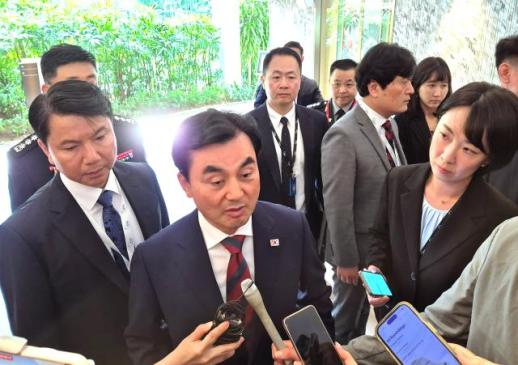 An Kyoo-baek: Strengthening US-South Korea Alliance and Enhancing Self-Defense Capabilities An Kyoo-baek, South Korea's Minister of National Defense, announced plans to pursue a security strategy that strengthens the US-South Korea alliance while enhancing the country's self-defense capabilities in response to North Korea's nuclear and missile threats and deepening military cooperation between North Korea and Russia. According to Yonhap News, An made these remarks during a speech at the 23rd Shangri-La Dialogue in Singapore on May 30, 2026, addressing the theme of "Regional Security Challenges and South Korea's Strategic Response." He highlighted the advancement of North Korea's nuclear and missile capabilities and its hostile stance toward South Korea, stating, "The situation on the Korean Peninsula is a major variable in global security." He emphasized the need to maintain a robust US-South Korea combined defense posture while actively pursuing the enhancement of South Korea's independent defense capabilities for the peninsula. To counter the North Korean threat, An outlined plans to enhance the country's three-axis defense system and deepen cooperation with the U.S. on extended deterrence. He also mentioned accelerating the development of AI-based detection and strike systems, combined manned and unmanned combat systems, and strengthening cyber and space capabilities. An stressed the importance of international security cooperation, particularly regarding the Strait of Hormuz. He stated, "We recognize the importance of ensuring freedom of navigation based on international law" and noted that South Korea is reviewing realistic ways to contribute to international efforts for the safety of the strait. He added, "Maintaining stability on the Korean Peninsula is directly linked to global peace," and expressed a commitment to maintaining strong deterrence while pursuing a sustainable peace coexistence system through dialogue between the two Koreas. In a separate conversation with reporters, An addressed the recent controversy surrounding comments made by the U.S. Forces Korea commander, who referred to South Korea as a "dagger" against China. He stated, "I communicate regularly with U.S. Secretary of Defense Lloyd Austin, so I do not consider it a significant issue." An also praised Austin's positive assessment of South Korea's nuclear-powered submarines and the transition of wartime operational control, calling it a meaningful statement that reflects trust in the alliance.* This article has been translated by AI. 2026-05-30 20:24:00
 -
 Gas Prices Decline for Two Consecutive Weeks, Average Price at 2011 Won Domestic gasoline and diesel prices at gas stations have reported a slight decline for the second consecutive week. According to Yonhap News and the Korea National Oil Corporation's oil price information system, Opinet, the average selling price of gasoline at nationwide gas stations for the fourth week of May (May 24-28) fell by 0.2 won from the previous week to 2011.1 won per liter. In terms of regional prices, Seoul, which has the highest prices, saw a decrease of 0.6 won to 2050.8 won, while Daegu, with the lowest prices, recorded a drop of 0.8 won to 1993.6 won. By brand, SK Energy stations had the highest average price at 2015.4 won, while discount gas stations reported the lowest average price at 1996.6 won. The average selling price of diesel also fell by 0.2 won to 205.7 won. The price of Dubai crude oil, a benchmark for imported crude, decreased by $7.4 to $98.4. International gasoline prices dropped by $11.8 to $121.9, while international diesel prices fell by $18.4 to $142.8. Changes in international oil prices typically reflect in domestic gas station prices with a delay of about two to three weeks. The government has frozen the sixth round of maximum oil prices, which took effect on May 22. As a result, gasoline prices will remain at 1934 won per liter, diesel at 1923 won, and kerosene at 1530 won, consistent with the fifth round of maximum prices.* This article has been translated by AI. 2026-05-30 20:03:00
 -
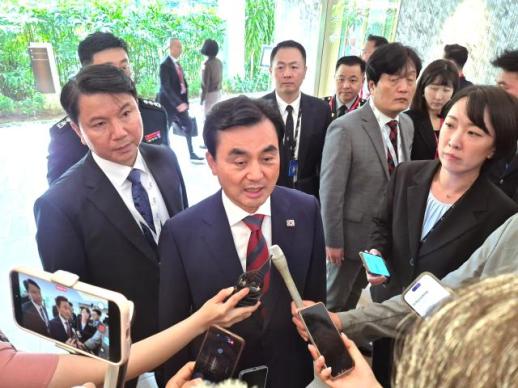 South Korea and Japan to Conduct Joint Search and Rescue Exercise on July 7 The South Korean Navy and the Japan Maritime Self-Defense Force will hold a joint search and rescue exercise (SAREX) on July 7. This marks the first such training since 2017, raising hopes for the restoration of defense cooperation between the two countries. According to Yonhap News on May 30, South Korean Defense Minister An Kyung-bae announced the exercise during a bilateral meeting with Japanese Defense Minister Shinjiro Koizumi at the 23rd Shangri-La Dialogue, a multilateral security conference in Singapore. Minister An stated, "The resumption of the exercise after nine years carries symbolic and declarative significance. The two countries should further develop and deepen this cooperation." The Korea-Japan search and rescue exercise is designed to review procedures for joint responses to maritime distress incidents near the Korean Peninsula. Initiated in 1999, the training was conducted biennially until 2017, when it was halted due to defense exchange disruptions stemming from the 'Rising Sun Flag' controversy and conflicts over patrol aircraft. Last year, both countries aimed to resume the training, but it was canceled due to issues related to the Black Eagles' refueling support. Following ongoing discussions to restore defense exchanges, the two nations agreed to resume the exercise during a defense ministerial meeting earlier this year and have been coordinating the timing. Minister Koizumi emphasized, "Given the current challenging security environment, cooperation between our two countries is essential. South Korea and Japan must take the lead in efforts to ensure peace and stability in the Indo-Pacific region."* This article has been translated by AI. 2026-05-30 19:54:00
 -
 Finance Minister Koo Yoon-cheol Addresses Concerns Over Market Bubble Koo Yoon-cheol, Deputy Prime Minister and Minister of Economy and Finance, recently addressed concerns regarding a potential bubble in the South Korean capital market, stating, "Such worries arise when there is a lack of innovative efforts." According to a report by Yonhap News on May 30, Koo expressed these views during an appearance on the YouTube channel Sampro TV, responding to fears that the KOSPI index might drop below the 8,000 mark. He emphasized that the government would promote structural reforms and a rebound in potential growth rates through its economic growth strategy for the second half of the year. In response to suggestions that structural reforms could lead to price stability in the stock market, Koo added, "The government has outlined a direction for advancing towards a super-innovative economy, focusing on workforce development in artificial intelligence (AI) and green transformation, as well as supporting youth entrepreneurship." He further stated, "If we implement these substantive efforts, I believe the market will reassess our stock market." Regarding the growth rate forecast to be announced in the upcoming second-half economic growth strategy, Koo remarked, "I am curious about it as well." On the outlook for tax revenue due to strong semiconductor performance, he noted, "It is clear that there will be additional excess tax revenue," but he refrained from providing specific figures, stating that they would be confirmed with the corporate tax interim payment in August. Koo also commented on the fiscal tightening under the Yoon Suk-yeol administration, saying, "The previous government reduced research and development (R&D) budgets, leading to decreased tax revenue and increased fiscal deficits. In this era of AI transformation, we must boldly invest in solid items. Please observe how national debt and deficits will look next year."* This article has been translated by AI. 2026-05-30 19:48:00
 -
 Early Voting for National Assembly By-Elections Sees 24.12% Turnout, Lowest in Daegu Dalseong Early voting for the National Assembly by-elections, held alongside the June 3 local elections, concluded on May 30 with a final turnout of 24.12%. According to the National Election Commission, 546,757 out of 2,267,121 eligible voters participated in early voting, which took place from 6 a.m. on May 29 to 6 p.m. on May 30. Among the 14 electoral districts nationwide, Jeonbuk Gunsan, Gimje, and Buan recorded the highest turnout at 42.59%. This was followed by Chungnam Gongju, Buyeo, and Cheongyang at 30.16%, and Jeonbuk Gunsan, Gimje, and Buan Gap at 29.71%. In contrast, Daegu Dalseong reported the lowest early voting turnout at 17.56%. The competitive district of Gyeonggi Pyeongtaek also fell below the national average with a turnout of 18.39%. The early voting rate in Busan Buk-gap, considered a key battleground, was 25.57%, surpassing the national average. In this district, candidates include Ha Jung-woo from the Democratic Party, Park Min-sik from the People Power Party, and independent candidate Han Dong-hoon. In Gyeonggi Pyeongtaek, attention is focused on the main candidates: Kim Yong-nam from the Democratic Party, Yoo Ui-dong from the People Power Party, and Jo Guk from the Justice Party, as the results of the main voting approach.* This article has been translated by AI. 2026-05-30 19:33:00