
Journalist

Tom Stacey
-
 Samsung Display locks in Apple foldable edge over China SEOUL, April 21 (AJP) - South Korea’s premium OLED champion Samsung Display has reasserted itself as Apple Inc.’s primary iPhone panel supplier, staging a decisive comeback against Chinese rivals and tightening its grip on the high-end display market as Apple prepares to enter the foldable era. Samsung Display sharply expanded its share of Apple’s iPhone OLED supply chain in 2025, helped by production setbacks at China’s BOE and a reported three-year exclusive deal to supply panels for Apple’s first foldable iPhone. According to market tracker Omdia, Samsung Display accounted for 56.8 percent of Apple’s iPhone display procurement in 2025, up from 49.1 percent a year earlier. Shipments rose about 15 percent to 141.6 million units from 122.3 million in 2024, widening the gap again with LG Display and BOE after competition had briefly tightened the previous year. The surge translated directly into earnings. Samsung Display posted 9.5 trillion won ($6.6 billion) in fourth-quarter revenue and 2.0 trillion won in operating profit for the October–December period of 2025. For the full year, the display unit reported 29.8 trillion won in revenue and 4.1 trillion won in operating profit. For the first quarter, operating profit is projected at around 1 trillion won—roughly halved from the previous quarter but doubled from a year earlier during the typically slow season of the January–March period. The turnaround was driven in part by a technological inflection point. As Apple expanded the use of low-temperature polycrystalline oxide (LTPO) OLED panels across its latest iPhone lineup to improve power efficiency, BOE struggled to meet Apple’s stringent yield and quality thresholds. The bottleneck effectively pushed the Chinese supplier into a secondary role, allowing Samsung to capture incremental volume while strengthening its pricing power. "Apple’s quality standards are exceptionally high," said Kim Hyun-jae, a professor of electrical and electronic engineering at Yonsei University. "Because the latest LTPO technology is highly difficult and takes time to master, BOE had to step in as a secondary vendor for lower-tier products rather than premium models." Samsung’s lead is now set to deepen further. Industry reports indicate Apple has tapped Samsung Display as the sole OLED supplier for its first foldable iPhone for an initial three-year period—a move that underscores the still-wide gap in foldable panel durability, crease control and yield stability. "Apple initially hesitated to enter the foldable market, but currently, Samsung Display is the only manufacturer capable of producing what they need," Professor Kim noted. "Samsung possesses significant accumulated know-how from producing its own Galaxy Fold series." The reported exclusivity highlights a broader structural divide. While China dominates global LCD capacity, Korea continues to command the premium OLED segment, where margins are higher and technological barriers remain steep. Each time Chinese players narrow the gap in one generation, Korean firms have moved ahead with the next. "For about a decade, observers have warned that China would soon catch up, but the gap is constantly being maintained," Kim added. "While China is number one in overall volume like LCDs, Korea is still number one in the premium products that actually generate profit." To sustain that edge, Samsung Display is accelerating its next manufacturing leap. The company is ramping up the world’s first 8.6-generation OLED production line in Asan, South Chungcheong Province, with mass production targeted this year. The larger substrate size—2,250 by 2,600 millimeters—is expected to lower unit costs and reduce material waste, reinforcing a structural cost advantage that rivals will struggle to replicate. 2026-04-21 16:32:55
 -
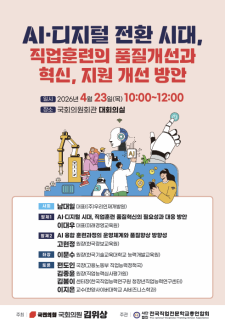 South Korea’s National Assembly to Host Forum on AI-Era Job Training Reform A National Assembly forum will be held to discuss how vocational training should evolve in the AI and digital era. The Korea Federation of Vocational Schools said April 21 it will hold the forum April 23 in the main auditorium of the National Assembly Members’ Office Building under the theme, “Ways to Develop Vocational Training in the AI and Digital Era.” Organizers said the event is intended to share the need to shift the vocational training system amid rapid industrial change and to discuss policy solutions to support employment for young and middle-aged workers and improve training quality. About 400 people are expected to attend, including federation Chairman Song Gwan-ho, heads of vocational schools and officials from related organizations. The forum is hosted by People Power Party lawmaker Kim Wi-sang. It will open at 10 a.m., followed by opening remarks and congratulatory addresses from lawmakers. Two presentations are scheduled. Lee Dae-woo, head of the Future Management Education Institute, will speak on the need for quality innovation in vocational training in the AI and digital era and response measures. Ko Hyeon-jeong, director of the Korea Information Education Institute, will present on operating systems for AI convergence training courses and directions for improving quality. A panel discussion will follow, moderated by Lee Moon-su, director of the Competency Development Education Institute at Korea University of Technology and Education. Panelists are Pyeon Do-in, director general for vocational competency policy at the Ministry of Employment and Labor; Kim Jong-yoon, head of the Vocational Competency Assessment and Evaluation Institute; Kim Bom-i, head of the Youth and Middle-Aged Vocational Competency Research Center at the Korea Research Institute for Vocational Education and Training; and Lee Ji-eun, a professor in the AI Business Department at Hanyang Cyber University. They are expected to discuss revamping training systems to match industrial change, strengthening field-based education and building sustainable support systems. The forum is scheduled to close at 11:50 a.m., concluding a roughly two-hour program. Organizers said they expect the forum to help set new benchmarks for vocational training suited to the AI and digital transition and to serve as a practical venue linking policy and the field.* This article has been translated by AI. 2026-04-21 16:32:21
 -
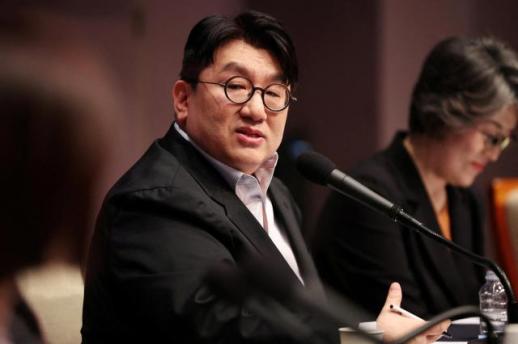 Police seek arrest warrant for HYBE Chairman Bang Si-hyuk over alleged IPO fraud SEOUL, April 21 (AJP) - South Korean police have applied for an arrest warrant for Bang Si-hyuk, chairman of BTS agency HYBE, on allegations that he misled investors ahead of the company’s initial public offering (IPO), authorities said Tuesday. The Seoul Metropolitan Police Agency’s Financial Crimes Investigation Unit said it requested the warrant from the Seoul Southern District Prosecutors’ Office on charges under the Capital Markets Act. The move comes about 16 months after police launched their investigation. Police allege that in 2019, Bang Si-hyuk falsely told investors there were no plans to list HYBE, then known as Big Hit Entertainment, encouraging them to sell their shares to a private equity fund linked to him. The company later went public, with Bang reportedly securing 190 billion won ($130 million) through a prior agreement to receive 30 percent of the fund’s post-listing profits. Under South Korea’s Capital Markets Act, obtaining financial gains through deceptive practices related to financial investment products is prohibited. Violations involving profits exceeding 5 billion won can result in life imprisonment or a minimum of five years in prison. Police began an internal probe in late 2024 before expanding it into a formal investigation in mid-2025, which included raids on the Korea Exchange and HYBE headquarters. Bang was questioned five times between September and November last year, and authorities also froze 156.8 billion won worth of his shares. The investigation drew criticism for its pace after police took no apparent action for more than five months, citing legal reviews. The case also sparked controversy when the U.S. Embassy in Seoul reportedly sent a letter requesting that a travel ban be lifted to allow Bang to attend BTS-related events abroad. Bang has denied any wrongdoing, maintaining that all legal and regulatory requirements were followed during HYBE’s listing. In a statement released through his legal team Tuesday, he said it was “regrettable” that an arrest warrant had been sought despite his cooperation and pledged to “faithfully explain his position in future legal proceedings.” Prosecutors will now decide whether to formally request the warrant from the court. If they do, a hearing to review the warrant typically takes place within two to three days. The development places Bang, HYBE’s largest shareholder and key decision-maker, at a critical juncture as the company closely monitors the outcome. HYBE shares fell 2.35 percent to close at 249,000 won on Tuesday following news of the warrant request. 2026-04-21 16:31:59
 -
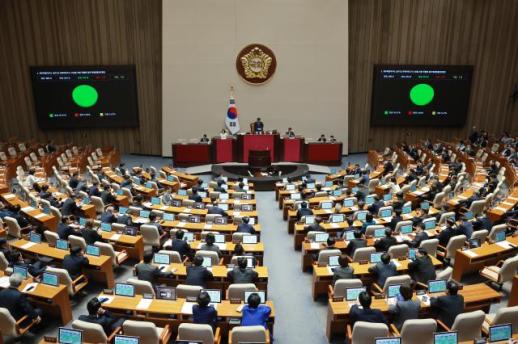 Forced share cancellations redraw control map across Korea Inc. SEOUL, April 21 (AJP) - Mandatory treasury share retirements are rapidly reshaping ownership structures across South Korea’s conglomerates, with cancellations surging past $30 billion in the first quarter alone under a tougher Commercial Act of South Korea. According to a study of 73 conglomerates and 339 affiliates by corporate tracker CEO Score, listed firms canceled shares worth 42.52 trillion won ($30 billion) in the January–March period—more than triple the 13.29 trillion won recorded for all of last year. “Share cancellations are no longer a matter of choice but are required by law, particularly for large conglomerates,” said Shin Hyun-han, a finance professor at Yonsei University’s School of Business. Under the revised rules, newly acquired treasury shares must be canceled within one year, while previously held shares must be retired within 18 months. Exceptions are tightly limited—such as for employee stock compensation—and require shareholder approval. The bulk of cancellations was concentrated among market heavyweights. Samsung Electronics led with 14.9 trillion won, followed by SK hynix at 12.24 trillion won. Together, the two accounted for 63.8 percent of total cancellations in the first quarter. In terms of treasury share holdings prior to retirement, SK Group topped the list at 24.8 percent of common shares, followed by Taekwang Industrial at 24.41 percent, Lotte Corp. at 23.69 percent and Mirae Asset Life Insurance at 21.83 percent. As cancellations accelerate, founding families are seeing their controlling stakes diluted—a structural shift long debated in Korea’s corporate governance landscape. Taekwang Industrial recorded the steepest decline, with controlling ownership falling from 78.94 percent to 54.53 percent. At SK Group, the stake dropped from 50.21 percent to 31.87 percent. At Samsung Electronics, Chairman Lee Jae-yong and related parties saw their combined stake slip below the symbolic 20 percent threshold to 19.95 percent following the cancellations. Still, experts caution against equating lower ownership with weaker control. “Corporate leadership should not be interpreted in a limited way,” Shin said, noting that governance in large conglomerates often rests on a broader mix of cross-shareholding structures, board influence and managerial control rather than simple equity percentages alone. 2026-04-21 16:31:43
 -
 SK Telecom to Revamp Job Grades, Create CEO-Led B2B Task Force Under CEO Jeong Jae-heon SK Telecom said April 21 that it will overhaul its job-grade system and set up a CEO-led task force to strengthen its business-to-business competitiveness, announcing the plans through its newsroom as CEO Jeong Jae-heon marked six months in the role. Jeong, speaking at a town hall meeting at the company’s headquarters in Seoul’s Euljiro area, stressed the need for customer-centered change. “In a sense of crisis that the company could collapse, the core is ultimately the ‘customer,’” he said, adding, “Getting back to customers, each drop of sweat is creating change.” Jeong also said the company’s future growth engines run through AI. SK Telecom plans to build planning and development capabilities for mid- to long-term projects in its telecom business, including an AI-optimized integrated computing system, while strengthening its current digital competitiveness. The company said it will step up its push into the B2B market as what it described as the country’s only “full-stack” provider spanning AI infrastructure, models and services. To consolidate B2B capabilities, it will create an enterprise task force reporting directly to the CEO. The task force will be led concurrently by Han Myung-jin, head of the Mobile Network Operator (MNO) CIC. SK Telecom also said it will accelerate its AI data center business. Within its AI CIC, it will establish dedicated units by area, including an AI DC Business Division (to be led concurrently by AI CIC head Jeong Seok-geun) and an AI DC Development Division headed by Ha Min-yong. The company will also change its job-grade structure to three levels from the current two-stage system. The current A and B bands will be reorganized into Growth Level 1 for developing practitioners, Growth Level 2 for key contributors, and Growth Level 3 for leaders and leadership candidates. “For plans spanning 10 years and 20 years, we selected growth businesses and moved to 추진 organizational pivoting and changes to HR systems,” Jeong said. “In the near term, tangible results may come slowly, and the AX transition may take more time, but let’s execute boldly for the future that will come when we overcome this.” 2026-04-21 16:31:38
 -
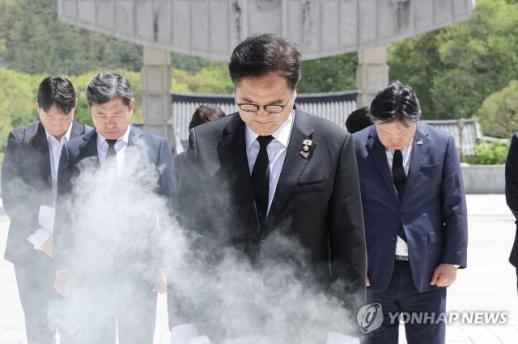 National Assembly Speaker Woo Won-shik urges PPP to back constitutional amendment on May 18 spirit National Assembly Speaker Woo Won-shik said the spirit of the May 18 movement left South Korea with a historic lesson that “no power can defeat the people,” and urged the People Power Party to join a parliamentary vote on a constitutional amendment reflecting that spirit. According to Yonhap News Agency, Woo visited the May 18 National Cemetery in Unjeong-dong, Buk-gu, Gwangju, on April 21 and reiterated that the May 18 spirit should be included in the preamble to the Constitution. On the National Assembly’s vote on the amendment, Woo said it was “regrettable” that the People Power Party opposes it as a party line. “They have all promised it, and they have come here and made countless pledges,” he said. “No matter how I think about it, there is absolutely no reason for the People Power Party to oppose it.” “This is no longer a time for promises, but a time for action,” Woo said, arguing the bill could pass if lawmakers are allowed a free vote. After laying flowers and burning incense at the cemetery, Woo visited the newly renovated former South Jeolla provincial government building in Dong-gu, Gwangju. “The restored provincial office is truly meaningful, and the intensity, devastation, resolve and anger of that time are etched into it as they were, leaving my heart heavy,” he said. “I look forward to the day the May 18 spirit is proudly written into the Constitution’s preamble.” Woo has repeatedly called for constitutional revision to include the May 18 spirit in the preamble and to strengthen National Assembly control over martial law. Leaders of six parties, excluding the People Power Party, submitted a constitutional amendment bill to the National Assembly on April 3 in the names of 187 lawmakers, including the provision on the May 18 spirit. Passage requires approval by at least two-thirds of the 295 sitting lawmakers, or 197 votes. That would require support from nine to 10 People Power Party lawmakers. To hold a national referendum on the amendment on the June 3 local election day, the bill must be approved by the National Assembly by May 10. * This article has been translated by AI. 2026-04-21 16:28:40
 -
 Daebang Construction Tightens Companywide Quality Controls to Prevent Defects Daebang Construction is stepping up efforts to strengthen construction quality management. The company said April 21 it is operating a companywide quality-control system built around three priorities: strict oversight of construction quality, reducing defects and responding actively after problems arise. A key feature is joint inspections by headquarters and job sites. In addition to on-site staff, the headquarters architecture team visits all sites in person to check common areas and identify potential defect risks in advance. The company said it also continually revises construction guidelines using data gathered at sites and applies updates immediately across projects. When defects occur, it aims to respond quickly before issues escalate into disputes, focusing on reducing inconvenience for residents. Daebang Construction said it was not ranked in the Transport Ministry’s list of the “top 20 apartment builders by defect rulings for the first half of 2026,” neither for the past six months nor on a cumulative five-year basis. The company noted the indicator is widely viewed as one measure consumers use to gauge builders’ quality and reliability. “Residential products ultimately come down to quality and trust,” a company official said. “We will continue revising guidelines based on site data and reflecting them across all sites.”* This article has been translated by AI. 2026-04-21 16:27:55
 -
 Gijang Anchovy Festival Marks 30th Anniversary at Daebyeon Port April 24-26 Busan’s Gijang County said it will hold the 30th Gijang Anchovy Festival from April 24 to 26 at and around Daebyeon Port in Gijang-eup. County officials said this year’s event, marking the festival’s 30th anniversary, will feature expanded programs for visitors. Gijang’s spring anchovies are known locally for their high calcium content and, during peak season, their higher fat content and tender texture. A free raw-anchovy tasting will run throughout the three-day festival, and visitors will also be able to buy fresh anchovies at relatively low prices during the abundant catch period. Performances and hands-on events are scheduled across the venue. On April 24, Jeong Seo-ju and Cheon Rok-dam will open the festival with congratulatory performances. On April 25, Son Bin-a, Chae Yun and Choi Ji-ye will take the stage. On April 26, Mister Pang, Kim Su-hee and Jang Ha-on will close out the event. After the Gijang Anchovy Song Festival finals on April 26, a “Taegun Singing Contest,” hosted by MC Park-gun and Na Tae-ju, is planned. Family-oriented programs include a fishing-boat ride experience, catching live fish by hand, a “Silver Joy” anchovy-themed performance, and an offshore fireworks show. To ease congestion, the county said it will run a free shuttle bus on April 25 and 26 from 9 a.m. to 5 p.m. between the second parking lot at Gijang Station on the Donghae Line and the Mu-yang Village roundabout. Choi Il-cheon, chairman of the Gijang Anchovy Festival Promotion Committee, said organizers have prepared food and attractions “with more substance than ever,” and invited visitors to share in the festival and make special memories in Gijang during the spring season.* This article has been translated by AI. 2026-04-21 16:27:04
 -
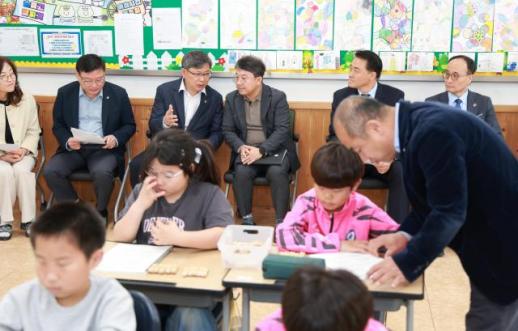 Acting Jeonbuk Education Superintendent Visits Basic Skills Lead School in Namwon Yoo Jeong-gi, acting superintendent of education for Jeonbuk Special Self-Governing Province, visited Namwon Elementary School on the 21st to review how the province’s “basic skills lead school” program is being carried out in classrooms. The Jeonbuk Office of Education said it expanded the number of basic skills lead schools to 369 this year — about half of all schools — from 99 last year, aiming to prevent learning gaps early and reduce disparities in education. Namwon Elementary, now in its fourth year as a lead school, has built a classroom culture designed to keep all students engaged through a “one classroom, two teachers” model in which a specialist teacher and the homeroom teacher co-teach lessons. The school reported that after three years of operating as a lead school, achievement among students needing learning support improved significantly, including in math. After observing a third-grade co-taught class, Yoo held a meeting with Principal Ahn Jung-man and teachers to hear requests from the field, including the stable placement of specialist teachers and support for running lead schools. “The Namwon Elementary co-teaching model is an excellent example of how classroom-centered accountability in education can be put into practice at schools,” Yoo said. He added that the office would provide administrative and financial support so no student is left behind in learning, including expanding lead schools to 60% of all schools next year. Senior officials hold integrity policy forum, focus on upgrading Jeonbuk-style model The Jeonbuk Special Self-Governing Province Office of Education held a “senior officials integrity policy forum” on the 20th at its headquarters, with Yoo and about 50 executives attending, including heads of education support offices from 14 cities and counties. The office said the forum was held to seek strategies to improve integrity by analyzing areas vulnerable to corruption, based on results from an integrity-level assessment conducted in February. Participants discussed ways to ensure fairness on issues that can hurt public trust, including illegal donations tied to school sports teams and suspected collusion in construction and contracting. They also discussed factors that can undermine internal confidence, such as unfair personnel decisions, authoritarian abuse of power, and distrust in reporting systems. The forum presented action steps to raise integrity, including establishing an everyday culture of integrity, building cooperative networks by corruption-vulnerable area, and expanding a joint integrity governance framework involving the public and private sectors and labor. The office said senior officials’ leadership by example and building a field-centered system for implementation were emphasized as key tasks. It said it plans to use the forum as a starting point to further develop a Jeonbuk-style integrity model for clean education administration.* This article has been translated by AI. 2026-04-21 16:22:19
 -
 Rents Surge in Seoul’s Nowon-Dobong-Gangbuk as 1 Million Won Leases Jump As ultra-high monthly rents expand, prices are also rising sharply in Seoul’s outer districts, according to an analysis of new apartment lease contracts. In the so-called “Nowon-Dobong-Gangbuk” area — long seen as a last affordable option for working-class residents — the share of contracts with monthly rent of 1 million won or more jumped over the past year, adding to concerns that housing costs are reaching a breaking point. An analysis of new monthly-rent contracts for Seoul apartments signed from January through Tuesday, using the Transport Ministry’s public real-transaction price system, found a steep upswing in outer-district rents. In Nowon, Dobong and Gangbuk districts, the shift toward higher monthly rents was pronounced in small- and mid-sized apartments. Of 2,322 new monthly-rent contracts in the area this year, 671 — or 28.9% — were for 1 million won or more a month. A year earlier, 543 of 2,431 contracts, or 22.3%, were at that level, meaning the share rose 6.6 percentage points. Across Seoul, higher monthly rents also became more common. Of 18,733 new monthly-rent apartment contracts this year, 6,020 — 32.1% — were for 1.5 million won or more, up 3.4 percentage points from 28.7% a year earlier. The Korea Real Estate Board said Seoul’s average apartment monthly rent stood at 1.515 million won as of February, up 12.5% from a year earlier. In the market, critics say tighter financial rules are pushing renters into expensive monthly leases. With loan restrictions last year lowering the jeonse loan limit for one-home owners to 200 million won and applying stricter debt service ratio rules, tenants with limited ability to raise large deposits have flowed into the monthly-rent market. A real estate agent in Gangbuk said tenants often cannot cover the gap even after borrowing the maximum for a jeonse deposit, leaving them to look for listings with monthly rent above 1 million won. The agent said monthly-rent deals overtaking jeonse in working-class neighborhoods shows how difficult it has become to hold on in the jeonse market. Supply constraints are also lifting rents, the report said. With all of Seoul designated as a land transaction permit zone, so-called gap investment has been blocked, and tighter owner-occupancy requirements have kept would-be rental units off the market. According to the real estate big-data platform Asil, Seoul had 14,649 apartment monthly-rent listings as of Tuesday, down 31.4% from the start of the year. With fewer listings available, some landlords have increasingly passed tax burdens onto tenants through higher rents. KB Real Estate’s monthly rent price index, which rose gradually through June 2024, has climbed more steeply since last year, reaching 133.99 in March. Nam Hyeok-woo, a researcher at Woori Bank’s real estate research center, said monthly rents remain strong because supply in the rental market is limited and new supply in non-apartment markets has fallen to its lowest level. 2026-04-21 16:21:02