
Journalist

Wolfgang Preiser, Cheryl Baxter, Jean Nachega
-
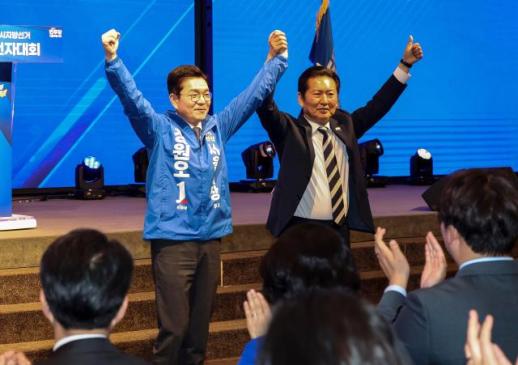 Election Campaigns Kick Off for Local Elections in South Korea The Democratic Party and the People Power Party launched their official election campaigns on May 21, kicking off active canvassing efforts. Jung Cheong-rae, the Democratic Party leader, focused on supporting Jeong Won-oh, the party's candidate for the Seoul mayoral election, while Jang Dong-hyuk targeted Yang Hyang-ja, who is vying to reclaim the Gyeonggi governor's office. Jung began his support for Jeong at the Dong Seoul Postal Center, where he emphasized delivering a new vision for Seoul that residents can feel. He participated in receiving policy proposals from the 25 districts of Seoul and engaged in sorting packages to encourage the postal workers. After the work concluded, Jung told reporters, "I want to deliver the future of Seoul to our descendants through this local election. I envision the changes and developments in Seoul, as Jeong demonstrated during his tenure as the Seongdong District mayor. I believe I am delivering Jeong Won-oh's victory." He added, "I want to deliver a bright and hopeful South Korea, where democracy shines, by eradicating the 12.3 emergency martial law and insurrection alongside the people on June 3." Conversely, Jang visited Yang's hunger strike site in Pyeongtaek, where he urged a compromise between labor and management at Samsung Electronics, focusing on the Gyeonggi region, which narrowly lost in the last local elections. Jang explained his choice to start his campaign at Yang's hunger strike site, stating, "I thought it would be good to begin the election campaign in a place where Yang is fighting desperately to prevent South Korea from coming to a standstill. I believe party members, supporters, and all citizens will remember and evaluate Yang's determination to undertake this hunger strike." He highlighted the recent provisional agreement reached between Samsung Electronics' labor and management on May 20, saying, "Yang has fought with the urgency that if the semiconductor industry stops, South Korea stops. I believe this agreement was reached because of her life-and-death struggle." Meanwhile, Oh Se-hoon and Choo Mi-ae, who are competing against Jeong and Yang in the Seoul mayoral and Gyeonggi gubernatorial races, respectively, also began their campaign activities. Oh visited the Garak-dong Agricultural and Fishery Wholesale Market, aiming to revitalize Seoul's economy, while Choo announced the start of her campaign at the Wolam Public Garage in Uiwang, Gyeonggi Province.* This article has been translated by AI. 2026-05-21 01:04:05
 -
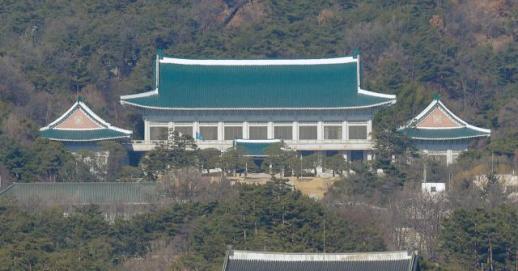 Blue House Thanks Samsung Electronics for Labor Agreement Decision On May 20, the Blue House expressed gratitude for the labor-management agreement reached just before a planned strike at Samsung Electronics, stating, "We appreciate the labor and management's grand decision for the nation and the people."In a press release that evening, the Blue House commented on the Samsung labor union's decision to postpone the strike.The statement added, "This is the result of the efforts of government officials, including Minister of Labor Kim Young-hoon, who worked tirelessly to mediate the situation."On the night of May 20, Samsung Electronics and its labor union signed a tentative agreement on performance bonuses for 2026 at the Gyeonggi Provincial Labor Relations Commission.With the tentative wage agreement for 2026 now in place, the planned strike set for May 21 has been postponed for the time being.* This article has been translated by AI. 2026-05-20 23:48:38
 -
 Korean Business Group Welcomes Samsung Electronics Labor Agreement The Korean Employers Federation (KEF) expressed relief on May 20 after Samsung Electronics and its labor union reached a tentative agreement on performance bonuses. The KEF stated, "It is fortunate that an agreement was reached, avoiding the worst-case scenario of a strike." In a statement released around 11 p.m., the KEF noted that the agreement is significant as it reflects both parties stepping back to find common ground amid a challenging business environment characterized by intensified competition in the semiconductor industry and growing uncertainties in the global market. However, the KEF voiced concerns about the potential spread of the union's demands for performance bonuses across the broader industry. The KEF emphasized, "This agreement reflects Samsung Electronics' unique circumstances, and the labor sector should not generalize it to promote excessive demands for performance bonuses across the industry. We hope that both labor and management will use this agreement as a stepping stone to quickly resolve uncertainties and establish a rational labor-management relationship." Samsung Electronics and its labor union dramatically signed the tentative agreement about an hour and a half before the union's planned general strike on May 21. The union has decided to postpone the strike and will conduct a vote among its members on the tentative agreement from May 22 to May 28.* This article has been translated by AI. 2026-05-20 23:33:45
 -
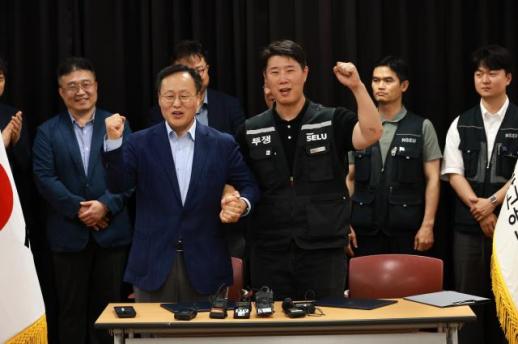 Samsung Electronics Avoids Major Strike as Union Votes on Tentative Agreement Samsung Electronics and its labor union reached a tentative agreement just hours before a planned strike. Labor Minister Kim Young-hoon intervened in the negotiations, which lasted six hours at the Gyeonggi Employment and Labor Agency, leading to the agreement. On May 20, the union's joint action headquarters announced that the planned strike from May 21 to June 7 would be postponed until further notice. All members are expected to participate in a vote on the tentative wage agreement from May 23 at 9 a.m. to May 28 at 10 a.m. Choi Seung-ho, chairman of the union's joint action headquarters, expressed gratitude for the government's mediation efforts and acknowledged the internal conflicts that had caused public concern. He stated, "We have reached a tentative agreement just hours before the strike and decided to postpone it. The vote will take place from May 22 to 27." Yeom Young-gu, head of the Samsung Electronics DS People Team, apologized to employees for the prolonged negotiations and thanked the union and the government for their efforts. He emphasized the importance of the agreement in fostering a cooperative labor-management culture and committed to implementing the terms faithfully. Minister Kim remarked, "Our support for democracy stems from our belief in the power of dialogue to address common challenges. I extend my sincere gratitude to both parties for reaching a tentative agreement through autonomous negotiations." He acknowledged the anxiety felt by the public amid challenging domestic and international conditions and credited the government's role in facilitating dialogue. "This is a growing pain, and I believe it demonstrates the K-competitiveness of resolving issues through conversation," he added. Regarding the specifics of the agreement, Kim noted that while there were contentious issues, both sides made concessions to find a solution. Choi explained that the company agreed to postpone the distribution method for loss-making divisions for one year, which had been a point of contention. Yeom added that the company and the union shared a common goal and worked collaboratively to resolve the issues, highlighting the minister's contributions to the successful conclusion of the negotiations. The tentative agreement was reached after the labor committee's mediation failed earlier that morning. Kim emphasized the government's commitment to facilitating dialogue and understanding the reasons behind the breakdown in negotiations to find a way forward. He concluded by stating that while principles are important, there are no absolute exceptions, and he was pleased that the company accepted the agreement. Yeom noted that the agreement reflects a commitment to rewarding performance while adhering to fundamental principles. 2026-05-20 23:22:13
 -
 Samsung Avoids Strike Crisis, But Vote Looms as Deadline Approaches Samsung Electronics has temporarily averted a major crisis as a strike loomed. Just over an hour before a planned strike on May 21, the company and its labor union reached a tentative agreement. However, concerns remain as a final vote by union members is still pending.The Samsung Electronics union's joint action committee announced around 10:30 p.m. on May 20 that the planned strike from May 21 to June 7 would be postponed until further notice.With the strike averted at the last moment, the union immediately began the process of gathering member opinions and securing control over the vote. The union plans to conduct a vote on the tentative agreement regarding the 2026 wage negotiations from 2 p.m. on May 22 to 10 a.m. on May 27.This agreement effectively buys Samsung Electronics a crucial week, as even a brief halt in semiconductor production can lead to losses amounting to billions of won. The postponement of the strike is seen as a decision by both parties to prevent a disaster.However, it remains uncertain whether the tentative agreement will ultimately be approved. If the results of the member vote, to be announced in a week, show a majority against the agreement, the union has indicated it will immediately resume preparations for a long-term strike. This effectively pushes the deadline for a potential strike back by a week.Should the union vote reject the agreement and a strike materialize, the government is likely to activate its previously announced strong legal measures, including the 'emergency mediation authority.'Earlier, Prime Minister Kim Min-seok stated in a public address on May 17 that if the Samsung Electronics strike poses a significant threat to the national economy, the government would have no choice but to consider all legal measures, including emergency mediation. The government cannot afford to remain passive in the face of a disruption to the semiconductor supply chain, which is vital to the national economy.Emergency mediation authority is a powerful legal measure that the Minister of Employment and Labor can invoke when there is a significant risk to the national economy or public safety. Once activated, the union must immediately cease all strike activities, and a complete ban on strikes will be in effect for 30 days. This measure serves to prevent the escalation of the strike.During this cooling-off period, if no voluntary agreement is reached between the parties, the chair of the Central Labor Relations Commission can decide to refer the matter for mediation. The mediation decision at this stage has the same effect as a collective agreement, meaning both parties must comply. 2026-05-20 23:19:05
 -
 Samsung and Labor Union Agree on 10-Year Bonus System Tied to Stock Samsung Electronics and its labor union have confirmed that their tentative wage and collective bargaining agreement, reached just before a general strike, includes a 10-year validity period for the bonus system. This agreement not only establishes the method for calculating bonuses but also formalizes the payment method and duration, setting the framework for Samsung's performance compensation system for the next decade. According to industry sources on May 20, Samsung and the union signed the tentative agreement and decided to postpone the general strike while proceeding with a member vote from May 23 to 28. The agreement reportedly includes a total bonus of 12%, combining an OPI of 1.5% and a special management bonus of 10.5%. The bonuses will be calculated based on performance criteria agreed upon by both parties. The previously contentious cap on bonus amounts has been eliminated. The special management bonus will only be paid if minimum operating profit requirements are met. If performance falls below certain thresholds, the special bonus will not be awarded. A notable aspect of the agreement is the payment method. The tentative agreement stipulates that bonuses will be paid entirely in company stock after taxes, rather than in cash. This approach is seen as a compromise aimed at linking employee compensation to the company's long-term value. It is also reported that there will be restrictions on the sale of these shares. The distribution structure for bonuses has also been established. Sixty percent of the total will be allocated to profitable divisions within the DS sector, while the remaining 40% will be distributed across the entire DS division. Differential treatment for unprofitable divisions will be implemented starting in 2027. Although there were last-minute conflicts over compensation for unprofitable divisions, both sides found common ground by not applying penalties for this year's bonuses. Industry observers believe this agreement shifts the focus of the Samsung bonus debate from "how much will be received this year" to "what criteria will be used for future distributions." The 10-year validity period and stock payment method place burdens and responsibilities on both the company and the union. The company must institutionalize the bonus criteria over the long term, while the union must accept the uncertainties associated with stock prices and performance. However, the special management bonus will only be awarded if minimum operating profit is achieved during the 10-year period. The agreement also includes provisions for cooperative initiatives. Samsung plans to announce a funding plan for cooperative efforts soon and will operate joint programs with the union. This is interpreted as a measure to mitigate external impacts, given the concerns about the general strike affecting suppliers and the semiconductor ecosystem. The union will inform its members about the tentative agreement and conduct a direct and secret ballot for approval. The agreement must receive majority attendance and majority support to be finalized. The union has decided to postpone the planned general strike until the voting results are announced. This tentative agreement was reached after negotiations resumed under the leadership of Minister of Employment and Labor Kim Young-hoon, following the breakdown of mediation by the Central Labor Relations Commission the previous day. While the worst-case scenario of a first-ever general strike at Samsung Electronics has been averted for now, the long-term implications of the bonus calculation criteria and stock payment method will likely be evaluated during the member voting process. 2026-05-20 23:16:14
 -
 Samsung Electronics Reaches Tentative Agreement Amid Strike Threat Samsung Electronics and its labor union have reached a tentative agreement on wages and collective bargaining. This development comes amid discussions of a potential first-ever total strike, alleviating concerns over semiconductor production disruptions and uncertainty in the industry. On May 20, Samsung Electronics issued a statement confirming the tentative agreement, stating, "The agreement was reached thanks to the support of the public, shareholders, and customers, as well as the dedicated mediation efforts of the government and the steadfast commitment of our employees." The company also apologized for the heightened concerns in the market and industry due to labor disputes, saying, "We sincerely thank everyone and deeply apologize for the worries we have caused during this time." The tentative agreement was reached just hours before a planned total strike. Although the parties could not find common ground during post-adjustment discussions at the Central Labor Relations Commission, negotiations continued under the leadership of the Minister of Employment and Labor. The union has decided to suspend the total strike and will present the tentative agreement for a vote among its members. Samsung Electronics expressed its commitment to improving labor relations, stating, "We will humbly work to build a more mature and constructive labor-management relationship to prevent such situations from occurring again." The company added, "We will do our utmost to fulfill our roles and responsibilities as a business and contribute more to the national economy." (While this tentative agreement has temporarily mitigated the risk of a strike, key issues such as performance-based bonuses and the institutionalization of compensation systems remain structural challenges for future labor relations.)* This article has been translated by AI. 2026-05-20 23:06:50
 -
 Samsung Live: Strike suspended, union puts the agreement to vote until May 27 SUWON, May 20 (AJP) -Samsung Electronics narrowly avoided a closely watched 18-day general strike late Wednesday after marathon last-minute negotiations led by Labor Minister Kim Young-hoon produced a tentative wage agreement between management and the company’s largest labor union. The deal halted what could have become the biggest labor disruption in the history of the world’s largest memory chipmaker, which accounts for nearly 40 percent of the global DRAM market and roughly one-fifth of South Korea’s exports. The agreement came after weeks of escalating tensions over bonus structures, compensation for employees in loss-making divisions and the removal of caps on performance-based incentives. The National Samsung Electronics Union (NSEU) announced that the planned strike scheduled for May 21 through June 7 would be suspended pending a vote by union members on the tentative deal. Under “Protest Directive No. 3” issued Wednesday night, the union said all strike actions previously declared under its earlier directive would be put on hold “until further notice.” Union members will vote on the tentative 2026 wage agreement from 2 p.m. Thursday through 10 a.m. May 27. Details were not revealed, but the sticking point would involve compensation for loss-making divisions of Samsung Electronics. The breakthrough followed more than six hours of direct mediation by Labor Minister Kim at the Gyeonggi Regional Labor Office in Suwon, after earlier series of government-led post-adjustment talks at the National Labor Relations Commission had collapsed over disputes involving compensation for workers in deficit-running business divisions. Earlier in the day, union chief Choi Seung-ho had declared negotiations deadlocked and vowed to proceed with the strike as planned. Samsung Electronics had also sharply criticized the union in an internal statement, accusing it of demanding “socially unacceptable” compensation for loss-making units even after the company had already accepted most proposals on incentive structures. But signs of a late reversal emerged after Samsung quietly deleted the internal statement from its employee bulletin board while negotiations resumed under Kim’s direct supervision. Vice Labor Minister Kwon Chang-joon later joined the talks around 8:15 p.m., fueling expectations of a dramatic settlement only hours before the planned walkout. At a late-night joint press briefing following the agreement, union and management representatives appeared together holding hands in a rare public show of reconciliation after months of confrontation. “We sincerely apologize for causing concern internally,” Choi said, bowing deeply before reporters. “We have decided to suspend the joint struggle after reaching a tentative agreement through autonomous negotiations led by the labor minister.” Choi thanked union members for their support throughout the months-long dispute and said the union would focus on stabilizing labor-management relations while preparing for the membership vote. “We will do our best to become a mature labor union that can proudly present results,” he said. Yeo Myung-gu, Samsung Electronics vice president and head of the People Team, also apologized to employees for the prolonged negotiations. “We are grateful to employees, the government and the union for helping bring these talks to a conclusion,” Yeo said. “This agreement will become the starting point for a new culture of coexistence between labor and management. We will faithfully implement the terms of the agreement and do our utmost for mutual growth.” Labor Minister Kim framed the settlement as a victory for dialogue over confrontation. “We never let go of the thread of dialogue because we believe in democracy and the power of conversation,” Kim said. “Samsung is a national company supported by the Korean people. I hope this agreement will be faithfully implemented so the company can overcome these growing pains in a manner worthy of Korea’s No. 1 company.” Kim also thanked National Labor Relations Commission Chairman Park Soo-geun for helping narrow differences between the two sides on key issues. Industry officials had warned that a prolonged strike involving as many as 50,000 unionized workers could severely disrupt semiconductor production and inflict economic damage estimated at up to 100 trillion won ($72 billion). 2026-05-20 23:04:18
 -
 Samsung Avoids Major Strike, Easing Semiconductor Production Concerns Samsung Electronics' labor union has postponed a planned strike just over an hour before it was set to begin. The potential for the company's first-ever total strike has been averted for now, easing concerns in the industry about disruptions to semiconductor production and the global supply chain. According to industry sources on May 20, the Samsung Electronics union's joint action committee announced in a directive to members that "the total strike scheduled for May 21 to June 7 is postponed until further notice." The union plans to hold a vote on the tentative wage agreement from 9 a.m. on May 23 to 10 a.m. on May 28, 2026. As a result, the strike that was set to begin on May 21 has been halted just before it could materialize. Although the tentative agreement has not yet been finalized, the union's decision to withdraw the strike card has significantly reduced uncertainties regarding the operation of Samsung's semiconductor production lines. This postponement is seen as a result of government mediation working at a critical juncture. The labor and management teams resumed negotiations around 4:40 p.m. in Suwon, Gyeonggi Province, under the leadership of Labor Minister Kim Young-hoon. After a third round of mediation by the Central Labor Relations Commission ended in failure the previous day, it appeared that the strike would proceed on May 21. However, the negotiations were reopened just before the strike, leading to a last-minute turnaround. The two sides had been engaged in mediation at the government office in Sejong since May 18, but they could not narrow their differences over performance bonus criteria and the institutionalization of compensation systems. The second meeting adjourned past midnight, and the third meeting the following morning also ended without agreement. Immediately after the negotiations broke down, the union announced it would proceed with the strike as planned on May 21. Samsung Electronics issued a statement asserting that "there should be no strike under any circumstances," and pledged to continue efforts to resolve the issues through further negotiations and direct dialogue. As both sides maintained firm positions, concerns grew in the industry about the likelihood of an actual strike. However, the situation changed when negotiations resumed under the Labor Minister just a day before the strike. The government reportedly pressured both sides to reach a voluntary agreement, considering the potential impact of a strike on semiconductor production and the national economy. The business community had also expressed concerns that a strike could disrupt not only production but also the supply chains of partner companies and exports. With the postponement of the strike, Samsung Electronics has temporarily alleviated fears of production disruptions in the semiconductor sector. This is particularly significant in businesses where timely delivery to global clients is crucial, such as high-bandwidth memory and foundry services. A prolonged strike risk could have had unavoidable repercussions. However, if the tentative agreement is rejected in the member vote, the potential for a total strike could reignite, leading analysts to view this decision as more of a "temporary reprieve" than a complete resolution. Additionally, the core issues of performance bonus criteria and compensation for loss-making divisions remain unresolved and could resurface in the future. Internal decision-making processes and representation issues within the union also remain as separate challenges. An industry insider remarked, "This postponement of the strike is a significant event not only for Samsung Electronics but for the entire South Korean semiconductor industry. However, if the underlying conflict structure remains unchanged, similar crises could arise again at any time."* This article has been translated by AI. 2026-05-20 22:58:21
 -
 Samsung Live: Samsung Union halts historic strike after eleventh-hour wage deal SEOUL, May 20 (AJP) - Samsung Electronics' largest labor union on Wednesday night suspended its planned full-scale strike, narrowly averting a historic walkout just an hour before it was scheduled to begin. The dramatic breakthrough came after management and union leadership reached a tentative agreement on the 2026 wage negotiations. "The general strike scheduled from May 21 to June 7 will be suspended until further notice," the union’s joint strike committee announced in an urgent directive to its members. The union instructed all members to participate in a mandatory vote to ratify the tentative agreement, which will run from May 22 to May 27. The late-night resolution caps off a chaotic day of negotiation, following the initial collapse of official government-mediated talks in Sejong earlier in the morning. 2026-05-20 22:48:16